Results by title
36 books match the query 'Federal government'
A Second Look at First Things
A Case for Conservative Politics: The Hadley Arkes FestschriftFrancis J. Beckwith
St. Augustine's Press, 2013

After the Deluge
Regional Crises and Political Consolidation in RussiaDaniel S. Treisman
University of Michigan Press, 2001
Yet, by mid-decade, a fragile equilibrium had emerged out of the apparently chaotic brinkmanship of central and regional officials. Based on extensive statistical analysis of previously unpublished data as well as interviews with numerous central and regional policymakers, After the Deluge suggests an original and counterintuitive interpretation of this experience.
In most cases, confrontations between regions and Moscow constituted a functional kind of drama. Regional leaders signaled just how much they were willing to risk to secure particular benefits. With a policy of "selective fiscal appeasement," federal officials directed subsidies, tax breaks, and other benefits to the most protest-prone regions, which in turn engendered a shift in local public opinion. By buying off potential regional dissenters, Moscow halted what might have become an accelerating bandwagon.
Besides offering insight into Russia's emerging politics, After the Deluge suggests a range of parallels to other cases of territorially divided states and empires--from contemporary China to Ottoman Turkey. It should appeal to a broad audience of scholars in political science, economics, history, geography, and policy studies.
Daniel S. Treisman is Assistant Professor of Political Science, University of California, Los Angeles.

Boundaries of the State in US History
Edited by James T. Sparrow, William J. Novak, and Stephen W. Sawyer
University of Chicago Press, 2015
Here, James T. Sparrow, William J. Novak, and Stephen W. Sawyer assemble definitional essays that search for explanations to account for the extraordinary growth of US power without resorting to exceptionalist narratives. Turning away from abstract, metaphysical questions about what the state is, or schematic models of how it must work, these essays focus instead on the more pragmatic, historical question of what it does. By historicizing the construction of the boundaries dividing America and the world, civil society and the state, they are able to explain the dynamism and flexibility of a government whose powers appear so natural as to be given, invisible, inevitable, and exceptional.

Children of Facundo
Caudillo and Gaucho Insurgency during the Argentine State-Formation Process (La Rioja, 1853-1870)Ariel de la Fuente
Duke University Press, 2000
La Rioja, a province in the northwest section of the country, was the land of the caudillos immortalized by Domingo F. Sarmiento, particularly in his foundational and controversial book Facundo. De la Fuente focuses on the repeated rebellions in this district during the 1860s, when Federalist caudillos and their followers, the gauchos, rose up against the new Unitarian government. In this social and cultural analysis, de la Fuente argues that the conflict was not a factional struggle between two ideologically identical sectors of the elite, as commonly depicted. Instead, he believes, the struggle should be seen from the perspective of the lower-class gauchos, for whom Unitarianism and Federalism were highly differentiated party identities that represented different experiences during the nineteenth century. To reconstruct this rural political culture de la Fuente relies on sources that heretofore have been little used in the study of nineteenth-century Latin American politics, most notably a rich folklore collection of popular political songs, folktales, testimonies, and superstitions passed down by old gauchos who had been witnesses or protagonists of the rebellions. Criminal trial records, private diaries, and land censuses add to the originality of de la Fuente’s study, while also providing a new perspective on Sarmiento’s works, including the classic Facundo.
This book will interest those specializing in Latin American history, literature, politics, and rural issues.
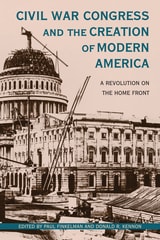
Civil War Congress and the Creation of Modern America
A Revolution on the Home FrontPaul Finkelman
Ohio University Press, 2018
Most literature on the Civil War focuses on soldiers, battles, and politics. But for every soldier in the United States Army, there were nine civilians at home. The war affected those left on the home front in many ways. Westward expansion and land ownership increased. The draft disrupted families while a shortage of male workers created opportunities for women that were previously unknown.
The war also enlarged the national government in ways unimagined before 1861. The Homestead Act, the Land Grant College Act, civil rights legislation, the use of paper currency, and creation of the Internal Revenue Service to collect taxes to pay for the war all illustrate how the war fundamentally, and permanently, changed the nation.
The essays in this book, drawn from a wide range of historical expertise and approaching the topic from a variety of angles, explore the changes in life at home that led to a revolution in American society and set the stage for the making of modern America.
Contributors: Jean H. Baker, Jenny Bourne, Paul Finkelman, Guy Gugliotta, Daniel W. Stowell, Peter Wallenstein, Jennifer L. Weber.
Conservative Innovators
How States Are Challenging Federal PowerBen Merriman
University of Chicago Press, 2019
Conservative Innovators traces the activity of far-right conservatives in Kansas who have in the past decade used the powers of state-level offices to fight federal regulation on a range of topics from gun control to voting processes to Medicaid. Telling their story, Ben Merriman then expands the scope of the book to look at the tactics used by conservative state governments across the country to resist federal regulations, including coordinated lawsuits by state attorneys general, refusals to accept federal funds and spending mandates, and the creation of programs designed to restrict voting rights. Through this combination of state-initiated lawsuits and new administrative practices, these state officials weakened or halted major parts of the Obama Administration’s healthcare, environmental protection, and immigration agendas and eroded federal voting rights protections. Conservative Innovators argues that American federalism is entering a new, conflict-ridden era that will make state governments more important in American life than they have been at any time in the past century.
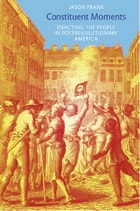
Constituent Moments
Enacting the People in Postrevolutionary AmericaJason Frank
Duke University Press, 2010
Elaborating his theory of constituent moments, Frank focuses on specific historical instances when under-authorized individuals or associations seized the mantle of authority, and, by doing so, changed the inherited rules of authorization and produced new spaces and conditions for political representation. He looks at crowd actions such as parades, riots, and protests; the Democratic-Republican Societies of the 1790s; and the writings of Walt Whitman and Frederick Douglass. Frank demonstrates that the revolutionary establishment of the people is not a solitary event, but rather a series of micropolitical enactments, small dramas of self-authorization that take place in the informal contexts of crowd actions, political oratory, and literature as well as in the more formal settings of constitutional conventions and political associations.
Constructing Tomorrow's Federalism
New Perspectives on Canadian GovernanceIan Peach
University of Manitoba Press, 2007
Creative Politics
Taxes and Public Goods in a Federal SystemGlenn Beamer
University of Michigan Press, 2000

Czecho/Slovakia
Ethnic Conflict, Constitutional Fissure, Negotiated BreakupEric Stein
University of Michigan Press, 2000
Establishing Congress
The Removal to Washington, D.C., and the Election of 1800Kenneth R. Bowling
Ohio University Press, 2005
Establishing Congress: The Removal to Washington, D.C., and the Election of 1800 focuses on the end of the 1790s, when, in rapid succession, George Washington died, the federal government moved to Washington, D.C., and the election of 1800 put Thomas Jefferson and the Democratic-Republican Party in charge of the federal government.
Establishing Congress dispels the myths and misinformation that surround the federal government’s move to Washington and demonstrates that the election of 1800 changed American party politics forever, establishing the success of the American experiment in government and completing the founding of the Republic. It also contends that the lame-duck session of Congress had far-reaching implications for the governance of the District of Columbia. Later chapters examine aspects of the political iconography of the Capitol—one illuminating Jefferson’s role in turning the building into a temple for the legislature and an instrument for nation-building, another analyzing the fascinating decades-long debate over whether to bury George Washington in the Capitol.
The book considers as well the political implications of social life in early Washington, examining the political lobbying by Washington women within a social context and detailing the social and political life in the city’s homes, hotels, boardinghouses, and eating messes. Establishing Congress is an invaluable reference work for anyone interested in these pivotal moments in American history.
Ethnic Federalism
The Ethiopian Experience in Comparative PerspectiveDavid Turton
Ohio University Press, 2006
Since 1991, Ethiopia has gone further than any other country in using ethnicity as the fundamental organizing principle of a federal system of government. And yet this pioneering experiment in “ethnic federalism” has been largely ignored in the growing literature on democratization and ethnicity in Africa and on the accommodation of ethnic diversity in democratic states. Ethnic Federalism brings a much-needed comparative dimension to the discussion of this experiment in Ethiopia.
Ethnic Federalism closely examines aspects of the Ethiopean case and asks why the use of territorial decentralism to accommodate ethnic differences has been generally unpopular in Africa, while it is growing in popularity in the West.
The book includes case studies of Nigerian and Indian federalism and suggests how Ethiopia might learn from both the failures and successes of these older federations. In the light of these broader issues and cases, it identifies the main challenges facing Ethiopia in the next few years, as it struggles to bring political practice into line with constitutional theory and thereby achieve a genuinely federal division of powers.
Exploring Federalism
Daniel J. Elazar
University of Alabama Press, 1987
CHOICE OUTSTANDING ACADEMIC BOOK
A definitive exploration of the ideas, institutions, and principles that shape federal government.
Exploring Federalism is a seminal study by political scientist Daniel J. Elazar that examines the origins, evolution, and enduring significance of federal systems of government. Widely regarded as one of the leading scholars of federalism, Elazar offers a comprehensive analysis of how federal principles have shaped political institutions across diverse societies and historical periods. Rather than limiting his discussion to the United States, he adopts a global and comparative perspective, exploring how federal arrangements provide workable solutions for nations seeking to balance unity with diversity, shared governance with local autonomy, and collective action with individual liberty.
Drawing on history, constitutional theory, and political philosophy, Elazar investigates the covenantal foundations of federalism and explains how federal systems distribute authority, protect regional identities, and promote democratic participation. He also examines contemporary trends toward both centralization and decentralization, arguing that federalism remains one of the most effective frameworks for governing pluralistic societies. Exploring Federalism remains an essential resource for students, scholars, policymakers, and anyone interested in constitutional government and democratic institutions.
Federalism and Social Policy
Patterns of Redistribution in 11 DemocraciesEdited by Scott L. Greer and Heather Elliott
University of Michigan Press, 2019
Federalism
A DialogueDavid L. Shapiro
Northwestern University Press, 1995
Federalism
Political Identity and Tragic CompromiseMalcolm M. Feeley and Edward Rubin
University of Michigan Press, 2011
Federalism is one of the most influential concepts in modern political discourse as well as the focus of immense controversy resulting from the lack of a single coherent definition. Malcolm M. Feeley and Edward Rubin expose the ambiguities of modern federalism, offering a powerful but generous treatise on the modern salience of the term.
—Sanford Levinson, University of Texas at Austin
“At last, an insightful examination of federalism stripped of its romance. An absolutely splendid book, rigorous but still accessible.”
—Larry Yackle, Boston University
“Professors Feeley and Rubin clearly define what is and is not federal system. This book should be required for serious students of comparative government and American government.”
—G. Ross Stephens, University of Missouri, Kansas City
“Feeley and Rubin have written a brilliant book that looks at federalism from many different perspectives—historical, political, and constitutional. Significantly expanding on their earlier pathbreaking work, they have explained the need for a theory of federalism and provided one. This is a must read book for all who are interested in the Constitution.”
—Erwin Chemerinsky, Duke University School of Law
Legacies of Losing in American Politics
Jeffrey K. Tulis and Nicole Mellow
University of Chicago Press, 2017
With Legacies of Losing in American Politics, Jeffrey K. Tulis and Nicole Mellow rethink three pivotal moments in American political history: the founding, when anti-Federalists failed to stop the ratification of the Constitution; the aftermath of the Civil War, when President Andrew Johnson’s plan for restoring the South to the Union was defeated; and the 1964 presidential campaign, when Barry Goldwater’s challenge to the New Deal order was soundly defeated by Lyndon B. Johnson. In each of these cases, the very mechanisms that caused the initial failures facilitated their eventual success. After the dust of the immediate political defeat settled, these seemingly discredited ideas and programs disrupted political convention by prevailing, often subverting, and occasionally enhancing constitutional fidelity. Tulis and Mellow present a nuanced story of winning and losing and offer a new understanding of American political development as the interweaving of opposing ideas.
Limited Government and the Bill of Rights
Patrick M. Garry
University of Missouri Press, 2012
What was the intended purpose and function of the Bill of Rights? Is the modern understanding of the Bill of Rights the same as that which prevailed when the document was ratified? In Limited Government and the Bill of Rights, Patrick Garry addresses these questions. Under the popular modern view, the Bill of Rights focuses primarily on protecting individual autonomy interests, making it all about the individual. But in Garry’s novel approach, one that tries to address the criticisms of judicial activism that have resulted from the Supreme Court’s contemporary individual rights jurisprudence, the Bill of Rights is all about government—about limiting the power of government. In this respect, the Bill of Rights is consistent with the overall scheme of the original Constitution, insofar as it sought to define and limit the power of the newly created federal government.
Garry recognizes the desire of the constitutional framers to protect individual liberties and natural rights, indeed, a recognition of such rights had formed the basis of the American campaign for independence from Britain. However, because the constitutional framers did not have a clear idea of how to define natural rights, much less incorporate them into a written constitution for enforcement, they framed the Bill of Rights as limited government provisions rather than as individual autonomy provisions. To the framers, limited government was the constitutional path to the maintenance of liberty. Moreover, crafting the Bill of Rights as limited government provisions would not give the judiciary the kind of wide-ranging power needed to define and enforce individual autonomy.
With respect to the application of this limited government model, Garry focuses specifically on the First Amendment and examines how the courts in many respects have already used a limited government model in their First Amendment decision-making. As he discusses, this approach to the First Amendment may allow for a more objective and restrained judicial role than is often applied under contemporary First Amendment jurisprudence.
Limited Government and the Bill of Rights will appeal to anyone interested in the historical background of the Bill of Rights and how its provisions should be applied to contemporary cases, particularly First Amendment cases. It presents an innovativetheory about the constitutional connection between the principle of limited government and the provisions in the Bill of Rights.
Navigating Climate Change Policy
The Opportunities of FederalismEdella C. Schlager
University of Arizona Press, 2011
Federalism—the system of government in which power is divided among a national government and state and regional governments—is well-suited to address the challenges of climate change because it permits distinctive policy responses at a variety of scales. The chapters in this book explore questions such as what are appropriate relationships between states, tribes, and the federal government as each actively pursues climate-change policies? How much leeway should states have in designing and implementing climate-change policies, and how extensively should the federal government exercise its preemption powers to constrain state activity? What climate-change strategies are states best suited to pursue, and what role, if any, will regional state-based collaborations and associations play? This book examines these questions from a variety of perspectives, blending legal and policy analyses to provide thought-provoking coverage of how governments in a federal system cooperate, coordinate, and accommodate one another to address this global problem.
Navigating Climate Change Policy is an essential resource for policymakers and judges at all levels of government who deal with questions of climate governance. It will also serve as an important addition to the curriculum on climate change and environmental policy in graduate and undergraduate courses and will be of interest to anyone concerned with how the government addresses environmental issues.
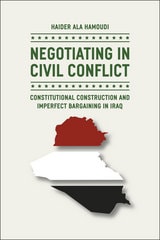
Negotiating in Civil Conflict
Constitutional Construction and Imperfect Bargaining in IraqHaider Ala Hamoudi
University of Chicago Press, 2013

Political Support in Canada
The Crisis YearsAllan Kornberg and Harold D. Clarke, editors
Duke University Press, 1983
The nature of popular support is first considered in broad, theoretical terms, then from the standpoint of those agents most responsible for maintaining support in Canadian democracy, then as influenced by particular issues and policies, and finally as it affects and is affected by the separatist movement in Quebec.
Polyphonic Federalism
Toward the Protection of Fundamental RightsRobert A. Schapiro
University of Chicago Press, 2009
The relationship between the states and the national government is among the most contested issues in the United States. And questions about where power should reside, how decisions should be made, and how responsibility should be allocated have been central to the American experiment in federalism. In Polyphonic Federalism, Robert A. Schapiro defends the advantages of multiple perspectives in government, arguing that the resulting “polyphony” creates a system that is more efficient, democratic, and protective of liberties.
This groundbreaking volume contends that contemporary views of federalism are plagued by outmoded dualist notions that seek to separate state and federal authority. Instead, Schapiro proposes a polyphonic model that emphasizes the valuable interaction of state and federal law, one that more accurately describes the intersecting realities of local and national power. Through an analysis of several legal and policy debates, Polyphonic Federalism demonstrates how a multifaceted government can best realize the potential of federalism to protect fundamental rights.
Prohibition, the Constitution, and States' Rights
Sean Beienburg
University of Chicago Press, 2019
Sean Beienburg recovers a largely forgotten constitutional debate, revealing how Prohibition became a battlefield on which skirmishes of American political development, including the debate over federalism and states’ rights, were fought. Beienburg focuses on the massive extension of federal authority involved in Prohibition and the passage of the Eighteenth Amendment, describing the roles and reactions of not just Congress, the presidents, and the Supreme Court but political actors throughout the states, who jockeyed with one another to claim fidelity to the Tenth Amendment while reviling nationalism and nullification alike. The most comprehensive treatment of the constitutional debate over Prohibition to date, the book concludes with a discussion of the parallels and differences between Prohibition in the 1920s and debates about the legalization of marijuana today.
Putting Federalism in Its Place
The Territorial Politics of Social Policy RevisitedScott L. Greer, Daniel Béland, André Lecours, and Kenneth A. Dubin
University of Michigan Press, 2023
What does federalism do to welfare states? This question arises in scholarly debates about policy design as well as in discussions about the right political institutions for a country. It has frustrated many, with federalism seeming to matter in all sorts of combinations with all sorts of issues, from nationalism to racism to intergovernmental competition. The diffuse federalism literature has not come to compelling answers for very basic questions.
Scott L. Greer, Daniel Béland, André Lecours, and Kenneth A. Dubin argue for a new approach—one methodologically focused on configurations of variables within cases rather than a fruitless attempt to isolate “the” effect of federalism; and one that is substantively engaged with identifying key elements in configurations as well as with when and how their interactions matter. Born out of their work on a multi-year, eleven-country project (published as Federalism and Social Policy: Patterns of Redistribution in Eleven Countries, University of Michigan Press, 2019), this book comprises a methodological and substantive agenda. Methodologically, the authors shift to studies that embraced and understood the complexity within which federal political institutions operate. Substantively, they make an argument for the importance of plurinationalism, changing economic interests, and institutional legacies.
Raising the Floor
Federalism and the Politics of US Minimum Wage PolicyShanna Rose
University of Chicago Press, 2026
A rich history of the development of American minimum wage policy with lessons for today.
Despite broad popular support for robust minimum wage policy, the federal minimum wage is now worth less—in real, inflation-adjusted terms—than at any time since 1949. While some state and local governments have stepped in to fill this void, others have declined to set any minimum wage standard at all. Traversing more than 100 years of history, Raising the Floor examines how interest groups have navigated the highly decentralized American political system to shape the development of federal, state, and local minimum wage laws.
In her analysis, Shanna Rose highlights the importance of American federalism. She argues that because federalism creates multiple arenas for policy change, interest groups have sought out the sites most conducive to their goals, shifting their lobbying efforts as new obstacles and opportunities emerge. Federalism has facilitated minimum wage policymaking by fostering policy experimentation, learning, and diffusion across states and by allowing state and local governments to overcome gridlock and status-quo biases at the national level. Yet, federalism has also been an instrument for containment, enabling those opposed to minimum wage increases to litigate and preempt local-level laws.
With rich historical chapters that illuminate different phases in the development of today’s patchwork of wage standards, Raising the Floor is a deep examination of the past, present, and future of American minimum wage law.
Rival Claims
Ethnic Violence and Territorial Autonomy under Indian FederalismBethany Lacina
University of Michigan Press, 2017
Using new data on ethnicity and sub-national discrimination in India, national and state archives, parliamentary records, cross-national analysis and her original fieldwork, Lacina explains ethnoterritorial politics as a three-sided interaction of the center and rival interests in the periphery. Ethnic entrepreneurs use militancy to create national political pressure in favor of their goals when the prime minister lacks clear electoral reasons to court one regional group over another. Second, ethnic groups rarely win autonomy or mobilize for violence in regions home to electorally influential anti-autonomy interests. Third, when a regional ethnic majority is politically important to the prime minister, its leaders can deter autonomy demands within their borders, while actively discriminating against minorities.
Rival Claims challenges the conventional beliefs that territorial autonomy demands are a reaction to centralized power and that governments resist autonomy to preserve central prerogatives. The center has allegiances in regional politics, and ethnoterritorial violence reflects the center’s entanglement with rival interests in the periphery.
The Backcountry and the City
Colonization and Conflict in Early AmericaEd White
University of Minnesota Press, 2005
Ed White explores the backcountry-city divide as well as the dynamics of indigenous peoples, bringing together two distinct bodies of scholarship: one stressing the political culture of the Revolutionary era, the other taking an ethnohistorical view of white–Native American contact. White concentrates his study in Pennsylvania, a state in which the majority of the population was rural, and in Philadelphia, a city that was a center of publishing and politics and the national capital for a decade. Against this backdrop, White reads classic political texts such as Crèvecoeur’s Letters from an American Farmer, Franklin’s Autobiography, and Paine’s “Agrarian Justice,” alongside missionary and captivity narratives, farmers’ petitions, and Native American treaties. Using historical and ethnographic sources to enrich familiar texts, White demonstrates the importance of rural areas in the study of U.S. nation formation and finds unexpected continuities between the early colonial period and the federal ascendancy of the 1790s.
Ed White is associate professor of English at the University of Florida.

The Dimensions of Federalism
State Governments and Pollution Control PoliciesWilliam R. Lowry
Duke University Press, 1991

The Federal Future of Europe
From the European Community to the European UnionDusan Sidjanski
University of Michigan Press, 2000
The author argues that federalism is the best antidote to the reemergence of nationalism in Europe. It is also the best guarantee for a peaceful community that balances the claims of national, regional, and local identity against the need for large-scale economies that springs from the forces of globalization, competition, and technical change. The Union preserves diversity within a flexible and innovating European system.
This major study of the development of the European project, informed by a thorough knowledge of the Community and Union over the years and by deep understanding of the relevant literatures in political science and political economy is important for all who study the European Union or work with it as officials and business people.
Dusan Sidjanski is founder and Professor Emeritus of the Department of Political Science, University of Geneva and Professor Emeritus, European Institute. He has authored numerous publications, most recently, The ECE in the Age of Change (United Nations Economic Commission for Europe, United Nations).
The Governors' Lobbyists
Federal-State Relations Offices and Governors Associations in WashingtonJennifer M. Jensen
University of Michigan Press, 2016

The Lavender Scare
The Cold War Persecution of Gays and Lesbians in the Federal GovernmentDavid K. Johnson
University of Chicago Press, 2003
Historian David K. Johnson here relates the frightening, untold story of how, during the Cold War, homosexuals were considered as dangerous a threat to national security as Communists. Charges that the Roosevelt and Truman administrations were havens for homosexuals proved a potent political weapon, sparking a "Lavender Scare" more vehement and long-lasting than McCarthy's Red Scare. Relying on newly declassified documents, years of research in the records of the National Archives and the FBI, and interviews with former civil servants, Johnson recreates the vibrant gay subculture that flourished in New Deal-era Washington and takes us inside the security interrogation rooms where thousands of Americans were questioned about their sex lives. The homosexual purges ended promising careers, ruined lives, and pushed many to suicide. But, as Johnson also shows, the purges brought victims together to protest their treatment, helping launch a new civil rights struggle.
The Lavender Scare shatters the myth that homosexuality has only recently become a national political issue, changing the way we think about both the McCarthy era and the origins of the gay rights movement. And perhaps just as importantly, this book is a cautionary tale, reminding us of how acts taken by the government in the name of "national security" during the Cold War resulted in the infringement of the civil liberties of thousands of Americans.
The Lavender Scare
The Cold War Persecution of Gays and Lesbians in the Federal GovernmentDavid K. Johnson
University of Chicago Press, 2023
In The Lavender Scare, David K. Johnson tells the frightening story of how, during the Cold War, homosexuals were considered as dangerous a threat to national security as Communists. Charges that the Roosevelt and Truman administrations were havens for homosexuals proved a potent political weapon, sparking a “Lavender Scare” more vehement and long-lasting than Joseph McCarthy’s Red Scare. Drawing on declassified documents, years of research in the records of the National Archives and the FBI, and interviews with former civil servants, Johnson recreates the vibrant gay subculture that flourished in midcentury Washington and takes us inside the security interrogation rooms where anti-homosexual purges ruined the lives and careers of thousands of Americans. This enlarged edition of Johnson’s classic work of history—the winner of numerous awards and the basis for an acclaimed documentary broadcast on PBS—features a new epilogue, bringing the still-relevant story into the twenty-first century.
The Politics of Information
Problem Definition and the Course of Public Policy in AmericaFrank R. Baumgartner and Bryan D. Jones
University of Chicago Press, 2014
With The Politics of Attention, leading policy scholars Frank R. Baumgartner and Bryan D. Jones demonstrated the central role attention plays in how governments prioritize problems. Now, with The Politics of Information, they turn the focus to the problem-detection process itself, showing how the growth or contraction of government is closely related to how it searches for information and how, as an organization, it analyzes its findings. Better search processes that incorporate more diverse viewpoints lead to more intensive policymaking activity. Similarly, limiting search processes leads to declines in policy making. At the same time, the authors find little evidence that the factors usually thought to be responsible for government expansion—partisan control, changes in presidential leadership, and shifts in public opinion—can be systematically related to the patterns they observe.
Drawing on data tracing the course of American public policy since World War II, Baumgartner and Jones once again deepen our understanding of the dynamics of American policy making.
The Provincial Deputation in Mexico
Harbinger of Provincial Autonomy, Independence, and FederalismBy Nettie Lee Benson
University of Texas Press, 1992
Mexico and the United States each have a constitution and a federal system of government. This fact has led many historians to assume that the Mexican system of government, established in the 1820s, is an imitation of the U.S. model. But it is not.
First published in Spanish in 1955 and now translated by the author and amplified with new material, this interpretation of the independence movement tells the true story of Mexico's transition from colonial status to federal state. Benson traces the Mexican government's beginning to events in Spain in 1808–1810, when provincial juntas, or deputations, were established to oppose Napoleon's French rule and govern the provinces of Spain and its New World dominions during the Spanish monarch's imprisonment.
It was the provincial deputation, not the United States federal system, that provided the model for the state legislative bodies that were eventually formed after Mexico won its independence from Spain in 1821. This finding—the result of years of painstaking archival research—strongly confirms the independence of Mexico's political development from U.S. influence. Its importance to a study of Mexican history cannot be overstated.
The Rise of the Entrepreneurial State
State and Local Economic Development Policy in the United StatesPeter K. Eisinger
University of Wisconsin Press, 1989
Eisinger’s meticulous research uncovers state and local governments’ transition from supply-side to demand-side strategies of market creation. He shows that, instead of relying solely on the supply-side strategies of tax breaks and other incentives to encourage business relocation, some governments promoted innovation and the creation of new business approaches.
Three Civilizations, Two Cultures, One State
Canada's Political TraditionsDouglas Verney
Duke University Press, 1986