Results by title
329 books match the query 'Folklore & Mythology' and 23 start with a
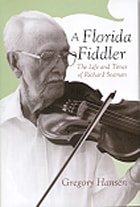
A Florida Fiddler
The Life and Times of Richard SeamanGregory Hansen
University of Alabama Press, 2007
Exploring Florida's cultural landscape through the life of a legendary fiddler.
This biography of 97-year-old Richard Seaman, who grew up in Kissimmee Park, Florida, relies on oral history and folklore research to define the place of musicianship and storytelling in the state's history from one artist's perspective. Gregory Hansen presents Seaman’s assessment of Florida’s changing cultural landscape through his tall tales, personal experience narratives, legends, fiddle tune repertory, and descriptions of daily life.
Seaman’s childhood memories of fiddling performances and rural dances explain the role such gatherings played in building and maintaining social order within the community. As an adult, Seaman moved to Jacksonville, Florida, where he worked as a machinist and performed with his family band. The evolution of his musical repertory from the early 1920s through the 1950s provides a resource for reconstructing social life in the rural south and for understanding how changes in musical style reflect the state's increasingly urban social structure. Hansen includes a set of Seaman's fiddle tunes, transcribed for the benefit of performer and researcher alike. The thirty tall tales included in the volume constitute a representative sample of Florida’s oral tradition in the early years of the 20th century.
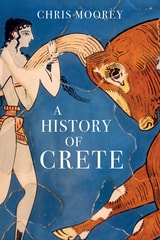
A History of Crete
Chris Moorey
Haus Publishing, 2019
To guide us through this spectacular history, Chris Moorey, who has lived in Crete for over twenty years, provides an engaging and lively account of the island spanning from the Stone Age to the present day. A History of Crete steps in to fill a gap in scholarship on this fascinating island, providing the first complete history of Crete to be published for over twenty years, and the first ever that is written with a wide readership in mind.
A Narrative Compass
Stories that Guide Women's LivesEdited by Betsy Hearne and Roberta Seelinger Trites
University of Illinois Press, 2008
Each of us has a narrative compass, a story that has guided our lifework. In this extraordinary collection, women scholars from a variety of disciplines identify and examine the stories that have inspired them, haunted them, and shaped their research, from Little House on the Prairie to Little Women, from the fairy tales of Hans Christian Andersen and Alice's Adventures in Wonderland to Nancy Drew, Mary Jane, and even the Chinese memoir Jottings from the Transcendant's Abode at Mt. Youtai. Telling the "story of her story" leads each of the essayists to insights about her own approach to studying narratives and to a deeper, often surprising, understanding of the power of imagination.
Contributors are Deyonne Bryant, Minjie Chen, Cindy L. Christiansen, Beverly Lyon Clark, Karen Coats, Wendy Doniger, Bonnie Glass-Coffin, Betsy Hearne, Joanna Hearne, Ann Hendricks, Rania Huntington, Christine Jenkins, Kimberly Lau, Pamela Riney-Kehrberg, Maria Tatar, Ebony Elizabeth Thomas, Roberta Seelinger Trites, Claudia Quintero Ulloa, and Ofelia Zepeda.

A Prelude to Biblical Folklore
UNDERDOGS AND TRICKSTERSSusan Niditch
University of Illinois Press, 1987
Using a unique combination of biblical scholarship and folklore methodology, Susan Niditch tracks stories of biblical characters who become heroes against the odds, either through trickery or through native wisdom, physical prowess, and the help of human or divine agents. In this volume, originally published as Underdogs and Tricksters, Niditch examines three cross-sections of the Old Testament in detail: stories in Genesis in which patriarchs pretend that their wives are really their sisters; the contrasting stories of two younger sons, the trickster Jacob and the earnest underdog Joseph; and the story of Esther as a paradigm of feminine wisdom pitted against unjust authority.
Linking these Old Testament heroes to the legendary tricksters and underdogs of other cultures, Niditch shows how the Israelites' worldview and self-image are reflected in the way biblical authors tell their stories. Through a thoughtful analysis of style, content, narrative choices, and attitudes to issues of gender and political authority in biblical narrative, A Prelude to Biblical Folklore draws persuasive conclusions about the identity, location, and provenance of the stories' authors and their audiences.
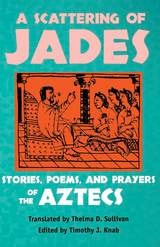
A Scattering of Jades
Stories, Poems, and Prayers of the AztecsThelma D. Sullivan
University of Arizona Press, 2003
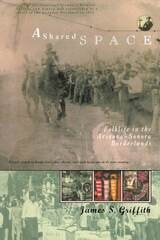
A Shared Space
James S. Griffith
Utah State University Press, 1995
Where it divides Arizona and Sonora, the international boundary between Mexico and the United States is both a political reality, literally expressed by a fence, and, to a considerable degree, a cultural illusion. Mexican, Anglo, and Native American cultures straddle the fence; people of various ethnic backgrounds move back and forth across the artificial divide, despite increasing obstacles to free movement. On either side is found a complex cultural mix of ethnic, religious, and occupational groups. In A Shared Space James Griffith examines many of the distinctive folk expressions of this varied cultural region.
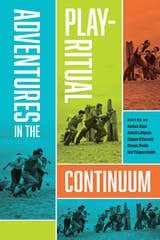
Adventures in the Play-Ritual Continuum
Audun Kjus
Utah State University Press, 2025
Adventures in the Play-Ritual Continuum explores the connectivity between the playful and the ritualized through a fresh theoretical perspective, highlighting the creative messiness and the cultural paradoxes such intersections allow. The chapters span topics such as hen parties, marriage proposals, ash scatterings, extreme sports races, football fans, computer game festivals, celebrations of fandom, migration heritages, and antiracist protests. While the case studies are selected to show a range of diversity with various mergings of play, game, ritual, ceremony, rite, and ritualizing, the introductory and concluding discussions offer sharpened perspectives on common aspects.
Following these excursions through the play-ritual continuum will be enjoyable for readers interested in how people make sense of their own existence and profitable for scholars in folklore, anthropology, religion, pedagogy, cultural studies, and social sciences and humanities more generally.

Aesopica
A Series of Texts Relating to Aesop or Ascribed to HimEdited by Ben Edwin Perry
University of Illinois Press, 1952
Ben Edwin Perry's Aesopica remains the definitive edition of all fables reputed to be by Aesop. The volume begins traditionally with a life of Aesop, but in two different and previously unedited Greek versions, with collations that record variations in the major recensions. It includes 179 proverbs attributed to Aesop and 725 carefully organized fables, for which Perry also provides their eldest known sources. To better evaluate the place of Aesop in literary history, Perry includes testimonies about Aesop made by Greek and Latin authors, from Herodotus to Maximus Planudes.
African Tales
Compiled by Harold Scheub
University of Wisconsin Press, 2005
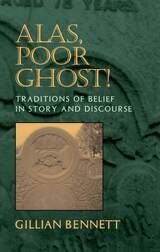
Alas Poor Ghost
Gillian Bennett
Utah State University Press, 1999
In the rational modern world, belief in the supernatural seemingly has been consigned to the worlds of entertainment and fantasy. Yet belief in other worldly phenomena, from poltergeists to telepathy, remains strong, as Gillian Bennett's research shows. Especially common is belief in continuing contact with, or the continuing presence of, dead family members. Bennett interviewed women in Manchester, England, asking them questions about ghosts and other aspects of the supernatural. (Her discussion of how her research methods and interview techniques evolved is in itself valuable.) She first published the results of the study in the well-received Traditions of Belief: Women and the Supernatural, which has been widely used in folklore and women's studies courses. "Alas, Poor Ghost!" extensively revises and expands that work. In addition to a fuller presentation and analysis of the original field research and other added material, the author, assisted by Kate Bennett, a gerontological psychologist, presents and discusses new research with a group of women in Leicester, England.
Bennett is interested in more than measuring the extent of belief in other worldly manifestations. Her work explores the relationship between narrative and belief. She anticipated that her questions would elicit from her interviewees not just yes or no replies but stories about their experiences that confirmed or denied notions of the supernatural. The more controversial the subject matter, the more likely individuals were to tell stories, especially if their answers to questions of belief were positive. These were most commonly individualized narratives of personal experience, but they contained many of the traditional motifs and other content, including belief in the supernatural, of legends. Bennett calls them memorates and discusses the cultural processes, including ideas of what is a "proper" experience of the supernatural and a "proper" telling of the story, that make them communal as well as individual. These memorates provide direct and vivid examples of what the storytellers actually believe and disbelieve. In a final section, Bennett places her work in historical context through a discussion of case studies in the history of supernatural belief.

American Fantastic
Myths of Violence and RedemptionDerek J. Thiess
University of Wisconsin Press, 2025
Thiess’s interdisciplinary study examines America’s past and present imperial projects, from the Hawaiian Islands to the Eastern Seaboard, as they proliferate in popular story forms. By interrogating American myths, legends, and fantastic narratives across an impressive array of genres, including folk narratives, science fiction, movies, and more, Thiess exposes how the “myth of redemptive violence” manifests in contemporary constructions of America’s fantastic imaginaries.
American Folklife
Edited by Don Yoder
University of Texas Press, 1976
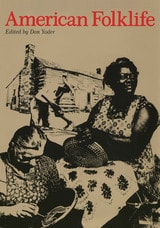
Knowledge of folk custom and folk belief can help to explain ways of thought and behavior in modern America. American Folklife, a unique collection of essays dedicated to the presentation of American tradition, broadens our understanding of the regional differences and ethnic folkways that color American life.
Folklife research examines the entire context of everyday life in past and present. It includes every aspect of traditional life, from regional architecture through the full range of material culture into spiritual culture, folk religion, witchcraft, and other forms of folk belief. This collection is especially useful in its application to American society, where countless influences from European, American Indian, and African cultural backgrounds merge. American Folklife relates folklife research to history, anthropology, cultural geography, architectural history, ethnographic film, folk technology, folk belief, and ethnic tensions in American society. It documents the folk-cultural background that is the root of our society.
American, African, and Old European Mythologies
Edited by Yves Bonnefoy
University of Chicago Press, 1993
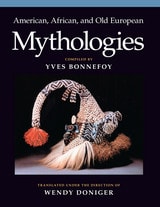
Almost all of Mythologies, originally published as a two-volume cloth set, is now available in four paperback volumes. These volumes reproduce the articles, introductory essays, and illustrations as they appeared in the full Mythologies set, and each includes a new Preface by Wendy Doniger.
This volume gathers eighty articles on mythologies from around the world. A section on the Americas and the South Pacific covers myths of native Americans, from the Inuit to the Mesoamericans, about such topics as the cosmos, fire, and the creation of the world. Essays on African mythology range from the 266 basic signs of West Africa to themes such as twins, the placenta, and masks. The final section, covering Celtic, Norse, and Slavic traditions opens with an overview of the Indo-Europeans and concludes with an essay on the religion and myths of Armenia.

An Amulet of Greek Earth
Generations of Immigrant Folk CultureHelen Papanikolas
Ohio University Press, 2002
The boys and men who left their Greek valley and mountain villages in the early 1900s for America came with amulets their mothers had made for them. Some were miniature sacks attached to a necklace; more often they were merely a square of fabric enclosing the values of their lives: a piece of a holy book or a sliver of the True Cross representing their belief in Greek Orthodoxy; a thyme leaf denoting their wild terrain; a blue bead to ward off the Evil Eye; and a pinch of Greek earth.
In her evocative and meticulously researched book An Amulet of Greek Earth, author Helen Papanikolas explains and examines the vibrant culture these immigrants brought with them to the new world. The Romiosini culture, as it was called, provided the foundation for their new lives and was oftentimes the cause of strife as they passed on their beliefs and traditions to successive generations of Greek Americans.
In the tradition of her fictional accounts of Greek immigrant life, Helen Papanikolas unearths the cultural beliefs and passions that compelled the Greek-American community to make its own way into the broader culture of America. Based on extensive study, personal interviews, and a lifetime of experience, An Amulet of Greek Earth is a revealing and informative chronicle of the immigrant’s experience in becoming an American.
An Arkansas Folklore Sourcebook
W.K. McNeil
University of Arkansas Press, 1992
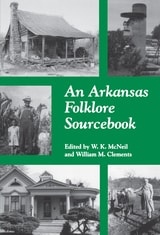
Arkansas’s rich folk tradition is shown by the variety of its manifestations: a 250-year-old ballad, an archaic method of hewing railroad crossties with a broadax, the use of poultices and toddies to treat the common cold, and swamps of evil repute are all parts of the tradition that constitutes Arkansas folklore. In fact, as the essays selected by W.K. McNeil and William M. Clements show, these few examples only begin to tell the story.
Starting with a working description of folklore as “cultural material that is traditional and unofficial” and characterized by a pattern of oral transmission, variation, formulaic structures, and usually uncertain origin, the authors survey in detail a wide array of folk objects, activities, beliefs, and customs. Among the rich offerings in this sourcebook are a discussion of the history of folklore research in Arkansas, an examination of some of the traditional songs and music still being preformed, a thoughtful exploration of the serious side of “tall tales” and “windies,” an investigation of folk architecture in Arkansas and what it reveals about our cultural origins, a study of many traditional foods and there preparation methods, an analysis of superstitions and beliefs, and a description of festivals and celebrations that are observed to this day.
Complemented by biographies of reference works and audio and video recordings of the state’s folk materials, An Arkansas Folklore Sourcebook is the first complete guide to the study of one state’s “unofficial culture.”
An Illini Place
Building the University of Illinois CampusIncoronata Inserra
University of Illinois Press, 2017
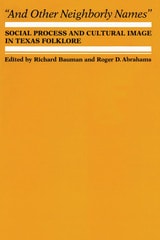
And Other Neighborly Names
Social Process and Cultural Image in Texas FolkloreEdited by Richard Bauman and Roger D. Abrahams
University of Texas Press, 1981
"And Other Neighborly Names"—the title is from a study by Americo Paredes of the names, complimentary and otherwise, exchanged across cultural boundaries by Anglos and Mexicans—is a collection of essays devoted to various aspects of folk tradition in Texas. The approach builds on the work of the folklorists who have helped give the study of folklore in Texas such high standing in the field-Mody Boatright, J. Frank Dobie, John Mason Brewer, the Lomaxes, and of course Paredes himself, to whom this book is dedicated.
Focusing on the ways in which traditions arise and are maintained where diverse peoples come together, the editors and other essayists—John Holmes McDowell, Joe Graham, Alicia María González, Beverly J. Stoeltje, Archie Green, José E. Limón, Thomas A. Green, Rosan A. Jordan, Patrick B. Mullen, and Manuel H. Peña—examine conjunto music, the corrido, Gulf fishermen's stories, rodeo traditions, dog trading and dog-trading tales, Mexican bakers' lore, Austin's "cosmic cowboy" scene, and other fascinating aspects of folklore in Texas. Their emphasis is on the creative reaction to socially and culturally pluralistic situations, and in this they represent a distinctively Texan way of studying folklore, especially as illustrated in the performance-centered approach of Paredes, Boatright, and others who taught at the University of Texas at Austin. As an overview of this approach—its past, present, and future—"And Other Neighborly Names" makes a valuable contribution both to Texas folklore and to the discipline as a whole.
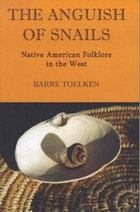
Anguish of Snails
Native American Folklore in the WestBarre Toelken
Utah State University Press, 2003
Winner of the 2004 Chicago Folklore Prize, The Anguish of Snails is an essential work for the collection of any serious reader in folklore or Native American studies.

Archie Green
The Making of a Working-Class HeroSean Burns
University of Illinois Press, 2011
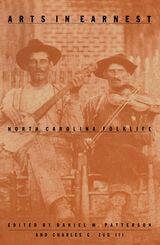
Arts in Earnest
North Carolina FolklifeDaniel W. Patterson and Charles G. Zugg, III, eds.
Duke University Press, 1990
Personal interviews are an important element in the book. Laura Lee, an elderly black woman from Chatham County, describes the quilts she made from funeral flower ribbons; witnesses and friends each remember varying details of the Duke University football player who single-handedly vanquished a gang of would-be muggers; Clyde Jones leads a safari through his backyard, which is filled with animals made of wood and cement that represent nontraditional folk art; the songs and sermon of a Primitive Baptist service flow together as one—“it tills you up all over”; Durham bluesman Willie Trice, one of a handful of Durham musicians who recorded in the 1930s and early 1940s, remembers when the active tobacco warehouses offered ready audiences—“They’d tip us a heap of change to play some music”; and Goldsboro tobacco auctioneer H. L. “Speed” Riggs chants 460 words per minute, five to six times faster than a normal conversational rate.
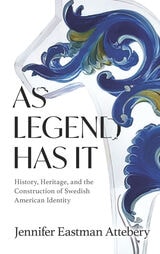
As Legend Has It
History, Heritage, and the Construction of Swedish American IdentityJennifer Eastman Attebery
University of Wisconsin Press, 2023
The legends Swedish Americans tell about their past are both similar to and distinct from those of others who migrated westward; they participated in settler colonialism while maintaining a sense of their specific, Swedish ethnicity. Unlike racial minority groups, Swedish Americans could claim membership in a majority white community without abandoning their cultural heritage. Their legends and local histories reflect that positioning. Attebery reveals how Swedish American legends are embedded within local history writing, how ostension and rhetoric operate in historical legends, and how vernacular local history writing works in tandem with historical legends to create a common message about a communal past. This impeccably researched study points to ways in which legends about the past possess qualities unique to their subgenre yet can also operate similarly to contemporary legends in their social impact.

Asian Mythologies
Edited by Yves Bonnefoy
University of Chicago Press, 1993
"The almost 100 contributors combine, with characteristic precision and élan, the arts of science and poetry, of analysis and translation. The result is a treasury of information, brilliant guesswork, witty asides, and revealing digressions. This is a work of genuine and enduring excitement."—Thomas D'Evelyn, Christian Science Monitor
At Play in Belfast
Children's Folklore and Identities in Northern IrelandLanclos, Donna M
Rutgers University Press, 2003
For Lanclos, children's experiences stimulate discussions about culture and society. In her words, "Children's everyday lives are more than just preparation for their futures, but are life itself."
At Play in Belfast is a volume in the Rutgers Series in Childhood Studies, edited by Myra Bluebond-Langner.