Results by title
6 books match the query 'Forest products industry'

Changing Pacific Forests
Historical Perspectives on the Pacific Basin Forest EconomyJohn Dargavel and Richard P. Tucker, eds.
Duke University Press, 1992
Drawing on a 1991 conference sponsored by the Forest History Society and the International Union of Forestry Research Organizations held in Honolulu, these papers address a range of topics related to the changing Pacific forests, including the remnants of colonialism, the emergence of the Third World, people and resources caught in the middle of policy decisions, land management, national forests, and subsistence use of the forest by indigenous peoples. Essays also explore macroeconomic theories of international trade and the interests of the United States and the former Soviet Union in the economic health of the region. Changing Pacific Forests will be of interest to scholars of the economy and environment of the Pacific Basin as well as of land management and the history of land use in general.
Contributors. Charles S. Backman, Thomas R. Cox, John Dargavel, Elizabeth Flint, Lim Hin Fui, G. R. Henning, Kenneth E. Jackson, Hiroaki Kakizawa, Nicholas K. Menzies, Andrew Price, John F. Richards, Jr., M. M. Roche, I. Gustin M. Tantra, Conrad Totman, Richard P. Tucker, Thomas R. Waggener

Fire Management in the American West
Forest Politics and the Rise of MegafiresMark Hudson
University Press of Colorado, 2011
Drawing on correspondence both between and within the Forest Service and the major timber industry associations, newspaper articles, articles from industry outlets, and policy documents from the late 1800s through the present, Hudson shows how the US forest industry, under the constraint of profitability, pushed the USFS away from private industry regulation and toward fire exclusion, eventually changing national forest policy into little more than fire policy.
More recently, the USFS has attempted to move beyond the policy of complete fire suppression. Interviews with public land managers in the Pacific Northwest shed light on the sources of the agency's struggles as it attempts to change the way we understand and relate to fire in the West.
Fire Management in the American West will be of great interest to environmentalists, sociologists, fire managers, scientists, and academics and students in environmental history and forestry.
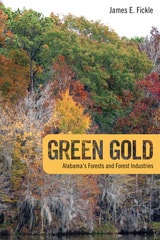
Green Gold
Alabama's Forests and Forest IndustriesJames E. Fickle
University of Alabama Press, 2014
Green Gold is a thorough and valuable compilation of information on Alabama’s timber and forest products industry, the largest manufacturing industry in the state.
Alabama has the third-largest commercial forest in the nation, after only Georgia and Oregon. Fully two-thirds of the state’s land supports the growth of over fifteen billion trees on twenty-two million acres, which explains why Alabama looks entirely green from space. Green Gold presents the story of human use of and impact on Alabama’s forests from pioneer days to the present, as James E. Fickle chronicles the history of the industry from unbridled greed and exploitation through virtual abandonment to revival, restoration, and enlightened stewardship.
As the state’s largest manufacturing industry, forest products have traditionally included naval stores such as tar, pitch, and turpentine, especially in the southern longleaf stands; sawmill lumber, both hardwood and pine; and pulp and paper milling. Green Gold documents all aspects of the industry, including the advent of “scientific forestry” and the development of reforestation practices with sustained yields. Also addressed are the historical impacts of Native Americans and of early settlers who used axes, saws, and water- and steam-powered sawmills to clear and utilize forests. Along with an account of railroad logging and the big mills of the lumber bonanza days of the late nineteenth and early twentieth centuries, the book also chronicles the arrival of professional foresters to the state, who began to deal with the devastating legacy of “cut out and get out” logging and to fight the perennial curse of woods arson. Finally, Green Gold examines the rise of the tree farm movement, the rebirth of large-scale lumbering, the advent of modern environmental concerns, and the movement toward the “Fourth Forest” in Alabama.
A Copublication with the Alabama Forestry Foundation
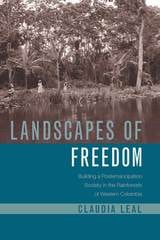
Landscapes of Freedom
Building a Postemancipation Society in the Rainforests of Western ColombiaClaudia Leal
University of Arizona Press, 2018
After emancipation in 1851, the African descendants living in the extra-humid rainforests of the Pacific coast of Colombia attained levels of autonomy hardly equaled anywhere else in the Americas. This autonomy rested on their access to a diverse environment—including small strips of fertile soils, mines, forests, rivers, and wetlands—that contributed to their subsistence and allowed them to procure gold, platinum, rubber, and vegetable ivory for export.
Afro-Colombian slave labor had produced the largest share of gold in the colony of New Granada. After the abolishment of slavery, some free people left the mining areas and settled elsewhere along the coast, making this the largest area of Latin America in which black people predominate into the present day. However, this economy and society, which lived off the extraction of natural resources, was presided over by a very small white commercial elite living in the region’s ports, where they sought to create an urban environment that would shelter them from the jungle.
Landscapes of Freedom reconstructs a nonplantation postemancipation trajectory that sheds light on how environmental conditions and management influenced the experience of freedom. It also points at the problematic associations between autonomy and marginality that have shaped the history of Afro-America. By focusing on racialized landscapes, Leal offers a nuanced and important approach to understanding the history of Latin America.

The Ground at My Feet
Sustaining a Family and a ForestAnn Stinson
Oregon State University Press, 2021
The Ground at My Feet is a memoir about loss and grief as well as a portrait of a family, a region, and an industry. Combining personal story and research, Stinson weaves essays, poems, history, and science into a rich and layered account of life in a family forest in the Pacific Northwest. She maps interactions between the land and its people over two centuries: the Cowlitz peoples, homesteaders, and several generations of logging families who have worked the property. She follows her family’s logs as they become lumber for fence boards and suburban homes, touring a local cedar mill and traveling with her father to visit mills in Japan.
Stinson adds a landowner’s voice to conversations about the human tendency to demand more of the land than it can sustain. With its uniquely personal view of the Pacific Northwest’s timber and forestry heritage, The Ground at My Feet is an engaging addition to the literature of the landscape and ecology of the West.
The Southern Forest
A ChronicleBy Laurence C. Walker
University of Texas Press, 1991
When the first European explorers reached the southern shores of North America in the early seventeenth century, they faced a solid forest that stretched all the way from the Atlantic coast to eastern Texas and Oklahoma. The ways in which they and their descendants used—and abused—the forest over the next nearly four hundred years form the subject of The Southern Forest.
In chapters on the explorers, pioneers, lumbermen, boatbuilders, and foresters, Laurence Walker chronicles the constant demands that people have made on forest resources in the South. He shows how the land's very abundance became its greatest liability, as people overhunted the animals, clearcut the forests, and wore out the soil with unwise farming practices—all in a mistaken belief that the forest's bounty (including new ground to be broken) was inexhaustible.
With the advent of professional forestry in the twentieth century, however, the southern forest has made a comeback. A professional forester himself, Walker speaks from experience of the difficulties that foresters face in balancing competing interests in the forest. How, for example, does one reconcile the country's growing demand for paper products with the insistence of environmental groups that no trees be cut? Should national forests be strictly recreational areas, or can they support some industrial logging? How do foresters avoid using chemical pesticides when the public protests such natural management practices as prescribed burning and tree cutting?
This personal view of the southern forest adds a new dimension to the study of southern history and culture. The primeval southern forest is gone, but, with careful husbandry on the part of all users, the regenerated southern forest may indeed prove to be the inexhaustible resource of which our ancestors dreamed.