Results by title
49 books match the query 'Foucault, Michel'
"Discourse and Truth" and "Parresia"
Michel Foucault
University of Chicago Press, 2019
These lectures—carefully edited and including notes and introductory material to fully illuminate Foucault’s insights—are a major addition to Foucault’s English language corpus.
"What Is Critique?" and "The Culture of the Self"
Michel Foucault
University of Chicago Press, 2024
Newly published lectures by Foucault on critique, Enlightenment, and the care of the self—now in paperback.
On May 27, 1978, Michel Foucault gave a lecture to the French Society of Philosophy where he redefined his entire philosophical project in light of Immanuel Kant’s 1784 text “What Is Enlightenment?” Foucault strikingly characterizes critique as the political and moral attitude consisting in the “art of not being governed like this,” one that performs the function of destabilizing power relations and creating the space for a new formation of the self within the “politics of truth.”
This volume presents the first critical edition of this crucial lecture alongside a previously unpublished lecture about the culture of the self and three public debates with Foucault at the University of California, Berkeley, in April 1983. There, for the first time, Foucault establishes a direct connection between his reflections on the Enlightenment and his analyses of Greco-Roman antiquity. However, far from suggesting a return to the ancient culture of the self, Foucault invites his audience to build a “new ethics” that bypasses the traditional references to religion, law, and science.
About the Beginning of the Hermeneutics of the Self
Lectures at Dartmouth College, 1980Michel Foucault
University of Chicago Press, 2015
Foucault analyzes the practices of self-examination and confession in Greco-Roman antiquity and in the first centuries of Christianity in order to highlight a radical transformation from the ancient Delphic principle of “know thyself” to the monastic precept of “confess all of your thoughts to your spiritual guide.” His aim in doing so is to retrace the genealogy of the modern subject, which is inextricably tied to the emergence of the “hermeneutics of the self”—the necessity to explore one’s own thoughts and feelings and to confess them to a spiritual director—in early Christianity. According to Foucault, since some features of this Christian hermeneutics of the subject still determine our contemporary “gnoseologic” self, then the genealogy of the modern subject is both an ethical and a political enterprise, aiming to show that the “self” is nothing but the historical correlate of a series of technologies built into our history. Thus, from Foucault’s perspective, our main problem today is not to discover what “the self” is, but to try to analyze and change these technologies in order to change its form.

After Foucault
Jonathan Arac
Rutgers University Press, 1988
The essays in this collection assess the impact of Michel Foucault’s work on the conditions of disciplinary knowledge in humanistic studies and speculate on the directions we might take from his work. They cover a wide range of fundamental concerns: from philosophy of knowledge in both theoretical and applied forms to philology, history, psychoanalysis, feminism, and politics. The result is a lively debate and further probing beyond disciplinary boundaries. After Foucault will interest political theorists, feminists, and scholars of history, philosophy, and literature.
Archaeologies of Vision
Foucault and Nietzsche on Seeing and SayingGary Shapiro
University of Chicago Press, 2003
Shapiro explores the whole range of Foucault's writings on visual art, including the theory of visual resistance, the concept of the phantasm or simulacrum, and his interrogation of the relation of painting, language, and power in artists from Bosch to Warhol. Shapiro also shows through an excavation of little-known writings that the visual is a major theme in Nietzsche's thought. In addition to explaining the significance of Nietzsche's analysis of Raphael, Dürer, and Claude Lorrain, he examines the philosopher's understanding of the visual dimension of Greek theater and Wagnerian opera and offers a powerful new reading of Thus Spoke Zarathustra.
Archaeologies of Vision will be a landmark work for all scholars of visual culture as well as for those engaged with continental philosophy.
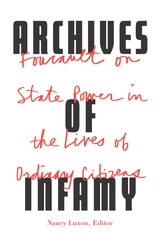
Archives of Infamy
Foucault on State Power in the Lives of Ordinary CitizensNancy Luxon
University of Minnesota Press, 2019
Expanding the insights of Arlette Farge and Michel Foucault’s Disorderly Families into policing, public order, (in)justice, and daily life
What might it mean for ordinary people to intervene in the circulation of power between police and the streets, sovereigns and their subjects? How did the police come to understand themselves as responsible for the circulation of people as much as things—and to separate law and justice from the maintenance of a newly emergent civil order? These are among the many questions addressed in the interpretive essays in Archives of Infamy.
Crisscrossing the Atlantic to bring together unpublished radio broadcasts, book reviews, and essays by historians, geographers, and political theorists, Archives of Infamy provides historical and archival contexts to the recent translation of Disorderly Families by Arlette Farge and Michel Foucault. This volume includes new translations of key texts, including a radio address Foucault gave in 1983 that explains the writing process for Disorderly Families; two essays by Foucault not readily available in English; and a previously untranslated essay by Farge that describes how historians have appropriated Foucault.
Archives of Infamy pushes past old debates between philosophers and historians to offer a new perspective on the crystallization of ideas—of the family, gender relations, and political power—into social relationships and the regimes of power they engender.
Contributors: Roger Chartier, Collège de France; Stuart Elden, U of Warwick; Arlette Farge, Centre national de recherche scientifique; Michel Foucault (1926–1984); Jean-Philippe Guinle, Catholic Institute of Paris; Michel Heurteaux; Pierre Nora, École des Hautes Études en Sciences Sociales; Michael Rey (1953–1993); Thomas Scott-Railton; Elizabeth Wingrove, U of Michigan.

Ariel and the Police
Frank Lentricchia
University of Wisconsin Press, 1989
In Ariel and the Police, Frank Lentricchia searches through the totalizing desires for power that have built and help to maintain tangible and intangible structures of confinement and purification within, and sometimes as, the house of modernism. And what he finds, in his lyrical effort to redeem the subject for history, is that someone lives there, slyly, sometimes even playfully defiant.
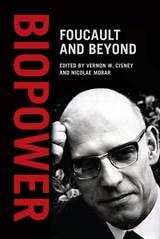
Biopower
Foucault and BeyondEdited by Vernon W. Cisney and Nicolae Morar
University of Chicago Press, 2015
Situating biopower as a radical alternative to traditional conceptions of power—what Foucault called “sovereign power”—the contributors examine a host of matters centered on life, the body, and the subject as a living citizen. Altogether, they pay testament to the lasting relevance of biopower in some of our most important contemporary debates on issues ranging from health care rights to immigration laws, HIV prevention discourse, genomics medicine, and many other topics.

Disorderly Families
Infamous Letters from the Bastille ArchivesArlette Farge
University of Minnesota Press, 2021
The first English translation of letters of arrest from eighteenth century France held in the archives of the Bastille
Drunken and debauched husbands; libertine wives; vagabonding children. These and many more are the subjects of requests for confinement written to the king of France in the eighteenth century. These letters of arrest (lettres de cachet) from France’s Ancien Régime were often associated with excessive royal power and seen as a way for the king to imprison political opponents. In Disorderly Families, first published in French in 1982, Arlette Farge and Michel Foucault collect ninety-four letters from ordinary families who, with the help of hired scribes, submitted complaints to the king to intervene and resolve their family disputes.
Gathered together, these letters show something other than the exercise of arbitrary royal power, and offer unusual insight into the infamies of daily life. From these letters come stories of divorce and marital conflict, sexual waywardness, reckless extravagance, and abandonment. The letters evoke a fluid social space in which life in the home and on the street was regulated by the rhythms of relations between husbands and wives, or parents and children. Most impressively, these letters outline how ordinary people seized the mechanisms of power to address the king and make demands in the name of an emerging civil order.
Arlette Farge and Michel Foucault were fascinated by the letters’ explosive qualities and by how they both illustrated and intervened in the workings of power and governmentality. Disorderly Families sheds light on Foucault’s conception of political agency and his commitment to theorizing how ordinary lives come to be touched by power. This first English translation is complete with an introduction from the book’s editor, Nancy Luxon, as well as notes that contextualize the original 1982 publication and eighteenth-century policing practices.

Feminism and the Final Foucault
Edited by Dianna Taylor and Karen Vintges
University of Illinois Press, 2004
Rather than simply debating the merits or limitations of Foucault's later work, the essays in this collection examine women's historical self-practices, conceive of feminism as a shared ethos, and consider the political significance of this conceptualization in order to elucidate, experiment with, and put into practice the conceptual "tools" that Foucault offers for feminist ethics and politics. The volume illustrates the ways in which Foucault's later thinking on ethics as "care of the self" can reintroduce a number of issues and themes that feminists jettisoned in the wake of postmodernism, including consciousness raising, feminist therapy, the subject woman, identity politics, and feminist agency.
Taken as a whole, the diversity of feminist viewpoints presented provide important new insights into "the final Foucault," and thus serve as a productive intervention in current Foucault scholarship.

Foucault
Gilles Deleuze
University of Minnesota Press, 1988
Foucault And Heidegger
Critical EncountersAlan Milchman
University of Minnesota Press, 2003
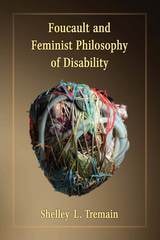
Foucault and Feminist Philosophy of Disability
Shelley L. Tremain
University of Michigan Press, 2017

Foucault and His Interlocutors
Edited by Arnold I. Davidson
University of Chicago Press, 1997
This volume also includes several important works by Foucault previously unpublished in English. The other contributors are Georges Canguilhem, Gilles Deleuze, Jacques Derrida, Pierre Hadot, Michel Serres, and Paul Veyne.
Here for the first time is the French Foucault.
This volume offers lucid and important texts that will appeal to students and professors at every level of study. It is essential reading for all scholars of twentieth-century philosophy and critical theory.

Foucault and Law
Towards a Sociology of Law As GovernanceAlan Hunt and Gary Wickham
Pluto Press, 1994
Foucault and Political Reason
Liberalism, Neo-Liberalism, and Rationalities of GovernmentEdited by Andrew Barry, Thomas Osborne, and Nikolas Rose
University of Chicago Press, 1996
These twelve essays provide a critical introduction to Foucault's work on politics, exploring its relevance to past and current thinking about liberal and neo-liberal forms of government. Moving away from the great texts of liberal political philosophy, this book looks closely at the technical means with which the ideals of liberal political rationalities have been put into practice in such areas as schools, welfare, and the insurance industry.
This fresh approach to one of the seminal thinkers of the twentieth century is essential reading for anyone interested in social and cultural theory, sociology, and politics.
Foucault and the Government of Disability
Shelley Tremain, Editor
University of Michigan Press, 2005
Foucault and the Government of Disability is the first book-length investigation of the relevance and importance of the ideas of Michel Foucault to the field of disability studies-and vice versa. Over the last thirty years, politicized conceptions of disability have precipitated significant social change, including the landmark Americans with Disabilities Act in 1990, the redesign of urban landscapes, the appearance of closed-captioning on televisions, and the growing recognition that disabled people constitute a marginalized and disenfranchised constituency.
The provocative essays in this volume respond to Foucault's call to question what is regarded as natural, inevitable, ethical, and liberating, while they challenge established understandings of Foucault's analyses and offer fresh approaches to his work. The book's roster of distinguished international contributors represents a broad range of disciplines and perspectives, making this a timely and necessary addition to the burgeoning field of disability studies.
Foucault and the Government of Disability
Shelley Tremain, Editor
University of Michigan Press, 2005
“[A]n important, prescient, and necessary contribution…a kind of litmus test for the efficacy of Foucault’s concepts in the study of disability, concepts that lead to a refusal of the biological essentialism implied in the disability/impairment binary.”
—Foucault Studies
“Tremain has done an exceptional job at organizing and procuring important, rigorously argued, and entertaining essays…. This book should be a mandatory read for anyone interested in contemporary philosophical debates surrounding the experience of disability."
—Essays in Philosophy
“A beautiful exploration of how Foucault’s analytics of power and genealogies of discursive knowledges can open up new avenues for thinking critically about phenomena that many of us take to be inevitable and thus new ways of resisting and possibly at times redirecting the forces that shape our lives. Every scholar, every person with an interest in Foucault or in political theory generally, needs to read this book.”
—Ladelle McWhorter, University of Richmond
Foucault and the Iranian Revolution
Gender and the Seductions of IslamismJanet Afary and Kevin B. Anderson
University of Chicago Press, 2005
In this important and controversial account, Janet Afary and Kevin B. Anderson illuminate Foucault's support of the Islamist movement. They also show how Foucault's experiences in Iran contributed to a turning point in his thought, influencing his ideas on the Enlightenment, homosexuality, and his search for political spirituality. Foucault and the Iranian Revolution informs current discussion on the divisions that have reemerged among Western intellectuals over the response to radical Islamism after September 11. Foucault's provocative writings are thus essential for understanding the history and the future of the West's relationship with Iran and, more generally, to political Islam. In their examination of these journalistic pieces, Afary and Anderson offer a surprising glimpse into the mind of a celebrated thinker.

Foucault and the Kamasutra
The Courtesan, the Dandy, and the Birth of Ars Erotica as Theater in IndiaSanjay K. Gautam
University of Chicago Press, 2016
Gautam shows how closely intertwined the history of erotics in Indian culture is with the history of theater-aesthetics grounded in the discourse of love, and Foucault provides the framework for opening up an intellectual horizon of Indian thought. To do this, Gautam looks to the history of three inglorious characters in classical India: the courtesan and her two closest male companions—her patron, the dandy consort; and her teacher and advisor, the dandy guru. Foucault’s distinction between erotic arts and the science of sexuality drives Gautam’s exploration of the courtesan as a symbol of both sexual-erotic and aesthetic pleasure. In the end, by entwining together Foucault’s works on the history of sexuality in the West and the classical Indian texts on eros, Gautam transforms our understanding of both, even as he opens up new ways of investigating erotics, aesthetics, gender relations, and subjectivity.
Foucault in Iran
Islamic Revolution after the EnlightenmentBehrooz Ghamari-Tabrizi
University of Minnesota Press, 2016
Were the thirteen essays Michel Foucault wrote in 1978–1979 endorsing the Iranian Revolution an aberration of his earlier work or an inevitable pitfall of his stance on Enlightenment rationality, as critics have long alleged? Behrooz Ghamari-Tabrizi argues that the critics are wrong. He declares that Foucault recognized that Iranians were at a threshold and were considering if it were possible to think of dignity, justice, and liberty outside the cognitive maps and principles of the European Enlightenment.
Foucault in Iran centers not only on the significance of the great thinker’s writings on the revolution but also on the profound mark the event left on his later lectures on ethics, spirituality, and fearless speech. Contemporary events since 9/11, the War on Terror, and the Arab Uprisings have made Foucault’s essays on the Iranian Revolution more relevant than ever. Ghamari-Tabrizi illustrates how Foucault saw in the revolution an instance of his antiteleological philosophy: here was an event that did not fit into the normative progressive discourses of history. What attracted him to the Iranian Revolution was precisely its ambiguity.
Theoretically sophisticated and empirically rich, this interdisciplinary work will spark a lively debate in its insistence that what informed Foucault’s writing was not an effort to understand Islamism but, rather, his conviction that Enlightenment rationality has not closed the gate of unknown possibilities for human societies.
Foucault's Askesis
An Introduction to the Philosophical LifeEdward McGushin
Northwestern University Press, 2007
Through a detailed study of Foucault's last courses, McGushin demonstrates that this new way of practicing philosophical askēsis evokes Foucault's ethical resistance to modern relations of power and knowledge. In order to understand Foucault's later project, then, it is necessary to see it within the context of his earlier work. If his earlier projects represented an attempt to bring to light the relations of power and knowledge that narrowed and limited freedom, then this last project represents his effort to take back that freedom by redefining it in terms of care of the self. Foucault always stressed that modern power functions by producing individual subjects. This book shows how his excavation of ancient philosophical practices gave him the tools to counter this function-with a practice of self-formation, an askēsis.
Foucault's Discipline
The Politics of SubjectivityJohn S. Ransom
Duke University Press, 1997
Foucault’s Discipline demonstrates how Foucault’s valorization of descriptive critique over prescriptive plans of action can be applied to the decisively altered political landscape of the end of this millennium. By reconstructing the philosopher’s arguments concerning the significance of disciplinary institutions, biopower, subjectivity, and forms of resistance in modern society, Ransom shows how Foucault has provided a different way of looking at and responding to contemporary models of government—in short, a new depiction of the political world.

Foucault, Politics, and Violence
Johnanna Oksala
Northwestern University Press, 2012
How to Read Foucault's Discipline and Punish
Stephen Shapiro and Anne Schwan
Pluto Press, 2011
Michel Foucault’s Discipline and Punish is one of the best-selling works of critical theory and a key text on many undergraduate courses. However, it is a long, difficult text which makes Anne Schwan and Stephen Shapiro's excellent step-by-step reading guide a welcome addition to the How to Read Theory series.
Undergraduates across a wide range of disciplines are expected to have a solid understanding of Foucault's key terms, which have become commonplace in critical thinking today. While there are many texts that survey Foucault's thought, these are often more general overviews or biographical précis that give little in the way of robust explanation and discussion. In contrast, Schwan and Shapiro take a plain-speaking, yet detailed, approach, specifically designed to give students a thorough understanding of one of the most influential texts in contemporary cultural theory.
Intolerable
Writings from Michel Foucault and the Prisons Information Group (1970–1980)Michel Foucault
University of Minnesota Press, 2020
A groundbreaking collection of writings by Michel Foucault and the Prisons Information Group documenting their efforts to expose France’s inhumane treatment of prisoners
Founded by Michel Foucault and others in 1970–71, the Prisons Information Group (GIP) circulated information about the inhumane conditions within the French prison system. Intolerable makes available for the first time in English a fully annotated compilation of materials produced by the GIP during its brief but influential existence, including an exclusive new interview with GIP member Hélène Cixous and writings by Gilles Deleuze and Jean Genet.
These archival documents—public announcements, manifestos, reports, pamphlets, interventions, press conference statements, interviews, and round table discussions—trace the GIP’s establishment in post-1968 political turmoil, the new models of social activism it pioneered, the prison revolts it supported across France, and the retrospective assessments that followed its denouement. At the same time, Intolerable offers a rich, concrete exploration of Foucault’s concept of resistance, providing a new understanding of the arc of his intellectual development and the genesis of his most influential book, Discipline and Punish.
Presenting the account of France’s most vibrant prison resistance movement in its own words and on its own terms, this significant and relevant collection also connects the approach and activities of the GIP to radical prison resistance movements today.

Joyce/Foucault
Sexual ConfessionsWolfgang Streit
University of Michigan Press, 2004
Joyce/Foucault: Sexual Confessions examines instances of sexual confession in works of James Joyce, with a special emphasis on Portrait of the Artist as a Young Man and Ulysses. Using Michel Foucault's historical analysis of Western sexuality as its theoretical underpinning, the book foregrounds the role of the Jesuit order in the spread of a confessional force, and finds this influence inscribed into Joyce's major texts. Wolfgang Streit goes on to argue that the tension between the texts' erotic passages and Joyce's criticism of even his own sexual writing energizes Joyce's narratives-and enables Joyce to develop the radical skepticism of power revealed in his work.
Wolfgang Streit is Lecturer, Ludwig Maximilians University, Munich.

Kenneth Burke and Contemporary European Thought
Rhetoric in TransitionBernard L. Brock
University of Alabama Press, 1995
Kenneth Burke and Contemporary European Thought: A Rhetoric in Transition reflects the present transitional nature of rhetoric and society. Its purpose is to relate the rhetorical theory of Burke to the theories of four major European philosophers—Jürgen Habermas, Ernesto Grassi, Foucault, and Jacques Derrida—as they discuss the nature of language and its central role in society.
This book describes a rhetorical world in transition but not a world in chaos. It points to the centrality of symbolism in theories of language and rhetoric and illustrates Burke’s influence as a pivotal things and theorist in the communication arts and sciences, suggesting that the observations regarding shifting paradigms and perspectives made by other scholars are indeed emergent in the realm of rhetoric. It also regards the powerful impact of language and symbolic action in both the critique and construction of human knowledge and augurs a central role for rhetoric in the intellectual and social transformations of this and the next century.
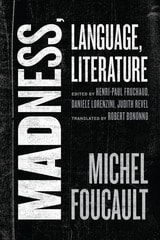
Madness, Language, Literature
Michel Foucault
University of Chicago Press, 2023
Perceiving an enigmatic relationship between madness, language, and literature, French philosopher Michel Foucault developed ideas during the 1960s that are less explicit in his later, more well-known writings. Collected here, these previously unpublished texts reveal a Foucault who undertakes an analysis of language and experience detached from their historical constraints. Three issues predominate: the experience of madness across societies; madness and language in Artaud, Roussel, and Baroque theater; and structuralist literary criticism. Not only do these texts pursue concepts unique to this period such as the “extra-linguistic,” but they also reveal a far more complex relationship between structuralism and Foucault than has typically been acknowledged.
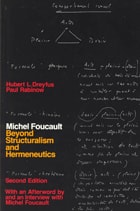
Michel Foucault
Beyond Structuralism and HermeneuticsHubert L. Dreyfus and Paul Rabinow
University of Chicago Press, 1983
To demonstrate the sense in which Foucault's work is beyond structuralism and hermeneutics, the authors unfold a careful, analytical exposition of his oeuvre. They argue that during the of Foucault's work became a sustained and largely successful effort to develop a new method—"interpretative analytics"—capable fo explaining both the logic of structuralism's claim to be an objective science and the apparent validity of the hermeneutical counterclaim that the human sciences can proceed only by understanding the deepest meaning of the subject and his tradition.
"There are many new secondary sources [on Foucault]. None surpass the book by Hubert Dreyfus and Paul Rabinow. . . . The American paperback edition contains Foucault's 'On the Genealogy of Ethics,' a lucid interview that is now our best source for seeing how he construed the whole project of the history of sexuality."—David Hoy, London Review of Books

Opacity and the Closet
Queer Tactics in Foucault, Barthes, and WarholNicholas de Villiers
University of Minnesota Press, 2012
Opacity and the Closet interrogates the viability of the metaphor of “the closet” when applied to three important queer figures in postwar American and French culture: the philosopher Michel Foucault, the literary critic Roland Barthes, and the pop artist Andy Warhol. Nicholas de Villiers proposes a new approach to these cultural icons that accounts for the queerness of their works and public personas.
Rather than reading their self-presentations as “closeted,” de Villiers suggests that they invent and deploy productive strategies of “opacity” that resist the closet and the confessional discourse associated with it. Deconstructing binaries linked with the closet that have continued to influence both gay and straight receptions of these intellectual and pop celebrities, de Villiers illuminates the philosophical implications of this displacement for queer theory and introduces new ways to think about the space they make for queerness.
Using the works of Foucault, Barthes, and Warhol to engage each other while exploring their shared historical context, de Villiers also shows their queer appropriations of the interview, the autobiography, the diary, and the documentary—forms typically linked to truth telling and authenticity.
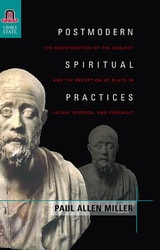
Postmodern Spiritual Practices
The Construction of the Subject and the Reception of Plato in Lacan, Derrida, and FoucaultPaul Allen Miller
The Ohio State University Press, 2007
On the other hand, blindness to the merits of postmodern thought is also due to Anglo-American philology’s own parochial instincts. Ensconced within a nineteenth-century model of Alterumswissenschaft, only a minority of classicists have made forays into philosophical, psychoanalytic, and other speculative modes of inquiry. The result has been that postmodern French thought has largely been the province of scholars of modern languages.
A situation thus emerges in which most classicists do not know theory, and so cannot appreciate the scope of these thinkers’ contribution to our understanding of the genealogy of Western thought, while most theorists do not know the Platonic texts and their contexts that ground them. This book bridges this gap, offering detailed and theoretically informed readings of French postmodernism’s chief thinkers’ debts to Plato and the ancient world.

Race and the Education of Desire
Foucault's History of Sexuality and the Colonial Order of ThingsAnn Laura Stoler
Duke University Press, 1995
Drawing on Foucault’s little-known 1976 College de France lectures, Stoler addresses his treatment of the relationship between biopower, bourgeois sexuality, and what he identified as “racisms of the state.” In this critical and historically grounded analysis based on cultural theory and her own extensive research in Dutch and French colonial archives, Stoler suggests how Foucault’s insights have in the past constrained—and in the future may help shape—the ways we trace the genealogies of race.
Race and the Education of Desire will revise current notions of the connections between European and colonial historiography and between the European bourgeois order and the colonial treatment of sexuality. Arguing that a history of European nineteenth-century sexuality must also be a history of race, it will change the way we think about Foucault.

Rebirth of the Clinic
Places and Agents in Contemporary Health CareCindy Patton
University of Minnesota Press, 2010
Combining theory, history, and ethnography, the contributors to this volume ground today's clinic in a larger scheme of power relations, identifying the cultural, political, and economic pressures that frame clinical relationships, including the instrumentalist definition of health, actuarial-based medical practices, and patient self-help movements, which simultaneously hem in and create the conditions under which agents creatively change ideas of illness and treatment.
From threatened community health centers in poor African American locales to innovative nursing practices among the marginally housed citizens of Canada's poorest urban neighborhood, this volume addresses not just the who, what, where, and how of place-specific clinical practices, but also sets these local experiences against a theoretical backdrop that links them to the power of modern medicine in shaping fundamental life experiences.
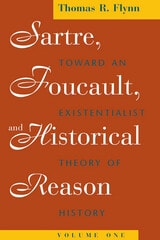
Sartre, Foucault, and Historical Reason, Volume One
Toward an Existentialist Theory of HistoryThomas R. Flynn
University of Chicago Press, 1997
A history, thought Foucault, should be a kind of map, a comparative charting of structural transformations and displacements. But for Sartre, authentic historical understanding demanded a much more personal and committed narrative, a kind of interpretive diary of moral choices and risks compelled by critical necessity and an exacting reality. Sartre's history, a rational history of individual lives and their intrinsic social worlds, was in essence immersed in biography.
In Volume One of this authoritative two-volume work, Thomas R. Flynn conducts a pivotal and comprehensive reconstruction of Sartrean historical theory, and provocatively anticipates the Foucauldian counterpoint to come in Volume Two.
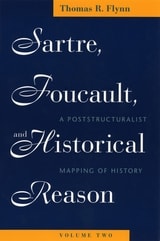
Sartre, Foucault, and Historical Reason, Volume Two
A Poststructuralist Mapping of HistoryThomas R. Flynn
University of Chicago Press, 2005
A history, theorized Foucault, should be a kind of map, a comprehensive charting of structural transformations and displacements over time. Contrary to other Foucault scholars, Flynn proposes an "axial" rather than a developmental reading of Foucault's work. This allows aspects of Foucault's famous triad of knowledge, power, and the subject to emerge in each of his major works. Flynn maps existentialist categories across Foucault's "quadrilateral," the model that Foucault proposes as defining modernist conceptions of knowledge. At stake is the degree to which Sartre's thought is fully captured by this mapping, whether he was, as Foucault claimed, "a man of the nineteenth century trying to think in the twentieth."
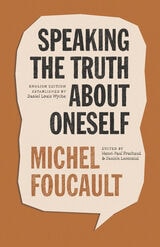
Speaking the Truth about Oneself
Lectures at Victoria University, Toronto, 1982Michel Foucault
University of Chicago Press, 2021
Just before the summer of 1982, French philosopher Michel Foucault gave a series of lectures at Victoria University in Toronto. In these lectures, which were part of his project of writing a genealogy of the modern subject, he is concerned with the care and cultivation of the self, a theme that becomes central to the second, third, and fourth volumes of his History of Sexuality. Foucault had always been interested in the question of how constellations of knowledge and power produce and shape subjects, and in the last phase of his life, he became especially interested not only in how subjects are formed by these forces but in how they ethically constitute themselves.
In this lecture series and accompanying seminar, Foucault focuses on antiquity, starting with classical Greece, the early Roman empire, and concluding with Christian monasticism in the fourth and fifth centuries AD. Foucault traces the development of a new kind of verbal practice—“speaking the truth about oneself”—in which the subject increasingly comes to be defined by its inner thoughts and desires. He deemed this new form of “hermeneutical” subjectivity important not just for historical reasons, but also due to its enduring significance in modern society.
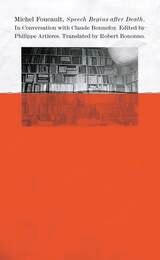
Speech Begins after Death
Michel Foucault
University of Minnesota Press, 2016
In 1968, Michel Foucault agreed to a series of interviews with critic Claude Bonnefoy, which were to be published in book form. Bonnefoy wanted a dialogue with Foucault about his relationship to writing rather than about the content of his books. The project was abandoned, but a transcript of the initial interview survived and is now being published for the first time in English. In this brief and lively exchange, Foucault reflects on how he approached the written word throughout his life, from his school days to his discovery of the pleasure of writing.
Wide ranging, characteristically insightful, and unexpectedly autobiographical, the discussion is revelatory of Foucault’s intellectual development, his aims as a writer, his clinical methodology (“let’s say I’m a diagnostician”), and his interest in other authors, including Raymond Roussel and Antonin Artaud. Foucault discloses, in ways he never had previously, details about his home life, his family history, and the profound sense of obligation he feels to the act of writing. In his Introduction, Philippe Artières investigates Foucault’s engagement in various forms of oral discourse—lectures, speeches, debates, press conferences, and interviews—and their place in his work.
Speech Begins after Death shows Foucault adopting a new language, an innovative autobiographical communication that is neither conversation nor monologue, and is one of his most personal statements about his life and writing.
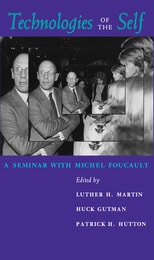
Technologies of the Self
A Seminar with Michel FoucaultLuther H. Martin
University of Massachusetts Press, 1988
Shortly before his death in 1984, Michel Foucault spoke of an idea for a new book on “technologies of the self.” He described it as “composed of different papers about the self. . . . about the role of reading and writing in constituting the self. . . . and so on.” The book Foucault envisioned was based on a faculty seminar on “Technologies of the Self,” originally presented at the University of Vermont in the fall of 1982. This volume is a partial record of that seminar.
In many ways, Foucault's project on the self was the logical conclusion to his historical inquiry over twenty-five years into insanity, deviancy, criminality, and sexuality. Because Foucault died before he completed the revisions of his seminar presentations, this volume includes a careful transcription instead...as a prolegomenon to that unfinished task.
Foucault was a French philosopher, historian of ideas, social theorist, philologist and literary critic.
This volume was edited by Luther H. Martin, Huck Gutman, and Patrick H. Hutton.

The Age of the World Target
Self-Referentiality in War, Theory, and Comparative WorkRey Chow
Duke University Press, 2006

The Biopolitics of Punishment
Derrida and FoucaultEdited by Rick Elmore and Ege Selin Islekel
Northwestern University Press, 2022
With the resurgence of fascism and authoritarianism across the globe, the rise of white supremacist and xenophobic violence, and the continued brutality of state-sanctioned and extrajudicial killings by police, border patrols, and ordinary citizens, there is a pressing need to critically analyze our political present. These essays bring to bear the critical force of Derrida’s and Foucault’s biopolitical thought to practices of mass incarceration, the death penalty, life without parole, immigration and detention, racism and police violence, transphobia, human and animal relations, and the legacies of colonization. At the heart of their biopolitics, the volume shows, lies the desire to deconstruct and resist in the name of a future that is more just and less policed. It is this impulse that makes reading their work together, at this moment, both crucial and worthwhile.
The Constitution of a Historical Transcendental in Hegel's "Phenomenology of Spirit"
Graduate Thesis in Philosophy, 1949Michel Foucault
University of Chicago Press, 0
The first English translation of Foucault’s previously lost master’s thesis, itself an original contribution to the study of Hegel’s philosophy.
On June 11, 1949, a twenty-three-year-old Michel Foucault defended his master’s thesis in philosophy at the Sorbonne entitled The Constitution of a Historical Transcendental in Hegel’s “Phenomenology of Spirit.” Long considered a lost holy grail of French philosophy, the thesis was only recently rediscovered, and it is presented here in English for the first time.
In his master’s thesis, Foucault offers an original reading of Hegel that understands “absolute knowing,” the famous but enigmatic final figure of experience in the Phenomenology, as inextricably bound to time, language, and historical experience. Indeed, readers will discover how many of Foucault’s famous later concepts—the historical a priori, the episteme, and the limit-experience—are intimately rooted in his early, intense engagement with Hegel’s philosophy.
An introduction and critical apparatus provided by Hegel scholar Christophe Bouton traces previously unknown connections between the thesis and Foucault’s later masterpieces, particularly History of Madness and The Order of Things. Introducing a fundamental shift in our understanding of Foucault’s intellectual trajectory, this book is an essential text for anyone interested in Foucault, Hegel, and the dramatic evolution of twentieth-century continental philosophy.
The Elements of Foucault
Gregg Lambert
University of Minnesota Press, 2020
A new conceptual diagram of Foucault’s original vision of the biopolitical order
The history around the critical reception of Michel Foucault’s published writings is troubled, according to Gregg Lambert, especially in light of the controversy surrounding his late lectures on biopolitics and neoliberal governmentality. In this book, Lambert’s unique approach distills Foucault’s thought into its most basic components in order to more fully understand its method and its own immanent rules of construction.
The Elements of Foucault presents a critical study of Foucault’s concept of method from the earlier History of Sexuality, Volume 1, to his later lectures. Lambert breaks down Foucault’s post-1975 analysis of the idea of biopower into four elements: the method, the conceptual device (i.e., dispositif), the grid of intelligibility, and the notion of “milieu.” Taken together, these elements compose the diagram of Foucault’s early analysis and the emergence of the neoliberal political economy. Lambert further delves into how Foucault’s works have been used and misused over time, challenging the periodization of Foucault’s later thought in scholarship as well as the major and most influential readings of Foucault by other contemporary philosophers—in particular Gilles Deleuze and Giorgio Agamben.
The Elements of Foucault is the first generally accessible, yet rigorous and comprehensive, discussion of lectures and major published works of Foucault’s post-1975 theory of biopower and of the major innovation of the concept of dispositif. It is also the first critical work to address the important influence of French philosopher Georges Canghuilhem on Foucault’s thought.
The Force of Truth
Critique, Genealogy, and Truth-Telling in Michel FoucaultDaniele Lorenzini
University of Chicago Press, 2023
Many blame Michel Foucault for our post-truth and conspiracy-laden society. In this provocative work, Daniele Lorenzini argues that such criticism fundamentally misunderstands the philosopher’s project. Foucault did not question truth itself but what Lorenzini calls “the force of truth,” or how some truth claims are given the power to govern our conduct while others are not. This interest, Lorenzini shows, drove Foucault to articulate a new ethics and politics of truth-telling precisely in order to evade the threat of relativism. The Force of Truth explores this neglected dimension of Foucault’s project by putting his writings on regimes of truth and parrhesia in conversation with early analytic philosophy and by drawing out the “possibilizing” elements of Foucault’s genealogies that remain vital for practicing critique today.
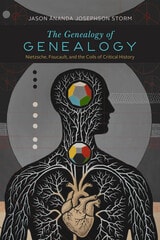
The Genealogy of Genealogy
Nietzsche, Foucault, and the Coils of Critical HistoryJason Ananda Josephson Storm
University of Chicago Press, 2026
The genealogical method—a mode of historical analysis that shows that what looks timeless is in fact contingent, bound to shifting relations of meaning, knowledge, and power—has become the dominant paradigm of humanistic inquiry. In The Genealogy of Genealogy, Jason Ānanda Josephson Storm turns this influential practice back on itself, tracing its unlikely rise through Nietzsche and Foucault and uncovering its suppressed ties to eugenics and racism. He rethinks the very stakes of critical history and proposes new tools for thinking about historical continuity, change, and difference.
Provocative and timely, The Genealogy of Genealogy offers both a diagnosis and a vision, challenging scholars across the humanities and social sciences to rethink how we write history and whether our most trusted methods are fit for the futures we seek to build.
The Illusion of History
Andrew R. Russ
Catholic University of America Press, 2012
The Powers of Sensibility
Aesthetic Politics through Adorno, Foucault, and RancièreMichael Feola
Northwestern University Press, 2018
Feola provides insightful engagements with the works of Adorno, Foucault, and Rancière as well as a survey of contemporary debates on aesthetics and politics. He uses this aesthetic framework to develop a more robust account of political agency, demonstrating that politics is not reducible to the exchange of views or the building of institutions, but rather incorporates public modes of feeling, seeing, and hearing (or not-seeing and not-hearing). These sensory modes must themselves be transformed in the work of emancipatory politics.
The book explores the core question: what does the aesthetic offer that is missing from the official languages of politics, citizenship, and power? Of interest to readers in the fields of critical theory, political theory, continental philosophy, and aesthetics, The Powers of Sensibility roots itself within the classical tradition of critical theory and yet uses these resources to speak to a variety of contemporary political movements.

The Sciences in Enlightened Europe
Edited by William Clark, Jan Golinski, and Simon Schaffer
University of Chicago Press, 1999
The contributors examine the production of new disciplines through work with instruments and techniques; consider how institutions of public taste and conversation helped provide a common frame for the study of human and nonhuman natures; and explore the regional operations of scientific culture at the geographical fringes of Europe.
Implicated in the rise of both fascism and liberal secularism, the moral and political values that shaped the Enlightenment remain controversial today. Through careful scrutiny of how these values influenced and were influenced by the concrete practices of its sciences, this book gives us an entirely new sense of the Enlightenment.
Wrong-Doing, Truth-Telling
The Function of Avowal in JusticeMichel Foucault
University of Chicago Press, 2014
Three years before his death, Michel Foucault delivered a series of lectures at the Catholic University of Louvain that until recently remained almost unknown. These lectures—which focus on the role of avowal, or confession, in the determination of truth and justice—provide the missing link between Foucault’s early work on madness, delinquency, and sexuality and his later explorations of subjectivity in Greek and Roman antiquity.