Results by title
23 books match the query 'Freedom of the press'
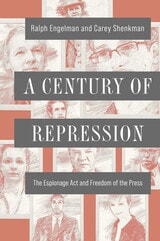
A Century of Repression
The Espionage Act and Freedom of the PressRalph Engelman and Carey Shenkman
University of Illinois Press, 2022
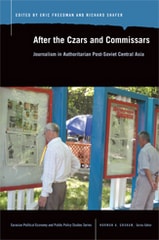
After the Czars and Commissars
Journalism in Authoritarian Post-Soviet Central AsiaEric Freedman
Michigan State University Press, 2011
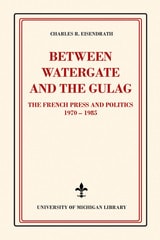
Between Watergate and the Gulag
The French Press and Politics, 1970–1985Charles R. Eisendrath
Michigan Publishing Services, 2022
Also introduced: “surplus freedom” a novel approach for gauging self-censorship by comparing the degree of free expression a legal system permits to what publications actually exercise.
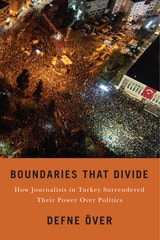
Boundaries That Divide
How Journalists in Turkey Surrendered Their Power over PoliticsDefne Över
Rutgers University Press, 2026
Turkey presents a striking example of the most recent wave of global authoritarian turns. The two-decade-long transition in the country’s political system also transformed its media environment. As mainstream journalists gradually yielded their places to sycophants, much more willing to praise the government in their news, the mainstream media that once oversaw—however imperfectly—political decisions started devoting its full service to cheerleading the government. Simultaneously, a new sphere of critical journalism began to emerge, with mainstream media journalists joining their fellows in the peripheries of the media. Considering the transformation of Turkey’s news media as the decay of a democratic institution, this book asks, How does the media break down under the rule of an elected government?
Drawing on fieldwork and in-depth interviews, the book traces the ruling AKP’s manipulation of social divides to consolidate power and journalists’ navigation of the resulting climate of fear, hope, doubt, and anger. The book shows how Turkey’s news media surrendered its power over politics as some journalists embraced disinformation as a path to heightened status, others turned to self-censorship for protection, and still others resisted capture through continuous but fragmented efforts.
The book portrays journalists as central actors in media decay, while also revealing that resilience to decay emerges where rising demand for “news” meets the contentious mobilization of journalists. Although focused on Turkey, the book’s insights extend far beyond, offering urgent lessons about the future of journalism in an age of populism, polarization, and institutional erosion.
Censorship in Vietnam
Brave New WorldThomas A. Bass
University of Massachusetts Press, 2017
After the book was published, Bass flew to Vietnam to meet his censors, at least the half dozen who would speak with him. In Censorship in Vietnam, he describes these meetings and examines how censorship works, both in Vietnam and elsewhere in the world. An exemplary piece of investigative reporting, Censorship in Vietnam opens a window into the country today and shows us the precarious nature of intellectual freedom in a world governed by suppression.
Confessions of a Presidential Speechwriter
Craig R. Smith
Michigan State University Press, 2014
Freedom from the Press
Journalism and State Power in SingaporeCherian George
National University of Singapore Press, 2011
Game Faces
Sport Celebrity and the Laws of ReputationSarah K. Fields
University of Illinois Press, 2016
Images of a Free Press
Lee C. Bollinger
University of Chicago Press, 1991
"Images of a Free Press is the natural sequel to Lee Bollinger's first book, The Tolerant Society, and is destined to become a standard in first amendment scholarship."—Rodney A. Smolla, Constitutional Commentary
"Revisiting themes he first explored some fifteen years ago, Bollinger now adds further to our understanding of the complex relationship among the First Amendment, the Supreme Court, the public, the press and the democratic process. This is a work of insight, sensitivity, and power. Bollinger has a profound knowledge of and a deep affection for his subject, and it shows."—Geoffrey R. Stone, Michigan Law Review
"This thoughtful, understated book remains a call to come join the town meeting and hammer out some new rules of order. Scholars and citizens alike could do well to read Bollinger's book and accept his challenge."—Yale Law Review
"For a number of years, Lee Bollinger has argued that the First Amendment has been applied differently to the print media than it has been to the broadcast media. In his new book, Images of a Free Press, Bollinger provides a concise, persuasive account of why this is so—and why it ought to be so."—Columbia Law Review
In Sullivan's Shadow
The Use and Abuse of Libel Law during the Long Civil Rights StruggleAimee Edmondson
University of Massachusetts Press, 2019
Drawing on archival research and scholarship in journalism, legal history, and African American studies, Edmondson offers a new narrative of brave activists, bold journalists and publishers, and hardheaded southern officials. These little-known courtroom dramas at the intersection of race, libel, and journalism go beyond the activism of the 1960s and span much of the country's history, beginning with lawsuits filed against abolitionist William Lloyd Garrison and concluding with a suit spawned by the 1988 film Mississippi Burning.
Journalistic Autonomy
The Genealogy of a ConceptHenrik Örnebring
University of Missouri Press, 2022
The idea that journalism should be independent is foundational to its contemporary understandings and its role in democracy. But from what, exactly, should journalism be independent? This book traces the genealogy of the idea of journalistic autonomy, from the press freedom debates of the 17th century up to the digital, networked world of the 21st. Using an eclectic and thought-provoking theoretical framework that draws upon Friedrich Nietzsche, feminist philosophy, and theoretical biology, the authors analyze the deeper meanings and uses of the terms independence and autonomy in journalism.
This work tackles, in turn, questions of journalism’s independence from the state, politics, the market, sources, the workplace, the audience, technology, and algorithms. Using broad historical strokes as well as detailed historical case studies, the authors argue that autonomy can only be meaningful if it has a purpose. Unfortunately, for large parts of journalism’s history this purpose has been the maintenance of a societal status quo and the exclusion of large groups of the population from the democratic polity. “Independence,” far from being a shining ideal to which all journalists must aspire, has instead often been used to mask the very dependencies that lie at the heart of journalism. The authors posit, however, that by learning the lessons of history and embracing a purpose fit for the needs of the 21st century world, journalism might reclaim its autonomy and redeem its exclusionary uses of independence.

Last Rights
Revisiting *Four Theories of the Press*Edited by John C. Nerone
University of Illinois Press, 1995
Though subjected to years of criticism, Four Theories of the Press remains a core text in communications. Its influence on the field, impact on generations of journalists, and ability to spark debate on why the press acts as it does continue to make it an oft-quoted source and classroom staple.
In Last Rights, eight communications scholars critique and expand on the classic text. The authors argue that Four Theories spoke to and for a world beset by a cold war ended long ago. At the same time, they praise the book for offering an alternative view of the press and society and as a useful tool for helping scholars and citizens alike grapple with contradictions in classical liberalism. They also raise important questions about the Internet and other major changes in communications systems and society since the original publication of Four Theories.
Contributors: William E. Berry, Sandra Braman, Clifford Christians, Thomas G. Guback, Steven J. Helle, Louis W. Liebovich, John C. Nerone, and Kim B. Rotzoll
Liberal Democracy and the Limits of Tolerance
Essays in Honor and Memory of Yitzhak RabinRaphael Cohen-Almagor, Editor
University of Michigan Press, 2000

Media Freedom
The Contradictions of Communications in the Age of ModernityRichard Barbrook
Pluto Press, 1995
Mr. Justice Black and His Critics
Tinsley E. Yarbrough
Duke University Press, 1988
Late in his career, however, Black's commitment to literalism and intent led him to assume apparently conservative positions in civil liberties cases. In an era characterized by growing acceptance of the belief that judges should adapt the Constitution to changing social and ethical perceptions, many came to regard Black's position as unrealistic and irrelevant.
Tinsley E. Yarbrough analyzes Black's judicial and constitutional philosophy, as well as his approach to specific cases, through the eyes of Black's critics (such as Justices Frankfurter and Harlan) and through an assessment of scholarly opinion of his jurisprudence. The result is a stimulating and provocative addition to the study of Justice Black and the Supreme Court.
Normative Theories of the Media
Journalism in Democratic SocietiesClifford G. Christians, Theodore Glasser, Denis McQuail, Kaarle Nordenstreng, Ro
University of Illinois Press, 2008
Party Colonisation of the Media in Central and Eastern Europe
Péter Bajomi-Lázár
Central European University Press, 2014
Pen and Sword
American War Correspondents, 1898-1975Mary S. Mander
University of Illinois Press, 2010
Regulating the Press
Tom O'Malley and Clive Soley
Pluto Press, 2000

The Constitution, the Law, and Freedom of Expression
1787-1987James Brewer Stewart
Southern Illinois University Press, 1987
In recognition of the bicentennial of the Constitution of the United States, former chief justice Warren E. Burger, Justice Antonin Scalia, ACLU president Norman Dorsen, and others delivered papers at the first annual DeWitt Wallace Conference on the Liberal Arts, held at Macalester College, St. Paul.
Joining some of the best legal minds in America were novelist John Edgar Wideman, chemist Harry B. Gray, historian Mary Beth Norton, and psychiatrist and social psychologist Robert Jay Lifton.
Opening the conference and this book, former chief Justice Burger emphasizes the daring of those who drafted the Constitution. Justice Scalia, noting the great reduction in curbs to freedom of expression since World War I, points out that the proliferation of freedom has forced courts to distinguish between types of expression.
Although the views expressed in these essays differ widely, opinion concerning the major issue falls into two definite camps: Burger, Scalia, and Dorsen contend that freedom of expression depends on the legal structure for survival; Wideman, Gray, Lifton, and Norton maintain that social forces determine freedom of expression.
The Idea of a Free Press
The Enlightenment and Its Unruly LegacyDavid Copeland
Northwestern University Press, 2006
The rise of a free press was, in many ways, a legacy of the Reformation and Enlightenment. Copeland describes a discourse centered on questions of religion--a discussion that the government, with all its religious authority, could not suppress because of the belief that the ability to reason for oneself was God-given. In this account we see how the debate moved from religion to the purely political sphere, and how, through the increased use of the printing press, it was opened to a multiplicity of voices and opinions. Spanning nearly four centuries in Britain and America, Copeland's book reveals how the tension between government control and the right to debate public affairs openly ultimately led to the idea of a free press; in doing so, it documents an intellectual development of unparalleled relevance and importance to the history of journalism.
The Supreme Court and the Press
The Indispensable ConflictJoe Mathewson
Northwestern University Press, 2011
Violence As Obscenity
Limiting the Media's First Amendment ProtectionKevin W. Saunders
Duke University Press, 1996
Saunders examines the public debate on media violence, the arguments of professional and public interest groups urging governmental action, and the media and the ACLU’s desire for self-regulation. Citing research that links violence in the media to actual violence, Saunders argues that a present danger to public safety may be reduced by invoking the existing law on obscenity. Reviewing the justifications of that law, he finds that not only is the legal history relied on by the Supreme Court inadequate to distinguish violence from sex, but also many of the justifications apply more forcefully to instances of violence than to sexually explicit material that has been ruled obscene. Saunders also examines the actions that Congress, states, and municipalities have taken to regulate media violence as well as the legal limitations imposed on such regulations by the First Amendment protections given to speech and the press. In discussing the current operation of the obscenity exception and confronting the issue of censorship, he advocates adapting to the regulation of violent material the doctrine of variable obscenity, which applies a different standard for material aimed at youth, and the doctrine of indecency, which allows for federal regulation of broadcast material.
Cogently and passionately argued, Violence as Obscenity will attract scholars of American constitutional law and mass communication, and general readers moved by current debates about media violence, regulation, and censorship.