Results by title
18 books match the query 'Frontiers'

Frontiers Of Illusion
Science, Technology, and the Politics of ProgressDaniel Sarewitz
Temple University Press, 1996
For the past fifty years, science and technology—supported with billions of dollars from the U.S. government—have advanced at a rate that would once have seemed miraculous, while society's problems have grown more intractable, complex, and diverse. Yet scientists and politicians alike continue to prescribe more science and more technology to cure such afflictions as global climate change, natural resource depletion, overpopulation, inadequate health care, weapons proliferation, and economic inequality.
Daniel Sarewitz scrutinizes the fundamental myths that have guided the formulation of science policy for half a century—myths that serve the professional and political interests of the scientific community, but often fail to advance the interests of society as a whole. His analysis ultimately demonstrates that stronger linkages between progress in science and progress in society will require research agendas that emerge not from the intellectual momentum of science, but from the needs and goals of society.
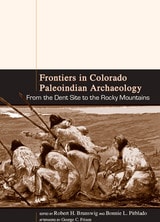
Frontiers in Colorado Paleoindian Archaeology
From the Dent Site to the Rocky MountainsRobert H. Brunswig
University Press of Colorado, 2007
The editors introduce the research with scientific context. A review of seventy-five years of Paleoindian archaeology in Colorado highlights the foundation on which new work builds, and a survey of Colorado's ancient climates and ecologies helps readers understand Paleoindian settlement patterns.
Eight essays discuss archaeological evidence from Plains to high Rocky Mountain sites. The book offers the most thorough analysis to date of Dent--the first Clovis site discovered. Essays on mountain sites show how advances in methodology and technology have allowed scholars to reconstruct settlement patterns and changing lifeways in this challenging environment.
Colorado has been home to key moments in human settlement and in the scientific study of our ancient past. Readers interested in the peopling of the New World as well as those passionate about the methods and history of archaeology will find new material and satisfying overviews in this book. Contributors include Rosa Maria Albert, Robert H. Brunswig, Reid A. Bryson, Linda Scott Cummings, James Doerner, Daniel C. Fisher, David L. Fox, Bonnie L. Pitblado, Jeffrey L. Saunders, Todd A. Surovell, R. A. Varney, and Nicole M. Waguespack.
Frontiers in Comparative Medicine
W.I.B. Beveridge
University of Minnesota Press, 1972

Frontiers in Hardware Security and Trust
Theory, design and practiceChip Hong Chang
The Institution of Engineering and Technology, 2021

Frontiers in Securing IP Cores
Forensic detective control and obfuscation techniquesAnirban Sengupta
The Institution of Engineering and Technology, 2020
Frontiers in the Economics of Aging
Edited by David A. Wise
University of Chicago Press, 1998
Frontiers in the Economics in Aging directs attention to four topics: the role of retirement accounts, such as IRAs and 401(k)s in personal saving; the economics of health care; new advances in research methodology; and aging in relation to inequality. Some of the issues analyzed within these topics are the implications of rising personal retirement saving in recent years, how health and health insurance affect labor supply, and the effects of pensions on the distribution of wealth.
David Wise's lucid introduction provides an overview of each paper. In addition to this book's appeal for specialists and microeconomists, it offers immediately practical ideas and methods for shaping public policy. In fact, one of the papers in this volume, "The Taxation of Pensions: A Shelter Can Become a Trap," helped to spur new legislation that reformed laws on pension distribution.

Frontiers of Capital
Ethnographic Reflections on the New EconomyMelissa S. Fisher and Greg Downey, eds.
Duke University Press, 2006
Some contributors highlight how expedited flows of information allow business professionals to develop new knowledge practices. They analyze dynamics ranging from the decision-making processes of the Federal Reserve Board to the legal maneuvering necessary to buttress a nascent Japanese market in over-the-counter derivatives. Others focus on the social consequences of globalization and new modes of communication, evaluating the introduction of new information technologies into African communities and the collaborative practices of open-source computer programmers. Together the essays suggest that social relations, rather than becoming less relevant in the high-tech age, have become more important than ever. This finding dovetails with the thinking of many corporations, which increasingly employ anthropologists to study and explain the “local” cultural practices of their own workers and consumers. Frontiers of Capital signals the wide-ranging role of anthropology in explaining the social and cultural contours of the New Economy.
Contributors. Jean Comaroff, John L. Comaroff, Greg Downey, Melissa S. Fisher, Douglas R. Holmes, George E. Marcus, Siobhán O’Mahony, Aihwa Ong, Annelise Riles, Saskia Sassen, Paul A. Silverstein, AbdouMaliq Simone, Neil Smith, Caitlin Zaloom
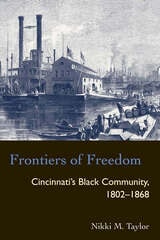
Frontiers of Freedom
Cincinnati’s Black Community 1802–1868Nikki M. Taylor
Ohio University Press, 2004
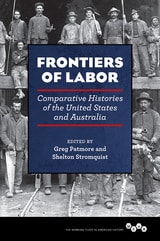
Frontiers of Labor
Comparative Histories of the United States and AustraliaEdited by Greg Patmore and Shelton Stromquist
University of Illinois Press, 2018
Greg Patmore and Shelton Stromquist curate innovative essays that use transnational and comparative analysis to explore the two nations’ differences. The contributors examine five major areas: World War I’s impact on labor and socialist movements; the history of coerced labor; patterns of ethnic and class identification; forms of working-class collective action; and the struggles related to trade union democracy and independent working-class politics. Throughout, many essays highlight how hard-won transnational ties allowed Australians and Americans to influence each other’s trade union and political cultures.
Contributors: Robin Archer, Nikola Balnave, James R. Barrett, Bradley Bowden, Verity Burgmann, Robert Cherny, Peter Clayworth, Tom Goyens, Dianne Hall, Benjamin Huf, Jennie Jeppesen, Marjorie A. Jerrard, Jeffrey A. Johnson, Diane Kirkby, Elizabeth Malcolm, Patrick O’Leary, Greg Patmore, Scott Stephenson, Peta Stevenson-Clarke, Shelton Stromquist, and Nathan Wise

Frontiers of Screen History
Imagining European Borders in Cinema, 1945-2010Edited by Raita Merivirta, Kimmo Ahonen, Heta Mulari, and Rami Mähkä
Intellect Books, 2013
Marriage Migration in Asia
Emerging Minorities at the Frontiers of Nation-StatesEdited by Sari K. Ishii
National University of Singapore Press, 2016

Oscillator Circuits
Frontiers in design, analysis and applicationsYoshifumi Nishio
The Institution of Engineering and Technology, 2017
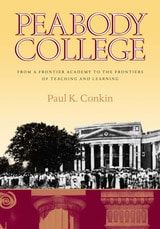
Peabody College
From a Frontier Academy to the Frontiers of Teaching and LearningPaul K. Conkin
Vanderbilt University Press, 2002
It all began as a small frontier academy in 1785. The institution that would become Peabody experienced its first reinvention two decades later as it became Cumberland College, and then, in 1826, the University of Nashville. The University maintained an elite undergraduate college until 1850, and, despite the success of its medical school and a military institute, it failed in three subsequent efforts to restart its undergraduate program.
In 1875 the University offered its campus and degree-granting authority to the first normal school in the state of Tennessee, a school funded by the Peabody Education Fund. The Peabody Normal College was the best in the South, and, as such, exerted an enormous influence on education in the region.
A new era began in 1909. The trustees of the Peabody Fund, at its liquidation, provided an eventual $1.5 million to establish a graduate-level George Peabody College for Teachers. It opened for classes in 1914, on its present campus, where it quickly became the premier teachers' college in the South. As was the case with many private, independent institutions, Peabody faced intermittent financial struggles, which finally ended with its union with Vanderbilt. Today Peabody is, by almost any criteria, one of the five or six strongest colleges of education in the United States.
Politics, Policy, and Organizations
Frontiers in the Scientific Study of BureaucracyGeorge A. Krause & Kenneth J. Meier, Editors
University of Michigan Press, 2003
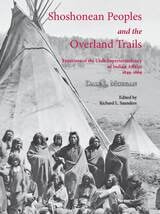
Shoshonean Peoples and the Overland Trail
Frontiers of the Utah Superintendency of Indian Affairs, 1849–1869Richard Saunders
Utah State University Press, 2007
This compilation of Dale Morgan’s historical work on Indians in the Intermountain West focuses primarily on the Shoshone who lived near the Oregon and California trails. Three connected works by Morgan are included: First is his classic article on the history of the Utah Superintendency of Indian Affairs. This is followed by an important set of government reports and correspondence from the National Archives concerning the Eastern Shoshone and their leader Washakie. Morgan heavily annotated these for serial publication in the Annals of Wyoming. He also wrote a previously unpublished history of early relations among the Western Shoshone, emigrants, and the government along the California Trail. Morgan biographer Richard L. Saunders introduced, edited, and further annotated this collection. His introduction includes an intellectual biography of Morgan that focuses on the place of the anthologized pieces in Morgan’s corpus. Gregory E. Smoak, a leading historian of the Shoshone, contributed an ethnohistorical essay as additional context for Morgan’s work.

The Chosen Folks
Jews on the Frontiers of TexasBy Bryan Edward Stone
University of Texas Press, 2010
Texas has one of the largest Jewish populations in the South and West, comprising an often-overlooked vestige of the Diaspora. The Chosen Folks brings this rich aspect of the past to light, going beyond single biographies and photographic histories to explore the full evolution of the Jewish experience in Texas.
Drawing on previously unpublished archival materials and synthesizing earlier research, Bryan Edward Stone begins with the crypto-Jews who fled the Spanish Inquisition in the late sixteenth century and then discusses the unique Texas-Jewish communities that flourished far from the acknowledged centers of Jewish history and culture. The effects of this peripheral identity are explored in depth, from the days when geographic distance created physical divides to the redefinitions of "frontier" that marked the twentieth century. The rise of the Ku Klux Klan, the creation of Israel in the wake of the Holocaust, and the civil rights movement are covered as well, raising provocative questions about the attributes that enabled Texas Jews to forge a distinctive identity on the national and world stage. Brimming with memorable narratives, The Chosen Folks brings to life a cast of vibrant pioneers.

The Frontiers of Women's Writing
Women's Narratives and the Rhetoric of Westward ExpansionBrigitte Georgi-Findlay
University of Arizona Press, 1996
Brigitte Georgi-Findlay presents a range of writings that reflects the diversity of the western experience. Beginning with the narratives of Caroline Kirkland and other women of the early frontier, she reviews the diaries of the overland trails; letters and journals of the wives of army officers during the Indian wars; professional writings, focusing largely on travel, by women such as Caroline Leighton from the regional publishing cultures that emerged in the Far West during the last quarter of the century; and late-nineteenth- and early-twentieth-century accounts of missionaries and teachers on Indian reservations. Most of the writers were white, literate women who asserted their own kind of cultural authority over the lands and people they encountered. Their accounts are not only set in relation to a masculine frontier myth but also investigated for clues about their own involvement with territorial expansion. By exploring the various ways in which women writers actively contributed to and at times rejected the development of a national narrative of territorial expansion based on empire building and colonization, the author shows how their accounts are implicated in expansionist processes at the same time that they formulate positions of innocence and detachment.
Georgi-Findlay has drawn on American studies scholarship, feminist criticism, and studies of colonial discourse to examine the strategies of women's representation in writing about the West in ways that most theorists have not. She critiques generally accepted stereotypes and assumptions--both about women's writing and its difference of view in particular, and about frontier discourse and the rhetoric of westward expansion in general--as she offers a significant contribution to literary studies of the West that will challenge scholars across a wide range of disciplines.

Where Currents Meet
Frontiers of Memory in Post-Soviet Fiction of Kharkiv, UkraineTanya Zaharchenko
Central European University Press, 2016
Where Currents Meet, Tanya Zaharchenko’s path-breaking study of literature and cultural memory, moves decisively beyond the simplistic view of a post-Soviet Ukraine divided between east and west. It positions the Ukrainian and Russian components of cultural experience in the country’s east as elements of a complex continuum. Combining insights from memory studies and border studies, Zaharchenko analyzes a generation of younger riters in the city of Kharkiv—a “doubletake generation” that came of age at the time of the Soviet Union’s collapse and now revisits this experience through fiction. In the works of Serhiy Zhadan, Andreĭ Krasniashchikh, Yuri Tsaplin, Oleh Kotsarev, and others the author reveals how borderlands and frontiers, both geographical and conceptual, acquire zonal qualities of their own as these writers navigate the historical legacy they have inherited.