Results by title
12 books match the query 'Gun control'

Guns in Law
Austin Sarat
University of Massachusetts Press, 2019
Weapons have been a source of political and legal debate for centuries. Aristotle considered the possession of arms a fundamental source of political power and wrote that tyrants “mistrust the people and deprive them of their arms.” Today ownership of weapons—whether handguns or military-grade assault weapons—poses more acute legal problems than ever before. In this volume, the editors' introduction traces the history of gun control in the United States, arguing that until the 1980s courts upheld reasonable gun control measures. The contributors confront urgent questions, among them the usefulness of history as a guide in ongoing struggles over gun regulation, the changing meaning of the Second Amendment, the perspective of law enforcement on guns and gun control law, and individual and relational perspectives on gun rights.
The contributors include the editors and Carl T. Bogus, Jennifer Carlson, Saul Cornell, Darrell A.H. Miller, Laura Beth Nielsen, and Katherine Shaw.

Guns, Democracy, and the Insurrectionist Idea
Joshua Horwitz and Casey Anderson
University of Michigan Press, 2009
---Saul Cornell, Ohio State University

Language of the Gun
Youth, Crime, and Public PolicyBernard E. Harcourt
University of Chicago Press, 2006
Home to over 150 repeat offenders ranging in age from twelve to seventeen, the Catalina Mountain School is made up of a particular stratum of boys—those who have committed the most offenses but will still be released upon reaching adulthood. In an effort to understand the symbolic and emotional language of guns and gun carrying, Harcourt interviewed dozens of these incarcerated Catalina boys. What do these youths see in guns? What draws them to handguns? Why do some of them carry and others not? For Harcourt, their often surprising answers unveil many of the presuppositions that influence our laws and policies.

Murder Town, USA
Homicide, Structural Violence, and Activism in WilmingtonYasser Arafat Payne
Rutgers University Press, 2023
Far too many poor Black communities struggle with gun violence and homicide. The result has been the unnatural contortion of Black families and the inter-generational perpetuation of social chaos and untimely death. Young people are repeatedly ripped away from life by violence, while many men are locked away in prisons. In neighborhoods like those of Wilmington, Delaware, residents routinely face the pressures of violence, death, and incarceration. Murder Town, USA is thus a timely ethnography with an innovative structure: the authors helped organize fifteen residents formerly involved with the streets and/or the criminal justice system to document the relationship between structural opportunity and experiences with violence in Wilmington's Eastside and Southbridge neighborhoods.
Earlier scholars offered rich cultural analysis of violence in low-income Black communities, and yet this literature has mostly conceptualized violence through frameworks of personal responsibility or individual accountability. And even if acknowledging the pressure of structural inequality, most earlier researchers describe violence as the ultimate result of some moral failing, a propensity for crime, and the notion of helplessness. Instead, in Murder Town USA, Payne, Hitchens, and Chamber, along with their collaborative team of street ethnographers, instead offer a radical re-conceptualization of violence in low-income Black communities by describing the penchant for violence and involvement in crime overall to be a logical, "resilient" response to the perverse context of structural inequality.

On Interpretive Conflict
John Frow
University of Chicago Press, 2019
On Interpretive Conflict delves into four case studies where sharply different sets of values come into play—gun control, anti-Semitism, the religious force of images, and climate change. In each case, Frow lays out the way these controversies unfold within interpretive regimes that establish what counts as an interpretable object and the protocols of evidence and proof that should govern it. Whether applied to a Shakespeare play or a Supreme Court case, interpretation, he argues, is at once rule-governed and inherently conflictual. Ambitious and provocative, On Interpretive Conflict will attract readers from across the humanities and beyond.
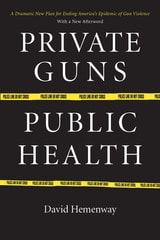
Private Guns, Public Health
David Hemenway
University of Michigan Press, 2004
-Richard F. Corlin, Past President, American Medical Association
"This lucid and penetrating study is essential reading for anyone who wishes to understand the tragedy of gun violence in America and-even more important-what we can do to stop it. David Hemenway cuts through the cant and rhetoric in a way that no fair-minded person can dismiss, and no sane society can afford to ignore."
-Richard North Patterson, novelist
"The rate of gun-related homicide, suicide, and accidental injury has reached epidemic proportions in American society. Diagnosing and treating the gun violence epidemic demands the development of public health solutions in conjunction with legislative and law enforcement strategies."
-Kweisi Mfume, President and CEO of NAACP
"In scholarly, sober analytic assessments, including rigorous critiques of NRA-popularized pseudoscience, David Hemenway constructs a convincing case that firearm availability is a critical and proximal cause of unparalleled carnage. By formulating such violence as a public health issue, he proposes workable policies analogous to ones that reduced injuries from tobacco, alcohol, and automobiles."
-Jerome P. Kassirer, Editor-in-Chief Emeritus, New England Journal of Medicine, and Distinguished Professor, Tufts University School of Medicine
"As a former District Attorney and Attorney General, I know the urgency of providing safe homes, schools and neighborhoods for all. This remarkable tour-de-force is a powerful study of one promising solution: a data-rich, eminently readable demonstration of why we should treat gun violence as an American epidemic."
-Scott Harshbarger, Former Attorney General of Massachusetts, President and CEO of Common Cause
On an average day in the United States, guns are used to kill almost eighty people, and to wound nearly three hundred more. If any other consumer product had this sort of disastrous effect, the public outcry would be deafening; yet when it comes to guns such facts are accepted as a natural consequence of supposedly high American rates of violence.
Private Guns, Public Health explodes that myth and many more, revealing the advantages of treating gun violence as a consumer safety and public health problem. David Hemenway fair-mindedly and authoritatively demonstrates how a public-health approach-which emphasizes prevention over punishment, and which has been so successful in reducing the rates of injury and death from infectious disease, car accidents, and tobacco consumption-can be applied to gun violence.
Hemenway uncovers the complex connections between guns and self-defense, gun violence and schools, gun prevalence and homicide, and more. Finally, he outlines a policy course that would significantly reduce gun-related injury and death.
With its bold new public-health approach to guns, Private Guns, Public Health marks a shift in our understanding of guns that will-finally-point us toward a solution.
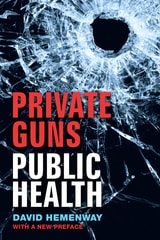
Private Guns, Public Health, New Ed.
David Hemenway
University of Michigan Press, 2017
Hemenway fair-mindedly and authoritatively outlines a policy course that would significantly reduce gun-related injury and death, pointing us toward a solution.

Rhetoric and Guns
Lydia Wilkes
Utah State University Press, 2021
Guns hold a complex place in American culture. Over 30,000 Americans die each year from gun violence, and guns are intimately connected to issues of public health, as is evident whenever a mass shooting occurs. But guns also play an important role in many Americans’ lives that is not reducible to violence and death—as tools, sporting equipment, and identity markers. They are also central to debates about constitutional rights, as seen in ongoing discussions about the Second Amendment, and they are a continuous source of legislative concern, as apparent in annual ratings of gun-supporting legislators.
Even as guns are wrapped up with other crucial areas of concern, they are also fundamentally a rhetorical concern. Guns and gun violence occupy a unique rhetorical space in the United States, one characterized by silent majorities, like most gun owners; vocal minorities, like the firearm industry and gun lobby; and a stalemate that fails to stem the flood of the dead. How Americans talk, deliberate, and fight about guns is vital to how guns are marketed, used, and regulated. A better understanding of the rhetorics of guns and gun violence can help Americans make better arguments about them in the world. However, where guns are concerned, rhetorical studies is not terribly different from American culture more generally. Guns are ever-present and exercise powerful effects, but they are commonly talked about in oblique, unsystematic ways.
Rhetoric and Guns advances more direct, systematic engagement in the field and beyond by analyzing rhetoric about guns, guns in rhetoric, and guns as rhetoric, particularly as they relate to specific instances of guns in culture. The authors attempt to understand rhetoric’s relationship to guns by analyzing rhetoric about guns and how they function in and as rhetoric related to specific instances—in media coverage, political speech, marketing, and advertising. Original chapters from scholars in rhetorical studies, communication, education, and related fields elucidate how rhetoric is used to maintain and challenge the deadly status quo of gun violence in the United States and extend rhetoricians’ sustained interest in the fields’ relationships to violence, brutality, and atrocity.
Contributors: Ira J. Allen, Brian Ballentine, Matthew Boedy, Peter Buck, Lisa Corrigan, Rosa Eberly, Kendall Gerdes, Ian E. J. Hill, Nathalie Kuriowa-Lewis, Patricia Roberts-Miller, Craig Rood, Bradley Serber, Catherine R. Squires, Scott Gage
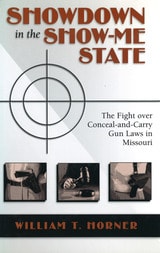
Showdown in the Show-Me State
The Fight Over Conceal-and-Carry Gun Laws in MissouriWilliam T. Horner
University of Missouri Press, 2005

Under Fire
The Nra and the Battle for Gun ControlOsha Gray Davidson
University of Iowa Press, 1998

Unforgiving Places
The Unexpected Origins of American Gun ViolenceJens Ludwig
University of Chicago Press, 2025
In 2007, economist Jens Ludwig moved to the South Side of Chicago to research two big questions: Why does gun violence happen, and is there anything we can do about it? Almost two decades later, the answers aren’t what he expected. Unforgiving Places is Ludwig’s revelatory portrait of gun violence in America’s most famously maligned city.
Disproving the popular narrative that shootings are the calculated acts of malicious or desperate people, Ludwig shows how most shootings actually grow out of a more fleeting source: interpersonal conflict, especially arguments. By examining why some arguments turn tragic while others don't, Ludwig shows gun violence to be more circumstantial—and more solvable—than our traditional approaches lead us to believe.
Drawing on decades of research and Ludwig’s immersive fieldwork in Chicago, including “countless hours spent in schools, parks, playgrounds, housing developments, courtrooms, jails, police stations, police cars, and lots and lots of McDonald'ses,” Unforgiving Places is a breakthrough work at the cutting edge of behavioral economics. As Ludwig shows, progress on gun violence doesn’t require America to solve every other social problem first; it only requires that we find ways to intervene in the places and the ten-minute windows where human behaviors predictably go haywire.
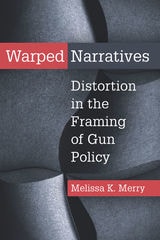
Warped Narratives
Distortion in the Framing of Gun PolicyMelissa K. Merry
University of Michigan Press, 2020
The politics of gun policy in the United States are dramatic. Against the backdrop of daily gun violence—which claims more than 33,000 lives per year—gun control groups push for stronger regulations, while gun rights groups resist infringements upon their Second Amendment rights. To illuminate the dynamics of this polarized debate, Warped Narratives examines how and why interest groups frame the gun violence problem in particular ways, exploring the implication of groups’ framing choices for policymaking and politics. Melissa K. Merry argues that the gun policy arena is warped, and that both gun control and gun rights organizations contribute to the distortion of the issue by focusing on atypical characters and settings in their policy narratives. Gun control groups emphasize white victims, child victims, and mass shootings in suburban locales, while gun rights groups focus on self-defense shootings, highlighting threats to “law-abiding” gun owners. In reality, most gun deaths are the result of suicide. Homicides occur disproportionately in urban areas, mainly affecting racial minorities. While warping makes political sense in the short term, it may lead to negative, long-term consequences, including constraints on groups’ ability to build broad-based coalitions and to reduce prospects for compromise. To demonstrate warping, Merry analyzes nearly 67,000 communications by 15 national gun policy groups between 2000 and 2017 collected from blogs, emails, Facebook posts, and press releases. This book is the first to systematically assess the role of race in gun policy groups’ framing and offers the most comprehensive examination to date of interest groups’ presentation of this issue.