Results by title
32 books match the query 'Hebrew language'
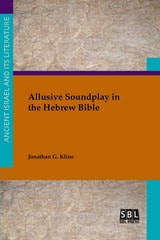
Allusive Soundplay in the Hebrew Bible
Jonathan G. Kline
SBL Press, 2016
The first study to focus exclusively on the use in the Hebrew Bible of soundplay to allude to and interpret earlier literary traditions
This book focuses on the way the biblical writers used allusive soundplay to construct theological discourse, that is, in service of their efforts to describe the nature of God and God's relationship to humanity. By showing that a variety of biblical books contain examples of allusive soundplay employed for this purpose, Kline demonstrates that this literary device played an important role in the growth of the biblical text as a whole and in the development of ancient Israelite and early Jewish theological traditions.
Features:- Demonstrates that allusive soundplay was a productive compositional technique in ancient Israel
- Identifies examples of innerbiblical allusion that have not been identified before
- A robust methodology for identifying soundplay in innerbiblical allusions
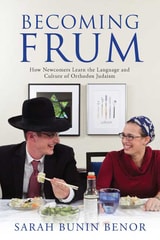
Becoming Frum
How Newcomers Learn the Language and Culture of Orthodox JudaismSarah Bunin Benor
Rutgers University Press, 2012
Winner, 2013 Sami Rohr Choice Award for Jewish Literature
When non-Orthodox Jews become frum (religious), they encounter much more than dietary laws and Sabbath prohibitions. They find themselves in the midst of a whole new culture, involving matchmakers, homemade gefilte fish, and Yiddish-influenced grammar. Becoming Frum explains how these newcomers learn Orthodox language and culture through their interactions with community veterans and other newcomers. Some take on as much as they can as quickly as they can, going beyond the norms of those raised in the community. Others maintain aspects of their pre-Orthodox selves, yielding unique combinations, like Matisyahu’s reggae music or Hebrew words and sing-song intonation used with American slang, as in “mamish (really) keepin’ it real.”
Sarah Bunin Benor brings insight into the phenomenon of adopting a new identity based on ethnographic and sociolinguistic research among men and women in an American Orthodox community. Her analysis is applicable to other situations of adult language socialization, such as students learning medical jargon or Canadians moving to Australia. Becoming Frum offers a scholarly and accessible look at the linguistic and cultural process of “becoming.”
Brandeis Modern Hebrew
Vardit Ringvald, Bonit Porath, Yaron Peleg, Esther Shorr, and Sara Hascal
Brandeis University Press, 2015
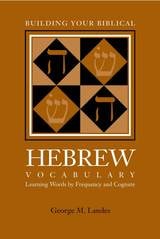
Building Your Biblical Hebrew Vocabulary
Learning Words by Frequency and CognateGeorge M. Landes
SBL Press, 2001
A classic resource for beginning Hebrew students
First published over thirty years ago under the title A Student's Vocabulary of Biblical Hebrew, this classic work has been completely revised, updated, and expanded by the author to assist a new generation of students in naturally developing a basic Biblical Hebrew vocabulary. Designed to help beginning Hebrew readers acquire vocabulary quickly, this valuable teaching tool focuses on words that occur most frequently in the Hebrew Bible, while arranging them by roots and cognates allowing students to naturally expand their working vocabulary. Vocabulary lists have been kept to a manageable size; extensive cross-references document when words appear frequently with different meanings, and an index allows rapid location of every word encountered. As a result, students who master this volume will remember words more easily, consult a lexicon less frequently but more intelligently, and translate the Hebrew Bible at sight more readily and enjoyably.
Features
- Vocabulary groupings based on frequency, roots, and cognates
- Separate listing for nouns without verbal roots in the Hebrew Bible
- Appendices including proper names and the forms and meanings of pronominal suffixes
Encounters in Modern Hebrew
Level 1Edna Amir Coffin
University of Michigan Press, 1992
Encounters in Modern Hebrew
Level 2Edna Amir Coffin
University of Michigan Press, 1993
Encounters in Modern Hebrew
Level 3Edna Amir Coffin
University of Michigan Press, 1997
This volume shows students a wider range of Hebrew-speaking cultural activities in a larger human context, from materials about holidays, including a Jewish holiday celebrated only in North Africa, to discussions of the roles of women that raise the issue of gender equality. Other chapters examine ethnic jokes and their problematic qualities, geography, and the differences between popular and literary language registers. Encounters in Modern Hebrew, Level 3 ushers the Hebrew student through a wide domain of the human community.
Faithful Renderings
Jewish-Christian Difference and the Politics of TranslationNaomi Seidman
University of Chicago Press, 2006
Bringing together central issues in translation studies with episodes in Jewish–Christian history, Naomi Seidman considers a range of texts, from the Bible to Elie Wiesel’s Night, delving into such controversies as the accuracy of various Bible translations, the medieval use of converts from Judaism to Christianity as translators, the censorship of anti-Christian references in Jewish texts, and the translation of Holocaust testimony. Faithful Renderings ultimately reveals that translation is not a marginal phenomenon but rather a crucial issue for understanding the relations between Jews and Christians and indeed the development of each religious community.
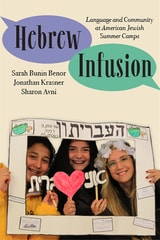
Hebrew Infusion
Language and Community at American Jewish Summer CampsSarah Bunin Benor, Jonathan B. Krasner, and Sharon Avni
Rutgers University Press, 2019
Each summer, tens of thousands of American Jews attend residential camps, where they may see Hebrew signs, sing and dance to Hebrew songs, and hear a camp-specific hybrid language register called Camp Hebraized English, as in: “Let’s hear some ruach (spirit) in this chadar ochel (dining hall)!” Using historical and sociolinguistic methods, this book explains how camp directors and staff came to infuse Hebrew in creative ways and how their rationales and practices have evolved from the early 20th century to today. Some Jewish leaders worry that Camp Hebraized English impedes Hebrew acquisition, while others recognize its power to strengthen campers’ bonds with Israel, Judaism, and the Jewish people. Hebrew Infusion explores these conflicting ideologies, showing how hybrid language can serve a formative role in fostering religious, diasporic communities. The insightful analysis and engaging descriptions of camp life will appeal to anyone interested in language, education, or American Jewish culture.
Hebrew for Biblical Interpretation
Arthur W. Walker-Jones
SBL Press, 2003
Historical Linguistics and Biblical Hebrew
Steps Toward an Integrated ApproachRobert Rezetko
SBL Press, 2014
A philologically robust approach to the history of ancient Hebrew
In this book the authors work toward constructing an approach to the history of ancient Hebrew that overcomes the chasm of academic specialization. The authors illustrate how cross-textual variable analysis and variation analysis advance research on Biblical Hebrew and correct theories based on extra-linguistic assumptions, intuitions, and ideologies by focusing on variation of forms/uses in the Masoretic text and variation between the Masoretic text and other textual traditions.
Features:
- A unique approach that examines the nature of the sources and the description of their language together
- Extensive bibliography for further research
- Tables of linguistic variables and parallels
Intermediate Biblical Hebrew Grammar
A Student's Guide to Phonology and MorphologyEric D. Reymond
SBL Press, 2018
A unique grammar for intermediate or advanced students of Hebrew
This grammar is intended for students of Hebrew who wish to learn more about the history of the Hebrew language, specifically its phonology and morphology. Reymond focuses on aspects of Hebrew that will encourage a student to better remember the words and their inflection as well as those that will reinforce general principles of the language. Specific examples for memorization are outlined at the end of each chapter. The book also serves as a resource for students wishing to remind themselves of the relative frequency of certain phenomena. The book provides students with a full picture of the language's morphology.
Features:
- Tables of nouns and adjectives illustrating the absolute and construct, singular and plural forms, as well as all the forms with suffixes
- Tables include forms not found in the Masoretic Text
- Additional tables that set similar verbal inflections side by side
Jewish Rhetorics
History, Theory, PracticeEdited by Michael Bernard-Donals and Janice W. Fernheimer
Brandeis University Press, 2014
Judaism
The Genealogy of a Modern NotionBoyarin, Daniel
Rutgers University Press, 2019
Land and Desire in Early Zionism
Boaz Neumann
Brandeis University Press, 2011
Lessons in Modern Hebrew
Level 1Edna Amir Coffin
University of Michigan Press, 1977
Lessons in Modern Hebrew
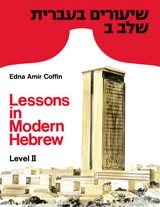
Level 2Edna Amir Coffin
University of Michigan Press, 1978
A comprehensive introduction to modern Israeli Hebrew, Lessons in Modern Hebrew: Level I and Level II provide English-speaking students and well-motivated individuals with all the basic classroom tools necessary for mastery of the language. The lessons introduce the student to the core vocabulary which is then included in reading passages, conversational text, and written communication. All grammatical features of modern Hebrew are thoroughly explained and reinforced by drills and exercises. The books have been classroom-tested at the University of Michigan. Both audio-lingual and cognitive approaches are used.
Cassettes are available from the University of Michigan Language Resource Center: Phone: (734) 764-0424; Email: lrc.contact@umich.edu.
Mishkan T'filah World Union Edition
Elyse D. Frishman
Central Conference of American Rabbis, 2010
Mishkan T'filah for the House of Mourning
A Reform SiddurRabbi Elaine S. Zecher and Rabbi Hara E. Person
Central Conference of American Rabbis, 2010
Mishkan T'filah
A Reform Siddur, transliterated (Shabbat, Weekdays, Festivals): A Reform SiddurRabbi Elyse D. Frishman
Central Conference of American Rabbis, 2007
Includes services for Shabbat, weekdays, and festivals, as well as other occasions of public worship and texts for more than a hundred songs. Mishkan T'filah reflects the full diversity of our Movement.
This Siddur includes:
- Broad selection of readings, including beloved passages from our Reform liturgical tradition and great poetic writings from throughout Jewish history
- Faithful, elegant translations
- Contemporary, gender-inclusive English
- Theological and stylistic diversity
- Full transliteration
- Extensive commentaries, source notes and usage guides
- More than 100 contemporary and traditional song texts
- Innovative design in two-page spreads (additional Shabbat services in linear style also included)
- Two-color printing to enhance usability
Mishkan T'filah
Gift EditionElyse D. Frishman
Central Conference of American Rabbis, 2007
Mishkan T'filah
Journal Edition: A Reform SiddurRabbi Joel Abraham and Michelle Shapiro Abraham
Central Conference of American Rabbis, 2010
Note: Page numbers in this special edition are meant to be consistent with the page numbering of the standard, complete edition of Mishkan T'filah. However, because the Journal Edition does not contain some of the material from the complete edition, there are several jumps in page numbering in this edition.
Modern Hebrew for Beginners
A Multimedia Program for Students at the Beginning and Intermediate LevelsBy Esther Raizen
University of Texas Press, 2016
Modern Hebrew for Beginners—which is now revised and updated—and Modern Hebrew for Intermediate Students are the core of a multimedia program for the college-level Hebrew classroom developed at the University of Texas at Austin in the early 2000s. Within an intensive framework of instruction that assumes six weekly hours in the classroom, the program provides for two semesters of instruction, at the end of which most successful students will reach the intermediate-mid or intermediate-high levels of proficiency in speaking and reading, and some will reach advanced-low proficiency, as defined by the American Council on the Teaching of Foreign Languages (ACTFL).
In addition to a variety of written exercises, the workbook includes vocabulary lists, reading selections, discussions of cultural topics, illustrations of grammar points, notes on registers, suggestions for class and individual activities, and glossaries. The workbook is complemented by a website (http://www.laits.utexas.edu/hebrew) that provides short video segments originally scripted and filmed in Israel and the United States, vocabulary flashcards with sound, interactive exercises on topics included in the workbook, sound files parallel to the reading selections in the workbook, and additional materials that enhance the learning experience. The stability of the workbook, combined with the dynamic nature of the website and the internet searches the students are directed to conduct, allows language instructors to reshape the curriculum and adapt it to the needs of their students and the goals of their programs.
Modern Hebrew for Intermediate Students
A Multimedia ProgramBy Esther Raizen
University of Texas Press, 2016
Modern Hebrew for Intermediate Students—which is now revised and updated—and Modern Hebrew for Beginners are the core of a multimedia program for the college-level Hebrew classroom developed at the University of Texas at Austin in the early 2000s. Within an intensive framework of instruction that assumes six weekly hours in the classroom, the program provides for two semesters of instruction, at the end of which most successful students will reach the intermediate-mid or intermediate-high levels of proficiency in speaking and reading, and some will reach advanced-low proficiency, as defined by the American Council on the Teaching of Foreign Languages (ACTFL).
In addition to a variety of written exercises, the workbook includes vocabulary lists, reading selections, discussions of cultural topics, illustrations of grammar points, notes on registers, suggestions for class and individual activities, and glossaries. The workbook is complemented by a website (http://www.laits.utexas.edu/hebrew) that provides short video segments originally scripted and filmed in Israel and the United States, vocabulary flashcards with sound, interactive exercises on topics included in the workbook, sound files parallel to the reading selections in the workbook, and additional materials that enhance the learning experience. The stability of the workbook, combined with the dynamic nature of the website and the internet searches the students are directed to conduct, allows language instructors to reshape the curriculum and adapt it to the needs of their students and the goals of their programs.
Qumran Hebrew
An Overview of Orthography, Phonology, and MorphologyEric D. Reymond
SBL Press, 2014
A unique study of the Hebrew of the Dead Sea Scrolls
In Qumran Hebrew, Reymond examines the orthography, phonology, and morphology of the Dead Sea Scrolls. Short sections treat specific linguistic phenomena and present a synopsis and critique of previous research. Reymond’s approach emphasizes problems posed by scribal errors and argues that guttural letters had not all “weakened” but instead were “weak” in specific linguistic environments, texts, or dialects. Reymond illustrates that certain phonetic shifts (such as the shift of yodh > aleph and the opposite shift of aleph > yodh) occur in discernible linguistic contexts that suggest this was a real phonetic phenomenon.
Features:
- Summary and critique of previous research
- Discussion of the most recently published scrolls
- Examination of scribal errors, guttural letters, and phonetic shifts
Scribal Memory and Word Selection
Text Criticism of the Hebrew BibleRaymond F. Person Jr.
SBL Press, 2023
What were ancient scribes doing when they copied a manuscript of a literary work? This question is especially problematic when we realize that ancient scribes preserved different versions of the same literary texts. In Scribal Memory and Word Selection: Text Criticism of the Hebrew Bible, Raymond F. Person Jr. draws from studies of how words are selected in everyday conversation to illustrate that the same word-selection mechanisms were at work in scribal memory. Using examples from manuscripts of the Hebrew Bible, Person provides new ways of understanding the cognitive-linguistic mechanisms at work during the composition/transmission of texts. Person reveals that, while our modern perspective may consider textual variants to be different literary texts, from the perspective of the ancient scribes and their audiences, these variants could still be understood as the same literary text.
Sifrut al Ketzeh Halashon
Intermediate Hebrew TextbookEdna Genossar Grad
Northwestern University Press, 1992

Textbook of Israeli Hebrew
Haiim B. Rosén
University of Chicago Press, 1976
The work is organized into sections that can be worked through in an academic year—presentation of features, text samples, exercises, grammatical synopses, and individual and comprehensive glossaries. This text may be used by teachers without specialized training in linguistics. It can be used by self-teaching students as well as by those at college level, and it will valuable for immigrants to Israel.
The Invention of Hebrew
Seth L. Sanders
University of Illinois Press, 2011
Seth L. Sanders connects the Bible's distinctive linguistic form--writing down a local spoken language--to a cultural desire to speak directly to people, summoning them to join a new community that the text itself helped call into being. Addressing the people of Israel through a vernacular literature, Hebrew texts reimagined their audience as a public. By comparing Biblical documents with related ancient texts in Hebrew, Ugaritic, and Babylonian, this book shows Hebrew's distinctiveness as a self-conscious political language. Illuminating the enduring stakes of Biblical writing, Sanders demonstrates how Hebrew assumed and promoted a source of power previously unknown in written literature: "the people" as the protagonist of religion and politics.
The Old Greek of Isaiah
An Analysis of Its Pluses and MinusesMirjam van der Vorm-Croughs
SBL Press, 2014
A concise study of a large number of examples of pluses and minus providing insight into translation from Hebrew to Greek
Van der Vorm-Croughs focuses this translation study on the processes leading to pluses and minuses including linguistic and stylistic aspects (i.e., cases in which elements have been added or omitted for the sake of a proper use of the Greek language), literary aspects (additions and omissions meant to embellish the Greek text), translation technical aspects (e.g., the avoidance of redundancy), and contextual and intertextual exegesis and harmonization. This work also covers the relation between the Greek Isaiah and its possible Hebrew Vorlage to try to determine which pluses and minuses may have been the result of the translator’s use of a different Hebrew text.
Features:
- Eleven categories for the pluses and minuses of the Greek Isaiah
- Examination of translation techniques and translator errors
- Use of Joseph Ziegler’s critical edition
The Subversion of the Apocalypses in the Book of Jubilees
Todd R. Hanneken
SBL Press, 2012
These Words
Poetic Midrash on the Language of TorahAlden Solovy
Central Conference of American Rabbis, 2023
In These Words, liturgist Alden Solovy distills the Torah into its very essence: the individual words it contains. Echoing the midrash that the Torah has seventy faces, Solovy selects seventy of its Hebrew words that are pregnant with meaning. For each word, he delves into the etymology, translation, and usage, providing deeper insights into familiar texts. Then Solovy presents a beautiful poem—what he calls “poetic midrash”—inspired by and interpreting each word. From b’reishit (“in beginning”) to shamayim (“heavens”) to zachor (“remember”), These Words will change the way you look at the language of the Torah.