Results by title
6 books match the query 'His Time'
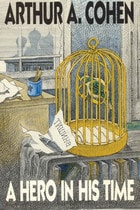
A Hero in His Time
Arthur A. Cohen
University of Chicago Press, 1987
"Cohen has achieved here a tour de force, bringing the idea of poetry to life in a messy little man, no hero at all, not even that much of a poet. . . . [The novel] is stately as well as funny, an authentically noble account of a celebrant. . . . It is the true article."—Geoffrey Wolff, New York Times Book Review
"Arthur Cohen catches fire. . . . A Hero in His Time represents for him a great imaginative leap, for we are shown the interior mental landscape of a middle-aged Russian-Jewish minor poet and . . . most astonishing is that we believe, without question, in this poet."—Doris Grumbach, Village Voice
"A tremendous achievement. . . . To have made this tremendous imaginative leap from the heart of American Jewishness to the heart of Russian Jewishness was a daring thing to do, and it has been accomplished with absolute conviction."—The Sunday Times (London)
"A rich compound of high seriousness and robust comedy."—Newsweek

Duffy Daugherty
A Man Ahead of His TimeDavid Claerbaut
Michigan State University Press, 2018
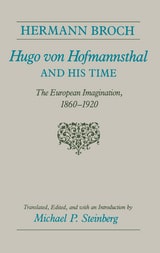
Hugo von Hofmannsthal and His Time
The European Imagination, 1860-1920Hermann Broch
University of Chicago Press, 1984
Through an analysis of the changing thought and career of the Austrian poet, librettist, and essaist Hugo von Hofmannsthal (1874-1929), Broch attempts to define and analyze the major intellectual issues of the European fin de siècle, a period that he characterizes according to the Nietzschean concepts of the breakdown of rationality and the loss of a central value system. The result is a major examination of European thought as well as a comparative study of political systems and artistic styles.
Moses Maimonides and His Time
Eric L. Ormsby
Catholic University of America Press, 2018

Shakespearean Pragmatism
Market of His TimeLars Engle
University of Chicago Press, 1993
To Engle, the problems of worth, price, and value that appear so frequently in Shakespeare's works reveal a playwright dramatizing the negotiable nature of perception and belief—in short, the nature of his audience's purchase on reality. This innovative argument is the first to view Shakespeare in the context of contemporary pragmatism and to show that Shakespeare in many ways anticipated pragmatism as it has been developed in the thought of Richard Rorty, Barbara Herrnstein Smith, and others. With detailed reference to the sonnets and plays, Engle explores Shakespeare's tendency to treat knowledge, truth, and certainty as relatively stable goods within a theatrical economy of social interaction. He shows the playwright recasting kingship, aristocracy, and poetic immortality in pragmatic terms.
As attentive to history as it is to contemporary theory, this book mediates between current and traditional accounts of Shakespeare. In doing so, it offers a sweeping new account of Shakespeare's enterprise that will interest philosophers, literary theorists, and Shakespeare scholars alike.

Thomas Hobbes in His Time
Ralph Ross, Herbert W. Schneider, and Theodore Waldman, Editors
University of Minnesota Press, 1975
Thomas Hobbes in His Time was first published in 1975. Minnesota Archive Editions uses digital technology to make long-unavailable books once again accessible, and are published unaltered from the original University of Minnesota Press editions.
Thomas Hobbes, the seventeenth-century English philosopher, is the subject of lively discussion among philosophers, historians, and political theorists today. Both as a participant in a revolutionary commonwealth and as a student of the science of human nature, Hobbes has achieved a new relevance to contemporary society. As the editors of this volume point out, moralists are apt to place him in the twentieth century, and historians are apt to portray him as an antique. The aim of these essays is to get an accurate account of how radical Hobbes was in his own revolutionary century.
The essays are the fruit of years of cooperative study, going back to John Dewey's calling attention to Hobbe's interest in transforming the courts of common law into courts of equity. The recent discovery of more manuscripts and the publication of better editions of his writings have stimulated an extensive reinterpretation of Hobbe's ideas and goals.
Even in his own time, Hobbes was subject to attacks from many sides. Although scholars now generally reject the stereotype of "Hobbism" which grew during four centuries of revolutionary developments, new stereotypes to describe his philosophy have emerged. By assessing Hobbes in terms of his own day, the book will serve to counteract much contemporary misunderstanding.
The essays cover four aspects of Hobbe's thought: his political theory, his views on religion, his moral philosophy, and his theory of motion and philosophical method. With the exception of John Dewey's "The Motivation of Hobbes's Political Philosophy," all the essays were written especially for this book. The other essays and authors are "The Anglican Theory of Salvation in Hobbes" by Paul Johnson, San Bernardino State College; "Some Puzzles in Hobbes" by Ralph Ross, Scripps College, The Claremont Colleges; "The Piety of Hobbes" by Herbert W. Schneider, emeritus professor of Columbia University and Claremont Graduate School, The Claremont Colleges; "The Generation of the Public Person" by Theodore Waldman, Harvey Mudd College, The Claremont Colleges; and "The Philosophia Prima of Thomas Hobbes" by Craig Walton, University of Nevada.