Results by title
21 books match the query 'Homeless persons'
An American (Homeless) in Paris
Chris Ames
University of Utah Press, 2017
Ames circles serious questions, rarely losing a sense of irony, bewilderment, or amusement, especially at his circumstances, with their inherent discomforts, risks, and not-so-reassuring self-revelation. As readers see him stumble into renewed social bonds, his skewed searching and unconventional existence will engage and sometimes befuddle them.
“I’m not saying become homeless, but do understand it opens many doors, and helps us appreciate the doors we can close.”—from the introduction
Winner of the Nonfiction Award in the Utah Division of Arts and Museums Original Writing Competition
Interview with Tom Williams at Access Utah
Becoming Somebody Else
Blackouts, Addiction, and Agency amongst London's HomelessJoshua Burraway
HAU, 2025
What does it mean to exist outside the normative temporality of life, of housed living, and, ultimately, of selfhood? Becoming Somebody Else takes up this question, offering a window into the fragmented and chaotic lives of people experiencing homelessness in urban London as they drink and drug themselves into blackout in post-austerity Britain. A state of being where time, body, agency, and self collapse into a memoryless abyss, the blackout is a prism into how human beings make and unmake their selfhood in the wake of social suffering and personal trauma. Attending to the words and histories of several individuals, Joshua Burraway knits together structural, psychological, and phenomenological approaches to understand the ways in which memory, agency, and selfhood are sites of struggle and belonging, and in doing so, suggests new ways of thinking about addiction, homelessness, and therapeutic possibility.

Cinco Becknell
LEE MAYNARD
West Virginia University Press, 2015
Cinco Becknell is the story of a homeless man with no memory. Locked in the emptiness of his mind is a secret, a past, which will either keep him alive or get him killed.
As Cinco staggers through a dangerous journey of rediscovery, he is hunted by psychopaths who want to kill him, and he has no idea why; he is shadowed by a woman who may keep him alive—or not; and he is finally helped by another woman who can bring back to him the light he looks for—if he can stay alive. But he is running out of time, and people around him are dying, always violently.
Gradually, he begins to understand the true, brutal, nature of himself and of the darkness of his past. But it is a past, and a present, that he may never fully understand.
This novel, based on generations of violent, local family history, is set in the underbelly of the pseudo-glitzy streets of Santa Fe, New Mexico.
Derelict Paradise
Homelessness and Urban Development in Cleveland, OhioDaniel R. Kerr
University of Massachusetts Press, 2011
Seeking answers to the question, “Who benefits from homelessness?” this book takes the reader on a sweeping tour of Cleveland's history from the late nineteenth-century through the early twenty-first. Daniel Kerr shows that homelessness has deep roots in the shifting ground of urban labor markets, social policy, downtown development, the criminal justice system, and corporate power. Rather than being attributable to the illnesses and inadequacies of the unhoused themselves, it is a product of both structural and political dynamics shaping the city. Kerr locates the origins of today's shelter system in the era that followed the massive railroad rebellions of 1877. From that period through the Great Depression, business and political leaders sought to transform downtown Cleveland to their own advantage. As they focused on bringing business travelers and tourists to the city and beckoned upper-income residents to return to its center, they demolished two downtown working-class neighborhoods and institutionalized a shelter system to contain and control the unhoused and unemployed. The precedents from this period informed the strategies of the post–World War II urban renewal era as the "new urbanism" of the late twentieth century. The efforts of the city's elites have not gone uncontested. Kerr documents a rich history of opposition by people at the margins of whose organized resistance and everyday survival strategies have undermined the grand plans crafted by the powerful and transformed the institutions designed to constrain the lives of the homeless.
Down and Out in Los Angeles and Berlin
The Sociospatial Exclusion of Homeless PeopleJurgen von Mahs
Temple University Press, 2015
Drawing on fascinating ethnographic insights, von Mahs shows how homeless people in both cities face sociospatial exclusion-legal displacement for criminal activities, poor shelters in impoverished neighborhoods, as well as market barriers that restrict reintegration. Providing a necessary wake-up call, Down and Out in Los Angeles and Berlin addresses the critical public policy issues that can produce effective services to improve homeless people's chances for a lasting exit.
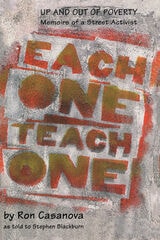
Each One Teach One
Up and Out of Poverty, Memoirs of a Street ActivistRon Casanova and Stephen Blackburn
Northwestern University Press, 2010
Underlying Each One Teach One, with its vivid cast of characters and intimate descriptions of Harlem and other urban areas, is the profound sense that no matter what your circumstance, you can use your past experience to help others. Ultimately, Casanova's story is a message of hope for the future and for the possibility of self-sufficiency and self-empowerment for each individual.
For a Liberatory Politics of Home
Michele Lancione
Duke University Press, 2023

Homeless Families
THE STRUGGLE FOR DIGNITYBarry Jay Seltser and Donald E. Miller
University of Illinois Press, 1993
Homeless In Paradise
A Map of the TerrainRobert Rosenthal
Temple University Press, 1993
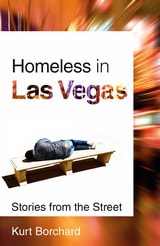
Homeless in Las Vegas
Stories from the StreetKurt Borchard
University of Nevada Press, 2011
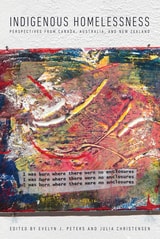
Indigenous Homelessness
Perspectives from Canada, Australia, and New ZealandEvelyn J. Peters
University of Manitoba Press, 2016

Nomads of a Desert City
Personal Stories from Citizens of the StreetBarbara Seyda
University of Arizona Press, 2001
You see them as faceless shapes on the median or in city parks. You recognize them by their cardboard signs, their bags of aluminum cans, or their weathered skin. But you do not know them.
In Nomads of a Desert City Barbara Seyda meets the gazes of our homeless neighbors and, with an open heart and the eye of an accomplished photographer, uncovers their compelling stories of life on the edge.
Byrdy is a teenager from Alaska who left a violent husband and misses the young daughter her mother now cares for. Her eyes show a wisdom that belies her youth. Samuel is 95 and collects cans for cash. His face shows a lifetime of living outside while his eyes hint at the countless stories he could tell. Lamanda worked as an accountant before an act of desperation landed her in prison. Now she struggles to raise the seven children of a woman she met there. Dorothy—whose earliest memories are of physical and sexual abuse—lives in a shelter, paycheck to paycheck, reciting affirmations so she may continue “to grace the world with my presence.”
They live on the streets or in shelters. They are women and men, young and old, Native or Anglo or Black or Hispanic. Their faces reflect the forces that have shaped their lives: alcoholism, poverty, racism, mental illness, and abuse. But like desert survivors, they draw strength from some hidden reservoir.
Few recent studies on homelessness offer such a revealing collection of oral history narratives and compelling portraits. Thirteen homeless women and men open a rare window to enrich our understanding of the complex personal struggles and triumphs of their lives. Nomads of a Desert City sheds a glaring light on the shadow side of the American Dream—and takes us to the crossroads of despair and hope where the human spirit survives.
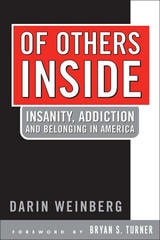
Of Others Inside
Insanity, Addiction And Belonging in AmericaDarin Weinberg, foreword by Bryan S. Turner
Temple University Press, 2005
Seeking to offer a new sociological understanding of the relationship between social exclusion and mental disability, Of Others Inside considers the general social conditions of homelessness, poverty, and social marginality in the U.S. Weinberg also explores questions about American perceptions of these conditions, and examines in great detail the social reality of mental disability and drug addiction without reducing people's suffering to simple notions of biological fate or social disorder.
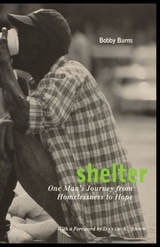
Shelter
Bobby Burns
University of Arizona Press, 1998
Shelter is filled with the sights and sounds of homelessness. Shelter life is patterned by meals provided by church volunteers, lines for soap and clean towels, the repeated meticulous washing of hands by an obsessive-compulsive resident, the rare pleasure of a fried chicken dinner, the illicit smell of marijuana within the shelter. Burns witnesses the residents' struggles with drugs, alcohol, and disability, and he wonders daily whether he will have the courage to emerge from this life. Bobby's diary expresses the full range of emotions of a homeless person: anger, self-pity, pride, humility, shame, depression, and optimism. These are not contradictions; taken together they represent the real feelings provoked by homelessness.
But with rare inner courage, Bobby stokes the fires of hope within himself, marking the days in his journal to keep himself from sliding deeper into a spiral of despair. Bobby confronts his own stereotypes about the homeless and learns firsthand what it means to struggle daily for survival and for dignity. He learns greater courage and he learns greater kindness. He is given food and a bed for 41 days, but he finds shelter on his own, deep within himself.
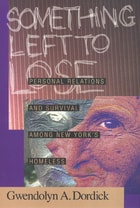
Something Left To Lose
Personal Relations and Survival among New York's HomelessGwendolyn Dordick
Temple University Press, 1997
In Something Left to Lose, Gwendolyn A. Dordick gives us a dramatic portrait of the social and personal lives of the homeless. Through her extensive "hanging out" with homeless people, Dordick came to a profound understanding of the web of relationships that provides complex social structure in situations where, to the casual eye, there appears to be only chaos and paralysis.
The author shows us that improvising shelter means working hard to co-exist with others. Lacking conventional private dwellings, the homeless find or create shelter in unconventional places -- on street corners adjoining bus stations, on empty lots of land, or in shelters, public or private -- and negotiate the rules of these places with authorities, passersby, and fellow homeless.
The different environments lead to quite different social relations. The Armory, for example, is a frightening place, thanks to the authoritarian attitudes of the employees and cliques of homeless people in charge. In the Shanty, on the other hand, the difficult issues are those of a self-governing community concerned about safety -- controlling the drug use of some residents, deciding who is allowed to tap into the electricity, and worrying about intruders.
In all settings, daily life for people without homes, like daily life for people with homes, if full of the concerns of personal relationships. How will we share our goods and emotions, speak respectfully to each other, love and joke and work out our disputes, and act in a trustworthy fashion?
This book is also a miniature research odyssey, complete with moments of fear, frustration, blunders, distrust, and trust. In order to gather these interviews, Dordick had to not only win the the confidence of the homeless people she visited (the women at the Station thought she was interested in their boyfriends) but also negotiate with unsympathetic police and shelters employees or defy them.
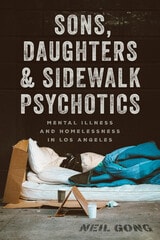
Sons, Daughters, and Sidewalk Psychotics
Mental Illness and Homelessness in Los AngelesNeil Gong
University of Chicago Press, 2024
Drawing on the nuanced experiences of patients and care providers, Sons, Daughters, and Sidewalk Psychotics introduces readers to two drastically different forms of community psychiatric services: public safety net clinics focused on keeping people housed and out of jail and elite private care trying to push clients toward respectable futures.
In downtown Los Angeles, many people in psychiatric crisis only receive help after experiencing homelessness or arrest. Public providers engage in guerrilla social work to secure housing and safety, but these programs are rarely able to deliver true rehabilitation for psychological distress and addiction. Patients are free to refuse treatment or use illegal drugs—so long as they do so away from public view. Across town in West LA or Malibu, wealthy people diagnosed with serious mental illness attend luxurious treatment centers. Programs may offer yoga and organic meals alongside personalized therapeutic treatments, but patients can feel trapped, as their families pay exorbitantly to surveil and “fix” them. Meanwhile, middle-class families—stymied by private insurers, unable to afford elite providers, and yet not poor enough to qualify for social services—struggle to find care at all.
Examining this divergent treatment of people facing similar mental struggles, Gong raises provocative questions about urban policy, individual freedom, and what it would take to create a fundamentally different psychiatric system—one that will meet the needs of patients, their loved ones, and society at large.
Street Addicts in the Political Economy
Alisse Waterston
Temple University Press, 1997

The Librarian's Guide to Homelessness
An Empathy-Driven Approach to Solving Problems, Preventing Conflict, and Serving EveryoneRyan Dowd
American Library Association, 2018
Homelessness is a perennial topic of concern at libraries. In fact, staff at public libraries interact with almost as many homeless individuals as staff at shelters do. Empathy and understanding, along with specific actionable advice that’s drawn from experience, makes all the difference in working with this group. In this book Dowd, executive director of a homeless shelter, spotlights best practices drawn from his own shelter’s policies and training materials. Filled with to-the-point guidance that will help frontline public library staff and managers understand and serve this population better, this resource
- includes facts about homelessness every librarian should know;
- debunks widespread myths about these individuals, explaining how they see themselves, what issues they struggle with, and how libraries can shift towards supporting them;
- shares de-escalation techniques like showing respect, ways to avoid making things personal, and using proper body language;
- walks readers through dealing with common issues like a sleeping patron, questionable hygiene, offensive behavior, and asking a patron to leave; and
- advises on how to provide backup to a colleague and when to call the police.

The Stable Boy
The First Witness Tells His StoryShirley A. Taylor
Parkhurst Brothers, Inc., 2012
"Shirley Taylor's story gives readers and hearers insight into the town of Bethlehem at the time of the birth of Christ. Wendell Hall's illustrations help us imagine that scene wonderfully. The young homeless boy touches our hearts and imaginations. Not just for children, this is a read aloud book for all ages." - Lauretta Phillips, Storyteller, Author, Radio & TV Host
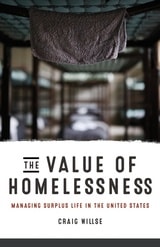
The Value of Homelessness
Managing Surplus Life in the United StatesCraig Willse
University of Minnesota Press, 2015
It is all too easy to assume that social service programs respond to homelessness, seeking to prevent and understand it. The Value of Homelessness, however, argues that homelessness today is an effect of social services and sciences, which shape not only what counts as such but what will?or ultimately won’t?be done about it.
Through a history of U.S. housing insecurity from the 1930s to the present, Craig Willse traces the emergence and consolidation of a homeless services industry. How to most efficiently allocate resources to control ongoing insecurity has become the goal, he shows, rather than how to eradicate the social, economic, and political bases of housing needs. Drawing on his own years of work in homeless advocacy and activist settings, as well as interviews conducted with program managers, counselors, and staff at homeless services organizations in New York, Los Angeles, San Francisco, and Seattle, Willse provides the first analysis of how housing insecurity becomes organized as a governable social problem.
An unprecedented and powerful historical account of the development of contemporary ideas about homelessness and how to manage homelessness, The Value of Homelessness offers new ways for students and scholars of social work, urban inequality, racial capitalism, and political theory to comprehend the central role of homelessness in governance and economy today.
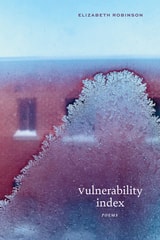
Vulnerability Index
PoemsElizabeth Robinson
Northwestern University Press, 2026
During Elizabeth Robinson’s six years working with chronically unhoused people in Boulder, Colorado, her relationships with the community’s most vulnerable deepened—even as they were filtered through a web of paperwork, systems, and strictures. The Vulnerability Index questionnaire is just one such system. Ubiquitous in shelters across America, it is representative of the endless tasks that people living on the street must complete to receive even minor assistance.
Moving between the local court, jail, shelter, and soup kitchen, Robinson’s poems capture the strange juxtapositions of the intimate, bureaucratic, and absurd that such spaces demand: a frostbite victim wants to share his state-sponsored recovery room with a friend from the street, a domestic violence survivor must change her name and even her social security number, an unhoused activist joins a vigil for another woman only to discover that she is, mistakenly, the person being mourned. Spare yet richly empathetic, Robinson’s verse works to implicate the reader’s own vulnerability on every page.