Results by title
517 books match the query 'In literature' and 34 start with a
A Commentary on Cicero, De Legibus
Andrew R. Dyck
University of Michigan Press, 2004
Surprisingly, de Legibus has been one of Cicero's most neglected works. Andrew R. Dyck's commentary is the first to appear on the complete work in well over one hundred years. Dyck provides a detailed interpretation and sets the essay into the context of the politics and philosophical thought of its time. While previous commentaries focused primarily on grammar and textual criticism, this one also seeks to relate Cicero's text to the political, philosophical, and religious trends of his day. The author identifies the influences on Cicero's thinking and analyzes the relation of this theoretical treatise to his other works. This commentary is based on a new text, worked out in consultations between the author and Jonathan Powell of Royal Holloway, London.
Andrew Dyck is Professor of Classics, University of California at Los Angeles.

A Ghost in Trieste
Joseph Cary
University of Chicago Press, 1993
Here is the crossroads of East and West. A port held in turn by the Romans, the Venetians, the Austrians, the Germans, the Slavs, and finally the Italians, Trieste is the capital of nowhere, fertile source of a unique literary florescence before the First World War. At times an exile home and an exiled city. "I cannot claim to have walked across it all,:" wrote Saba, the poet of Trieste in 1910 of the city Cary crosses and recrosses, seeking the poetry of the place that inspired its literary giants. Trieste's cultural and historical riches, its geographical splendor of hills and sea and mysterious presence unfold in a series of stories, monologues and literary juxtapositions that reveal the city's charms as well as its seductive hold on the writer's imagination. Throughout, literary and immediate impressions alike are elaborated in paintings and maps, and in handsome line drawings by Nicholas Read.
This "clownish and adolescent Parsifal," this Trieste of the "prickly grace," this place "impaled in my heart like a permanent point," this symbol of the Adriatic, this "city made of books" — here the book remakes the city. The Trieste of allusions magically becomes a city of palpable allure, of warmth and trying contradictions and gritty beauty. Part travel diary, part guide book, part literary history, A Ghost in Trieste is a brilliant introduction to an extraordinary time and place. In Joseph Cary, Trieste has found a new poet, and readers, a remarkably captivating companion and guide.
A Literary History of Iowa
Clarence A. Andrews
University of Iowa Press, 1972
A Map of Mexico City Blues
Jack Kerouac as PoetJames T. Jones
Southern Illinois University Press, 1992
In this pioneering critical study of Jack Kerouac’s book-length poem, Mexico City Blues—apoetic parallel to the writer’s fictional saga, the Duluoz Legend—James T. Jones uses a rich and flexible neoformalist approach to argue his case for the importance of Kerouac’s rarely studied poem.
After a brief summary of Kerouac’s poetic career, Jones embarks on a thorough reading of Mexico City Blues from several different perspectives: he first focuses on Kerouac’s use of autobiography in the poem and then discusses how Kerouac’s various trips to Mexico, his conversion to Buddhism, his theory of spontaneous poetics, and his attraction to blues and jazz influenced the theme, structure, and sound of Mexico City Blues.
A Question of Class
The Redneck Stereotype in Southern FictionDuane Carr
University of Wisconsin Press, 1997
A Symposion of Praise
Horace Returns to Lyric in Odes IVTimothy Johnson
University of Wisconsin Press, 2007
Johnson shows the Horatian panegyrist is more than a dependent poet representing only the desires of his patrons. The poet forges the panegyric agenda, setting out the character of the praise (its mode, lyric, and content both positive and negative), and calls together a community to join in the creation and adaptation of Roman identities and civic ideologies. With this insightful reading, A Symposion of Praise will be of interest to historians of the Augustan period and its literature, and to scholars interested in the dynamics between personal expression and political power.
A Tawdry Place of Salvation
The Art of Jane BowlesEdited by Jennie Skerl
Southern Illinois University Press, 1997
Through these essays—which deal with Bowles’s published as well as her unpublished work—Skerl seeks to generate serious critical attention for an important but neglected female experimental writer of the mid-twentieth century and to celebrate her originality, power, and craft.
Based in disciplines and theoretical approaches that range from feminist criticism to Middle Eastern studies, from postmodernism to queer theory, and from Victorianism to the Beat Generation, the essayists naturally approach Bowles’s fiction and drama from a wide variety of critical perspectives. All of these essays are unpublished and written for this volume.
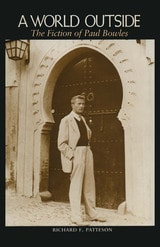
A World Outside
The Fiction of Paul BowlesBy Richard F. Patteson
University of Texas Press, 1987
Expatriation, the sense of being "outside" or exposed, is a central theme in the life and work of Paul Bowles. Beginning with Bowles' account of a frightening childhood memory, A World Outside explores how the dichotomies of inside and outside, safety and danger, enclosure and exposure—fundamental dualities in Bowles' fiction—have their deepest origin in the fabric of Bowles' own life and also mark his kinship with other twentieth-century writers. Like V. S. Naipaul, Paul Bowles is one of those writers who have an uncanny grasp of what it is like never to feel "at home."
In this much-needed study, Richard Patteson explores how this sense of "outsidedness" characterizes one's experience in a world in which many of the traditional shelters—social, familial, religious—seem to have lost their ability to protect. He discovers that storytelling is the vehicle by which both Bowles and his characters attempt to domesticate inchoate experience, bringing it into the familiar interior of human comprehension.
The music world has for decades recognized Paul Bowles' stature as a composer, but his fiction is only recently receiving the close attention it has long deserved from students of American and contemporary literature. Bowles is an author who neither sought nor received the kind of publicity often lavished on his contemporaries but one whom an ever-growing audience regards as a commanding figure of twentieth-century American literature.
A World among These Islands
Essays on Literature, Race, and National Identity in Antillean AmericaRoberto Marquez
University of Massachusetts Press, 2010
Caribbean literature and culture have all too often been viewed in fragmented terms, without attention to the broader commonalities of the region. In this collection of essays written over many years, Roberto Márquez offers a more encompassing vision, one that respects the individual traditions of particular locales, languages, and cultures but also sees the larger themes that bind the area's literary heritage and history. Márquez begins by making the case for a genuinely Caribbean literary criticism, one that moves beyond the colonial history of fragmentation and isolation and the critical insularity of more conventional approaches. His pan-Caribbean perspective provides a point of departure for the scrutiny of the evolving dramas of race, nationality, nation-building, and cultural articulation in the region. Márquez then focuses specifically on Puerto Rico—its literary and socio—historical experience, the particularities of its “New Creole” incarnations, and the effects of waves of migration to the United States. In the final section of the book, he discusses writers and cultural figures from the other Spanish, Anglophone, and Francophone territories and the ways in which they engage or reflect the defining themes of literature, race, and national identity in Antillean America.
Across Continents
Writing Goans, Making WorldsR. Benedito Ferrão
University of Michigan Press, 2026
Across Continents employs Goan literary subjectivity as epistemology to critique a specific limitation of postcolonial thought, one that does not account for the situations or afterlife of Portuguese colonialism. Employing various novels, R. Benedito Ferrão considers the relationship between Portuguese and British colonialisms through the displacement of Goan characters betwixt Asia, Africa, Europe, and North America. The experiences of these figures in dealing with the processes of nation, statecraft, and political intrigue at various historical junctures offer a comparative understanding of the tumultuous conditions of postcoloniality in the making of marginalized subjectivity across continents.
In examining the mobility and diversity of Goan experiences as represented in works by Salman Rushdie, M. G. Vassanji, Roger King, and Margaret Mascarenhas, this book calls into question limits of citizenship, nationality, and notions of belonging. Ferrão centers seemingly minor figures to exemplify the effects of colonial and postcolonial changes that connect diverse geopolities.
Actium and Augustus
The Politics and Emotions of Civil WarRobert Alan Gurval
University of Michigan Press, 1998
Actium and Augustus marks a turning point as well. Robert Alan Gurval's unusual approach is to examine contemporary views of the battle and its immediate political and social consequences. He starts with a consideration of the official celebration and public commemoration of the Actian victory and then moves on to other questions. What were the "Actian" monuments that Octavian erected on the battle site and later in Rome? What role did the Actian victory play in the political formation of the Principate and its public ideology? What was the response of contemporary poetry? Throughout, this volume concentrates on contemporary views of Actium and its results.
Written to include the general reader, Actium and Augustus presents a thoughtful examination of a complex period. All Greek and Latin quotations are translated, and extensive illustrations present graphic evidence about the issues Romans faced.
Robert Alan Gurval is Associate Professor of Classics, University of California, Los Angeles, and has been a recipient of the Rome Prize awarded by the American Academy in Rome.
Acts of Faith and Imagination
Theological Patterns in Catholic FictionBrent Little
Catholic University of America Press, 2023
After Empire
Scott, Naipaul, RushdieMichael Gorra
University of Chicago Press, 1997
Arguing against a model of cultural identity based on race, Gorra begins with Scott's portrait, in The Raj Quartet, of the character Hari Kumar—a seeming oxymoron, an "English boy with a dark brown skin," whose very existence undercuts the belief in an absolute distinction between England and India. He then turns to the opposed figures of Naipaul and Rushdie, the two great novelists of the Indian diaspora. Whereas Naipaul's long and controversial career maps the "deep disorder" spread by both imperialism and its passing, Rushdie demonstrates that certain consequences of that disorder, such as migrancy and mimicry, have themselves become creative forces.
After Empire provides engaging and enlightening readings of postcolonial fiction, showing how imperialism helped shape British national identity—and how, after the end of empire, that identity must now be reconfigured.
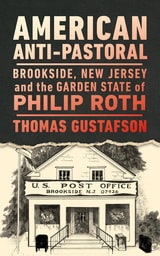
American Anti-Pastoral
Brookside, New Jersey and the Garden State of Philip RothThomas Gustafson
Rutgers University Press, 2024
American Anti-Pastoral reads the events in Roth’s novel in relation to the history of Brookside and its region. While Roth’s protagonist Seymour “Swede” Levov initially views Old Rimrock as an idyllic paradise within the Garden State, its real-world counterpart has a more complex past in its origins as a small industrial village, as well as a site for the politics of exclusionary zoning and a 1960s anti-war protest at its celebrated 4th of July parade. Literary historian and Brookside native Thomas Gustafson casts Roth’s canonical novel in a fresh light as he studies both Old Rimrock in comparison to Brookside and the novel in relationship to NJ literature, making a case for it as the Great New Jersey novel. For Roth fans and history buffs alike, American Anti-Pastoral peels back the myths about the bucolic Garden State countryside to reveal deep fissures along the fault-lines of race and religion in American democracy.
American Indian Literature and the Southwest
Contexts and DispositionsBy Eric Gary Anderson
University of Texas Press, 1999
Culture-to-culture encounters between "natives" and "aliens" have gone on for centuries in the American Southwest—among American Indian tribes, between American Indians and Euro-Americans, and even, according to some, between humans and extraterrestrials at Roswell, New Mexico. Drawing on a wide range of cultural productions including novels, films, paintings, comic strips, and historical studies, this groundbreaking book explores the Southwest as both a real and a culturally constructed site of migration and encounter, in which the very identities of "alien" and "native" shift with each act of travel.
Eric Anderson pursues his inquiry through an unprecedented range of cultural texts. These include the Roswell spacecraft myths, Leslie Marmon Silko's Almanac of the Dead, Wendy Rose's poetry, the outlaw narratives of Billy the Kid, Apache autobiographies by Geronimo and Jason Betzinez, paintings by Georgia O'Keeffe, New West history by Patricia Nelson Limerick, Frank Norris' McTeague, Mary Austin's The Land of Little Rain, Sarah Winnemucca's Life Among the Piutes, Willa Cather's The Professor's House, George Herriman's modernist comic strip Krazy Kat, and A. A. Carr's Navajo-vampire novel Eye Killers.
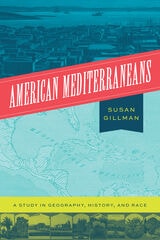
American Mediterraneans
A Study in Geography, History, and RaceSusan Gillman
University of Chicago Press, 2022
The naturalist Alexander von Humboldt, visiting the Gulf-Caribbean in the early nineteenth century, called it America’s Mediterranean. Almost a century later, Southern California was hailed as “Our Mediterranean, Our Italy!” Although “American Mediterranean” is not a household phrase in the United States today, it once circulated widely in French, Spanish, and English as a term of art and folk idiom. In this book, Susan Gillman asks what cultural work is done by this kind of unsystematic, open-ended comparative thinking.
American Mediterraneans tracks two centuries of this geohistorical concept, from Humboldt in the early 1800s, to writers of the 1890s reflecting on the Pacific world of the California coast, to writers of the 1930s and 40s speculating on the political past and future of the Caribbean. Following the term through its travels across disciplines and borders, American Mediterraneans reveals a little-known racialized history, one that paradoxically appealed to a range of race-neutral ideas and ideals.
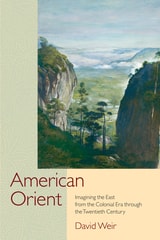
American Orient
Imagining the East from the Colonial Era through the Twentieth CenturyDavid Weir
University of Massachusetts Press, 2011
Surveying the American fascination with the Far East since the mid-eighteenth century, this book explains why the Orient had a fundamentally different meaning in the United States than in Europe or Great Britain. David Weir argues that unlike their European counterparts, Americans did not treat the East simply as a site of imperialist adventure; on the contrary, colonial subjugation was an experience that early Americans shared with the peoples of China and India.
In eighteenth-century America, the East was, paradoxically, a means of reinforcing the enlightenment values of the West: Franklin, Jefferson, and other American writers found in Confucius a complement to their own political and philosophical beliefs. In the nineteenth century, with the shift from an agrarian to an industrial economy, the Hindu Orient emerged as a mystical alternative to American reality. During this period, Emerson, Thoreau, and other Transcendentalists viewed the “Oriental” not as an exotic other but as an image of what Americans could be, if stripped of all the commercialism and materialism that set them apart from their ideal. A similar sense of Oriental otherness informed the aesthetic discoveries of the early twentieth century, as Pound, Eliot, and other poets found in Chinese and Japanese literature an artistic purity and intensity absent from Western tradition. For all of these figures the Orient became a complex fantasy that allowed them to overcome something objectionable, either in themselves or in the culture of which they were a part, in order to attain some freer, more genuine form of philosophical, religious, or artistic expression.
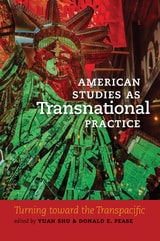
American Studies as Transnational Practice
Turning toward the TranspacificEdited by Yuan Shu and Donald E. Pease
Dartmouth College Press, 2016
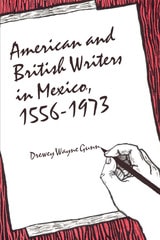
American and British Writers in Mexico, 1556-1973
By Drewey Wayne Gunn
University of Texas Press, 1974
American and British Writers in Mexico is the study that laid the foundation upon which subsequent examinations of Mexico’s impact upon American and British letters have built. Chosen by the Mexican government to be placed, in translation, in its public libraries, the book was also referenced by Nobel Laureate Octavio Paz in an article in the New Yorker, “Reflections—Mexico and the United States.” Drewey Wayne Gunn demonstrates how Mexican experiences had a singular impact upon the development of English writers, beginning with early British explorers who recorded their impressions for Hakluyt’s Voyages, through the American Beats, who sought to escape the strictures of American culture.
Among the 140 or so writers considered are Stephen Crane, Ambrose Bierce, Langston Hughes, D. H. Lawrence, Somerset Maugham, Katherine Anne Porter, Hart Crane, Malcolm Lowry, John Steinbeck, Graham Greene, Tennessee Williams, Saul Bellow, William Carlos Williams, Robert Lowell, Ray Bradbury, Allen Ginsberg, William Burroughs, and Jack Kerouac.
Gunn finds that, while certain elements reflecting the Mexican experience—colors, landscape, manners, political atmosphere, a sense of the alien—are common in their writings, the authors reveal less about Mexico than they do about themselves. A Mexican sojourn often marked the beginning, the end, or the turning point in a literary career. The insights that this pioneering study provide into our complex cultural relationship with Mexico, so different from American and British authors’ encounters with Continental cultures, remain vital. The book is essential for anyone interested in understanding the full range of the impact of the expatriate experience on writers.
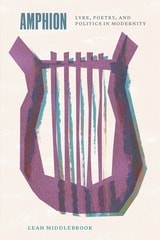
Amphion
Lyre, Poetry, and Politics in ModernityLeah Middlebrook
University of Chicago Press, 2024
Amphion is the figure in Greek mythology who played so skillfully on a lyre that stones moved of their own accord to build walls for Thebes. While Amphion still presides over music and architecture, he was once fundamental to the concept of lyric poetry. Amphion figured the human power to inspire action, creating and undoing polities by means of language. In contrast to the individual inspiration we associate with the better-known Orpheus, Amphion represents the relentless, often violent, play of harmony and disorder in human social life.
In this wide-ranging study, Leah Middlebrook introduces readers to Amphion-inspired poetics and lyrics and traces the tradition of the Amphionic from the Renaissance through modernist and postmodern poetry and translation from the Hispanic, Anglophone, French, Italian, and ancient Roman worlds. Amphion makes a significant contribution to scholarship on the connection between poetry and politics and the history of the lyric, offering an account well-suited to our times.
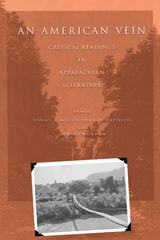
An American Vein
Critical Readings in Appalachian LiteratureDanny L. Miller
Ohio University Press, 2005
The blossoming of Appalachian studies began some thirty years ago. Thousands of young people from the hills have since been made aware of their region’s rich literary tradition through high school and college courses. An entire generation has discovered that their own landscapes, families, and communities had been truthfully portrayed by writers whose background was similar to their own.
An American Vein: Critical Readings in Appalachian Literature is an anthology of literary criticism of Appalachian novelists, poets, and playwrights. The book reprises critical writing of influential authors such as Joyce Carol Oates, Cratis Williams, and Jim Wayne Miller. It introduces new writing by Rodger Cunningham, Elizabeth Engelhardt, and others.
Many writers from the mountains have found success and acclaim outside the region, but the region itself as a thriving center of literary creativity has not been widely appreciated. The editors of An American Vein have remedied this, producing the first general collection of Appalachian literary criticism. This book is a resource for those who teach and read Appalachian literature. What’s more, it holds the promise of introducing new readers, nationally and internationally, to Appalachian literature and its relevance to our times.
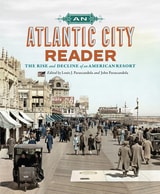
An Atlantic City Reader
The Rise and Decline of an American ResortLouis J. Parascandola
Rutgers University Press, 2026
As Atlantic City grew to become one of the largest tourist destinations on the East Coast, it loomed ever larger in the imaginations of American writers. Generation upon generation of novelists, journalists, musicians, and poets visited Atlantic City and left with vivid impressions of its kaleidoscopic delights and its seedy underbelly.
This new reader collects all of these diverse perspectives on the city in one place, including accounts of Atlantic City by such famous visitors as Walt Whitman, William Carlos Williams, Fanny Hurst, Arthur Conan Doyle, Damon Runyon, Langston Hughes, Elmore Leonard, and Bruce Springsteen. Arranged chronologically, the anthology traces the city’s history from its humble beginnings as a quiet health resort to its rapid ascent to the world’s playground, its gradual decline, and its hopeful if tenuous future. Together, the pieces in this collection take us inside the city’s glitz, glamor, and gambling palaces, but they also don’t shy away from its troubling histories of racial discrimination, political corruption, and urban decay. Compiling fiction, poetry, drama, memoirs, newspaper stories, and magazine reports, The Atlantic City Reader presents an engaging and multifaceted portrait of this iconic resort town.
An Unsentimental Education
Writers and ChicagoMolly McQuade
University of Chicago Press, 1995
Interviews with:Saul Bellow, Paul Carroll, Hayden Carruth, Robert Coover, Leon Forrest, June Jordan, Janet Kauffman, Morris Philipson, M. L. Rosenthal, Philip Roth, Susan Fromberg Shaeffer, Charles Simic, Susan Sontag, George Starbuck, George Steiner, Richard Stern, Nathaniel Tarn, Douglas Unger, Kurt Vonnegut, and Marguerite Young.
And Here
100 Years of Upper Peninsula Writing, 1917–2017Ronald Riekki
Michigan State University Press, 2017
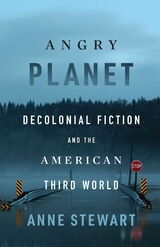
Angry Planet
Decolonial Fiction and the American Third WorldAnne Stewart
University of Minnesota Press, 2022
Before the idea of the Anthropocene, there was the angry planet
How might we understand an earthquake as a complaint, or erosion as a form of protest—in short, the Earth as an angry planet? Many novels from the end of the millennium did just that, centering around an Earth that acts, moves, shapes human affairs, and creates dramatic, nonanthropogenic change.
In Angry Planet, Anne Stewart uses this literature to develop a theoretical framework for reading with and through planetary motion. Typified by authors like Colson Whitehead, Octavia Butler, and Leslie Marmon Silko, whose work anticipates contemporary critical concepts of entanglement, withdrawal, delinking, and resurgence, angry planet fiction coalesced in the 1990s and delineated the contours of a decolonial ontology. Stewart shows how this fiction brought Black and Indigenous thought into conversation, offering a fresh account of globalization in the 1990s from the perspective of the American Third World, construing it as the era that first made connections among environmental crises and antiracist and decolonial struggles.
By synthesizing these major intersections of thought production in the final decades of the twentieth century, Stewart offers a recent history of dissent to the young movements of the twenty-first century. As she reveals, this knowledge is crucial to incipient struggles of our contemporary era, as our political imaginaries grapple with the major challenges of white nationalism and climate change denial.
Anomalous States
Irish Writing and the Post-Colonial MomentDavid Lloyd
Duke University Press, 1993
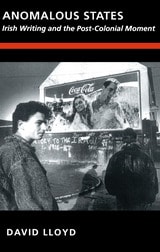
Beginning with Heaney and Beckett, Lloyd shows how in these authors the question of identity connects with the dominance of conservative cultural nationalism and argues for the need to understand Irish culture in relation to the wider experience of colonized societies. A central essay reads Yeats's later works as a profound questioning of the founding of the state. Final essays examine the gradual formation of the state and nation as one element in a cultural process that involves conflict between popular cultural forms and emerging political economies of nationalism and the colonial state. Modern Ireland is thus seen as the product of a continuing process in which, Lloyd argues, the passage to national independence that defines Ireland's post-colonial status is no more than a moment in its continuing history.
Anomalous States makes an important contribution to the growing body of work that connects cultural theory with post-colonial historiography, literary analysis, and issues in contemporary politics. It will interest a wide readership in literary studies, cultural studies, anthropology, and history.
Anonymous Connections
The Body and Narratives of the Social in Victorian BritainTina Young Choi
University of Michigan Press, 2016

Argentina
Stories for a NationAmy K. Kaminsky
University of Minnesota Press, 2008
By the end of the twentieth century, Argentina’s complex identity-tango and chimichurri, Eva Perón and the Mothers of the Plaza de Mayo, the Falklands and the Dirty War, Jorge Luis Borges and Maradona, economic chaos and a memory of vast wealth-has become entrenched in the consciousness of the Western world.
In this wide-ranging and at times poetic new work, Amy K. Kaminsky explores Argentina’s unique national identity and the place it holds in the minds of those who live beyond its physical borders. To analyze the country’s meaning in the global imagination, Kaminsky probes Argentina’s presence in a broad range of literary texts from the United States, Poland, England, Western Europe, and Argentina itself, as well as internationally produced films, advertisements, and newspaper features.
Kaminsky’s examination reveals how Europe consumes an image of Argentina that acts as a pivot between the exotic and the familiar. Going beyond the idea of suffocating Eurocentrism as a theory of national identity, Kaminsky presents an original and vivid reading of national myths and realities that encapsulates the interplay among the many meanings of “Argentina” and its place in the world’s imagination.
Amy Kaminsky is professor of gender, women, and sexuality studies and global studies at the University of Minnesota and author of After Exile (Minnesota, 1999).
Artful Assassins
Murder as Art in Modern MexicoFernando Fabio Sanchez
Vanderbilt University Press, 2010
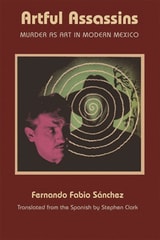
Sanchez argues that the seemingly hopeless cycle of violence experienced by Mexico in the 20th century, as reflected in its "crime genre," reveals a broader intrinsic cultural and political failure that suggests grave implications for the current state of crisis. Tracing the development of a national Mexican identity from the 1910 Mexican Revolution onward, Sanchez focuses on the indelible presence of violence and crime underlying the major works that contributed to a larger communal narrative.
Artful Assassins ultimately offers a panoramic overview of the evolution of Mexican arts and letters, as well as nationalism, by claiming murder and assassination as literary and cinematic motifs. The collapse of post-revolutionary political unity was presaged all along in Mexican culture, Sanchez argues. It need only to have been sought in the art of the nation.
Artificial Africas
Colonial Images in the Times of GlobalizationRuth Mayer
Dartmouth College Press, 2002
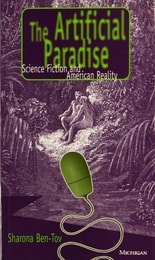
Artificial Paradise
Science Fiction and American RealitySharona Ben-Tov
University of Michigan Press, 1995
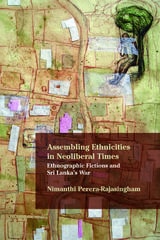
Assembling Ethnicities in Neoliberal Times
Ethnographic Fictions and Sri Lanka’s WarNimanthi Perera-Rajasingham
Northwestern University Press, 2019
Assembling Ethnicities in Neoliberal Times: Ethnographic Fictions and Sri Lanka’s War argues that the bloody war fought between the Sri Lankan state and the separatist Tamil Tigers from 1983 to 2009 should be understood as structured and animated by the forces of global capitalism. Using Aihwa Ong’s theorization of neoliberalism as a mobile technology and assemblage, this book explores how contemporary globalization has exacerbated forces of nationalism and racism.
Nimanthi Perera-Rajasingham finds that ethnographic fictions have both internalized certain colonial Orientalist impulses and critically engaged with categories of objective gazing, empiricism, and temporal distancing. She demonstrates that such fictions take seriously the task of bearing witness and documenting the complex productions of ethnic identities and the devastations wrought by warfare. To this end, Assembling Ethnicities
explores colonial-era travel writing by Robert Knox (1681) and Leonard Woolf (1913); contemporary works by Michael Ondaatje, Romesh Gunesekera, Shobasakthi, Dharmasiri Bandaranayake, and Thamotharampillai Shanaathanan; and cultural festivals and theater, including vernacular performances of Euripides’s The Trojan Women and women workers’ theater.
The book interprets contemporary fictions to unpack neoliberalism’s entanglements with nationalism and racism, engaging current issues such as human rights, the pastoral, Tamil militancy, immigrant lives, feminism and nationalism, and postwar developmentalism.
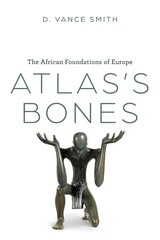
Atlas's Bones
The African Foundations of EuropeD. Vance Smith
University of Chicago Press, 2025
Virgil. Chaucer. Petrarch. These names resonate with many as cornerstones of European culture. Yet, in Atlas’s Bones, D. Vance Smith reveals that much of what is claimed as European culture up to the Middle Ages—its great themes in literature, its sources in political thought, its religious beliefs—originated in the writings of African thinkers like Augustine, Fulgentius, and Martianus Capella, or Europeans who thought extensively about Africa. In fact, a third of Virgil’s Aeneid takes place in Africa. Francis Petrarch believed his most important achievement was his epic Africa; while Geoffrey Chaucer wrote repeatedly about the figures of Scipio Africanus, actually two different men who defeated and destroyed Carthage.
Smith tells the story of how Europe created a false “medieval” version of Africa to acquire resources and power during the era of imperialism and colonialism. The first half of the book, “Reading Africa,” traces Egypt’s, Libya’s, and Carthage’s influence on classical and medieval thinking about Africa, highlighting often ignored literary and legendary traditions, for example, that Alexander the Great named himself the son of an African god. The second part, “Writing Africa,” focuses on how the different cultures of the two great African cities—Carthage and Alexandria—shaped modern literary criticism and political theology and examines the cross-influences of modern anthropology, medieval studies, and colonial law.
Atlas’s Bones firmly re-establishes the significance of Africa in European intellectual history. It will be essential reading for anyone seeking to understand how much of Africa informs our artistic and cultural world.
Australian Voices
Writers and Their WorkBy Ray Willbanks
University of Texas Press, 1991
Contemporary Australian fiction is attracting a world audience, particularly in the United States, where a growing readership eagerly awaits new works. In Australian Voices, Ray Willbanks goes beyond the books to their authors, using sixteen interviews to reveal the state of fiction writing in Australia—what nags from the past, what engages the imagination for the future.
Willbanks engages the writers in lively discussions of their own work, as well as topics of collective interest such as the past, including convict times; the nature of the land; the treatment of Aborigines; national identity and national flaws; Australian-British antipathy; sexuality and feminism; drama and film; writing, publishing, and criticism in Australia; and the continuous and pervasive influence of the United States on Australia.
The interviews in Australian Voices are gossipy, often funny, and always informative, as Willbanks builds a structured conversation that reveals biography, personality, and significant insight into the works of each writer. They will be important for both scholars and the reading public.