Results by title
26 books match the query 'Influence (Literary, artistic, etc.)'
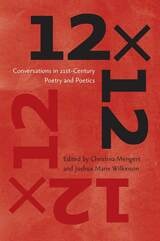
12 x 12
Conversations in 21st-Century Poetry and PoeticsChristina Mengert
University of Iowa Press, 2009
Christina Mengert and Joshua Marie Wilkinson have assembled an expansive and searching view of the world through the eyes of twenty-four of our most vital and engaging poets. Punctuated by poems from each contributor, 12 × 12 brings together an unparalleled range of poets and poetries, men and women from around the world, working poets for whom the form vitally matters.
Contributors
Jennifer K. Dick–Laura Mullen
Jon Woodward–Rae Armantrout
Sabrina Orah Mark–Claudia Rankine
Christina Hawkey–Tomaž Šalamun
Christine Hume–Rosemarie Waldrop
Srinkath Reddy–Mark Levine
Karen Volkman–Allen Grossman
Paul Fattaruso–Dara Wier
Mark Yakich–Mary Leader
Michelle Robinson–Paul Auster
Sawako Nakayasu–Carla Harryman
Ben Lerner–Aaron Kunin
A Change in the Weather
Modernist Imagination, African American ImaginaryGeoffrey Jacques
University of Massachusetts Press, 2009
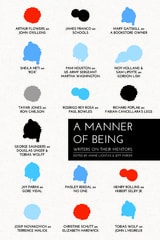
A Manner of Being
Writers on Their MentorsAnnie Liontas
University of Massachusetts Press, 2015
What do the punk singer Henry Rollins, the Guatemalan writer Rodrigo Rey Rosa, the American authors Tobias Wolff, Tayari Jones, and George Saunders, the Canadian writer Sheila Heti, and the Russian poet Polina Barskova have in common? At some point they all studied the art of writing deeply with someone.
The nearly seventy short essays in A Manner of Being, by some of the best contemporary writers from around the world, pay homage to mentors—the writers, teachers, nannies, and sages—who enlighten, push, encourage, and sometimes hurt, fail, and limit their protégés. There are mentors encountered in the schoolhouse and on farms, in NYC and in MFA programs; mentors who show up exactly when needed, offering comfort, a steadying hand, a commiseration, a dose of tough love. This collection is rich with anecdotes from the heartfelt to the salacious, gems of writing advice, and guidance for how to live the writing life in a world that all too often doesn't care whether you write or not.
Each contribution is intimate and distinct—yet a common theme is that mentors model a manner of being.
Selections include:
Arthur Flowers on John O'Killens
James Franco on Harmony Korine
Mary Gaitskill on an Ann Arbor bookstore owner
Noy Holland and Sam Lipsyte on Gordon Lish
Tayari Jones on Ron Carlson
Henry Rollins on Hubert Selby Jr.
Rodrigo Rey Rosa on Paul Bowles
George Saunders on Douglas Unger and Tobias Wolff
Christine Schutt on Elizabeth Hardwick
Tobias Wolff on John L'Heureux
. . . and many more
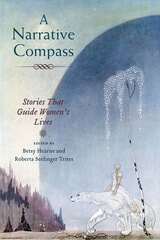
A Narrative Compass
Stories that Guide Women's LivesEdited by Betsy Hearne and Roberta Seelinger Trites
University of Illinois Press, 2008
Each of us has a narrative compass, a story that has guided our lifework. In this extraordinary collection, women scholars from a variety of disciplines identify and examine the stories that have inspired them, haunted them, and shaped their research, from Little House on the Prairie to Little Women, from the fairy tales of Hans Christian Andersen and Alice's Adventures in Wonderland to Nancy Drew, Mary Jane, and even the Chinese memoir Jottings from the Transcendant's Abode at Mt. Youtai. Telling the "story of her story" leads each of the essayists to insights about her own approach to studying narratives and to a deeper, often surprising, understanding of the power of imagination.
Contributors are Deyonne Bryant, Minjie Chen, Cindy L. Christiansen, Beverly Lyon Clark, Karen Coats, Wendy Doniger, Bonnie Glass-Coffin, Betsy Hearne, Joanna Hearne, Ann Hendricks, Rania Huntington, Christine Jenkins, Kimberly Lau, Pamela Riney-Kehrberg, Maria Tatar, Ebony Elizabeth Thomas, Roberta Seelinger Trites, Claudia Quintero Ulloa, and Ofelia Zepeda.
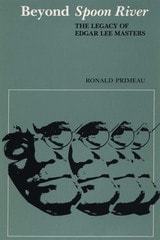
Beyond Spoon River
The Legacy of Edgar Lee MastersBy Ronald Primeau
University of Texas Press, 1981
As the first full-length critical study of Edgar Lee Masters, Beyond Spoon River is important not only for its reevaluation of this American poet and his work but also for its valuable insights into central questions of aesthetics, regionalism, and the nature and meaning of literary influence.
The inordinate popularity of Spoon River Anthology has for many years unfairly restricted Masters' reputation as a "one-book phenomenon," although between 1911 and 1942 he wrote over fifty other books—most of which were neglected or misinterpreted precisely because they attempted a large-scale rewriting of what he felt had been obscured or distorted in the Anglo-American tradition. Masters' wide reading in the whole of western literature shaped his own attitudes, themes, and style, and his detailed accounts of that reading and its effect on his work form the basis for this reinterpretation of his place in American poetry in this century.
After reviewing Masters' own statements on literary influence and his role as a critic, Primeau devotes the main body of his study to the major influences on Masters' work—the Greeks, Goethe, Emerson, Whitman, Shelley, and Browning. For Masters, the composite of all these influences provided a corrective to the poetry and criticism of his time, which he little admired. Primeau concludes by exploring Masters' midwestern heritage in the light of recent reinterpretations of regionalism.
CROSS-CULTURAL VISIONS IN AFRICAN AMERICAN MODERNISM
FROM SPATIAL NARRATIVE TO JAZZ HAIKUYOSHINOBU HAKUTANI
The Ohio State University Press, 2006
In writing Black Boy, the centerpiece of the Chicago Renaissance, Wright was inspired by Theodore Dreiser. Because the European and African cultural visions that Wright, Ralph Ellison, Alice Walker, and Toni Morrison acquired were buttressed by the universal humanism that is common to all cultures, this ideology is shown to transcend the problems of society. Fascinated by Eastern thought and art, Wright, Walker, Sonia Sanchez, and James Emanuel wrote highly accomplished poetry and prose. Like Ezra Pound, Wright was drawn to classic haiku, as reflected in the 4,000 haiku he wrote at the end of his life. As W. B. Yeats’s symbolism was influenced by his cross-cultural visions of noh theatre and Irish folklore, so is James Emanuel’s jazz haiku energized by his cross-cultural rhythms of Japanese poetry and African American music.
The book demonstrates some of the most visible cultural exchanges in modern and postmodern African American literature. Such a study can be extended to other contemporary African American writers whose works also thrive on their cross-cultural visions, such as Amiri Baraka, Ishmael Reed, Charles Johnson, and haiku poet Lenard Moore.
Dostoevsky and Romantic Realism
A Study of Dostoevsky in Relation to Balzac, Dickens, and GogolDonald Fanger
Northwestern University Press, 1998
Edith Wharton in Context
Essays on IntertextualityAdeline R. Tintner
University of Alabama Press, 1999
Tintner provides a detailed analysis of the complex interplay between Wharton and James—how they influenced each other and how some of their writings operate as homages or personal jokes. So deeply was James in Wharton’s confidence, Tintner argues, that he provided her with source models for a number of her characters. In addition, Wharton found in his fiction structures for her own, especially for The Age of Innocence.
Tintner also brings her considerable knowledge of art history to bear in her study of art allusions in Wharton’s work. Wharton’s response both to the Italian painters active before Raphael and to the English Pre-Raphaelites of a generation before her own is analyzed here in three essays. These pieces demonstrate Wharton’s sensibility to changes in art tastes and collecting, the inheritance of Rossetti’s revolutionary paintings in the unfinished novel, The Buccaneers, and the importance of home in The Glimpses of the Moon, as demonstrated by Wharton’s use of Tiepolo’s fresco in the church of Scalzi.
Tintner concludes by considering Wharton’s literary legacy and who Wharton has figured in the imaginations of recent writers, including Richard Howard, Louis Auchincloss, and Cathleen Schine. Tintner finds some part of Wharton’s personality or work evoked in a number of contemporary works and argues that this presence signals the beginning of an increasing influence.
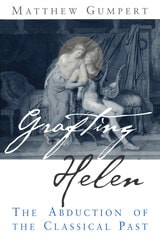
Grafting Helen
The Abduction of the Classical PastMatthew Gumpert
University of Wisconsin Press, 2001
Grafting Helen looks at "classicism"—the privileged rhetorical language for describing cultural origins in the West—as a protracted form of cultural embezzlement. No coin in the realm has been more valuable, more circulated, more coveted, or more counterfeited than the one that bears the face of Helen of Troy. Gumpert uncovers Helen as the emblem for the past as something to be stolen, appropriated, imitated, extorted, and coveted once again.
Tracing the figure of Helen from its classical origins through the Middle Ages, the French Renaissance, and the modern era, Gumpert suggests that the relation of current Western culture to the past is not like the act of coveting; it is the act of coveting, he argues, for it relies on the same strategies, the same defenses, the same denials, and the same delusions.
Hawthorne and Women
Engendering and Expanding the Hawthorne TraditionJohn L. Idol
University of Massachusetts Press, 1999
This collection of original essays presents a more complex and positive view of Hawthorne's attitudes toward women, demonstrating his recognition of the crucial role that women played--as critics, reviewers, readers, and authors--in building a national readership that made his writing career so successful.
The book begins with an examination of the influence exerted by the women in Hawthorne's immediate family. It goes on to explore his links to a broad range of women writers, as well as his attitudes toward the female characters he created. Among the authors discussed are Margaret Fuller, Harriet Beecher Stowe, Louisa May Alcott, Emily Dickinson, Sarah Orne Jewett, Willa Cather, Charlotte Perkins Gilman, George Eliot, Virginia Woolf, Flannery O'Connor, and Toni Morrison.
Influence and Intertextuality in Literary History
John B. Clayton
University of Wisconsin Press, 1991
This important collection explores and clarifies two of the most contested ideas in literary theory today, influence and intertextuality. The study of influence tends to center on major authors and canonical works, identifying prior documents as “sources” or “contexts” for a given author. Intertextuality, on the other hand, is a concept unconcerned with authors as individuals; it treats all texts as part of a network of discourse that includes culture, history, and social practices as well as other literary works. In thirteen essays drawing on the entire spectrum of English and American literary history, this volume considers the relationship between these two terms—their rivalry, their kinship, their range of uses.
Debates about these two concepts have been crucial to the “new historicism” and the resurgence of interest in literary history. The essays in this volume employ a refreshing array of examples from that history—poetry of the Renaissance and the twentieth century, novels of the eighteenth through twentieth centuries, Old English texts, and postmodernist productions that have served as recurrent “intertexts” for contemporary theory. The contributors treat such currently vital questions as the role of the author, canon formation, gender, causality, and the social dimension of texts. They illuminate old assumptions and new ideas about agency that lie behind notions of influence, and they examine models of an anonymous textual field that lie behind notions of intertextuality.
The volume takes much of its character from its own intertextual origin as a group project of the English faculty at the University of Wisconsin–Madison. Though diverse in their academic interests, concerns, and experience, the contributors particpated in an ongoing intellectual exchange that is a model of how new scholarship can arise from dialogue.
Joyce, Bakhtin, and the Literary Tradition
Toward a Comparative Cultural PoeticsM. Keith Booker
University of Michigan Press, 1997
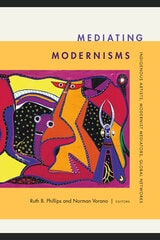
Mediating Modernisms
Indigenous Artists, Modernist Mediators, Global NetworksRuth B. Phillips and Norman Vorano, editors
Duke University Press, 2025
Contributors. Peter Brunt, Roberto Conduru, Hanna Horsberg Hansen, Elizabeth Harney, Jyotindra Jain, Sandra Klopper, Ian McLean, Anitra Nettleton, Chika Okeke-Agulu, Ruth B. Phillips, Una Rey, Megan Tamati-Quennell, Nicholas Thomas, Norman Vorano, Mark Andrew White
Mirrors of Our Playing
Paradigms and Presences in Modern DramaThomas R. Whitaker
University of Michigan Press, 1999
Ovid's Literary Loves
Influence and Innovation in the AmoresBarbara Weiden Boyd
University of Michigan Press, 1997
Boyd's thoughtful approach to imitation in Latin poetry brings into prominence the formative role played by Virgil in shaping Ovid's "poetic memory," even in the Amores. The detailed examination of Ovidian extended similes shows how the poet exploits the literary past precisely in order to free himself from generic restraint and to expand the narrow horizons of elegy. Boyd argues that this paradox is the essence of Ovidian poetics.
Ovid's Literary Loves is an imaginative approach to imitation in Latin poetry and makes a significant contribution to current discussions of the subject. This is one of the first contemporary scholarly monographs on the Amores, and it will find a large and welcoming audience of Latinists at all levels of study.
Barbara Weiden Boyd is Associate Professor of Classics, Bowdoin College, Brunswick, Maine.
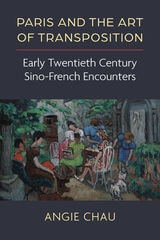
Paris and the Art of Transposition
Early Twentieth Century Sino-French EncountersAngie Chau
University of Michigan Press, 2023
While previous studies of Chinese modernism have focused on how Western modernist aesthetics were adapted or translated to the Chinese context, Angie Chau does the opposite by turning to Paris in the Chinese imaginary and discussing the literary and visual artwork of five artists who moved between France and China: the painter Chang Yu, the poet Li Jinfa, the art critic Fu Lei, the painter Pan Yuliang, and the writer Xu Xu. Chau draws the idea of transposition from music theory where it refers to shifting music from one key or clef to another, or to adapting a song originally composed for one instrument to be played by another. Transposing transposition to the study of art and literature, Chau uses the term to describe a fluid and strategic art practice that depends on the tension between foreign and familiar, new and old, celebrating both novelty and recognition—a process that occurs when a text gets placed into a fresh context.
Professing Poetry
Seamus Heaney’s PoeticsMichael Cavanagh
Catholic University of America Press, 2009
Reading Virgil and His Texts
Studies in IntertextualityRichard F. Thomas
University of Michigan Press, 2000
The articles and notes included in this volume have been selected for their diachronic aspect in addition to the synchronic status they had in their original context. Dealing with the intricate ways in which Virgil, and in the introductory chapter his predecessor Catullus, manipulated and appropriated their inherited Greek and Roman literary tradition, this book presents a coherent profile, through these detailed studies, of the mechanics of one of the most dynamic periods in the literary history of any culture.
Richard Thomas--one of the most important voices in Latin literary studies today--shows little anxiety about objections to authorial intentionality. Throughout there is a working assumption that intertextual connections can be established and, further, that functions and purposes, even intended ones, may be inferred from those connections.
This book will be of interest to scholars and students of Greek and Latin literature but will also be of great value to students of medieval, Renaissance, and early modern vernacular literatures, most of whose poets see themselves as closely connected to Virgil.
Richard F. Thomas is Professor of Greek and Latin, Harvard University.
Robert Frost and Feminine Literary Tradition
Karen L. Kilcup
University of Michigan Press, 1998
Soft Canons
American Women WritersKaren L. Kilcup
University of Iowa Press, 1999

The Afterlife of Plutarch
Edited by John North and Peter Mack
University of London Press, 2018
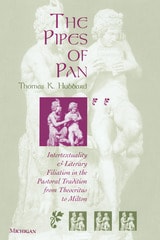
The Pipes of Pan
Intertextuality and Literary Filiation in the Pastoral Tradition from Theocritus to MiltonThomas K. Hubbard
University of Michigan Press, 1999
Pastoral poetry highlights the didactic relationship of older and younger shepherds, whether as rivals or as patron and successor. As such it is an ideal form for young poets' self-representation vis-à-vis their elders, whose work they simultaneously appropriated and transformed, even as the elder poets were represented in the new texts. This influence is reenacted in every generation: Theocritus vs. his Alexandrian forebears, Vergil vs. Theocritus, Calpurnius vs. Vergil, Nemesianus vs. Vergil and Calpurnius, Petrarch vs. Vergil, Boccaccio vs. Petrarch, Spenser vs. Vergil, along with Chaucer and Milton vs. Spenser.
The Pipes of Pan combines multiple strands of contemporary intertextual theory with reception aesthetics and Harold Bloom's theory of intersubjective conflict between generations of poets. It also provides one of the first systematic studies of intertextual and intersubjective dynamics within a whole genre.
This work will be of interest to classicists, students of literary theory, comparative literature, medieval and Renaissance literature, Italian humanism, and English literature of the sixteenth and seventeenth centuries. All texts are translated.
Thomas Hubbard is Associate Professor of Classics, University of Texas at Austin.
The Poetics of Transition
Emerson, Pragmatism, and American Literary ModernismJonathan Levin
Duke University Press, 1999
Levin draws on the pragmatist and neopragmatist writings of William James, John Dewey, George Santayana, Richard Rorty, and Cornel West to illuminate the work of modernist literature. In turn, he illuminates the poetic imperatives of pragmatism by tracing the ways in which Henry James, Gertrude Stein, and Wallace Stevens capture the moment of transition—a paradoxical moment that, once it is represented in language or art, requires its own perpetual overcoming. Throughout, he explores how modernist writers, who are masters at recording such “illegible” moments of transition in their poetry and prose, significantly contribute to an expanded understanding of pragmatism and its underlying aesthetics. By linking Emerson with the progressive philosophy of turn-of-the-century pragmatism and the experimentation of American literary modernism, Levin offers new insight into Emerson’s lasting influence on later American philosophers, novelists, and poets.
The Poetics of Transition will interest scholars and students in the fields of literary criticism, neopragmatism, literary modernism, and American literature.
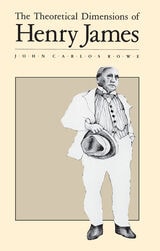
The Theoretical Dimensions of Henry James
John Carlos Rowe
University of Wisconsin Press, 1985
Rowe examines James from the perspectives of the psychology of literary influence, feminism, Marxism, psychoanalysis, literary phenomenology and impressionism, and reader-response criticism, transforming a literary monument into the telling point of intersection for modern critical theories.
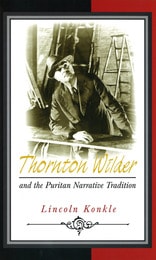
Thornton Wilder and the Puritan Narrative Tradition
Lincoln Konkle
University of Missouri Press, 2005

Vision and Textuality
Stephen Melville and Bill Readings, eds.
Duke University Press, 1995
With essays by Rosalind Krauss, Hal Foster, Norman Bryson, Victor Burgin, Martin Jay, Louis Marin, Thomas Crow, Griselda Pollock, and others, the volume is organized into sections devoted to the discipline of art history, the implications of semiotics, the new cultural history of art, and the impact of psychoanalysis. The works discussed in these essays range from Rembrandt’s Danae to Jorge Immendorf’s Café Deutschland, from Vauxhall Gardens to Max Ernst, and from the Imagines of Philostratus to William Godwin’s novel Caleb Williams. Each section is preceded by a short introduction that offers further contexts for considering the essays that follow, while the editors’ general introduction presents an overall exploration of the relation between vision and textuality in a variety of both institutional and theoretical contexts. Among other issues, it examines the relevance of aesthetics, the current concern with modernism and postmodernism, and the possible development of new disciplinary formations in the humanities.
Contributors. Mieke Bal, John Bender, Norman Bryson, Victor Burgin, Thomas Crow, Peter de Bolla, Hal Foster, Michael Holly, Martin Jay, Rosalind Krauss, Françoise Lucbert, Louis Martin, Stephen Melville, Griselda Pollock, Bill Readings, Irit Rogoff, Bennet Schaber, John Tagg