Results by title
17 books match the query 'Internal security'

Brown Threat
Identification in the Security StateKumarini Silva
University of Minnesota Press, 2016
What is “brown” in—and beyond—the context of American identity politics? How has the concept changed since 9/11? In the most sustained examination of these questions to date, Kumarini Silva argues that “brown” is no longer conceived of solely as a cultural, ethnic, or political identity. Instead, after 9/11, the Patriot Act, and the wars in Iran, Iraq, and Afghanistan, it has also become a concept and, indeed, a strategy of identification—one rooted in xenophobic, imperialistic, and racist ideologies to target those who do not neatly fit or subscribe to ideas of nationhood.
Interweaving personal narratives, ethnographic research, analyses of popular events like the Miss America pageant, and films and TV shows such as the Harold and Kumar franchise and Black-ish, Silva maps junctures where the ideological, political, and mediated terrain intersect, resulting in an appetite for all things “brown” (especially South Asian brown) by U.S. consumers, while political and nationalist discourses and legal structures (immigration, emigration, migration, outsourcing, incarceration) conspire to control brown bodies both within and outside the United States.
Silva explores this contradictory relationship between representation and reality, arguing that the representation mediates and manages the anxieties that come from contemporary global realities, in which brown spaces, like India, Pakistan, and the Middle East pose key economic, security, and political challenges to the United States. While racism is hardly new, what makes this iteration of brown new is that anyone or any group, at any time, can be branded as deviant, as a threat.
Building the Cold War Consensus
The Political Economy of U.S. National Security Policy, 1949-51Benjamin O. Fordham
University of Michigan Press, 1998

Citizenship in Cold War America
The National Security State and the Possibilities of DissentAndrea Friedman
University of Massachusetts Press, 2014
The stories told here capture a wide-ranging debate about the workings of the national security state and the meaning of American citizenship. Some of the participants in this debate—women like war bride Ellen Knauff and Pentagon employee Annie Lee Moss—were able to make their own experiences compelling examples of the threats posed by the national security regime. Others, such as Ruth Reynolds and Lolita Lebrón, who advocated an end to American empire in Puerto Rico, or the psychiatrist Fredric Wertham, who sought to change the very definition of national security, were less successful. Together, however, they exposed the gap between democratic ideals and government policies.
Friedman traverses immigration law and loyalty boards, popular culture and theoretical treatises, U.S. court-rooms and Puerto Rican jails, to demonstrate how Cold War repression made visible in new ways the unevenness and limitations of American citizenship. Highlighting the ways that race and gender shaped critiques and defenses of the national security regime, she offers new insight into the contradictions of Cold War political culture.

Clearer Than Truth
The Polygraph and the American Cold WarJohn Philipp Baesler
University of Massachusetts Press, 2018
In this first comprehensive history of the polygraph as a tool and symbol of American Cold War policies, John Philipp Baesler tells the story of a technology with weak scientific credentials that was nevertheless celebrated as a device that could expose both internal and external enemies. Considered the go-to technology to test agents' and employees' loyalty, the polygraph's true power was to expose deep ideological and political fault lines. While advocates praised it as America's hard-nosed yet fair answer to communist brainwashing, critics claimed that its use undermined the very values of justice, equality, and the presumption of innocence for which the nation stood.
Clearer Than Truth demonstrates that what began as quick-fix technology promising a precise test of honesty and allegiance eventually came to embody tensions in American Cold War culture between security and freedom, concerns that reach deep into the present day.
Feminist Surveillance Studies
Rachel E. Dubrofsky and Soshana Amielle Magnet, eds.
Duke University Press, 2015
Contributors. Seantel Anaïs, Mark Andrejevic, Paisley Currah, Sayantani DasGupta, Shamita Das Dasgupta, Rachel E. Dubrofsky, Rachel Hall, Lisa Jean Moore, Yasmin Jiwani, Ummni Khan, Shoshana Amielle Magnet, Kelli Moore, Lisa Nakamura, Dorothy Roberts, Andrea Smith, Kevin Walby, Megan M. Wood, Laura Hyun Yi Kang

Hatred at Home
al-Qaida on Trial in the American MidwestAndrew Welsh-Huggins
Ohio University Press, 2011
One day in 2002, three friends—a Somali immigrant, a Pakistan–born U.S. citizen, and a hometown African American—met in a Columbus, Ohio coffee shop and vented over civilian casualties in the war in Afghanistan. Their conversation triggered an investigation that would become one of the most unusual and far–reaching government probes into terrorism since the 9/11 attacks.
Over several years, prosecutors charged each man with unrelated terrorist activities in cases that embodied the Bush administration’s approach to fighting terrorism at home.
Government lawyers spoke of catastrophes averted; defense attorneys countered that none of the three had done anything but talk. The stories of these homegrown terrorists illustrate the paradox the government faces after September 11: how to fairly wage a war against alleged enemies living in our midst.
Hatred at Home is a true crime drama that will spark debate from all political corners about safety, civil liberties, free speech, and the government’s war at home.
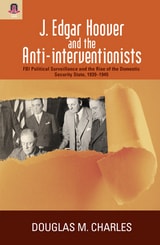
J. Edgar Hoover and the Anti-interventionists
FBI Political Surveillance and the Rise of the Domestic Security State, 1939–1945Douglas M. Charles
The Ohio State University Press, 2007
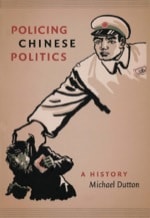
Policing Chinese Politics
A HistoryMichael Dutton
Duke University Press, 2005
The economic reform period that followed Mao Zedong’s rule contained a hint as to how the magic spell of political faith and commitment could be broken, but the cost of such disenchantment was considerable. This detailed, empirical tale of Chinese socialist policing is, therefore, more than simply a police story. It is a parable that offers a cogent analysis of Chinese politics generally while radically redrafting our understanding of what politics is all about. Breaking away from the traditional elite modes of political analysis that focus on personalities, factions, and betrayals, and from “rational” accounts of politics and government, Dutton provides a highly original understanding of the far-reaching consequences of acts of faith and commitment in the realm of politics.

Red Scare
Right-Wing Hysteria, Fifties Fanaticism, and Their Legacy in TexasBy Don Carleton
University of Texas Press, 2014

Security Integration in Europe
How Knowledge-based Networks Are Transforming the European UnionMai'a K. Davis Cross
University of Michigan Press, 2013
The European Union has made remarkable, unprecedented advances in both external and internal security integration. "Epistemic communities" of ambassadors, military generals, scientists, and other experts who supersede national governments in the diplomacy of security decision making are taking advantage of their shared expertise, common culture, professional norms, and frequent meetings to forge new levels of collaboration. Mai'a K. Davis Cross brings together numerous personal interviews and recent government documents across five separate case studies to construct a microsociological account of how EU governance really works and what future role the EU is likely to play internationally.
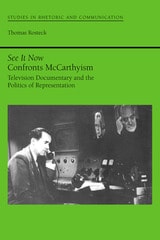
See It Now Confronts McCarthyism
Television Documentary and the Politics of RepresentationThomas Rosteck
University of Alabama Press, 1994
See It Now, Edward R. Murrow and Fred W. Friendly’s early documentary television program, has come to be recognized as the exemplar of nonfiction television. One important element in its reputation is a series of four telecasts directly dealing with abuses of McCarthyism and the Red Scare. This book is about those programs, but it is also about the early 1950s in America, the troubled era in which these programs were broadcast. This book is, then, both cultural history and media analysis.
As media analysis, this book seeks to understand the symbolic form, the aesthetic construction, and the subsequent experience that these four programs offered viewers. This sort of critical analysis is a development of recent vintage in American media studies. Whereas a decade ago television and the media were studied largely through an empiricist social scientific paradigm, now humanistic approaches to media discourses engage the interest of scholars in history, rhetoric and communication, political science, anthropology, and American studies. As case study, then, this book bridges classical humanist and contemporary mass media approaches, and as we go, I shall essay the utility of humanistic methods for the understanding and explication of mass media that is primarily visual in nature.
As cultural history, this book seeks to illuminate a unique era in the recent American past. My aim is to understand the programs as articulations of public “common sense” and as artifacts that help convey this common sense. Thus, a second theme of this book will be to locate-through the analysis of public discourse cast in the television documentary form—an American ideology: a set of “templates” that both ground the programs and reveal the cultural assumptions of the historical period.
In addition, from a slightly different historical perspective, our increased understanding of these See It Now broadcasts gives us an appreciation of the development of the television industry and the genre of television documentary. Coming at a time when few Americans had television sets, these See It Now programs coincided with an exponential increase in television ownership and popularity. As an elaborate defense of free speech for the medium, these documentaries may have helped to establish autonomy and a direction for a nascent broadcasting industry. More specifically, as the paradigm for the television documentary and as the first regularly scheduled documentary series, these See It Now programs shaped expectations and set the benchmark to which all nonfiction television, from Twentieth Century to White Paper to Sixty Minutes, has been compared. Thus, a third theme will be the implications of these seminal programs for media institutions and for the genre of television news documentary.
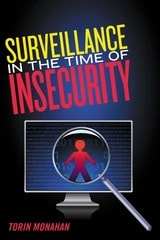
Surveillance in the Time of Insecurity
Monahan, Torin
Rutgers University Press, 2010
Surveillance in the Time of Insecurity fuses advanced theoretical accounts of state power and neoliberalism with original research from the social settings in which insecurity dynamics play out in the new century. Torin Monahan explores the counterterrorism-themed show 24, Rapture fiction, traffic control centers, security conferences, public housing, and gated communities, and examines how each manifests complex relationships of inequality, insecurity, and surveillance. Alleviating insecurity requires that we confront its mythic dimensions, the politics inherent in new configurations of security provision, and the structural obstacles to achieving equality in societies.

Suspect Community
People's Experiences of the Prevention of Terrorism ActPaddy Hillyard
Pluto Press, 1993
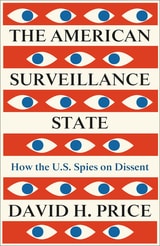
The American Surveillance State
How the U.S. Spies on DissentDavid H. Price
Pluto Press, 2022
New evidence has come to light proving how far the FBI monitored its citizens throughout the Cold War and beyond
When the possibility of wiretapping first became known to Americans they were outraged. Now, in our post-9/11 world, it’s accepted that corporations are vested with human rights, and government agencies and corporations use computers to monitor our private lives. David H. Price pulls back the curtain to reveal how the FBI and other government agencies have always functioned as the secret police of American capitalism up to today, where they luxuriate in a near-limitless NSA surveillance of all.
Price looks through a roster of campaigns by law enforcement, intelligence agencies, and corporations to understand how we got here. Starting with J. Edgar Hoover and the early FBI’s alignment with business, his access to 15,000 pages of never-before-seen FBI files shines a light on the surveillance of Edward Said, Andre Gunder Frank and Alexander Cockburn, Native American communists, and progressive factory owners.
Price uncovers patterns of FBI monitoring and harassing of activists and public figures, providing the vital means for us to understand how these new frightening surveillance operations are weaponized by powerful governmental agencies that remain largely shrouded in secrecy.

The Infrastructures of Security
Technologies of Risk Management in JohannesburgMartin J. Murray
University of Michigan Press, 2022
In The Infrastructures of Security, author Martin J. Murray concentrates on not only the turn toward technological solutions to managing the risk of crime through digital (and software-based) surveillance and automated information systems, but also the introduction of somewhat bizarre and fly-by-night experimental “answers” to perceived risk and danger. Digitalized surveillance is significant for two reasons: first, it enables monitoring to take place across wide "geographical distances with little time delay"; and second, it allows for the active sorting, identification, and "tracking of bodies, behaviors, and characteristics of subject populations on a continuous, real-time basis." These new software-based surveillance technologies represent monitoring, tracking, and information gathering without walls, towers, or guards.

The Paradox of Protection
The Making of Indirect Rule in Southern Sierra Leone, 1850–1915Trina Leah Hogg
Michigan State University Press, 2025
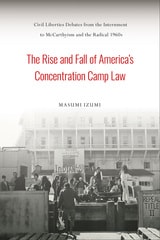
The Rise and Fall of America's Concentration Camp Law
Civil Liberties Debates from the Internment to McCarthyism and the Radical 1960sMasumi Izumi
Temple University Press, 2019
The Emergency Detention Act, Title II of the Internal Security Act of 1950, is the only law in American history to legalize preventive detention. It restricted the freedom of a certain individual or a group of individuals based on actions that may be taken that would threaten the security of a nation or of a particular area. Yet the Act was never enforced before it was repealed in 1971.
Masumi Izumi links the Emergency Detention Act with Japanese American wartime incarceration in her cogent study, The Rise and Fall of America’s Concentration Camp Law. She dissects the entangled discourses of race, national security, and civil liberties between 1941 and 1971 by examining how this historical precedent generated “the concentration camp law” and expanded a ubiquitous regime of surveillance in McCarthyist America.
Izumi also shows how political radicalism grew as a result of these laws. Japanese Americas were instrumental in forming grassroots social movements that worked to repeal Title II. The Rise and Fall of America’s Concentration Camp Law is a timely study in this age of insecurity where issues of immigration, race, and exclusion persist.