Results by title
751 books match the query 'International Relations' and 51 start with a
A Cardboard Castle?
An Inside History of the Warsaw Pact, 1955-1991The National Security Archive Mastny
Central European University Press, 2005
A Century of International Crisis Behavior
Edited by Jonathan Wilkenfeld, Kyle Beardsley, and Patrick James
University of Michigan Press, 2026
Perhaps more than ever, we need to invest in the study of the causes and consequences of crises. Since its founding in 1975, the International Crisis Behavior (ICB) Project has aimed to better equip academics, policymakers, and the next generation of engaged citizens to make sense of why crises arise and how they can be more effectively managed and prevented. The ICB Project’s data holdings consist of full-length qualitative case studies, along with an expanding range of quantitative datasets that include information regarding the characteristics of the states in crisis, crisis behavior, attempts at third-party crisis management, the role of nonstate actors, and the system-level context.
A Century of International Crisis Behavior summarizes the evolving patterns of international crisis behavior in the more than 500 cases cataloged since 1918, provides an accounting of the state of the scholarship to make sense of the patterns, and presents new findings that advance our understanding. Chapters are grouped according to their level of analysis: studies of systems, dyads, and states. The authors highlight what we have learned and what we have yet to learn regarding the prevention, escalation, and de-escalation of international crises.

A Death-Dealing Famine
The Great Hunger in IrelandChristine Kinealy
Pluto Press, 1997
A Documentary History of Communism and the World
From Revolution to CollapseEdited by Robert V. Daniels
Brandeis University Press, 1994
A Duel of Giants
Bismarck, Napoleon III, and the Origins of the Franco-Prussian WarDavid Wetzel
University of Wisconsin Press, 2001
Combining impeccable scholarship and literary elegance, David Wetzel depicts the drama of machinations and passions that exploded in a war that forever changed the face of European history.
A Foreign Policy in Transition
Moscow's Retreat from Central America and the Carribbean, 1985-1992Jan S. Adams
Duke University Press, 1992
Jan S. Adams analyzes the factors shaping Gorbachev's foreign policy in Central America by surveying Soviet political views old and new, by describing Gorbachev's bold restructuring of the Soviet foreign policy establishment, and by assessing the implications of his policy of perestroika. A series of country studies demonstrates how changes in Soviet policies and domestic and economic circumstances contributed to significant shifts in the internal conditions and external relations of the Central American and Caribbean nations. Adams discusses in detail such topics as the reduction of Soviet military and economic aid to the region and pressures exerted by Moscow on client states to effect the settlement of regional conflicts by political rather than military means.
The author concludes by speculating about which trends in foreign policy by Russia and other Soviet-successor states toward Central America and the Caribbean may persist in the post-Soviet period, discussing as the implications of these changes for future U.S. policy in the region.
A Miracle, A Universe
Settling Accounts with TorturersLawrence Weschler
University of Chicago Press, 1998
"Disturbing and often enthralling."—New York Times Book Review
"Extraordinarily moving. . . . Weschler writes brilliantly."—Newsday
"Implausible, intricate and dazzling."—Times Literary Supplement
"As Weschler's interviewees told their tales, I paced agitatedly, choked back tears. . . . Weschler narrates these two episodes with skill and tact. . . . An inspiring book."—George Scialabba, Los Angeles Weekly
A New Criminal Type in Jakarta
Counter-Revolution TodayJames T. Siegel
Duke University Press, 1998
Examining the links between the concept of criminality and scandal, rumor, fear, and the state, Siegel analyzes daily life in Jakarta through the seemingly disparate but strongly connected elements of family life, gossip, and sensationalist journalism. He offers close analysis of the preoccupation with crime in Pos Kota (a newspaper directed toward the lower classes) and the middle-class magazine Tempo. Because criminal activity has been a sensationalized preoccupation in Jakarta’s news venues and among its people, criminality, according to Siegel, has pervaded the identities of its ordinary citizens. Siegel examines how and why the government, fearing revolution and in an attempt to assert power, has made criminality itself a disturbing rationalization for the spectacular massacre of the people it calls criminals—many of whom were never accused of particular crimes. A New Criminal Type in Jakarta reveals that Indonesians—once united by Sukarno’s revolutionary proclamations in the name of “the people”—are now, lacking any other unifying element, united through their identification with the criminal and through a “nationalization of death” that has emerged with Suharto’s strong counter-revolutionary measures.
A provocative introduction to contemporary Indonesia, this book will engage those interested in Southeast Asian studies, anthropology, history, political science, postcolonial studies, public culture, and cultural studies generally.
A Not So Foreign Affair
Fascism, Sexuality, and the Cultural Rhetoric of American DemocracyAndrea Slane
Duke University Press, 2001
World War II marked a turning point in the cultural rhetoric of democracy, Slane claims, because it intensified a preoccupation with the political role of private life and pushed sexuality to the center of democratic discourse. Having created tremendous anxiety—and fascination—in American culture, Nazism became associated with promiscuity, sexual perversionand the destruction of the family. Slane reveals how this particular imprint of fascism is used in progressive as well as conservative imagery and language to further their domestic agendas and shows how our cultural engagement with Nazism reflects the inherent tension in democracy between the value of diversity, individual freedoms national identity, and notions of the common good. Finally, she applies her analysis of wartime narratives to contemporary texts, examining anti-abortion, anti-gay, and anti-federal rhetoric, as well as the psychic life of skinheads, censorship debates, and the contemporary fascination with incest.
An invaluable resource for understanding the language we use—both visual and narrative—to describe and debate democracy in the United States today, A Not So Foreign Affair will appeal to those interested in cultural studies, film and video studies, American studies, twentieth century history, German studies, rhetoric, and sexuality studies.
A User's Guide to the Crisis of Civilization
And How to Save ItNafeez Mosaddeq Ahmed
Pluto Press, 2010
It often seems that different crises are competing to devastate civilisation. This book argues that financial meltdown, dwindling oil reserves, terrorism and food shortages need to be considered as part of the same ailing system.
Most accounts of our contemporary global crises such as climate change, or the threat of terrorism, focus on one area, or another, to the exclusion of others. Nafeez Mosaddeq Ahmed argues that the unwillingness of experts to look outside their own fields explains why there is so much disagreement and misunderstanding about particular crises. This book attempts to investigate all of these crises, not as isolated events, but as trends and processes that belong to a single global system. We are therefore not dealing with a 'clash of civilisations', as Huntington argued. Rather, we are dealing with a fundamental crisis of civilisation itself.
This book provides a stark warning of the consequences of failing to take a broad view of the problems facing the world and shows how catastrophe can be avoided.
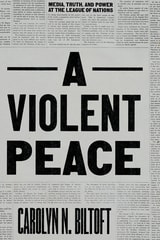
A Violent Peace
Media, Truth, and Power at the League of NationsCarolyn N. Biltoft
University of Chicago Press, 2021
An exploration of instability in information systems, the allure of fascism, and the contradictions at the heart of a global modernity, A Violent Peace paints a rich portrait of the emergence of the age of information—and all its attendant problems.
A War on Terror
Afghanistan and AfterPaul Rogers
Pluto Press, 2004
Paul Rogers is one of the world's leading security experts. Since the 11 September attacks, he has been a regular guest on TV news channels throughout America and Britain, where he has offered expert advice on the real implications of 9/11 and Bush's 'war on terror'. His articles in newspapers around the world, and in the web journal Open Democracy, have become essential reading for many thousands of people, including government officials, senior military, heads of UN agencies, opinion formers, journalists and peace activists.
A War on Terror is Paul Roger's radical assessment of Bush's new policy, the way it has affected world security and the grave implications that it holds for future peace, not only in the Middle East but throughout the world. Moving from the war in Afghanistan and its aftermath to the Israeli/Palestinian conflict, the continuing development of al-Qaida and its associates through to the war on Iraq, Rogers presents a uniquely cogent analysis of these rapid and traumatic events.
In a world in which the US and other states of the Atlantic community are increasingly speaking a different language to that of the majority of the world, Paul Rogers offers a vital critical assessment of the language of dominance and control as 'the New American Century' unfolds.
For the US, in particular, the post-9/11 world is one in which it is essential to maintain firm control of international security, extending to pre-emptive military action. In this book, Rogers demonstrates how futile, mistaken and deeply counter-productive that belief is, and points the way to more effective routes to a more just and secure world.
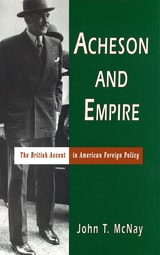
Acheson and Empire
The British Accent in American Foreign PolicyJohn T. McNay
University of Missouri Press, 2001
Acheson and Empire offers a compelling reassessment of Dean Acheson's policies toward the former colonial world during his period as secretary of state from 1949 to 1953. John T. McNay argues that Acheson inherited through his own personal history a way of understanding the world that encouraged imperial-style international relationships. This worldview represented a well-developed belief system rooted in his Ulster Protestant heritage that remained consistent throughout his life.
By exploring relationships of the United States with Britain and countries formerly or then controlled by Britain, such as India, Ireland, Iran, and Egypt, McNay shows the significance of Acheson's beliefs. McNay argues that Acheson's support of existing imperial relationships was so steadfast that it often led other nations to perceive that the United States was nothing more than a front for British interests. He believes this approach to foreign policy damaged American relations with emerging countries and misled the British regarding possibilities of an Anglo-American partnership.
Acheson and Empire contends that the widely accepted view of Acheson as a foreign policy realist is misleading and that historians should acknowledge that his affinity for the British Empire went beyond his clothing and mannerisms. McNay maintains that the widely accepted view of Acheson as one of a group of "wise men" who shaped the Cold War world by basing their decisions on cold calculation of American interests should be reconsidered.
Drawing from extensive research in archival sources, including the Truman Library, the National Archives, the Public Record Office in London, and Acheson's personal papers at Yale, Acheson and Empire offers a fresh look at Dean Acheson that runs counter to previous biographies and many histories of the Cold War.
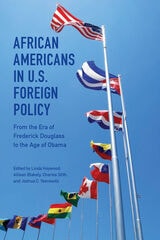
African Americans in U.S. Foreign Policy
From the Era of Frederick Douglass to the Age of ObamaEdited by Linda Heywood, Allison Blakely, Charles Stith, and Joshua C. Yesnowitz
University of Illinois Press, 2015
Groundbreaking and critical, African Americans in U.S. Foreign Policy expands on the scope and themes of recent collections to offer the most up-to-date scholarship to students in a range of disciplines, including U.S. and African American history, Africana studies, political science, and American studies.
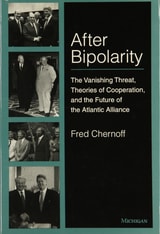
After Bipolarity
The Vanishing Threat, Theories of Cooperation and the Future of the Atlantic AllianceFred Chernoff, Editor
University of Michigan Press, 1995
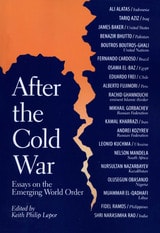
After the Cold War
Essays on the Emerging World OrderEdited by Keith Philip Lepor
University of Texas Press, 1997
The end of the Cold War between the United States and the former Soviet Union reassured people around the world who had lived in fear of a nuclear confrontation between the superpowers. Yet the early euphoria over "peace dividends" and a "new world order" was premature. Conflicts within and between nation-states are springing up around the globe, challenging world leaders and ordinary citizens to find peaceful means for national, group, and individual self-determination.
In this book of specially commissioned essays, twenty world leaders assess the possibilities and perils of the new strategic, political, and economic interrelationships that are emerging around the world. They tackle such fundamental questions as: What is the future of the international system as we approach the twenty-first century? What will be the fate of disintegrating nation-states, and how will the international community respond? Has the nation-state outlived its usefulness? Are we beginning to witness the complete breakdown of the international system?
The contributors are:
- Ali Alatas (Indonesia)
- Tariq Aziz (Iraq)
- James A. Baker III (United States)
- Benazir Bhutto (Pakistan)
- Boutros Boutros-Ghali (United Nations)
- Fernando Henrique Cardoso (Brazil)
- Osama El-Baz (Egypt)
- Eduardo Frei (Chile)
- Alberto Fujimori (Peru)
- Rachid Ghannouchi (eminent Islamic thinker)
- Mikhail Sergeyevich Gorbachev (Russian Federation)
- Kamal Kharrazi (Iran)
- Andrei Kozyrev (Russian Federation)
- Leonid Kuchma (Ukraine)
- Nelson Mandela (South Africa)
- Nursultan Nazarbayev (Kazakhstan)
- Olusegun Obasanjo (Nigeria)
- Muammar El-Qadhafi (Libya)
- Fidel Ramos (Philippines)
- Shri P. V. Narasimha Rao (India)
After the End
Making U.S. Foreign Policy in the Post-Cold War WorldJames M. Scott, ed.
Duke University Press, 1998
These essays examine the recent efforts of U.S. policymakers to recast the roles, interests, and purposes of the United States both at home and abroad in a political environment where policy making has become increasingly decentralized and democratized. The contributors suggest that foreign policy leadership has shifted from White House and executive branch dominance to an expanded group of actors that includes the president, Congress, the foreign policy bureaucracy, interest groups, the media, and the public. The volume includes case studies that focus on China, Russia, Bosnia, Somalia, democracy promotion, foreign aid, and NAFTA. Together, these chapters describe how policy making after 1991 compares to that of other periods and suggest how foreign policy will develop in the future.
This collection provides a broad, balanced evaluation of U.S. foreign policy making in the post–Cold War setting for scholars, teachers, and students of U.S. foreign policy, political science, history, and international studies.
Contributors. Ralph G. Carter, Richard Clark, A. Lane Crothers, I. M. Destler, Ole R. Holsti, Steven W. Hook, Christopher M. Jones, James M. McCormick, Jerel Rosati, Jeremy Rosner, John T. Rourke, Renee G. Scherlen, Peter J. Schraeder, James M. Scott, Jennifer Sterling-Folker, Rick Travis, Stephen Twing
After the Rubicon
Congress, Presidents, and the Politics of Waging WarDouglas L. Kriner
University of Chicago Press, 2010
When the United States goes to war, the nation’s attention focuses on the president. As commander in chief, a president reaches the zenith of power, while Congress is supposedly shunted to the sidelines once troops have been deployed abroad. Because of Congress’s repeated failure to exercise its legislative powers to rein in presidents, many have proclaimed its irrelevance in military matters.
After the Rubicon challenges this conventional wisdom by illuminating the diverse ways in which legislators influence the conduct of military affairs. Douglas L. Kriner reveals that even in politically sensitive wartime environments, individual members of Congress frequently propose legislation, hold investigative hearings, and engage in national policy debates in the public sphere. These actions influence the president’s strategic decisions as he weighs the political costs of pursuing his preferred military course.
Marshalling a wealth of quantitative and historical evidence, Kriner expertly demonstrates the full extent to which Congress materially shapes the initiation, scope, and duration of major military actions and sheds new light on the timely issue of interbranch relations.
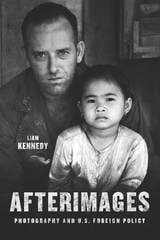
Afterimages
Photography and U.S. Foreign PolicyLiam Kennedy
University of Chicago Press, 2016
Liam Kennedy here maps the evolving relations between the American way of war and photographic coverage of it. Organized in its first section around key US military actions over the last fifty years, the book then moves on to examine how photographers engaged with these conflicts on wider ethical and political grounds, and finally on to the genre of photojournalism itself. Illustrated throughout with examples of the photographs being considered, Afterimages argues that photographs are important means for critical reflection on war, violence, and human rights. It goes on to analyze the high ethical, sociopolitical, and legalistic value we place on the still image’s ability to bear witness and stimulate action.
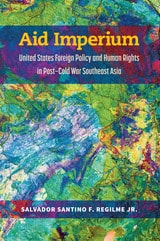
Aid Imperium
United States Foreign Policy and Human Rights in Post-Cold War Southeast AsiaSalvador Santino F. Regilme Jr.
University of Michigan Press, 2021
Does foreign aid promote human rights? As the world’s largest aid donor, the United States has provided foreign assistance to more than 200 countries. Deploying global numerical data on US foreign aid and comparative historical analysis of America’s post–Cold War foreign policies in Southeast Asia, Aid Imperium provides the most comprehensive explanation that links US strategic assistance to physical integrity rights outcomes in recipient countries, particularly in ways that previous quantitative studies have systematically ignored. The book innovatively highlights the active political agency of Global South states and actors as they negotiate and chart their political trajectories with the United States as the core state of the international system. Drawing from theoretical insights in the humanities and the social sciences as well as a wide range of empirical documents, Aid Imperium is the first multidisciplinary study to explain how US foreign policy affects state repression and physical integrity rights outcomes in Southeast Asia and the rest of the Global South.
Aid to Africa
So Much To Do, So Little DoneCarol Lancaster
University of Chicago Press, 1999
This balanced but tough-minded analysis does not reject the potential usefulness of foreign aid but does offer recommendations for fundamental changes in how governments and multilateral aid agencies can operate more effectively.
All International Politics Is Local
The Diffusion of Conflict, Integration, and DemocratizationKristian Skrede Gleditsch
University of Michigan Press, 2002
How does regional interdependence influence the prospects for conflict, integration, and democratization? Some researchers look at the international system at large and disregard the enormous regional variations. Others take the concept of sovereignty literally and treat each nation-state as fully independent. Kristian Skrede Gleditsch looks at disparate zones in the international system to see how conflict, integration, and democracy have clustered over time and space. He argues that the most interesting aspects of international politics are regional rather than fully global or exclusively national. Differences in the local context of interaction influence states' international behavior as well as their domestic attributes.
In All International Politics Is Local, Gleditsch clarifies that isolating the domestic processes within countries cannot account for the observed variation in distribution of political democracy over time and space, and that the likelihood of transitions is strongly related to changes in neighboring countries and the prior history of the regional context. Finally, he demonstrates how spatial and statistical techniques can be used to address regional interdependence among actors and its implications.
Kristian Skrede Gleditsch is Assistant Professor of Political Science at the University of California, San Diego.
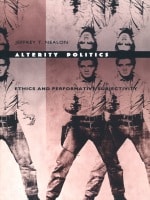
Alterity Politics
Ethics and Performative SubjectivityJeffrey T. Nealon
Duke University Press, 1998
While discussing the work of others who have refused to thematize difference in terms of the possibility or impossibility of sameness—Levinas, Butler, Derrida, Foucault, Deleuze, Guattari, Zizek, Jameson, Heidegger, Bakhtin—Nealon argues that ethics is constituted as inexorable affirmative response to different identities, not through an inability to understand or totalize the other. Alterity Politics combines this theoretical itinerary with crucial discussions of specific and diverse sites of literary and cultural production—the work of William S. Burroughs, Amiri Baraka, Andy Warhol, Ishmael Reed, Rush Limbaugh, and Vincent Van Gogh—along with analyses of the social formation of subjects as found in identity politics, and in multicultural and whiteness studies. In the process, Nealon takes on a wide variety of issues including white male anger, the ethical questions raised by drug addiction, the nature of literary meaning, and the concept of “becoming-black.”
In seeking to build an ethical structure around poststructuralist discourse and to revitalize the applied use of theoretical concepts to notions of performative identity, Alterity Politics marks a decisive intervention in literary theory, cultural studies, twentieth-century philosophy, and performance studies.
Ambassadors at Sea
The High and Low Adventures of a DiplomatBy Henry E. Catto, Jr.
University of Texas Press, 1998
In 1969, Henry Catto was selling insurance in San Antonio, Texas. Just twenty years later, he presented his credentials as ambassador to the Court of St. James's to Her Majesty, Queen Elizabeth II, at Buckingham Palace. In this engaging memoir, he retraces his journey from Texas outsider to Washington insider, providing a fascinating look at the glamour, day-to-day work, and even occasional danger that come with being a high-level representative of the United States government.
Catto's posts brought him into contact with the world's most powerful leaders and left him with a wealth of stories, which he recounts amusingly in these pages. He was the official host for Queen Elizabeth's visit to America during the Bicentennial year—and one of José Napoleon Duarte's protectors after his failed 1972 coup attempt in El Salvador. Catto accompanied Richard Nixon on his historic trip to Russia, sparred with Bill Moyers and the producers of "60 Minutes" as Caspar Weinberger's spokesman at the Pentagon, and hosted George Bush's planning meeting with Margaret Thatcher at the beginning of the Persian Gulf War. In telling these and other stories, he offers behind-the-scenes glimpses into how political power really works in Washington, London, and other world capitals.
Ambiguities of Domination
Politics, Rhetoric, and Symbols in Contemporary SyriaLisa Wedeen
University of Chicago Press, 2015
Wedeen shows how such flagrantly fictitious claims were able to produce a politics of public dissimulation in which citizens acted as if they revered the leader. By inundating daily life with tired symbolism, the regime exercised a subtle, yet effective form of power. The cult worked to enforce obedience, induce complicity, isolate Syrians from one another, and set guidelines for public speech and behavior. Wedeen‘s ethnographic research demonstrates how Syrians recognized the disciplinary aspects of the cult and sought to undermine them. In a new preface, Wedeen discusses the uprising against the Syrian regime that began in 2011 and questions the usefulness of the concept of legitimacy in trying to analyze and understand authoritarian regimes.
America at Risk
Threats to Liberal Self-Government in an Age of UncertaintyRobert Faulkner and Susan Shell, Editors
University of Michigan Press, 2009
America at Risk gathers original essays by a distinguished and bipartisan group of writers and intellectuals to address a question that matters to Americans of every political persuasion: what are some of the greatest dangers facing America today? The answers, which range from dwindling political participation to rising poverty, and religion to empire, add up to a valuable and timely portrait of a particular moment in the history of American ideas.
While the opinions are many, there is a central theme in the book: the corrosion of the liberal constitutional order that has long guided the country at home and abroad. The authors write about the demonstrably important dangers the United States faces while also breaking the usual academic boundaries: there are chapters on the family, religious polarization, immigration, and the economy, as well as on governmental and partisan issues.
America at Risk is required reading for all Americans alarmed about the future of their country.
Contributors
- Traci Burch
- James W. Ceaser
- Robert Faulkner
- Niall Ferguson
- William A. Galston
- Hugh Heclo
- Pierre Manent
- Harvey C. Mansfield
- Peter Rodriguez
- Kay Lehman Schlozman
- Susan Shell
- Peter Skerry
- James Q. Wilson
- Alan Wolfe
Robert Faulkner is Professor of Political Science at Boston College. Susan Shell is Professor of Political Science at Boston College.
"America at Risk goes well beyond the usual diagnoses of issues debated in public life like immigration, war, and debt, to consider the Republic’s founding principles, and the ways in which they have been displaced by newer thoughts and habits in contemporary America. A critical book for understanding our present condition."
—Francis Fukuyama, Bernard L. Schwartz Professor of International Political Economy, Johns Hopkins School of Advanced International Studies
"In this penetrating book, the nation’s finest social and political thinkers from across the spectrum take a careful and no-holds-barred look at the dangers facing the American political system. The conclusions are more unsettling than reassuring---but that is because they are honest and real."
—Norm Ornstein, Resident Scholar, American Enterprise Institute
"In the midst of overwrought pundits, irate soccer moms, and outraged bloggers, it is difficult to distinguish genuine dangers from false alarms and special pleading. This book enables us to do so, in a way that helps us to actually think about, not just feel anxious about, threats to those features of American society that are worth cherishing. The authors range in ideology and expertise, but they are uniformly judicious, incisive, and informative. This is a fascinating book about issues that the political system usually ignores or exaggerates."
—Jennifer L. Hochschild, Henry LaBarre Jayne Professor of Government and Professor of African and African American Studies, Harvard University
America's Miracle Man in Vietnam
Ngo Dinh Diem, Religion, Race, and U.S. Intervention in Southeast AsiaSeth Jacobs
Duke University Press, 2004
A diplomatic and cultural history, America’s Miracle Man in Vietnam draws on government archives, presidential libraries, private papers, novels, newspapers, magazines, movies, and television and radio broadcasts. Jacobs shows in detail how, in the 1950s, U.S. policymakers conceived of Cold War anticommunism as a crusade in which Americans needed to combine with fellow Judeo-Christians against an adversary dangerous as much for its atheism as for its military might. He describes how racist assumptions that Asians were culturally unready for democratic self-government predisposed Americans to excuse Diem’s dictatorship as necessary in “the Orient.” By focusing attention on the role of American religious and racial ideologies, Jacobs makes a crucial contribution to our understanding of the disastrous commitment of the United States to “sink or swim with Ngo Dinh Diem.”
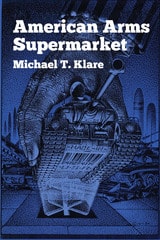
American Arms Supermarket
By Michael T. Klare
University of Texas Press, 1985
U.S. arms sales to Third World countries rapidly escalated from $250 million per year in the 1950s and 1960s to $10 billion and above in the 1970s and 1980s. But were these military sales, so critical in their impact on Third World nations and on America’s perception of its global role, achieving the ends and benefits attributed to them by U.S. policymakers? In American Arms Supermarket, Michael T. Klare responds to this troubling, still-timely question with a resounding no, showing how a steady growth in arms sales places global security and stability in jeopardy.
Tracing U.S. policies, practices, and experiences in military sales to the Third World from the 1950s to the 1980s, Klare explains how the formation of U.S. foreign policy did not keep pace with its escalating arms sales—how, instead, U.S. arms exports proved to be an unreliable instrument of policy, often producing results that diminished rather than enhanced fundamental American interests. Klare carefully considers the whole spectrum of contemporary American arms policy, focusing on the political economy of military sales, the evolution of U.S. arms export policy from John F. Kennedy to Ronald Reagan, and the institutional framework for arms export decision making. Actual case studies of U.S. arms sales to Latin America, Iran, and the Middle East provide useful data in assessing the effectiveness of arms transfer programs in meeting U.S. foreign policy objectives.
The author also rigorously examines trouble spots in arms policy: the transfer of arms-making technology to Third World arms producers, the relationship between arms transfers and human rights, and the enforcement of arms embargoes on South Africa, Chile, and other “pariah” regimes. Klare also compares the U.S. record on arms transfers to the experiences of other major arms suppliers: the Soviet Union and the “big four” European nations—France, Britain, the former West Germany, and Italy. Concluding with a reasoned, carefully drawn proposal for an alternative arms export policy, Klare vividly demonstrates the need for cautious, restrained, and sensitive policy.

American Civilization
Charles A. Jones
University of London Press, 2007
American Diplomacy
George F. Kennan
University of Chicago Press, 1985
This expanded edition retains the lectures and essays first published in 1951 as American Diplomacy, 1900-1950 and adds two lectures delivered in 1984 as well as a new preface by the author. In these additional pieces, Kennan explains how some of his ideas have changed over the years. He confronts the events and topics that have come to occupy American opinion in the last thirty years, including the development and significance of the Cold War, the escalation of the nuclear arms race, and the American involvement in Vietnam.
"A book about foreign policy by a man who really knows something about foreign policy."—James Reston,New York Times Book Review
"These celebrated lectures, delivered at the University of Chicago in 1950, were for many years the most widely read account of American diplomacy in the first half of the twentieth century. . . . The second edition of the work contains two lectures from 1984 that reconsider the themes of American Diplomacy"—Foreign Affairs, Significant Books of the Last 75 Years.
American Diplomacy
Sixtieth-Anniversary Expanded EditionGeorge F. Kennan
University of Chicago Press, 2012
For more than sixty years, George F. Kennan’s American Diplomacy has been a standard work on American foreign policy. Drawing on his considerable diplomatic experience and expertise, Kennan offers an overview and critique of the foreign policy of an emerging great power whose claims to rightness often spill over into self-righteousness, whose ambitions conflict with power realities, whose judgmentalism precludes the interests of other states, and whose domestic politics frequently prevent prudent policies and result in overstretch. Keenly aware of the dangers of military intervention and the negative effects of domestic politics on foreign policy, Kennan identifies troubling inconsistencies in the areas between actions and ideals—even when the strategies in question turned out to be decided successes.
In this expanded sixtieth-anniversary edition, a substantial new introduction by John J. Mearsheimer, one of America’s leading political realists, provides new understandings of Kennan’s work and explores its continued resonance. As America grapples with its new role as one power among many—rather than as the “indispensable nation” that sees “further into the future”—Kennan’s perceptive analysis of the past is all the more relevant. Today, as then, the pressing issue of how to wield power with prudence and responsibility remains, and Kennan’s cautions about the cost of hubris are still timely. Refreshingly candid, American Diplomacy cuts to the heart of policy issues that continue to be hotly debated today.
“These celebrated lectures, delivered at the University of Chicago in 1950, were for many years the most widely read account of American diplomacy in the first half of the twentieth century.”—Foreign Affairs, Significant Books of the Last 75 Years
American Dove
US Foreign Policy and the Failure of ForceZachary C. Shirkey
University of Michigan Press, 2020
American Power and International Theory at the Council on Foreign Relations, 1953-54
David M. McCourt, Editor
University of Michigan Press, 2020
Between December 1953 and June 1954, the elite think-tank the Council on Foreign Relations (CFR) joined prominent figures in International Relations, including Pennsylvania’s Robert Strausz-Hupé, Yale’s Arnold Wolfers, the Rockefeller Foundation’s William Thompson, government adviser Dorothy Fosdick, and nuclear strategist William Kaufmann. They spent seven meetings assessing approaches to world politics—from the “realist” theory of Hans Morgenthau to theories of imperialism of Karl Marx and V.I. Lenin—to discern basic elements of a theory of international relations.
The study group’s materials are an indispensable window to the development of IR theory, illuminating the seeds of the theory-practice nexus in Cold War U.S. foreign policy. Historians of International Relations recently revised the standard narrative of the field’s origins, showing that IR witnessed a sharp turn to theoretical consideration of international politics beginning around 1950, and remained preoccupied with theory. Taking place in 1953–54, the CFR study group represents a vital snapshot of this shift.
This book situates the CFR study group in its historical and historiographical contexts, and offers a biographical analysis of the participants. It includes seven preparatory papers on diverse theoretical approaches, penned by former Berkeley political scientist George A. Lipsky, followed by the digest of discussions from the study group meetings. American Power and International Theory at the Council on Foreign Relations, 1953–54 offers new insights into the early development of IR as well as the thinking of prominent elites in the early years of the Cold War.
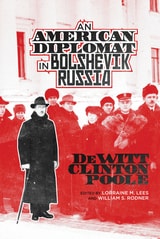
An American Diplomat in Bolshevik Russia
DeWitt Clinton Poole, Edited by Lorraine M. Lees and William S. Rodner
University of Wisconsin Press, 2014
Historians Lorraine M. Lees and William S. Rodner introduce and annotate Poole's recollections, which give a fresh, firsthand perspective on monumental events in world history and reveal the important impact DeWitt Clinton Poole (1885–1952) had on U.S.–Soviet relations. He was active in implementing U.S. policy, negotiating with the Bolshevik authorities, and supervising American intelligence operations that gathered information about conditions throughout Russia, especially monitoring anti-Bolshevik elements and areas of German influence. Departing Moscow in late 1918 via Petrograd, he was assigned to the port of Archangel, then occupied by Allied and American forces, and left Russia in June 1919.
An Independent Empire
Diplomacy & War in the Making of the United StatesMichael S. Kochin and Michael Taylor
University of Michigan Press, 2020
Foreign policies and diplomatic missions, combined with military action, were the driving forces behind the growth of the early United States. In an era when the Old and New Worlds were subject to British, French, and Spanish imperial ambitions, the new republic had limited diplomatic presence and minimal public credit. It was vulnerable to hostile forces in every direction. The United States could not have survived, grown, or flourished without the adoption of prescient foreign policies, or without skillful diplomatic operations.
An Independent Empire shows how foreign policy and diplomacy constitute a truly national story, necessary for understanding the history of the United States. In this lively and well-written book, episodes in American history—such as the writing and ratification of the Constitution, Henry Clay’s advocacy of an American System, Pinckney’s Treaty with Spain, and the visionary but absurd Congress of Panama—are recast as elemental aspects of United States foreign and security policy.
An Independent Empire tells the stories of the people who defined the early history of America’s international relationships. Throughout the book are brief, entertaining vignettes of often-overlooked intellectuals, spies, diplomats, and statesmen whose actions and decisions shaped the first fifty years of the United States. More than a dozen bespoke maps illustrate that the growth of the early United States was as much a geographical as a political or military phenomenon.
Anarchy, Order and Integration
How to Manage InterdependenceHarvey Starr
University of Michigan Press, 2000
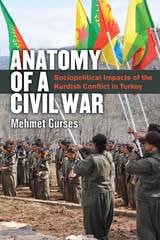
Anatomy of a Civil War
Sociopolitical Impacts of the Kurdish Conflict in TurkeyMehmet Gurses
University of Michigan Press, 2018
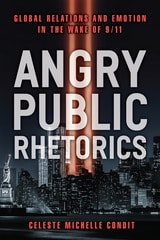
Angry Public Rhetorics
Global Relations and Emotion in the Wake of 9/11Celeste Michelle Condit
University of Michigan Press, 2018
These voices show that anger is more effective for producing some collective actions, such as rallying supporters, reifying existing worldviews, motivating attack, enforcing shared norms, or threatening from positions of power; and less effective for others, like broadening thought, attracting new allies, adjudicating justice across cultural norms, or threatening from positions of weakness. Because social anger requires shared norms, collectivized anger cannot serve social justice. In order for anger to be a force for global justice, the world’s peoples must develop shared norms to direct discussion of international relations. Angry Public Rhetorics provides guidance for such public forums.
Antidumping Law
Policy and ImplementationJohn H. Jackson, Editor
University of Michigan Press, 1979
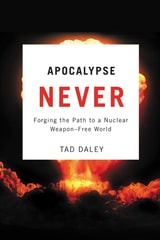
Apocalypse Never
Forging the Path to a Nuclear Weapon-Free WorldDaley, Tad
Rutgers University Press, 2012
Apocalypse Never maintains that the abolition of nuclear weapons is both essential and achievable, and reveals in fine detail what we need to do--both governments and movements--to make it a reality. Daley insists that while global climate change poses the single greatest long-term peril to the human race, the nuclear challenge in its many incarnation--nuclear terror, nuclear accident, a nuclear crisis spinning out of control--poses the single most immediate peril. Daley launches a wholesale assault on the nuclear double standard--the notion that the United States permits itself thousands of these weapons but forbids others from aspiring to even one--insisting that it is militarily unnecessary, morally indefensible, and politically unsustainable. He conclusively repudiates the most frequent objection to nuclear disarmament, "the breakout scenario"--the possibility that after abolition someone might whip back the curtain, reveal a dozen nuclear warheads, and proceed to "rule the world."
On the wings of a brand new era in American history, Apocalypse Never makes the case that a comprehensive nuclear policy agenda from President Obama, one that fully integrates nonproliferation with disarmament, can both eliminate immediate nuclear dangers and set us irreversibly on the road to abolition. In jargon-free language, Daley explores the possible verification measures, enforcement mechanisms, and governance structures of a nuclear weapon-free world. Most importantly, he decisively argues that universal nuclear disarmament is something we can transform from a utopian fantasy into a concrete political goal.
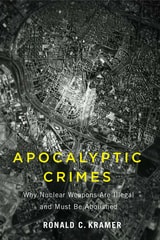
Apocalyptic Crimes
Why Nuclear Weapons Are Illegal and Must Be AbolishedRonald C. Kramer
Rutgers University Press, 2025
Kramer argues that any country holding on to its nuclear arsenal—including the United States—is committing a criminal act. Offering a sharp rebuke to the common claim that nuclear stockpiles serve to deter the escalation of conflict, Apocalyptic Crimes emphasizes the harm caused by the mere possession of these deadly weapons. It further considers the culpability of political officials, acting as representatives of the state, whose threatening statements about nuclear weapons contain actions or omissions that violate specific international laws. But Kramer also shows how a nuclear apocalypse might be averted and offers a pathway to disarmament. Through critical analysis and a specific criminology of nuclear weapons, Kramer outlines the political actions necessary to rewind the Doomsday Clock and pull the world back from the brink of destruction—before the clock strikes midnight.

Argentina, the United States, and the Anti-Communist Crusade in Central America, 1977–1984
Mis Lam#26Ariel Armony
Ohio University Press, 1997
Ariel Armony focuses, in this study, on the role played by Argentina in the anti–Communist crusade in Central America. This systematic examination of Argentina’s involvement in the Central American drama of the late 1970s and early 1980s fine–tunes our knowledge of a major episode of the Cold War era.
Basing his study on exhaustive research in the United States, Argentina, and Nicaragua, Armony adroitly demolishes several key assumptions that have shaped the work of scholars in U.S. foreign policy, Argentine military politics, and Central American affairs.
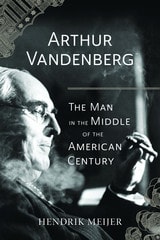
Arthur Vandenberg
The Man in the Middle of the American CenturyHendrik Meijer
University of Chicago Press, 2017
Originally the editor and publisher of the Grand Rapids Herald, Vandenberg was appointed and later elected to the Senate in 1928, where he became an outspoken opponent of the New Deal and a leader among the isolationists who resisted FDR’s efforts to aid European allies at the onset of World War II. But Vandenberg soon recognized the need for unity at the dawn of a new world order; and as a Republican leader, he worked closely with Democratic administrations to build the strong bipartisan consensus that established the Marshall Plan, the United Nations, and NATO. Vandenberg, as Meijer reveals, was instrumental in organizing Congressional support for these monumental twentieth-century foreign policy decisions.
Vandenberg’s life and career offer powerful lessons for today, and Meijer has given us a story that suggests an antidote to our current democratic challenges. After reading this poignant biography, many will ask: Where is the Vandenberg of today?
Asia First
China and the Making of Modern American ConservatismJoyce Mao
University of Chicago Press, 2015
Mao explores the deep resonance American conservatives felt with the defeat of Chiang Kai-Shek and his exile to Taiwan, which they lamented as the loss of China to communism and the corrosion of traditional values. In response, they fomented aggressive anti-communist positions that urged greater action in the Pacific, a policy known as “Asia First.” While this policy would do nothing to oust the communists from China, it was powerfully effective at home. Asia First provided American conservatives a set of ideals—American sovereignty, selective military intervention, strident anti-communism, and the promotion of a technological defense state—that would bring them into the global era with the positions that are now their hallmark.
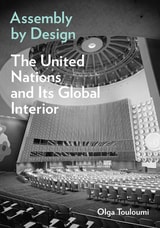
Assembly by Design
The United Nations and Its Global InteriorOlga Touloumi
University of Minnesota Press, 2024
How the United Nations headquarters became the architectural instrument and broadcast medium of global diplomacy
For almost seven years after World War II, a small group of architects took on an exciting task: to imagine the spaces of global governance for a new political organization called the United Nations (UN). To create the iconic headquarters of the UN in New York City, these architects experimented with room layouts, media technologies, and design in tribunal courtrooms, assembly halls, and council chambers. The result was the creation of a new type of public space, the global interior.
Assembly by Design shows how this space leveraged media to help the UN communicate with the world. With its media infrastructure, symbols, acoustic design, and architecture, the global interior defined political assembly both inside and outside the UN headquarters, serving as the architectural medium to organize multilateral encounters of international publics around the globe. Demonstrating how aesthetics have long held sway over political work, Olga Touloumi posits that the building framed diplomacy on the ground amid a changing political landscape that brought the United States to the forefront of international politics, destabilizing old and establishing new geopolitical alliances.
Uncovering previously closed institutional and family archives, Assembly by Design offers new information about the political and aesthetic decisions that turned the UN headquarters into a communications organism. It looks back at a moment of hope, when politicians, architects, and diplomats—believing that assembly was a matter of design—worked together to deliver platforms for global democracy and governance.
Atomic Diplomacy
Hiroshima and PotsdamGar Alperovitz
Pluto Press, 1995
Atrocity, Deviance, and Submarine Warfare
Norms and Practices during the World WarsNachman Ben-Yehuda
University of Michigan Press, 2013
In the early 20th century, the diesel-electric submarine made possible a new type of unrestricted naval warfare. Such brutal practices as targeting passenger, cargo, and hospital ships not only violated previous international agreements; they were targeted explicitly at civilians. A deviant form of warfare quickly became the norm.
In Atrocity, Deviance, and Submarine Warfare, Nachman Ben-Yehuda recounts the evolution of submarine warfare, explains the nature of its deviance, documents its atrocities, and places these developments in the context of changing national identities and definitions of the ethical, at both social and individual levels. Introducing the concept of cultural cores, he traces the changes in cultural myths, collective memory, and the understanding of unconventionality and deviance prior to the outbreak of World War I. Significant changes in cultural cores, Ben-Yehuda concludes, permitted the rise of wartime atrocities at sea.

Australian Adventure
Letters from an Ambassador's WifeBy Anne Clark
University of Texas Press, 1969
From August 1965 to February 1968, during his period of service in Australia, Ambassador Edward Clark traveled in that country as no other American and probably few Australians ever have. His wife, Anne Clark, traveled with him, then wrote her observations and impressions to friends and family in the United States.
Her letters, published for the first time in this volume, reveal the isolations and involvements as well as the opportunities and the pleasures of embassy life. The etiquette of official functions at times posed problems, as in the Clarks' first black-tie dinner with the Acting Governor General, where Mrs. Clark was supposed to curtsy. "Some Ambassadors feel strongly that the representative of the President of the United States should never bend his knee (or rather his wife's) to any man. Mrs. Battle, wife of our predecessor ... put the question directly to President Kennedy. His answer to her was, 'Curtsy you must, but keep a stiff upper knee.'"
Soon, Anne Clark realized that the routine of appearances and entertainments was constant: "I do not know when I will make peace with the schedule. I am a slave to the little black book that is my calendar."
In addition to the intricacies of embassy life, the Clarks encountered much that was unfamiliar—new people, almost a new language, new flowers, new animals—even a sky with its new moon upside down. But their warm hospitality and genuine interest in things Australian attracted friends throughout the continent. Figures from the government, the church, the diplomatic circle, and everyday life, plus well-known guests from home, all become known to the reader in this perceptive account of official life from the inside.
Authoritarian Apprehensions
Ideology, Judgment, and Mourning in SyriaLisa Wedeen
University of Chicago Press, 2019
Drawing on extensive fieldwork and a variety of Syrian artistic practices, Wedeen lays bare the ideological investments that sustain ambivalent attachments to established organizations of power and contribute to the ongoing challenge of pursuing political change. This masterful book is a testament to Wedeen’s deep engagement with some of the most troubling concerns of our political present and future.
Avoiding Losses/Taking Risks
Prospect Theory and International ConflictBarbara Farnham, Editor
University of Michigan Press, 1995
This volume is a comprehensive examination of the benefits and potential pitfalls of employing prospect theory---a leading alternative to expected utility as a theory of decision under risk---to understand and explain political behavior. The collection brings together both theoretical and empirical studies, thus grounding the conclusions about prospect theory's potential for enriching political analyses in an assessment of its performance in explaining actual cases.
The theoretical chapters provide an overview of the main hypotheses of prospect theory: people frame risk-taking decisions around a reference point, they tend to accept greater risk to prevent losses than to make gains, and they often perceive the devastation of a loss as greater than the benefit of a gain. The three case studies---Roosevelt's decision-making during the Munich crisis of 1938, Carter's April 1980 decision to rescue the American hostages in Iran, and Soviet behavior toward Syria in 1966-67---generally support these hypotheses. Nevertheless, the authors are frank about potentially difficult conceptual and methodological problems, making explicit reference to alternative explanations, such as the rational actor model, which posits the maximization of expected value.
Contributors to the volume include Jack Levy, Robert Jervis, Barbara Farnham, Rose McDermott, Audrey McInerney, and Eldar Shafir.