Results by title
19 books match the query 'Judaism and literature'
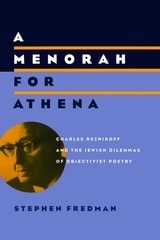
A Menorah for Athena
Charles Reznikoff and the Jewish Dilemmas of Objectivist PoetryStephen Fredman
University of Chicago Press, 2001
Stephen Fredman illuminates the relationship of Jewish intellectuals to modernity through a close look at Reznikoff's life and writing. He shows that when we regard the Objectivists as modern Jewish poets, we can see more clearly their distinctiveness as modernists and the reasons for their profound impact upon later poets, such as Allen Ginsberg and Charles Bernstein. Fredman also argues that to understand Reznikoff's work more completely, we must see it in the context of early, nonsectarian attempts to make the study of Jewish culture a force in the construction of a more pluralistic society. According to Fredman, then, the indelible images in Reznikoff's poetry open a window onto the vexed but ultimately successful entry of Jewish immigrants and their children into the mainstream of American intellectual life.
After The End
Representations Of Post-ApocalypseJames Berger
University of Minnesota Press, 1999
Explores the cultural function of the concept of “the end.”
Apocalyptic thought is hardly unique to the end of the twentieth century; it’s been a fixture of American culture for decades. Currently, the media are rife with omens and signs, and we’re bombarded with warnings that “the end is near.” But as James Berger argues here, the end never comes. There is always something left.
In this study of the cultural pursuit of the end and what follows, Berger contends that every apocalyptic depiction leaves something behind, some mixture of paradise and wasteland. Combining literary, psychoanalytic, and historical methods, Berger mines these depictions for their weight and influence on current culture. He applies wide-ranging evidence-from science fiction to Holocaust literature, from Thomas Pynchon to talk shows, from American politics to the fiction of Toni Morrison-to reveal how representations of apocalyptic endings are indelibly marked by catastrophic histories. These post-apocalyptic visions reveal as much about our perception of the past as they do about conceptions of the future. Berger examines the role of such historical crises as slavery, the Holocaust, and the Vietnam War and describes how these traumas continue to generate cultural symptoms. The shadow of impending apocalypse darkens today’s vision of the future, but it’s a familiar shadow: traumas we have already experienced as a culture are recycled into visions of new endings. Our “endings” are already after the end. Berger demonstrates that post-apocalyptic representations are both symptoms and therapies. Contemporary culture continually draws on these traumatic histories, trying to forget, remember, deny, and recover. After the End puts these visions in context, revealing them in some cases as dangerous evasions, in others as crucial tools for cultural survival. ISBN 0-8166-2932-3 Cloth £00.00 $47.95xxISBN 0-8166-2933-1 Paper £00.00 $18.95x248 Pages 5 7/8 x 9 MarchTranslation Inquiries: University of Minnesota Press
Crossing Cultures
Creating Identity in Chinese and Jewish American LiteratureJudith Oster
University of Missouri Press, 2003
Growing Up Ethnic
Nationalism and the Bildungsroman in African American and Jewish American FictionJaptok, Martin
University of Iowa Press, 2005
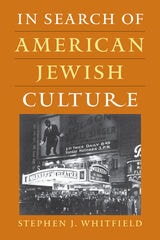
In Search of American Jewish Culture
Stephen J. Whitfield
Brandeis University Press, 2001
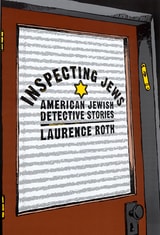
Inspecting Jews
American Jewish Detective StoriesRoth, Laurence
Rutgers University Press, 2003
Inthis book, Laurence Roth argues that the popular genre of Jewish detective stories offers new insights into the construction of ethnic and religious identity. Roth frames his study with the concept of “kosher hybridity” to look at the complex process of mediation between Jewish and American culture in which Jewish writers voice the desire to be both different from and yet the same as other Americans. He argues that the detective story, located at the intersection of narrative and popular culture in modern America, examines the need for order in a disorderly society, and thus offers a window into the negotiation of Jewish identity differing from that of literary fiction. The writers of these popular cultural texts, which are informed by contradiction and which thrive on intended and unintended ironies, formulate idioms for American Jewish identities that intentionally and unintentionally create social, ethnic, and religious syntheses in American Jewish life. Roth examines stories about American Jewish detectives—including Harry Kemelman’s Rabbi Small, Faye Kellerman’s Peter Decker and Rina Lazarus, Stuart Kaminsky’s Abe Lieberman, and Rochelle Krich’s Jessica Drake—not only as a genre of literature but also as a reflection of contemporary acculturation in the American Jewish popular arts.

Jewish Gangsters of Modern Literature
Rachel Rubin
University of Illinois Press, 2000
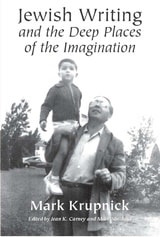
Jewish Writing and the Deep Places of the Imagination
Mark Krupnick
University of Wisconsin Press, 2005
When he learned he had ALS and roughly two years to live, literary critic Mark Krupnick returned to the writers who had been his lifelong conversation partners and asked with renewed intensity: how do you live as a Jew, when, mostly, you live in your head? The evocative and sinuous essays collected here are the products of this inquiry. In his search for durable principles, Krupnick follows Lionel Trilling, Cynthia Ozick, Geoffrey Hartman, Philip Roth, Saul Bellow, and others into the elemental matters of life and death, sex and gender, power and vulnerability.
The editors—Krupnick’s wife, Jean K. Carney, and literary critic Mark Shechner—have also included earlier essays and introductions that link Krupnick’s work with the “deep places” of his own imagination.
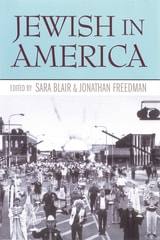
Jewish in America
Sara Blair and Jonathan Freedman, Editors
University of Michigan Press, 2004
-From the Introduction
This rare and original work of cultural studies offers uncommon and engaging perspectives-as well as provocative and humorous insights-on what it means to be Jewish in America.
Jewish in America features poetry, art, essays, and stories from an impressive and respected list of contributors, including among others Stephen Greenblatt, Richard Kostelanetz, Jacqueline Osherow, Robert Pinsky, Sharon Pomerantz, Nancy Reisman, Grace Schulman, Louis Simpson, Alisa Solomon, and Stephen J. Whitfield.
In addition to pieces by some of the country's leading writers, the book features a stunning gallery of original photographs that transport the viewer from the crowded Coney Island beaches of the 1940s to the landscapes of Oaxaca, Mexico in the 1990s.
Jurek Becker
A Life in Five WorldsSander L. Gilman
University of Chicago Press, 2003
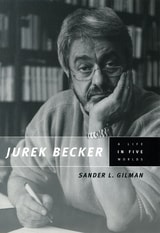
In the first biography of this fascinating figure, Sander Gilman tells the story of Becker's life in five worlds: the Polish-Jewish middle-class neighborhood where Becker was born; the Warsaw ghetto and the concentration camps where Becker spent his childhood; the socialist order of the GDR, which Becker idealized, resisted, and finally was forced to leave; the isolated world of West Berlin, where he settled down to continue his writing; and the new, reunified Germany, for which Becker served as both conscience and inspiration.
Gilman was close friends with Becker for nearly thirty years, and his biography is based on unprecedented access to both the man and his papers. As Gilman reveals, Becker's story encapsulates the fractured experience of life in twentieth-century Europe, a time and place in which political systems and national borders were constantly in flux. The life of Becker, we learn, was one of great literary achievement and notoriety, but it was also one of profound cultural dislocation. An important theme in the book is Becker's struggle with his Jewishness, an identity he repressed in socialist East Germany, but embraced after reunification, when he found himself at the center of Jewish culture and literature.
Sander Gilman's story of Jurek Becker is biography of the highest order, a portrait of an extraordinarily gifted artist whose hope and courage are manifested in his legacy as one of the greatest German writers of the past century.
Modeling Citizenship
Jewish and Asian American WritingAuthored by Cathy Schlund-Vials
Temple University Press, 2011
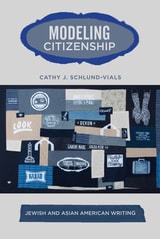
Navigating deftly among historical and literary readings, Cathy Schlund-Vials examines the analogous yet divergent experiences of Asian Americans and Jewish Americans in Modeling Citizenship. She investigates how these model minority groups are shaped by the shifting terrain of naturalization law and immigration policy, using the lens of naturalization, not assimilation, to underscore questions of nation-state affiliation and sense of belonging.
Modeling Citizenship examines fiction, memoir, and drama to reflect on how the logic of naturalization has operated at discrete moments in the twentieth century. Each chapter focuses on two exemplary literary works. For example, Schlund-Vials shows how Mary Antin's Jewish-themed play The Promised Land is reworked into a more contemporary Chinese American context in Gish Jen's Mona in the Promised Land.
In her compelling analysis, Schlund-Vials amplifies the structural, cultural, and historical significance of these works and the themes they address.
Radical Poetics and Secular Jewish Culture
Edited by Stephen Paul Miller and Daniel Morris
University of Alabama Press, 2009
--Franz Kafka
Kafka's quip--paradoxical, self-questioning, ironic--highlights vividly some of the key issues of identity and self-representation for Jewish writers in the 20th century. No group of writers better represents the problems of Jewish identity than Jewish poets writing in the American modernist tradition--specifically secular Jews: those disdainful or suspicious of organized religion, yet forever shaped by those traditions.
This collection of essays is the first to address this often obscured dimension of modern and contemporary poetry: the secular Jewish dimension. Editors Daniel Morris and Stephen Paul Miller asked their contributors to address what constitutes radical poetry written by Jews defined as "secular," and whether or not there is a Jewish component or dimension to radical and modernist poetic practice in general. These poets and critics address these questions by exploring the legacy of those poets who preceded and influenced them--Stein, Zukofsky, Reznikoff, Oppen, and Ginsberg, among others.
While there is no easy answer for these writers about what it means to be a Jew, in their responses there is a rich sense of how being Jewish reflects on their aesthetics and practices as poets, and how the tradition of the avant-garde informs their identities as Jews. Fragmented identities, irony, skepticism, a sense of self as "other" or "outsider," distrust of the literal, and belief in a tradition that questions rather than answers--these are some of the qualities these poets see as common to themselves, the poetry they make, and the tradition they work within.
Telling the Little Secrets
American Jewish Writing since the 1980sJanet Handler Burstein
University of Wisconsin Press, 2006
Janet Burstein argues that American Jewish writers since the 1980s have created a significant literature by wrestling with the troubled legacy of trauma, loss, and exile. Their ranks include Cynthia Ozick, Todd Gitlin, Art Spiegelman, Pearl Abraham, Aryeh Lev Stollman, Jonathan Rosen, and Gerda Lerner. Whether confronting the massive losses of the Holocaust, the sense of “home” in exile, or the continuing power of Jewish memory, these Jewish writers search for understanding within “the little secrets” of their dark, complicated, and richly furnished past.
The "Spirit of Poesy"
Essays on Jewish and German Literature and Thought in Honor of Geza von MolnarRichard Block and Peter Fenves
Northwestern University Press, 2000
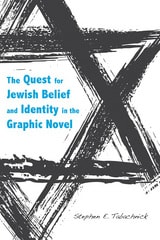
The Quest for Jewish Belief and Identity in the Graphic Novel
Stephen E. Tabachnick
University of Alabama Press, 2014
The creators of Superman (Jerry Siegel and Joe Shuster), Batman (Bob Kane and Bill Finger), and the Marvel superheroes (Stan Lee and Jack Kirby), were Jewish, as was the founding editor of Mad magazine (Harvey Kurtzman). They often adapted Jewish folktales (like the Golem) or religious stories (such as the origin of Moses) for their comics, depicting characters wrestling with supernatural people and events. Likewise, some of the most significant graphic novels by Jews or about Jewish subject matter deal with questions of religious belief and Jewish identity. Their characters wrestle with belief—or nonbelief—in God, as well as with their own relationship to the Jews, the historical role of the Jewish people, the politics of Israel, and other issues related to Jewish identity.
In The Quest for Jewish Belief and Identity in the Graphic Novel, Stephen E. Tabachnick delves into the vivid kaleidoscope of Jewish beliefs and identities, ranging from Orthodox belief to complete atheism, and a spectrum of feelings about identification with other Jews. He explores graphic novels at the highest echelon of the genre by more than thirty artists and writers, among them Harvey Pekar (American Splendor), Will Eisner (A Contract with God), Joann Sfar (The Rabbi’s Cat), Miriam Katin (We Are On Our Own), Art Spiegelman (Maus), J. T. Waldman (Megillat Esther), Aline Kominsky Crumb (Need More Love), James Sturm (The Golem’s Mighty Swing), Leela Corman (Unterzakhn), Ari Folman and David Polonsky (Waltz with Bashir), David Mairowitz and Robert Crumb’s biography of Kafka, and many more. He also examines the work of a select few non-Jewish artists, such as Robert Crumb and Basil Wolverton, both of whom have created graphic adaptations of parts of the Hebrew Bible.
Among the topics he discusses are graphic novel adaptations of the Bible; the Holocaust graphic novel; graphic novels about the Jews in Eastern and Western Europe and Africa, and the American Jewish immigrant experience; graphic novels about the lives of Jewish women; the Israel-centered graphic novel; and the Orthodox graphic novel. The book concludes with an extensive bibliography.
No study of Jewish literature and art today can be complete without a survey of the graphic novel, and scholars, students, and graphic novel fans alike will delight in Tabachnick’s guide to this world of thought, sensibility, and artfulness.

The Schlemiel as Metaphor, Revised and Enlarged Edition
Studies in Yiddish and American Jewish FictionSanford Pinsker
Southern Illinois University Press, 1991
The certainty that deep down we are all schlemiels is perhaps what makes America love an inept ball team or a Woody Allen who unburdens his neurotic heart in public.
In this unique, revised history of the schlemiel, Sanford Pinsker uses psychological, linguistic, and anecdotal approaches, as well as his considerable skills as a spritely storyteller, to trace the schlemiel from his beginnings in the Old Testament through his appearance in the nineteenth-century literature of Mendele Mocher Seforim and Sholom Aleichem to his final development as the beautiful loser in the works of Isaac Bashevis Singer, Bernard Malamud, Saul Bellow, Philip Roth, and Woody Allen. Horatio Alger might have once been a good emblem of the American sensibility, but today Woody Allen’s anxious, bespectacled punin (face) seems closer, and truer, to our national experience. His urban, end-of-the-century anxieties mirror—albeit in exaggeration—our own.
This expanded study of the schlemiel is especially relevant now, when scholarship of Yiddish and American Jewish literature is on the increase. By sketching the family tree of that durable anti-hero the schlemiel, Pinsker proves that Jewish humor is built upon the very foundations of the Jewish experience. Pinsker shows the evolution of the schlemiel from the comic butt of Yiddish jokes to a literary figure that speaks to the heart of our modern problems, and he demonstrates the way that Yiddish humor provides a sorely needed correction, a way of pulling down the vanities we all live by.
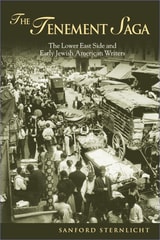
The Tenement Saga
The Lower East Side and Early Jewish American WritersSanford Sternlicht
University of Wisconsin Press, 2004
Sternlicht discusses the role of women, the Yiddish Theater, secular values, the struggle between generations, street crime, politics, labor unions, and the importance of newspapers and periodicals. He documents the decline of Yiddish culture as these immigrants blended into what they called "The Golden Land."
The Trace of Judaism
Dostoevsky, Babel, Mandelstam, LevinasVal Vinokur
Northwestern University Press, 2009
The defining quality of Russian literature, for most critics, is its ethical seriousness expressed through formal originality. The Trace of Judaism addresses this characteristic through the thought of the Lithuanian-born Franco-Jewish philosopher Emmanuel Levinas. Steeped in the Russian classics from an early age, Levinas drew significantly from Dostoevsky in his ethical thought. One can profitably read Russian literature through Levinas, and vice versa.
Witnessing the Disaster
Essays on Representation and the HolocaustEdited by Michael Bernard-Donals and Richard Glejzer
University of Wisconsin Press, 2003
These essayists aim to move past the notion that the Holocaust as an event defies representation. They look at specific cases of Holocaust representation and consider their effect, their structure, their authenticity, and the kind of knowledge they produce. Taken together they consider the tension between history and memory, the vexed problem of eyewitness testimony and its status as evidence, and the ethical imperatives of Holocaust representation.