Results by title
936 books match the query 'LGBTQ+ Studies' and 62 start with a
A Body in the O
Performances and StoriesTim Miller
University of Wisconsin Press, 2019
A Body of One's Own
A Trans History of ArgentinaPatricio Simonetto
University of Texas Press, 2024
2026 Silver Medal for the Best LGBTQ+ Themed Book, Conference on Latin American History (CLAH)
2026 Honorable Mention, Book Award, Social History Society
2025 Best Book in Social Sciences Award, Southern Cone Section, Latin American Studies Association
2024 Sylvia Rivera Award in Transgender Studies, The Center for LGBTQ Studies at the Graduate Center, CUNY
A history of Argentina that examines how trans bodies were understood, policed, and shaped in a country that banned medically assisted gender affirmation practices and punished trans lives.
As a trans history of Argentina, a country that banned medically assisted gender affirmation practices and punished trans lives, A Body of One’s Own places the histories of trans bodies at the core of modern Argentinian history. Patricio Simonetto documents the lives of people who crossed the boundaries of gender from the early twentieth century to the present. Based on extensive archival research in public and community-based archives, this book explores the mainstream medical and media portrayals of trans or travesti people, the state policing of gender embodiment, the experiences of those transgressing the boundaries of gender, and the development of homemade technologies from prosthetics to the self-injection of silicone. A Body of One's Own explores how trans activists' challenges to the exclusionary effects of Argentina’s legal, cultural, social, and political cisgender order led to the passage of the Gender Identity Law in 2012. Analyzing the decisive yet overlooked impact of gender transformation in the formation of the nation-state, gender-belonging, and citizenship, this book ultimately shows that supposedly abstract struggles to define the shifting notions of "sex," citizenship, and nationhood are embodied material experiences.
A Conditional Embrace
Black Queer Feminism in PerformanceKristyl D. Tift
The Ohio State University Press, 2026
In A Conditional Embrace, Kristyl D. Tift seeks to understand how Black queer women theater and film artists depict their own survival in heterosexist temporalities and spaces. Using the framework of lovin’ on—a theory inspired by Black feminist thought, performance theory, and queer theory—Tift closely reads the works of a selection of artists to investigate the “conditional embrace” of Black queer art in society. Her intersectional and intertextual methodology considers the text and body as part and parcel of performance work, allowing her to examine the multiple and complex intersections of identity at play in works meant to be read and performed. Tift puts the work of more visible artists such as Dee Rees, Sharon Bridgforth, and Staceyann Chin in direct conversation with lesser-known contributors to Black queer feminist performance such as Shirlene Holmes and Donnetta Lavinia Grays, analyzing not only their plays, installations, and poetry but also interviews, personal essays, performances, and more. Centering the works of artists situated, by birth or migration, in the Southern US and the Caribbean, A Conditional Embrace explores how artists at the margins of art and society represent Black queer women’s survival through processes of self-making, community-building, and homemaking.

A Desire for Women
Relational Psychoanalysis, Writing, and Relationships between WomenJuhasz, Suzanne
Rutgers University Press, 2003
Uniquely weaving together psychoanalytic, feminist, queer, and literary theory as well as memoir to examine the value and meaning of relationships between women, Juhasz explores the writings of adult daughters, mothers, and lovers to consider how language both traces and shapes the contours of experience. She emphasizes the initial bond between mother and infant as the bedrock of identity formation, a process involving love, recognition, desire, and language, and shows how that relationship serves as source and model for all future loves.
Juhasz's lucid prose unravels the meaningful yet overlooked intricacies of the relationships that inflect much of women's writing in the twentieth century.
A Desired Past
A Short History of Same-Sex Love in AmericaLeila J. Rupp
University of Chicago Press, 1999
"Most extraordinary about Leila J. Rupp's indeed short, two-hundred-page history of 'same-sex love and sexuality' is not that it manages to account for such a variety of individuals, races, and classes or take in such a broad chronological and thematic range, but rather that it does all this with such verve, lucidity, and analytical rigor. . . . [A]n elegant, inspiring survey." —John Howard, Journal of American History
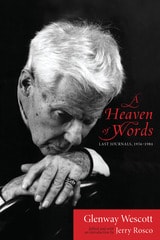
A Heaven of Words
Last Journals, 1956–1984Glenway Wescott; Edited and with an introduction by Jerry Rosco
University of Wisconsin Press, 2013
Winner, Gay Memoir/Biography, Lambda Literary Awards

A History of Bisexuality
Steven Angelides
University of Chicago Press, 2001
In a book that will become the center of debate about the nature of sexuality for years to come, A History of Bisexuality compels us to rethink contemporary discourses of sexual theory and politics.
A House of Prayer for All People
Contesting Citizenship in a Queer ChurchDavid K. Seitz
University of Minnesota Press, 2017
Perhaps an unlikely subject for an ethnographic case study, the Metropolitan Community Church of Toronto in Canada is a large predominantly LGBT church with a robust, and at times fraught, history of advocacy. While the church is often riddled with fault lines and contradictions, its queer and faith-based emphasis on shared vulnerability leads it to engage in radical solidarity with asylum-seekers, pointing to the work of affect in radical, coalition politics.
A House of Prayer for All People maps the affective dimensions of the politics of citizenship at this church. For nearly three years, David K. Seitz regularly attended services at MCCT. He paid special attention to how community and citizenship are formed in a primarily queer Christian organization, focusing on four contemporary struggles: debates on race and gender in religious leadership, activism around police–minority relations, outreach to LGBT Christians transnationally, and advocacy for asylum seekers. Engaging in debates in cultural geography, queer of color critique, psychoanalysis, and affect theory, A House of Prayer for All People stages innovative, reparative encounters with citizenship and religion.
Building on queer theory’s rich history of “subjectless” critique, Seitz calls for an “improper” queer citizenship—one that refuses liberal identity politics or national territory as the ethical horizon for sympathy, solidarity, rights, redistribution, or intimacy. Improper queer citizenship, he suggests, depends not only on “good politics” but also on people’s capacity for empathy, integration, and repair.

A Kiss across the Ocean
Transatlantic Intimacies of British Post-Punk and US LatinidadRichard T. Rodríguez
Duke University Press, 2022
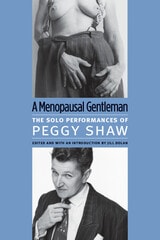
A Menopausal Gentleman
The Solo Performances of Peggy ShawPeggy Shaw
University of Michigan Press, 2011
"With classic butch finesse---that handsome combination of vulnerability and toughness---Peggy Shaw pieces together the challenges of growing up butch in the 1950s. Shaw is an engaging performer and inspired writer."
---Gay Community News
Obie-award-winning performer and writer Peggy Shaw has been playing her gender-bending performances on Off Broadway, regional, and international stages for three decades. Co-founder of the renowned troupe Split Britches, Shaw has gone on to create memorable solo performances that mix achingly honest introspection with campy humor, reflecting on everything from her Irish-American working-class roots to her aging butch body.
This collection of Shaw's solo performance scripts evokes a 54-year-old grandmother who looks like a 35-year-old man (in her classic Menopausal Gentleman); a mother's ambivalent ministrations to a daughter she treated like a son (in the raw You're Just Like My Father); Shaw's love for her biracial grandson, for whom she models masculinity (in the musically punctuated To My Chagrin); and a mapping of her body's long, bittersweet history (in the lyrical Must: The Inside Story, a collaboration with the UK's Clod Ensemble). The book also includes a selection of Shaw's other classic monologues and an extensive introduction by Jill Dolan, Professor of English and Theater and Dance at Princeton University and the blogger behind The Feminist Spectator website.
A volume in the series Triangulations: Lesbian/Gay/Queer Theater/Drama/Performance
Cover photos by Eva Weiss (top) and Robin Holland/robinholland.com (bottom).
A Part of the Heart Can't Be Eaten
A MemoirTristan Taormino
Duke University Press, 2023
Tristan’s world began to fall apart when her dad was diagnosed with AIDS. After a series of devastating events, she moved to the messy, glorious world of 1990s New York City. In the midst of grief and depression, she helped change queer sexual subculture with her zine Pucker Up, her infamous The Village Voice column, and her editorship of legendary lesbian porn magazine On Our Backs. After the publication of her first book, The Ultimate Guide to Anal Sex for Women, Tristan followed her own path that marked the beginning of her work as a trailblazing feminist pornographer.
After a lifetime of outrageous adventures, Tristan reflects on the bonds, loss, and mental-health struggles that shaped her. She weaves together history from her father’s unpublished memoir, exploring the surprising ways their personal patterns converge and diverge. Bracingly emotional and erotically charged, A Part of the Heart Can’t Be Eaten reveals the transformative power of queer pleasure and defiance.
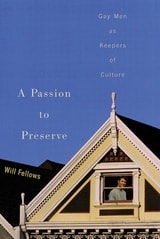
A Passion to Preserve
Gay Men as Keepers of CultureWill Fellows
University of Wisconsin Press, 2005
From large cities to rural communities, gay men have long been impassioned pioneers as keepers of culture: rescuing and restoring decrepit buildings, revitalizing blighted neighborhoods, saving artifacts and documents of historical significance. A Passion to Preserve explores this authentic and complex dimension of gay men’s lives by profiling early and contemporary preservationists from throughout the United States, highlighting contributions to the larger culture that gays are exceptionally inclined to make.
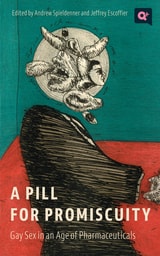
A Pill for Promiscuity
Gay Sex in an Age of PharmaceuticalsAndrew R. Spieldenner
Rutgers University Press, 2023
Finalist for Lambda Literary Award for Best LGBTQ+ Anthology
For a generation of gay men who came of age in the 1980s and 1990s, becoming sexually active meant confronting the dangers of catching and transmitting HIV. In the 21st century, however, the development of viral suppression treatments and preventative pills such as PrEP and nPEP has massively reduced the risk of acquiring HIV. Yet some of the stigma around gay male promiscuity and bareback sex has remained, inhibiting open dialogues about sexual desire, risk, and pleasure.
A Pill for Promiscuity brings together academics, artists, and activists—from different generations, countries, ethnic backgrounds, and HIV statuses—to reflect on how gay sex has changed in a post-PrEP era. Some offer personal perspectives on the value of promiscuity and the sexual communities it fosters, while others critique unequal access to PrEP and the increased role Big Pharma now plays in gay life. With a diverse group of contributors that includes novelist Andrew Holleran, trans scholar Lore/tta LeMaster, cartoonist Steve MacIsaac, and pornographic film director Mister Pam, this book asks provocative questions about how we might reimagine queer sex and sexuality in the 21st century.
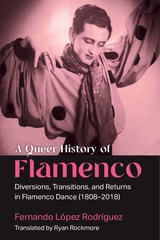
A Queer History of Flamenco
Diversions, Transitions, and Returns in Flamenco Dance (1808–2018)Fernando López Rodríguez, translation by Ryan Rockmore
University of Michigan Press, 2024
Tracing flamenco’s development from its birth up to the contemporary era, the book places flamenco within significant historical periods such as the Spanish Civil War, Franco’s dictatorship, the transition to democracy, and the economic crisis of 2008, up to contemporary performances of the late 2010s. In taking a queer approach to History, the author abandons antiquated debates about purities and impurities; anecdotes about the lives of artists that are completely detached from their processes of creation; and myths about geniuses who seem to make art alone and completely detached from their collaborators and the historical, social, economic and artistic moment in which they lived. A Queer History of Flamenco is not only about the present and the queerness of people living, performing, or creating in it, but also about flamenco’s past in which so many queer artists and practices and their lives have remained unearthed and unaddressed.
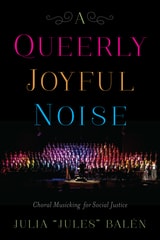
A Queerly Joyful Noise
Choral Musicking for Social JusticeJulia "Jules" Balén
Rutgers University Press, 2017
Honorable Mention, 2019 Herndon Book Prize - (SEM-GST)
A Queerly Joyful Noise examines how choral singing can be both personally transformative and politically impactful. As they blend their different voices to create something beautiful, LGBTIQ singers stand together and make themselves heard. Comparing queer choral performances to the uses of group singing within the civil rights and labor movements, Julia “Jules” Balén maps the relationship between different forms of oppression and strategic musical forms of resistance. She also explores the potential this queer communal space creates for mobilizing progressive social action.
A proud member of numerous queer choruses, Balén draws from years of firsthand observations, archival research, and extensive interviews to reveal how queer chorus members feel shared vulnerability, collective strength, and even moments of ecstasy when performing. A Queerly Joyful Noise serves as a testament to the power of music, intimately depicting how participation in a queer chorus is more than a pastime, but a meaningful form of protest through celebration.
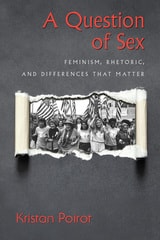
A Question of Sex
Feminism, Rhetoric, and Differences That MatterKristan Poirot
University of Massachusetts Press, 2014
Poirot focuses on five case studies—the circulation of Sojourner Truth's "Ain't I a Woman?" in early and contemporary feminist contexts; the visual rhetorics of the feminist self-help health movement; the public discourse of Elizabeth Cady Stanton and early nineteenth-century ideas about suffrage, sex, and race; the conflicts over lesbian sexuality in the 1960s and 1970s; and the discourse that surrounds twenty-first-century SlutWalks. In the process, Poirot rethinks the terms through which we understand U.S. feminist movements to explore the ways feminism has questioned sexed distinctions and practices over time. She emphasizes the importance of reading feminist engagements with sex as rhetorical endeavors—practices that are shaped by the instrumental demands of movements, the exigent situations that call for feminists to respond, and the enduring philosophical traditions that circulate in U.S. political contexts., reviewing a previous edition or volume
A Small Boy and Others
Imitation and Initiation in American Culture from Henry James to Andy WarholMichael Moon
Duke University Press, 1998
Moon illuminates the careers of James, Warhol, and others by examining the imaginative investments of their protogay childhoods in their work in ways that enable new, more complex cultural readings. He deftly engages notions of initiation and desire not within the traditional framework of “sexual orientation” but through the disorienting effects of imitation. Whether invoking the artist Joseph Cornell’s early fascination with the Great Houdini or turning his attention to James’s self-described “initiation into style” at the age of twelve—when he first encountered the homoerotic imagery in paintings by David, Géricault, and Girodet—Moon reveals how the works of these artists emerge from an engagement that is obsessive to the point of “queerness.”
Rich in historical detail and insistent in its melding of the recent with the remote, the literary with the visual, the popular with the elite, A Small Boy and Others presents a hitherto unimagined tradition of brave and outrageous queer invention. This long-awaited contribution from Moon will be welcomed by all those engaged in literary, cultural, and queer studies.
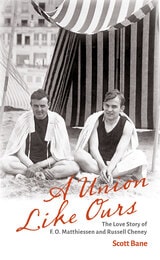
A Union Like Ours
The Love Story of F. O. Matthiessen and Russell CheneyScott Bane
University of Massachusetts Press, 2022
After a chance meeting aboard the ocean liner Paris in 1924, Harvard University scholar and activist F. O. Matthiessen and artist Russell Cheney fell in love and remained inseparable until Cheney’s death in 1945. During the intervening years, the men traveled throughout Europe and the United States, achieving great professional success while contending with serious personal challenges, including addiction, chronic disease, and severe depression.
During a hospital stay, years into their relationship, Matthiessen confessed to Cheney that “never once has the freshness of your life lost any trace of its magic for me. Every day is a new discovery of your wealth.” Situating the couple’s private correspondence alongside other sources, Scott Bane tells the remarkable story of their relationship in the context of shifting social dynamics in the United States. From the vantage point of the present day, with marriage equality enacted into law, Bane provides a window into the realities faced by same-sex couples in the early twentieth century, as they maintained relationships in the face of overt discrimination and the absence of legal protections.
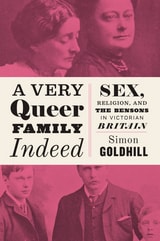
A Very Queer Family Indeed
Sex, Religion, and the Bensons in Victorian BritainSimon Goldhill
University of Chicago Press, 2016
So begins A Very Queer Family Indeed, which introduces us to the extraordinary Benson family. Edward White Benson became Archbishop of Canterbury at the height of Queen Victoria’s reign, while his wife, Mary, was renowned for her wit and charm—the prime minister once wondered whether she was “the cleverest woman in England or in Europe.” The couple’s six precocious children included E. F. Benson, celebrated creator of the Mapp and Lucia novels, and Margaret Benson, the first published female Egyptologist.
What interests Simon Goldhill most, however, is what went on behind the scenes, which was even more unusual than anyone could imagine. Inveterate writers, the Benson family spun out novels, essays, and thousands of letters that open stunning new perspectives—including what it might mean for an adult to kiss and propose marriage to a twelve-year-old girl, how religion in a family could support or destroy relationships, or how the death of a child could be celebrated. No other family has left such detailed records about their most intimate moments, and in these remarkable accounts, we see how family life and a family’s understanding of itself took shape during a time when psychoanalysis, scientific and historical challenges to religion, and new ways of thinking about society were developing. This is the story of the Bensons, but it is also more than that—it is the story of how society transitioned from the high Victorian period into modernity.
A View from the Bottom
Asian American Masculinity and Sexual RepresentationNguyen Tan Hoang
Duke University Press, 2014
A Xicana Codex of Changing Consciousness
Writings, 2000-2010Cherríe L. Moraga
Duke University Press, 2011
Thirty years after the publication of Anzaldúa and Moraga’s collection This Bridge Called My Back, a landmark of women-of-color feminism, Moraga’s literary and political praxis remains motivated by and intertwined with indigenous spirituality and her identity as Chicana lesbian. Yet aspects of her thinking have changed over time. A Xicana Codex of Changing Consciousness reveals key transformations in Moraga’s thought; the breadth, rigor, and philosophical depth of her work; her views on contemporary debates about citizenship, immigration, and gay marriage; and her deepening involvement in transnational feminist and indigenous activism. It is a major statement from one of our most important public intellectuals.
AIDS and the Distribution of Crises
Jih-Fei Cheng, Alexandra Juhasz, and Nishant Shahani, editors
Duke University Press, 2020
Contributors. Cecilia Aldarondo, Pablo Alvarez, Marlon M. Bailey, Emily Bass, Darius Bost, Ian Bradley-Perrin, Jih-Fei Cheng, Bishnupriya Ghosh, Roger Hallas, Pato Hebert, Jim Hubbard, Andrew J. Jolivette, Julia S. Jordan-Zachery, Alexandra Juhasz, Dredge Byung'chu Kang-Nguyễn, Theodore (Ted) Kerr, Catherine Yuk-ping Lo, Cait McKinney, Viviane Namaste, Elton Naswood, Cindy Patton, Margaret Rhee, Juana María Rodríguez, Sarah Schulman, Nishant Shahani, C. Riley Snorton, Eric A. Stanley, Jessica Whitbread, Quito Ziegler
Aberrations In Black
Toward a Queer of Color CritiqueRoderick A. Ferguson
University of Minnesota Press, 2003
A hard-hitting look at the regulation of sexual difference and its role in circumscribing African American culture
The sociology of race relations in America typically describes an intersection of poverty, race, and economic discrimination. But what is missing from the picture—sexual difference—can be as instructive as what is present. In this ambitious work, Roderick A. Ferguson reveals how the discourses of sexuality are used to articulate theories of racial difference in the field of sociology. He shows how canonical sociology—Gunnar Myrdal, Ernest Burgess, Robert Park, Daniel Patrick Moynihan, and William Julius Wilson—has measured African Americans’s unsuitability for a liberal capitalist order in terms of their adherence to the norms of a heterosexual and patriarchal nuclear family model. In short, to the extent that African Americans’s culture and behavior deviated from those norms, they would not achieve economic and racial equality.
Aberrations in Black tells the story of canonical sociology’s regulation of sexual difference as part of its general regulation of African American culture. Ferguson places this story within other stories—the narrative of capital’s emergence and development, the histories of Marxism and revolutionary nationalism, and the novels that depict the gendered and sexual idiosyncrasies of African American culture—works by Richard Wright, Ralph Ellison, James Baldwin, Audre Lorde, and Toni Morrison. In turn, this book tries to present another story—one in which people who presumably manifest the dysfunctions of capitalism are reconsidered as indictments of the norms of state, capital, and social science. Ferguson includes the first-ever discussion of a new archival discovery—a never-published chapter of Invisible Man that deals with a gay character in a way that complicates and illuminates Ellison’s project.
Unique in the way it situates critiques of race, gender, and sexuality within analyses of cultural, economic, and epistemological formations, Ferguson’s work introduces a new mode of discourse—which Ferguson calls queer of color analysis—that helps to lay bare the mutual distortions of racial, economic, and sexual portrayals within sociology.
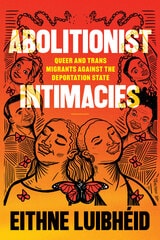
Abolitionist Intimacies
Queer and Trans Migrants against the Deportation StateEithne Luibheid
Duke University Press, 2025
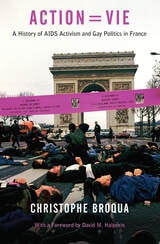
Action=Vie
A History of AIDS Activism and Gay Politics in FranceChristophe Broqua
Temple University Press, 2026
Act Up-Paris became one of the most notable protest groups in France in the mid-1990s. Founded in 1989, and following the New York model, it became a confrontational voice representing the interests of those affected by HIV through openly political activism. Action=Vie, the English-language translation of Christophe Broqua’s study of the grassroots activist branch, explains the reasons for the group’s success and sheds light on Act Up's defining features—such as its unique articulation between AIDS and gay activism.
Featuring numerous accounts by witnesses and participants, Broqua traces the history of Act Up-Paris and shows how thousands of gay men and women confronted the AIDS epidemic by mobilizing with public actions. Act Up-Paris helped shape the social definition not only of HIV-positive persons but also of sexual minorities. Broqua analyzes the changes brought about by the group, from the emergence of new treatments for HIV infection to normalizing homosexuality and a controversy involving HIV-positive writers’ remarks about unprotected sex. This rousing history ends in the mid-2000s before marriage equality and antiretroviral treatments caused Act Up-Paris to decline.
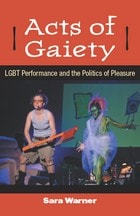
Acts of Gaiety
LGBT Performance and the Politics of PleasureSara Warner
University of Michigan Press, 2013
Acts of Gaiety explores the mirthful modes of political performance by LGBT artists, activists, and collectives that have inspired and sustained deadly serious struggles for revolutionary change. The book explores antics such as camp, kitsch, drag, guerrilla theater, zap actions, rallies, manifestos, pageants, and parades alongside more familiar forms of "legitimate theater." Against queer theory's long-suffering romance with mourning and melancholia and a national agenda that urges homosexuals to renounce pleasure if they want to be taken seriously by mainstream society, Acts of Gaiety seeks to reanimate notions of "gaiety" as a political value for LGBT activism.
The book mines the archives of lesbian-feminist activism of the 1960s-70s, highlighting the outrageous gaiety that lay at the center of the social and theatrical performances of the era and uncovering original documents long thought to be lost. Juxtaposing historical figures such as Valerie Solanas and Jill Johnston with more recent performers and activists (including Hothead Paisan, Bitch & Animal, and the Five Lesbian Brothers), Warner shows how reclaiming this largely discarded and disavowed past elucidates possibilities for being and belonging. Acts of Gaiety explores the mutually informing histories of gayness as politics and as joie de vivre, along with the centrality of liveliness to queer performance and protest.
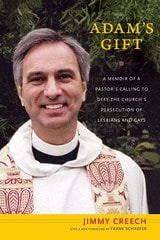
Adam's Gift
A Memoir of a Pastor's Calling to Defy the Church's Persecution of Lesbians and GaysJimmy Creech
Duke University Press, 2011
Adam’s visit prompted Creech to re-evaluate his belief that homosexuality was a sin, and to research the scriptural basis for the church’s position. He determined that the church was mistaken, that scriptural translations and interpretations had been botched and dangerously distorted. As a Christian, Creech came to believe that discriminating against lesbian, gay, bisexual, and transgender people was morally wrong. This understanding compelled him to perform same-gender commitment ceremonies, which conflicted with church directives. Creech was tried twice by The United Methodist Church, and, after the second trial, his ordination credentials were revoked. Adam’s Gift is a moving story and an important chapter in the unfinished struggle for lesbian, gay, bisexual, and transgender civil and human rights.
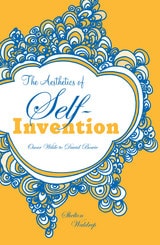
Aesthetics of Self-Invention
Oscar Wilde To David BowieShelton Waldrep
University of Minnesota Press, 2004
Traces the influence of Oscar Wilde as the precursor of twentieth-century artists of self-performance
By printing the title “Professor of Aesthetics” on his visiting cards, Oscar Wilde announced yet another transformation—and perhaps the most significant of his career, proclaiming his belief that he could redesign not just his image but his very self. Shelton Waldrep explores the cultural influences at play in Wilde’s life and work and his influence on the writing and performance of the twentieth century, particularly on the lives and careers of some of its most aestheticized performers: Truman Capote, Andy Warhol, David Hockney, and David Bowie. As Waldrep reveals, Wilde’s fusing of art with commerce foresaw the coming century’s cultural producers who would blend works of both “high art” and mass-market appeal.
Whether as a gay man or as a postmodern performance artist ahead of his time, Wilde ultimately emerges here as the embodiment of the twentieth-century media-savvy artist who is both subject and object of the aesthetic and economic systems in which he is enmeshed.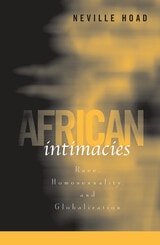
African Intimacies
Race, Homosexuality, and GlobalizationNeville Hoad
University of Minnesota Press, 2007
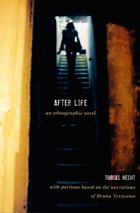
After Life
An Ethnographic NovelTobias Hecht
Duke University Press, 2006
Hecht had originally intended to write a biography of Veríssimo. But with interviews ultimately spanning a decade, he couldn't ignore that much of what he had been told wasn’t, strictly speaking, true. In Veríssimo’s recounting of her life, a sister who had never been born died tragically, while the very same rape that shattered the body and mind of an acquaintance occurred a second time, only with a different victim and several years later. At night, with the anthropologist’s tape recorder in hand, she became her own ethnographer, inventing informants, interviewing herself, and answering in distinct voices.
With truth impossible to disentangle from invention, Hecht followed the lead of Veríssimo, his would-be informant, creating characters, rendering a tale that didn’t happen but that might have, probing at what it means to translate a life into words.
A call and response of truth and invention, mental illness and yearning, After Life is a tribute to and reinterpretation of the Latin American testimonio genre. Desire, melancholy, longing, regret, and the hunger to live beyond the confines of past and future meet in this debut novel by Tobias Hecht.
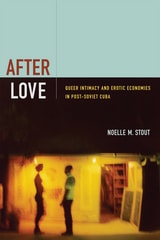
After Love
Queer Intimacy and Erotic Economies in Post-Soviet CubaNoelle Stout
Duke University Press, 2014

After Sex?
On Writing since Queer TheoryJanet Halley and Andrew Parker, eds.
Duke University Press, 2011
Contributors. Lauren Berlant, Leo Bersani, Michael Cobb, Ann Cvetkovich, Lee Edelman, Richard Thompson Ford, Carla Freccero, Elizabeth Freeman, Jonathan Goldberg, Janet Halley, Neville Hoad, Joseph Litvak, Heather Love, Michael Lucey, Michael Moon, José Esteban Muñoz, Jeff Nunokawa, Andrew Parker, Elizabeth A. Povinelli, Richard Rambuss, Erica Rand, Bethany Schneider, Eve Kosofsky Sedgwick, Kate Thomas
Against Citizenship
The Violence of the NormativeAmy L. Brandzel
University of Illinois Press, 2016
Brandzel's focus on three legal case studies--same-sex marriage law, hate crime legislation, and Native Hawaiian sovereignty and racialization--exposes how citizenship confounds and obscures the mutual processes of settler colonialism, racism, sexism, and heterosexism. In this way, Brandzel argues that citizenship requires anti-intersectionality, that is, strategies that deny the mutuality and contingency of race, class, gender, sexuality, and nation--and how, oftentimes, progressive left activists and scholars follow suit.
Against Citizenship is an impassioned plea for a queer, decolonial, anti-racist coalitional stance against the systemized human de/valuing and anti-intersectionalities of citizenship.
All the Rage
The Story of Gay Visibility in AmericaSuzanna Danuta Walters
University of Chicago Press, 2001
Many consider the new gay visibility a sign of social acceptance, while others charge that it is mere window dressing, obscuring the dogged persistence of discrimination. Walters moves beyond these positions and instead argues that these realities coexist: gays are simultaneously depicted as the sign of social decay and the chic flavor of the month. Taking on the common wisdom that visibility means progress, All the Rage maps the terrain on which gays are accepted as witty accessories in movies, gain access to political power, and yet still fall into constrictive stereotypes. Walters warns us with clarity and wit of the pitfalls of equating visibility with full integration into the fabric of American society. From the playful TV fantasies of lesbian weddings on Friends to the very real obstacles confronting gay marriage, from the award-winning comedy Will & Grace to Bible-thumping radio superhost Dr. Laura, All the Rage takes on naive celebrants and jaded naysayers alike. With a sophisticated mix of caution and optimism, it provides an illuminating guide through these exciting, controversial times.
Alternative Medicine
Rafael Campo
Duke University Press, 2013
Ambientes
New Queer Latino WritingLázaro Lima and Felice Picano
University of Wisconsin Press, 2011
As the U.S. Latino population grows rapidly, and as the LGBTQ Latino community becomes more visible and a more crucial part of our literary and artistic heritage, there is an increasing demand for literature that successfully highlights these diverse lives. Edited by Lázaro Lima and Felice Picano, Ambientes is a revolutionary collection of fiction featuring stories by established authors as well as emerging voices that present a collective portrait of gay, lesbian, bisexual, and transgender experience in America today. With a preface by Picano and an introduction by Lima that sets the stage for understanding Latino literary and cultural history, this is the first anthology to cross cultural and regional borders by offering a wide variety of urban, rural, East Coast, West Coast, and midwestern perspectives on Latina and Latino queers from different walks of life. Stories range from sensual pieces to comical romances and from inner-city dramas fueled by street language to portraits of gay domesticity, making this a much-needed collection for many different kinds of readers. The stories in this collection reflect a vibrant and creative community and redefine received notions of “gay” and “lesbian.”
Finalist, Over the Rainbow selection, American Library Association
Finalist, LGBT Anthology, Lambda Literary Awards
Best Special Interest Books, selected by the American Association of School Librarians
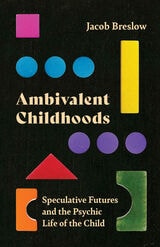
Ambivalent Childhoods
Speculative Futures and the Psychic Life of the ChildJacob Breslow
University of Minnesota Press, 2021
Explores childhood in relation to blackness, transfeminism, queerness, and deportability to interrogate what “the child” makes possible
The concept of childhood contains many contested and ambivalent meanings that have extraordinary implications, particularly for those staking their claim for belonging and justice on the wish for inclusion within it. In Ambivalent Childhoods, Jacob Breslow examines contemporary U.S. social justice movements (including Black Lives Matter, transfeminism, queer youth activism, and antideportation movements) to discover and reveal how childhood operates within and against them.
Ambivalent Childhoods brings together critical race, trans, feminist, queer, critical migration, and psychoanalytic theories to explore the role of childhood in shaping and challenging the disposability of young black life, the steadfastness of the gender binary, the queer life of children’s desires, and the precarious status of migrants. Through an engagement with“the psychic life of the child” that combines theoretical discussions of childhood, blackness, transfeminism, and deportability with critical readings of films, narrative, images, and social justice movements, Breslow demonstrates how childhood requires sustained attention as a complex and ambivalent site for contesting the workings of power, not only for the young.
Ambivalent Childhoods is a forward-thinking and intersectional analysis of how childhood affects activism, national belonging, and the violence directed against queer, trans, and racialized people.

Ambivalent Desires
Affect and Boys Love in ChinaLiang Ge
University of Michigan Press, 2027
Ambivalent Desires carefully investigates Chinese danmei creators’ and fans’ everyday affective experiences in the dynamic yet ambivalent boys love cultural ecology of China. Emerging in mainland China in the late 1990s and flourishing in the 2010s, danmei, also known as boys love fiction, is a genre that features male-male romances or erotica. This book offers a rich, empirically grounded account of danmei, examining the complex and embodied lived experiences of those producing and consuming male homoeroticism and framing ambivalence as an ongoing queer feminist project.
Proposing a novel theoretical framework of “the grammar of ambivalences,” Liang Ge seeks to understand how desires, affects, and queer feminist politics operate within and against the everyday heteropatriarchal and party-state conditions of postsocialist China. Ambivalent Desires attends simultaneously to the backward-looking normativities infused within danmei culture and the forward-facing transformative potential it generates, refusing the reductive binary of resistance versus escapism that has structured much existing scholarship.
American Gay
Stephen O. Murray
University of Chicago Press, 1996
Murray's erudite scholarship challenges prevailing assumptions about gay history and society. He questions conventional wisdom about the importance of World War II and the Stonewall riots for conceiving and challenging shared oppression. He reviews gay complicity in the repathologizing of homosexuality during the early years of the AIDS epidemic. Discussing recent demands for inclusion in the "straight" institutions of marriage and the US military, he concludes that these are new forms of resistance, not attempts to assimilate. Finally, Murray examines racial and ethnic differences in self-representation and identification.
Drawing on two decades of studying gay life in North America, this tour de force of empirical documentation and social theory critically reviews what is known about the emergence, growth, and internal diversity of communities of openly gay men and lesbians. American Gay thus deepens our understanding of the ways individuals construct sexualities through working and living together.

An American Obsession
Science, Medicine, and Homosexuality in Modern SocietyJennifer Terry
University of Chicago Press, 1999
Terry's overarching argument is compelling: that homosexuality served as a marker of the "abnormal" against which malleable, tenuous, and often contradictory concepts of the "normal" were defined. One of the few histories to take into consideration homosexuality in both women and men, Terry's work also stands out in its refusal to erase the agency of people classified as abnormal. She documents the myriad ways that gays, lesbians, and other sexual minorities have coauthored, resisted, and transformed the most powerful and authoritative modern truths about sex. Proposing this history as a "useable past," An American Obsession is an indispensable contribution to the study of American cultural history.
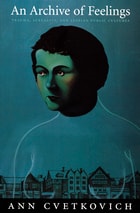
An Archive of Feelings
Trauma, Sexuality, and Lesbian Public CulturesAnn Cvetkovich
Duke University Press, 2003
An Archive of Feelings brings together oral histories from lesbian activists involved in act up/New York; readings of literature by Dorothy Allison, Leslie Feinberg, Cherríe Moraga, and Shani Mootoo; videos by Jean Carlomusto and Pratibha Parmar; and performances by Lisa Kron, Carmelita Tropicana, and the bands Le Tigre and Tribe 8. Cvetkovich reveals how activism, performance, and literature give rise to public cultures that work through trauma and transform the conditions producing it. By looking closely at connections between sexuality, trauma, and the creation of lesbian public cultures, Cvetkovich makes those experiences that have been pushed to the peripheries of trauma culture the defining principles of a new construction of sexual trauma—one in which trauma catalyzes the creation of cultural archives and political communities.
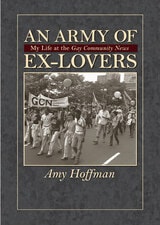
An Army of Ex-Lovers
My life at the Gay Community NewsAmy Hoffman
University of Massachusetts Press, 2007
Boston's weekly Gay Community News was “the center of the universe” during the late 1970s, writes Amy Hoffman in this memoir of gay liberation before AIDS, before gay weddings, and before The L Word. Provocative, informative, inspiring, and absurd, with a small circulation but a huge influence, Gay Community News produced a generation of leaders, writers, and friends. In addition to capturing the heady atmosphere of the times—the victories, controversies, and tragedies—Hoffman's memoir is also her personal story, written with wit and insight, of growing up in a political movement; of her deepening relationships with charismatic, talented, and sometimes utterly weird coworkers; and of trying to explain it all to her large Jewish family.
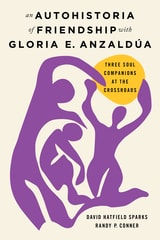
An Autohistoria of Friendship with Gloria E. Anzaldúa
Three Soul Companions at the CrossroadsDavid Hatfield Sparks and Randy P. Conner
University of Illinois Press, 2027
Beginning their story in a large Noe Valley flat, Sparks and Conner trace how a collective of artists and activists shaped a shared life across lines of race, gender, and sexuality while forging a community linked through prejudice, illness, and loss. The authors mix personal stories with history and cultural memory. They also discuss Anzaldúa’s idea of spiritual mestizaje, a practice for healing and growth that joins Indigenous, African, Latino, European, and Queer traditions. Their idea of El Mundo Zurdo imagines an inclusive world that values diversity and the power of difference to create connections among human beings.
Merging spirituality with activism, An Autohistoria of Friendship with Gloria E. Anzaldúa shares a vision of a more just and caring future.
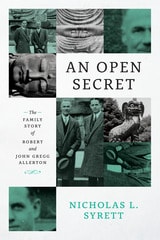
An Open Secret
The Family Story of Robert and John Gregg AllertonNicholas L. Syrett
University of Chicago Press, 2021
An Open Secret tells the striking story of these two iconoclasts, locating them among their queer contemporaries and exploring why becoming father and son made a surprising kind of sense for a twentieth-century couple who had every monetary advantage but one glaring problem: they wanted to be together publicly in a society that did not tolerate their love. Deftly exploring the nature of their design, domestic, and philanthropic projects, Nicholas L. Syrett illuminates how viewing the Allertons as both a same-sex couple and an adopted family is crucial to understanding their relationship’s profound queerness. By digging deep into the lives of two men who operated largely as ciphers in their own time, he opens up provocative new lanes to consider the diversity of kinship ties in modern US history.
An Open Secret
The Family Story of Robert and John Gregg AllertonNicholas L. Syrett
University of Chicago Press, 2021
This is an auto-narrated audiobook edition of this book.
In 1922 Robert Allerton—described by the Chicago Tribune as the “richest bachelor in Chicago”—met a twenty-two-year-old University of Illinois architecture student named John Gregg, who was twenty-six years his junior. Virtually inseparable from then on, they began publicly referring to one another as father and son within a couple years of meeting. In 1960, after nearly four decades together, and with Robert Allerton nearing ninety, they embarked on a daringly nonconformist move: Allerton legally adopted the sixty-year-old Gregg as his son, the first such adoption of an adult in Illinois history.
An Open Secret tells the striking story of these two iconoclasts, locating them among their queer contemporaries and exploring why becoming father and son made a surprising kind of sense for a twentieth-century couple who had every monetary advantage but one glaring problem: they wanted to be together publicly in a society that did not tolerate their love. Deftly exploring the nature of their design, domestic, and philanthropic projects, Nicholas L. Syrett illuminates how viewing the Allertons as both a same-sex couple and an adopted family is crucial to understanding their relationship’s profound queerness. By digging deep into the lives of two men who operated largely as ciphers in their own time, he opens up provocative new lanes to consider the diversity of kinship ties in modern US history.
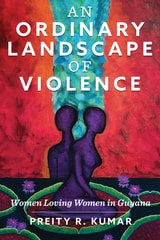
An Ordinary Landscape of Violence
Women Loving Women in GuyanaPreity R. Kumar
Rutgers University Press, 2024
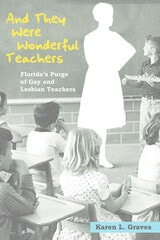
And They Were Wonderful Teachers
Florida's Purge of Gay and Lesbian TeachersKaren L. Graves
University of Illinois Press, 2008
Karen L. Graves details how teachers were targeted, interrogated, and stripped of their professional credentials, and she examines the extent to which these teachers resisted the invasion of their personal lives. She contrasts the experience of three groups--civil rights activists, gay and lesbian teachers, and University of South Florida personnel--called before the committee and looks at the range of response and resistance to the investigations. Based on archival research conducted on a recently opened series of Investigation Committee records in the State Archives of Florida, this work highlights the importance of sexuality in American and education history and argues that Florida's attempt to govern sexuality in schools implies that educators are distinctly positioned to transform dominant ideology in American society.
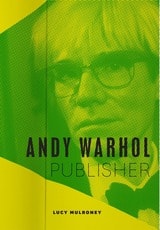
Andy Warhol, Publisher
Lucy Mulroney
University of Chicago Press, 2018
Journeying from the 1950s, when Warhol was starting to make his way through the New York advertising world, through the height of his career in the 1960s, to the last years of his life in the 1980s, Andy Warhol, Publisher unearths fresh archival material that reveals Warhol’s publications as complex projects involving a tantalizing cast of collaborators, shifting technologies, and a wide array of fervent readers.
Lucy Mulroney shows that whether Warhol was creating children’s books, his infamous “boy book” for gay readers, writing works for established houses like Grove Press and Random House, helping found Interview magazine, or compiling a compendium of photography that he worked on to his death, he readily used the elements of publishing to further and disseminate his art. Warhol not only highlighted the impressive variety in our printed culture but also demonstrated how publishing can cement an artistic legacy.
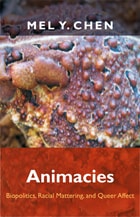
Animacies
Biopolitics, Racial Mattering, and Queer AffectMel Y. Chen
Duke University Press, 2012
Chen's book is the first to bring the concept of animacy together with queer of color scholarship, critical animal studies, and disability theory. Through analyses of dehumanizing insults, the meanings of queerness, animal protagonists in recent Asian/American art and film, the lead in toys panic in 2007, and the social lives of environmental illness, Animacies illuminates a hierarchical politics infused by race, sexuality, and ability. In this groundbreaking book, Chen rethinks the criteria governing agency and receptivity, health and toxicity, productivity and stillness—and demonstrates how attention to the affective charge of matter challenges commonsense orderings of the world.

AntoloGaia
Queering the Seventies, A Radical Trans MemoirPorpora Marcasciano
Rutgers University Press, 2024
In this stirring memoir by a member of the first generation of LGBTQ+ activists in Italy, Porpora Marcasciano tells her story and shares the struggles and accomplishments of her fellow activists who achieved so much in the 1970s yet suffered devastating losses during the AIDS epidemic of the 1980s. AntoloGaia offers an insider’s look at the beginnings of the gay liberation movement in Italy and reveals how it was intimately intertwined with other forms of left-wing activism. At the same time, it powerfully conveys the queer joy of a young person from a small village first encountering the vibrant sexual minority communities of Naples, Bologna, and Rome. As Marcasciano starts to embrace her trans identity, she meets the famous anthropologist Pino Simonelli, who introduces her to Naples’s unique femminielli subculture and gives her the name Porporino, which she later shortens to Porpora. In keeping with this story of gender, sexual, and political discovery, AntoloGaia is the first piece of Italian life-writing to use gender-neutral and mixed-gender language.