Results by title

20 books match the query 'Law in literature'
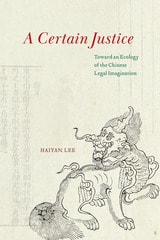
cover of A Certain Justice: Toward an Ecology of the Chinese Legal Imagination

A Certain Justice

Toward an Ecology of the Chinese Legal Imagination

Haiyan Lee

University of Chicago Press, 2023

A much-needed account of the hierarchy of justice that defines China’s unique political-legal culture.

To many outsiders, China has an image as a realm of Oriental despotism where law is at best window dressing and at worst an instrument of coercion and tyranny. In this highly original contribution to the interdisciplinary field of law and humanities, Haiyan Lee contends that this image arises from a skewed understanding of China’s political-legal culture, particularly the failure to distinguish what she calls high justice and low justice.

In the Chinese legal imagination, Lee shows, justice is a vertical concept, with low justice between individuals firmly subordinated to the high justice of the state. China’s political-legal culture is marked by a mistrust of law’s powers, and as a result, it privileges substantive over procedural justice. Calling on a wide array of narratives—stories of crime and punishment, subterfuge and exposé, guilt and redemption—A Certain Justice helps us recognize the fight for justice outside the familiar arenas of liberal democracy and the rule of law.
[more]
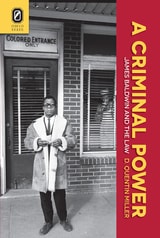
cover of A Criminal Power: James Baldwin and the Law

A Criminal Power

James Baldwin and the Law

D. Quentin Miller

The Ohio State University Press, 2012
James Baldwin, one of the major African American writers of the twentieth century, has been the subject of a substantial body of literary criticism. As a prolific and experimental author with a marginal perspective—a black man during segregation and the Civil Rights era, a homosexual at a time when tolerance toward gays was not common—Baldwin has fascinated readers for over half a century. Yet Baldwin’s critics have tended to separate his weighty, complex body of work and to examine it piecemeal. A Criminal Power: James Baldwin and the Law is the first thematic study to analyze the complete scope of his work. It accomplishes this through an expansive definition and thorough analysis of the social force that oppressed Baldwin throughout his life: namely, the law. Baldwin, who died in 1987, attempted suicide in 1949 at the age of 25 after spending eight-days in a French prison following an absurd arrest for “receiving stolen goods”—a sheet that his acquaintance had taken from a hotel. This seemingly trite incident made Baldwin painfully aware of what he would later call the law’s “criminal power.”
            Up to now, the only book-length studies to address Baldwin’s entire career have been biographies and artistic “portraits.” D. Quentin Miller corrects this oversight in a comprehensive volume that addresses and unifies all of Baldwin’s work. Miller asserts that the Baldwin corpus is a testament to how the abuse of power within the American legal, judicial, and penal systems manifested itself in the twentieth century.
[more]
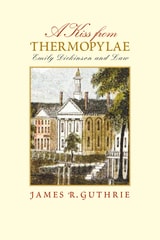
cover of A Kiss from Thermopylae: Emily Dickinson and Law

A Kiss from Thermopylae

Emily Dickinson and Law

James R. Guthrie

University of Massachusetts Press, 2015

Born into a family of attorneys, Dickinson absorbed law at home. She employed legal terms and concepts regularly in her writings, and her metaphors grounded in law derive much of their expressive power from a comparatively sophisticated lay knowledge of the various legal and political issues that were roiling nineteenth-century America. Dickinson displays interest in such areas as criminal law, contracts, equity, property, estate law, and bankruptcy. She also held in high regard the role of law in resolving disputes and maintaining civic order. Toward the end of her life, Dickinson cited the Spartans' defense at Thermopylae as an object lesson demonstrating why societies should uphold the rule of law.

Yet Dickinson was also capable of criticizing, even satirizing, law and lawyers. Her poetic personae inhabit various legal roles including those of jurymen, judges, and attorneys, and some poems simulate courtroom contests pitting the rights of individuals against the power of the state. She was keenly interested in legal matters pertaining to women, such as breach of promise, dower, and trusts. With her tone ranging from subservient to domineering, from reverential to ridiculing, Dickinson's writings reflect an abiding concern with philosophic and political principles underpinning the law, as well as an identification with the plight of individuals who dared confront authority.

A Kiss from Thermopylae reveals a new dimension of Dickinson's writing and thinking, one indicating that she was thoroughly familiar with the legal community's idiomatic language, actively engaged with contemporary political and ethical questions, and skilled at deploying a poetic register ranging from high romanticism to low humor.
[more]
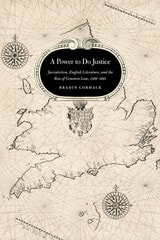
cover of A Power to Do Justice: Jurisdiction, English Literature, and the Rise of Common Law

A Power to Do Justice

Jurisdiction, English Literature, and the Rise of Common Law

Bradin Cormack

University of Chicago Press, 2008

English law underwent rapid transformation in the sixteenth century, in response to the Reformation and also to heightened litigation and legal professionalization. As the common law became more comprehensive and systematic, the principle of jurisdiction came under particular strain. When the common law engaged with other court systems in England, when it encountered territories like Ireland and France, or when it confronted the ocean as a juridical space, the law revealed its qualities of ingenuity and improvisation. In other words, as Bradin Cormack argues, jurisdictional crisis made visible the law’s resemblance to the literary arts.  
A Power to Do Justice
shows how Renaissance writers engaged the practical and conceptual dynamics of jurisdiction, both as a subject for critical investigation and as a frame for articulating literature’s sense of itself. Reassessing the relation between English literature and law from More to Shakespeare, Cormack argues that where literary texts attend to jurisdiction, they dramatize how boundaries and limits are the very precondition of law’s power, even as they clarify the forms of intensification that make literary space a reality.

Tracking cultural responses to Renaissance jurisdictional thinking and legal centralization, A Power to Do Justice makes theoretical, literary-historical, and methodological contributions that set a new standard for law and the humanities and for the cultural history of early modern law and literature.
[more]
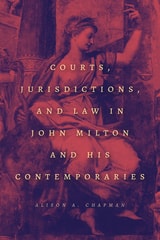
cover of Courts, Jurisdictions, and Law in John Milton and His Contemporaries

Courts, Jurisdictions, and Law in John Milton and His Contemporaries

Alison A. Chapman

University of Chicago Press, 2020

John Milton is widely known as the poet of liberty and freedom. But his commitment to justice has been often overlooked. As Alison A. Chapman shows, Milton’s many prose works are saturated in legal ways of thinking, and he also actively shifts between citing Roman, common, and ecclesiastical law to best suit his purpose in any given text. This book provides literary scholars with a working knowledge of the multiple, jostling, real-world legal systems in conflict in seventeenth-century England and brings to light Milton’s use of the various legal systems and vocabularies of the time—natural versus positive law, for example—and the differences between them.

Surveying Milton’s early pamphlets, divorce tracts, late political tracts, and major prose works in comparison with the writings and cases of some of Milton’s contemporaries—including George Herbert, John Donne, Ben Jonson, and John Bunyan—Chapman reveals the variety and nuance in Milton’s juridical toolkit and his subtle use of competing legal traditions in pursuit of justice.
 
[more]
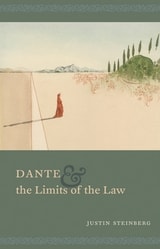
cover of Dante and the Limits of the Law

Dante and the Limits of the Law

Justin Steinberg

University of Chicago Press, 2013

In Dante and the Limits of the Law, Justin Steinberg offers the first comprehensive study of the legal structure essential to Dante’s Divine Comedy. Steinberg reveals how Dante imagines an afterlife dominated by sophisticated laws, hierarchical jurisdictions, and rationalized punishments and rewards. He makes the compelling case that Dante deliberately exploits this highly structured legal system to explore the phenomenon of exceptions to it, crucially introducing Dante to current debates about literature’s relation to law, exceptionality, and sovereignty.

Examining how Dante probes the limits of the law in this juridical otherworld, Steinberg argues that exceptions were vital to the medieval legal order and that Dante’s otherworld represents an ideal “system of exception.” In the real world, Dante saw this system as increasingly threatened by the dual crises of church and empire: the abuses and overreaching of the popes and the absence of an effective Holy Roman Emperor. Steinberg shows that Dante’s imagination of the afterlife seeks to address this gap between the universal validity of Roman law and the lack of a sovereign power to enforce it. Exploring the institutional role of disgrace, the entwined phenomena of judicial discretion and artistic freedom, medieval ideas about privilege and immunity, and the place of judgment in the poem, this cogently argued book brings to life Dante’s sense of justice.
[more]
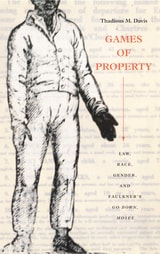
cover of Games of Property: Law, Race, Gender, and Faulkner's Go Down, Moses

Games of Property

Law, Race, Gender, and Faulkner's Go Down, Moses

Thadious M. Davis

Duke University Press, 2003

In Games of Property, distinguished critic Thadious M. Davis provides a dazzling new interpretation of William Faulkner’s Go Down, Moses. Davis argues that in its unrelenting attention to issues related to the ownership of land and people, Go Down, Moses ranks among Faulkner’s finest and most accomplished works. Bringing together law, social history, game theory, and feminist critiques, she shows that the book is unified by games—fox hunting, gambling with cards and dice, racing—and, like the law, games are rule-dependent forms of social control and commentary. She illuminates the dual focus in Go Down, Moses on property and ownership on the one hand and on masculine sport and social ritual on the other. Games of Property is a masterful contribution to understandings of Faulkner’s fiction and the power and scope of property law.
[more]
cover of Imagining the Penitentiary: Fiction and the Architecture of Mind in Eighteenth-Century England

Imagining the Penitentiary

Fiction and the Architecture of Mind in Eighteenth-Century England

John Bender

University of Chicago Press, 1987
This brilliant and insightful contribution to cultural studies investigates the role of literature—particularly the novel—and visual arts in the development of institutions. Arguing the attitudes expressed in narrative literature and art between 1719 and 1779 helped bring about the change from traditional prisons to penitentiaries, John Bender offers studies of Robinson Crusoe, Moll Flanders, The Beggar's Opera, Hogarth's Progresses, Jonathan Wild, and Amelia as well as illustrations from prison literature, art, and architecture in support of his thesis.
[more]
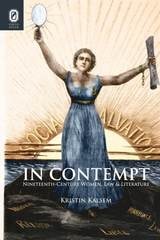
cover of In Contempt: Nineteenth-Century Women, Law, and Literature

In Contempt

Nineteenth-Century Women, Law, and Literature

Kristin Kalsem

The Ohio State University Press, 2012

 In Contempt: Nineteenth-Century Women, Law, and Literature, by Kristin Kalsem, explores the legal advocacy performed by nineteenth-century women writers in publications of nonfiction and fiction, as well as in real-life courtrooms and in the legal forum provided by the novel form.

 
The nineteenth century was a period of unprecedented reform in laws affecting married women’s property, child support and custody, lunacy, divorce, birth control, domestic violence, and women in the legal profession. Women’s contributions to these changes in the law, however, have been largely ignored because their work, stories, and perspectives are not recorded in authoritative legal texts; rather, evidence of their arguments and views are recorded in writings of a different kind. This book examines lesser-known works of nonfiction and fiction by legal reformers such as Annie Besant and Georgina Weldon and novelists such as Frances Trollope, Jane Hume Clapperton, George Paston, and Florence Dixie.
 
In Contempt brings to light new connections between Victorian law and literature, not only with its analysis of many “lost” novels but also with its new legal readings of old ones such as Emily Brontë’s Wuthering Heights (1847), George Eliot’s Adam Bede (1859), Lewis Carroll’s Alice’s Adventures in Wonderland (1865), Rider Haggard’s She (1887), and Thomas Hardy’s Jude the Obscure (1895). This study reexamines the cultural and political roles of the novel in light of “new evidence” that many nineteenth-century novels were “lawless”—showing contempt for, rather than policing, the law.
[more]
cover of Kafka's Law: "The Trial" and American Criminal Justice

Kafka's Law

"The Trial" and American Criminal Justice

Robert P. Burns

University of Chicago Press, 2014

The Trial is actually closer to reality than fantasy as far as the client’s perception of the system. It’s supposed to be a fantastic allegory, but it’s reality. It’s very important that lawyers read it and understand this.” Justice Anthony Kennedy famously offered this assessment of the Kafkaesque character of the American criminal justice system in 1993. While Kafka’s vision of the “Law” in The Trial appears at first glance to be the antithesis of modern American legal practice, might the characteristics of this strange and arbitrary system allow us to identify features of our own system that show signs of becoming similarly nightmarish?
           
With Kafka’s Law, Robert P. Burns shows how The Trial provides an uncanny lens through which to consider flaws in the American criminal justice system today. Burns begins with the story, at once funny and grim, of Josef K., caught in the Law’s grip and then crushed by it. Laying out the features of the Law that eventually destroy K., Burns argues that the American criminal justice system has taken on many of these same features. In the overwhelming majority of contemporary cases, police interrogation is followed by a plea bargain, in which the court’s only function is to set a largely predetermined sentence for an individual already presumed guilty. Like Kafka’s nightmarish vision, much of American criminal law and procedure has become unknowable, ubiquitous, and bureaucratic. It, too, has come to rely on deception in dealing with suspects and jurors, to limit the role of defense, and to increasingly dispense justice without the protection of formal procedures. But, while Kennedy may be correct in his grim assessment, a remedy is available in the tradition of trial by jury, and Burns concludes by convincingly arguing for its return to a more central place in American criminal justice.
[more]
cover of Masculine Births: Milton, Women, and the Law

Masculine Births

Milton, Women, and the Law

Lynne Greenberg

Northwestern University Press, 2026

Examining the legal lives of early modern women through Milton’s literary works

In his History of Britain, John Milton writes, “Laws are Masculin Births . . . nothing [is] more awry from the Law of God and Nature, then that a Woman should give Laws to Men.” In this interdisciplinary study, Lynne Greenberg explores the normative and nonnormative legal lives of early modern women as depicted in Milton’s works—unmarried and married women, mothers, heiresses, widows, and queens—providing cogent overviews of the laws of multiple jurisdictions to offer critical context for each case study. Greenberg explores a wide range of legal-juridical materials and previously unexplored archival and private family documents. As she demonstrates, while Milton’s narratives are at times enmeshed in existing jural paradigms, they also offer resistant responses to marital, custodial, property, inheritance, and criminal laws and even imagine alternative jural paradigms for women. Through Masculine Births: Milton, Women and the Law, Greenberg deftly reveals that Milton both reproduces seventeenth-century legal constructs and gives birth to laws that move us toward greater equality for women.
[more]
cover of Reconstituting Authority: American Fiction in the Province of the Law, 1880-1920

Reconstituting Authority

American Fiction in the Province of the Law, 1880-1920

William E. Moddelmog

University of Iowa Press, 2000

In Reconstituting Authority, William Moddelmog explores the ways in which American law and literature converged in the late nineteenth and early twentieth centuries. Through close readings of significant texts from the era, he reveals not only how novelists invoked specific legal principles and ideals in their fictions but also how they sought to reconceptualize the boundaries of law and literature in ways that transformed previous versions of both legal and literary authority.
Moddelmog does not assume a sharp distinction between literary and legal institutions and practices but shows how writers imagined the two fields as engaged in the same cultural process. He argues that because the law was instrumental in setting the terms by which concepts such as race, gender, nationhood, ownership, and citizenship were defined in the nineteenth century, authors challenging those definitions had to engage the law on its own terrain: to place their work in a dialogue with the law by telling stories that were already authorized (though perhaps suppressed) by legal institutions.
The first half of the book is devoted in separate chapters to William Dean Howells, Helen Hunt Jackson, and Pauline Hopkins. The focus shifts from large theoretical concerns to questions of contract and native sovereignty, to issues of African American citizenship and racial entitlement. In each case the discussion is rooted in a larger consideration of the rule (or misrule) of law.
The second half of the book turns from the rule of law to the issue of property, specifically the Lockean version of the self that tied identity to legal conceptions of property and economic value. In separate discussions of Charles Chesnutt, Edith Wharton, and Theodore Dreiser, Reconstituting Authority reveals authors as closely engaged with those changing perspectives on property and identity, in ways that challenged the racial, gendered, and economic consequences of America's possessive individualism.
[more]
cover of Reimagining "To Kill a Mockingbird": Family, Community, and the Possibility of Equal Justice under Law

Reimagining "To Kill a Mockingbird"

Family, Community, and the Possibility of Equal Justice under Law

Austin Sarat

University of Massachusetts Press, 2013

Fifty years after the release of the film version of Harper Lee's acclaimed novel To Kill a Mockingbird, this collection of original essays takes a fresh look at a classic text in legal scholarship. The contributors revisit and examine Atticus, Scout, and Jem Finch, their community, and the events that occur there through the interdisciplinary lens of law and humanities scholarship.

The readings in this volume peel back the film's visual representation of the many-layered social world of Maycomb, Alabama, offering sometimes counterintuitive insights through the prism of a number of provocative contemporary theoretical and interpretive questions. What, they ask, is the relationship between the subversion of social norms and the doing of justice or injustice? Through what narrative and visual devices are some social hierarchies destabilized while others remain hegemonic? How should we understand the sacrifices characters make in the name of justice, and comprehend their failures in achieving it?

Asking such questions casts light on the film's eccentricities and internal contradictions and suggests the possibility of new interpretations of a culturally iconic text. The book examines the context that gave meaning to the film's representation of race and how debates about family, community, and race are played out and reframed in law.

Contributors include Colin Dayan, Thomas L. Dumm, Susan Sage Heinzelman, Linda Ross Meyer, Naomi Mezey, Imani Perry, and Ravit Reichman.
[more]
cover of Shakespeare and the Law: A Conversation among Disciplines and Professions

Shakespeare and the Law

A Conversation among Disciplines and Professions

Edited by Bradin Cormack, Martha C. Nussbaum, and Richard Strier

University of Chicago Press, 2013

William Shakespeare is inextricably linked with the law. Legal documents make up most of the records we have of his life, and trials, lawsuits, and legal terms permeate his plays. Gathering an extraordinary team of literary and legal scholars, philosophers, and even sitting judges, Shakespeare and the Law demonstrates that Shakespeare’s thinking about legal concepts and legal practice points to a deep and sometimes vexed engagement with the law’s technical workings, its underlying premises, and its social effects.

The book’s opening essays offer perspectives on law and literature that emphasize both the continuities and contrasts between the two fields. The second section considers Shakespeare’s awareness of common law thinking and common law practice, while the third inquires into Shakespeare’s general attitudes toward legal systems. The fourth part of the book looks at how law enters into conversation with issues of politics and community, whether in the plays, in Shakespeare’s world, or in our own world. Finally, a colloquy among Supreme Court Justice Stephen Breyer, Judge Richard Posner, Martha C. Nussbaum, and Richard Strier covers everything from the ghost in Hamlet to the nature of judicial discretion.
[more]
cover of Shakespeare’s Legal Ecologies: Law and Distributed Selfhood

Shakespeare’s Legal Ecologies

Law and Distributed Selfhood

Kevin Curran

Northwestern University Press, 2017

Shakespeare’s Legal Ecologies offers the first sustained examination of the relationship between law and selfhood in Shakespeare’s work. Taking five plays and the sonnets as case studies, Kevin Curran argues that law provided Shakespeare with the conceptual resources to imagine selfhood in social and distributed terms, as a product of interpersonal exchange or as a gathering of various material forces. In the course of these discussions, Curran reveals Shakespeare’s distinctly communitarian vision of personal and political experience, the way he regarded living, thinking, and acting in the world as materially and socially embedded practices.
 
At the center of the book is Shakespeare’s fascination with questions that are fundamental to both law and philosophy: What are the sources of agency? What counts as a person? For whom am I responsible, and how far does that responsibility extend? What is truly mine? Curran guides readers through Shakespeare’s responses to these questions, paying careful attention to both historical and intellectual contexts.
 
The result is a book that advances a new theory of Shakespeare’s imaginative relationship to law and an original account of law’s role in the ethical work of his plays and sonnets. Readers interested in Shakespeare, theater and philosophy, law, and the history of ideas will find Shakespeare’s Legal Ecologies to be an essential resource. 
 
[more]
cover of The Legal Epic: "Paradise Lost" and the Early Modern Law

The Legal Epic

"Paradise Lost" and the Early Modern Law

Alison A. Chapman

University of Chicago Press, 2017

The seventeenth century saw some of the most important jurisprudential changes in England’s history, yet the period has been largely overlooked in the rich field of literature and law. Helping to fill this gap, The Legal Epic is the first book to situate the great poet and polemicist John Milton at the center of late seventeenth-century legal history.

Alison A. Chapman argues that Milton’s Paradise Lost sits at the apex of the early modern period’s long fascination with law and judicial processes. Milton’s world saw law and religion as linked disciplines and thought therefore that in different ways, both law and religion should reflect the will of God. Throughout Paradise Lost, Milton invites his readers to judge actions using not only reason and conscience but also core principles of early modern jurisprudence. Law thus informs Milton’s attempt to “justify the ways of God to men” and points readers toward the types of legal justice that should prevail on earth.

Adding to the growing interest in the cultural history of law, The Legal Epic shows that England’s preeminent epic poem is also a sustained reflection on the role law plays in human society.
[more]
cover of The Letters and the Law: Legal and Literary Culture in Late Imperial Russia

The Letters and the Law

Legal and Literary Culture in Late Imperial Russia

Anna Schur

Northwestern University Press, 2022

The Letters and the Law explores the fraught relationship between writers and lawyers in the four decades following Alexander II’s judicial reforms. Nineteenth-century Russian literature abounds in negative images of lawyers and the law. Literary scholars have typically interpreted these representations either as the common, cross‑cultural critique of lawyerly unscrupulousness and greed or as an expression of Russian hostility toward Western legalism, seen as antithetical to traditional Russian values. The Letters and the Law is the first book to frame the conflict in terms of the two professions’ competition for cultural authority.
 
Anna Schur combines historical research and literary analysis to argue that the first generations of Russian trial lawyers shaped their professional identity with an eye to the celebrated figure of the writer and that they considered their own activities to be a form of verbal art. A fuller understanding of writers’ antipathy to the law, Schur contends, must take into account this overlooked cultural backdrop. Laced with the better‑known critique of the lawyer’s legalistic proclivities and lack of moral principle are the writer’s reactions to a whole network of explicit and implicit claims of similarity between the two professions’ goals, methods, and missions that were central to the lawyer’s professional ideal. Viewed in this light, writers’ critiques of the law and lawyers emerge as a concerted effort at protecting literature’s exclusive cultural status in the context of modernization and the rapidly expanding public sphere.
 
The study draws upon a mix of well-known and rarely studied nineteenth-century authors and texts—with particular attention paid to Fyodor Dostoevsky and Mikhail Saltykov-Shchedrin—and on a wide range of nonliterary sources, including courtroom speeches, guides to forensic oratory, legal treatises, and specialized press.
 
[more]
cover of Trial by Farce: A Dozen Medieval French Comedies in English for the Modern Stage

Trial by Farce

A Dozen Medieval French Comedies in English for the Modern Stage

Edited and Translated by Jody Enders

University of Michigan Press, 2023

Was there more to comedy than Chaucer, the Second Shepherds’ Play, or Shakespeare? Of course! But, for a real taste of medieval and Renaissance humor and in-your-face slapstick, one must cross the Channel to France, where over two hundred extant farces regularly dazzled crowds with blistering satires. Dwarfing all other contemporaneous theatrical repertoires, the boisterous French corpus is populated by lawyers, lawyers everywhere. No surprise there. The lion’s share of mostly anonymous farces was written by barristers, law students, and legal apprentices. Famous for skewering unjust judges and irreligious ecclesiastics, they belonged to a 10,000-member legal society known as the Basoche, which flourished between 1450 and 1550. What is more, their dramatic send-ups of real and fictional court cases were still going strong on the eve of Molière, resilient against those who sought to censor and repress them. The suspenseful wait to see justice done has always made for high drama or, in this case, low drama. But, for centuries, the scripts for these outrageous shows were available only in French editions gathered from scattered print and manuscript sources.

In Trial by Farce, prize-winning theater historian Jody Enders brings twelve of the funniest legal farces to English-speaking audiences in a refreshingly uncensored but philologically faithful vernacular. Newly conceived as much for scholars as for students and theater practitioners, this repertoire and its familiar stock characters come vividly to life as they struggle to negotiate the limits of power, politics, class, gender, and, above all, justice. Through the distinctive blend of wit, social critique, and breathless boisterousness that is farce, we gain a new understanding of comedy itself as form of political correction. In ways presciently modern and even postmodern, farce paints a different cultural picture of the notoriously authoritarian Middle Ages with its own vision of liberty and justice for all. Theater eternally offers ways for new generations to raise their voices and act.
[more]
cover of Western Law, Russian Justice: Dostoevsky, the Jury Trial, and the Law

Western Law, Russian Justice

Dostoevsky, the Jury Trial, and the Law

Gary Rosenshield

University of Wisconsin Press, 2005
    Gary Rosenshield offers a new interpretation of Dostoevsky's greatest novel, The Brothers Karamazov. He explores Dostoevsky's critique and exploitation of the jury trial for his own ideological agenda, both in his journalism and his fiction, contextualizing his portrayal of trials and trial participants (lawyers, jurors, defendants, judges) in the political, social, and ideological milieu of his time. Further, the author presents Dostoevsky's critique in terms of the main notions of the critical legal studies movement in the United States, showing how, over one hundred and twenty years ago, Dostoevsky explicitly dealt with the same problems that the law-and-literature movement has been confronting over the past two decades. This book should appeal to anyone with an interest in Russian literature, Russian history and culture, legal studies, law and literature, narratology, or metafiction and literary theory.
[more]
cover of Women, Money, and the Law: Nineteenth-Century Fiction, Gender, and the Courts

Women, Money, and the Law

Nineteenth-Century Fiction, Gender, and the Courts

Joyce W. Warren

University of Iowa Press, 2005

Did 19th-century American women have money of their own? To answer this question, Women, Money, and the Law looks at the public and private stories of individual women within the context of American culture, assessing how legal and cultural traditions affected women's lives, particularly with respect to class and racial differences, and analyzing the ways in which women were involved in economic matters. Joyce Warren has uncovered a vast, untapped archive of legal documents from the New York Supreme Court that had been expunged from the official record. By exploring hundreds of court cases involving women litigants between 1845 and 1875--women whose stories had, in effect, been erased from history--and by studying the lives and works of a wide selection of 19th-century women writers, Warren has found convincing evidence of women's involvement with money. The court cases show that in spite of the most egregious gender restrictions of law and custom, many 19th-century women lived independently, coping with the legal and economic restraints of their culture while making money for themselves and often for their families as well. They managed their lives and their money with courage and tenacity and fractured constructed gender identities by their lived experience. Many women writers, even when they did not publicly advocate economic independence for women, supported themselves and their families throughout their writing careers and in their fiction portrayed the importance of money in women's lives. Women from all backgrounds--some defeated through ignorance and placidity, others as ruthless and callous as the most hardened businessmen--were in fact very much a part of the money economy. Together, the evidence of the court cases and the writers runs counter to the official narrative, which scripted women as economically dependent and financially uninvolved. Warren provides an illuminating counternarrative that significantly questions contemporary assumptions about the lives of 19th-century women. Women, Money, and the Law is an important corrective to the traditional view and will fascinate scholars and students in women's studies, literary studies, and legal history as well as the general reader.
[more]