Results by title
23 books match the query 'Lesbians in literature'

A Desire for Women
Relational Psychoanalysis, Writing, and Relationships between WomenJuhasz, Suzanne
Rutgers University Press, 2003
Uniquely weaving together psychoanalytic, feminist, queer, and literary theory as well as memoir to examine the value and meaning of relationships between women, Juhasz explores the writings of adult daughters, mothers, and lovers to consider how language both traces and shapes the contours of experience. She emphasizes the initial bond between mother and infant as the bedrock of identity formation, a process involving love, recognition, desire, and language, and shows how that relationship serves as source and model for all future loves.
Juhasz's lucid prose unravels the meaningful yet overlooked intricacies of the relationships that inflect much of women's writing in the twentieth century.
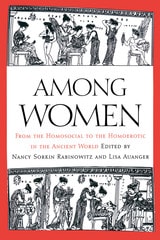
Among Women
From the Homosocial to the Homoerotic in the Ancient WorldEdited by Nancy Sorkin Rabinowitz and Lisa Auanger
University of Texas Press, 2002
Women's and men's worlds were largely separate in ancient Mediterranean societies, and, in consequence, many women's deepest personal relationships were with other women. Yet relatively little scholarly or popular attention has focused on women's relationships in antiquity, in contrast to recent interest in the relationships between men in ancient Greece and Rome. The essays in this book seek to close this gap by exploring a wide variety of textual and archaeological evidence for women's homosocial and homoerotic relationships from prehistoric Greece to fifth-century CE Egypt.
Drawing on developments in feminist theory, gay and lesbian studies, and queer theory, as well as traditional textual and art historical methods, the contributors to this volume examine representations of women's lives with other women, their friendships, and sexual subjectivity. They present new interpretations of the evidence offered by the literary works of Sappho, Ovid, and Lucian; Bronze Age frescoes and Greek vase painting, funerary reliefs, and other artistic representations; and Egyptian legal documents.

Are Girls Necessary?
Lesbian Writing and Modern HistoriesJulie Abraham
University of Minnesota Press, 2008
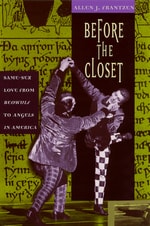
Before the Closet
Same-Sex Love from "Beowulf" to "Angels in America"Allen J. Frantzen
University of Chicago Press, 1998
With its ambitious scope and elegant style, Before the Closet sets same-sex relations in Anglo-Saxon sources in relation to the sexual themes of contemporary opera, dance, and theatre. Frantzen offers a comprehensive analysis of sources from the seventh to the twelfth century and traces Anglo-Saxon same-sex behavior through the age of Chaucer and into the Renaissance.
"Frantzen's marvelous book . . . opens up a world most readers will never have even known was there. It's a difficult topic, but Frantzen's comprehensive, readable and even wryly funny treatment makes this an unexpected pleasure."—Publishers Weekly, starred review
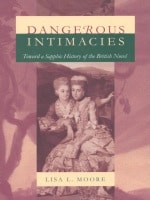
Dangerous Intimacies
Toward a Sapphic History of the British NovelLisa L. Moore
Duke University Press, 1997
Moore demonstrates that intimacy between women was vividly imagined in the British eighteenth century as not only chaste and virtuous, but also insistently and inevitably sexual. She looks at instances of sapphism in such novels as Millenium Hall, Memoirs of a Woman of Pleasure, Belinda, and Emma and analyzes how the new literary form of the novel made the bourgeois heroine’s successful negotiation of female friendship central to the establishment of her virtue. Moore also examines representations of sapphism through the sweeping economic and political changes of the period and claims that middle-class readers’ identifications with the heroine’s virtue helped the novel’s bourgeois audience justify the violent bases of their new prosperity, including slavery, colonialism, and bloody national rivalry.
In revealing the struggle over sapphism at the heart of these novels of female friendship—and at the heart of England’s national identity—Moore shows how feminine sexual agency emerged as an important cultural force in post-Enlightenment England
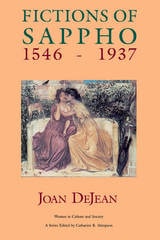
Fictions of Sappho, 1546-1937
Joan DeJean
University of Chicago Press, 1989
Lesbian Empire
Radical Crosswriting in the TwentiesGay Wachman
Rutgers University Press, 2001
Wachman places at the center of this tradition Sylvia Townsend Warner's achievement in undermining the inhibitions that faced women writing about forbidden love. She discusses Warner's use of crosswriting to transpose the otherwise unrepresentable lives of invisible lesbians into narratives about gay men, destabilizing the borders of race, class, and gender and challenging the codes of expression on which imperialist patriarchy and capitalism depended.
Lesbian Potentiality and Feminist Media in the 1970s
Jed Samer
Duke University Press, 2022
Lewd and Notorious
Female Transgression in the Eighteenth CenturyKatharine Kittredge, Editor
University of Michigan Press, 2003
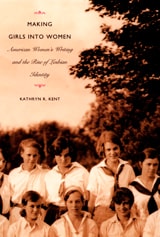
Making Girls into Women
American Women's Writing and the Rise of Lesbian IdentityKathryn R. Kent
Duke University Press, 2003
Kent not only analyzes how texts represent queer erotics, but also theorizes how texts might produce them in readers. She describes the ways postbellum sentimental literature such as that written by Harriet Beecher Stowe, Louisa May Alcott, and Emma D. Kelley eroticizes, reacts against, and even, in its own efforts to shape girls’ selves, contributes to the production of queer female identifications and identities. Tracing how these identifications are engaged and critiqued in the early twentieth century, she considers works by Djuna Barnes, Gertrude Stein, Marianne Moore, and Elizabeth Bishop, as well as in the queer subject-forming effects of another modern invention, the Girl Scouts. Making Girls into Women ultimately reveals that modern lesbian identity marks an extension of, rather than a break from, nineteenth-century women’s culture.

On Monique Wittig
Theoretical, Political, and Literary EssaysEdited by Namascar Shaktini
University of Illinois Press, 2004
On Monique Wittig contains twelve essays, representing French, Francophone, and U.S. critics, including three previously unpublished pieces by Wittig herself. Among the essays is Diane Griffin Crowder's discussion of the U.S. feminist movement, Linda Zerilli's consideration of gender and will, and Teresa de Lauretis's examination of the development of lesbian theory. Together, these essays situate Wittig's work in terms of the cultural contexts of its production and reception. This volume also contains the first authenticated chronology of Wittig's life and features the first translation of "For a Movement of Women's Liberation," which Wittig published with other "militantes" in May 1970.
As the first book to appear on Wittig following her death, On Monique Wittig is an indispensable tool for feminist scholars.
Sapphic Primitivism
Productions of Race, Class, and Sexuality in Key Works of Modern FictionHackett, Robin
Rutgers University Press, 2003
In this book, Robin Hackett examines portrayals of race, class, and sexuality in modernist texts by white women to argue for the existence of a literary device that she calls “Sapphic primitivism.” The works vary widely in their form and content and include Olive Schreiner’s proto-modernist exploration of New Womanhood, The Story of an African Farm; Virginia Woolf’s high modernist “play-poem,” The Waves; Sylvia Townsend Warner’s historical novel, Summer Will Show; and Willa Cather’s Southern pastoral, Sapphira and the Slave Girl. In each, blackness and working-class culture are figured to represent sexual autonomy, including lesbianism, for white women. Sapphic primitivism exposes the ways several classes of identification were intertwined with the development of homosexual identities at the turn of the century. Sapphic primitivism is not, however, a means of disguising lesbian content. Rather, it is an aesthetic displacement device that simultaneously exposes lesbianism and exploits modern, primitivist modes of self-representation. Hackett’s revelations of the mutual interests of those who study early twentieth-century constructions of race and sexuality and twenty-first-century feminists doing anti-racist and queer work are a major contribution to literary studies and identity theory.
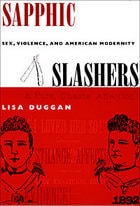
Sapphic Slashers
Sex, Violence, and American ModernityLisa Duggan
Duke University Press, 2000
Situating this story alongside simultaneously circulating lynching narratives (and its resistant versions, such as those of Memphis antilynching activist Ida B. Wells) Duggan reveals how stories of sex and violence were crucial to the development of American modernity. While careful to point out the differences between the public reigns of terror that led to many lynchings and the rarer instances of the murder of one woman by another privately motivated woman, Duggan asserts that dominant versions of both sets of stories contributed to the marginalization of African Americans and women while solidifying a distinctly white, male, heterosexual form of American citizenship. Having explored the role of turn-of-the-century print media—and in particular their tendency toward sensationalism—Duggan moves next to a review of sexology literature and to novels, most notably Radclyffe Hall’s The Well of Loneliness. Sapphic Slashers concludes with two appendices, one of which presents a detailed summary of Ward’s murder, the trial, and Mitchell’s eventual institutionalization. The other presents transcriptions of letters exchanged between the two women prior to the crime.
Combining cultural history, feminist and queer theory, narrative analysis, and compelling storytelling, Sapphic Slashers provides the first history of the emergence of the lesbian in twentieth-century mass culture.
Sappho in Early Modern England
Female Same-Sex Literary Erotics, 1550-1714Harriette Andreadis
University of Chicago Press, 2001
Silence and Power
A Reevaluation of Djuna BarnesEdited by Mary Lynn Broe. Afterword by Catharine Stimpson
Southern Illinois University Press, 1991
Roughly chronological, these essays explore Barnes’ early work in the New York newspaper world of the ‘teens, proceed through the 1954 publication of The Antiphon, and include several approaches to such works as Ryder, Ladies Almanack, and Nightwood. This judicious mix of essays—many of them illustrated by photographs and drawings—presents a comprehensive picture of the creative imagination of Djuna Barnes.
Essayists include Mary Lynn Broe, Nancy J. Levine, Ann Larabee, Joan Retallack, Carolyn Allen, Carolyn Burke, Sheryl Stevenson, Marie Ponsot, Frances M. Doughty, Susan Sniader Lanser, Frann Michel, Karla Jay, Jane Marcus, Judith Lee, Julie L. Abraham, Meryl Altman, Lynda Curry, Louise A. DeSalvo, and Catharine Stimpson. Individuals sharing personal recollections of Barnes are Ruth Ford, James B. Scott, Alex Gildzen, Hank O’Neal, Chester Page, Andrew Field, and Frances McCullough. Janice Thom and Kevin Engel provide an updated bibliography.
From The Book of Repulsive Women to The Antiphon, Barnes challenged old gender dichotomies as she shaped radical sociopolitical views. Her textual methods celebrated a multiplicity of voices, heterodox forms, and genres, transgressing those tenets of modernism that privilege the “high art” of a single, unified textual identity or a discrete discourse. These essays offer various critical approaches and sinuous readings of the full range of Barnes’ achievement. Interwoven through the essays and reminiscences is a lively commentary from Barnes’ friends and contemporaries as well as Barnes herself.

The Gloria Anzaldúa Reader
Gloria E. Anzaldúa
Duke University Press, 2009
This reader—which provides a representative sample of the poetry, prose, fiction, and experimental autobiographical writing that Anzaldúa produced during her thirty-year career—demonstrates the breadth and philosophical depth of her work. While the reader contains much of Anzaldúa’s published writing (including several pieces now out of print), more than half the material has never before been published. This newly available work offers fresh insights into crucial aspects of Anzaldúa’s life and career, including her upbringing, education, teaching experiences, writing practice and aesthetics, lifelong health struggles, and interest in visual art, as well as her theories of disability, multiculturalism, pedagogy, and spiritual activism. The pieces are arranged chronologically; each one is preceded by a brief introduction. The collection includes a glossary of Anzaldúa’s key terms and concepts, a timeline of her life, primary and secondary bibliographies, and a detailed index.
The Lesbian Menace
Ideology, Identity, and the Representation of Lesbian LifeSherrie A. Inness
University of Massachusetts Press, 1997
Electroshock. Hysterectomy. Lobotomy. These are only three of the many “cures” to which lesbians have been subjected in this century. How does a society develop such a profound aversion to a particular minority? In what ways do images in the popular media perpetuate cultural stereotypes about lesbians, and to what extent have lesbians been able to subvert and revise those images? This book addresses these and other questions by examining how lesbianism has been represented in American popular culture in the twentieth century and how conflicting ideologies have shaped lesbian experiences and identity.
In the first section, “Inventing the Lesbian,” Sherrie A. Inness explores depictions of lesbians in popular texts aimed primarily at heterosexual consumers. She moves from novels of the 1920s to books about life at women's colleges and boarding schools, to such contemporary women's magazines as Cosmopolitan, Glamour, and Vogue.
In the next section, “Forms of Resistance,” Inness probes the ways in which lesbians have refashioned texts intended for a heterosexual audience or created their own narratives. One chapter shows how lesbian readers have reinterpreted the Nancy Drew mysteries, looking at them from a distinctly “queer” perspective. Another chapter addresses the changing portrayal of lesbians in children's books over the past two decades.
The last section, “Writing in the Margins,” scrutinizes the extent to which lesbians, themselves a marginalized group, have created a society that relegates some of its own members to the outskirts. Topics include the geographic politics of lesbianism, the complex issue of "passing," and the meaning of butch identity in twentieth-century lesbian culture.
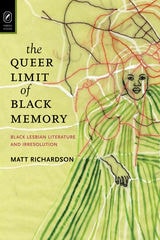
The Queer Limit of Black Memory
Black Lesbian Literature and IrresolutionMatt Richardson
The Ohio State University Press, 2013
The Sexuality of History
Modernity and the Sapphic, 1565-1830Susan S. Lanser
University of Chicago Press, 2014
In The Sexuality of History, Susan S. Lanser shows how intimacies between women became harbingers of the modern, bringing the sapphic into the mainstream of some of the most significant events in Western Europe. Ideas about female same-sex relations became a focal point for intellectual and cultural contests between authority and liberty, power and difference, desire and duty, mobility and change, order and governance. Lanser explores the ways in which a historically specific interest in lesbians intersected with, and stimulated, systemic concerns that would seem to have little to do with sexuality. Departing from the prevailing trend of queer reading whereby scholars ferret out hidden content in “closeted” texts, Lanser situates overtly erotic representations within wider spheres of interest. The Sexuality of History shows that just as we can understand sexuality by studying the past, so too can we understand the past by studying sexuality.
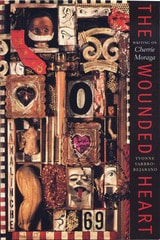
The Wounded Heart
Writing on Cherríe MoragaBy Yvonne Yarbro-Bejarano
University of Texas Press, 2001
In her work as poet, essayist, editor, dramatist, and public intellectual, Chicana lesbian writer Cherríe Moraga has been extremely influential in current debates on culture and identity as an ongoing, open-ended process. Analyzing the "in-between" spaces in Moraga's writing where race, gender, class, and sexuality intermingle, this first book-length study of Moraga's work focuses on her writing of the body and related material practices of sex, desire, and pleasure.
Yvonne Yarbro-Bejarano divides the book into three sections, which analyze Moraga's writing of the body, her dramaturgy in the context of both dominant and alternative Western theatrical traditions, and her writing of identities and racialized desire. Through close textual readings of Loving in the War Years, Giving Up the Ghost, Shadow of a Man, Heroes and Saints, The Last Generation, and Waiting in the Wings, Yarbro-Bejarano contributes to the development of a language to talk about sexuality as potentially empowering, the place of desire within politics, and the intricate workings of racialized desire.
Tortilleras
Hispanic & U.S. Latina Lesbian ExpressionLourdes Torres
Temple University Press, 2003
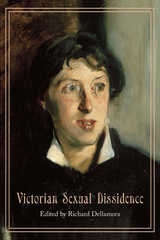
Victorian Sexual Dissidence
Edited by Richard Dellamora
University of Chicago Press, 1999
One essay, for example, traces the remarkable feminist appropriation of male-identified fields of study, such as Classical philology. Others address the validation of male bodies as objects of desire in writing, painting, and emergent modernist choreography. The writings shed light on the diverse interests served by a range of cultural practitioners and on the complex ways in which the late Victorians invented themselves as modern subjects.
This volume will be essential reading for students of British literary and cultural history as well as for those interested in feminist, gay, and lesbian studies.
Contributors are: Oliver Buckton, Richard Dellamora, Dennis Denisoff, Regenia Gagnier, Eric Haralson, Andrew Hewitt, Christopher Lane, Thaïs Morgan, Yopie Prins, Kathy Alexis Psomiades, Julia Saville, Robert Sulcer, Jr., Martha Vicinus.
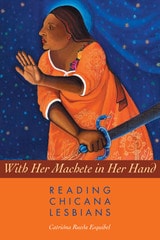
With Her Machete in Her Hand
Reading Chicana LesbiansBy Catrióna Rueda Esquibel
University of Texas Press, 2006
With the 1981 publication of the groundbreaking anthology This Bridge Called My Back: Writings by Radical Women of Color, Cherríe Moraga and Gloria Anzaldúa ushered in an era of Chicana lesbian writing. But while these two writers have achieved iconic status, observers of the Chicana/o experience have been slow to perceive the existence of a whole community—lesbian and straight, male as well as female—who write about the Chicana lesbian experience. To create a first full map of that community, this book explores a wide range of plays, novels, and short stories by Chicana/o authors that depict lesbian characters or lesbian desire.
Catrióna Rueda Esquibel starts from the premise that Chicana/o communities, theories, and feminisms cannot be fully understood without taking account of the perspectives and experiences of Chicana lesbians. To open up these perspectives, she engages in close readings of works centered around the following themes: La Llorona, the Aztec Princess, Sor Juana Inés de la Cruz, girlhood friendships, rural communities and history, and Chicana activism. Her investigation broadens the community of Chicana lesbian writers well beyond Moraga and Anzaldúa, while it also demonstrates that the histories of Chicana lesbians have had to be written in works of fiction because these women have been marginalized and excluded in canonical writings on Chicano life and experience.