Results by title
46 books match the query 'Literary form'
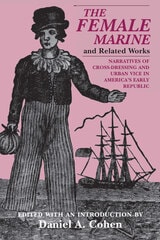
"The Female Marine" and Related Works
Narratives of Cross-Dressing and Urban Vice in America's Early RepublicDaniel A. Cohen
University of Massachusetts Press, 1997
The alternately racy and moralistic narrative recounts the adventures of a young woman from rural Massachusetts who is seduced by a false-hearted lover, flees to Boston, and is entrapped in a brothel. She eventually escapes by disguising herself as a man and serves with distinction on board the U.S. frigate Constitution during the War of 1812. After subsequent onshore adventures in and out of male dress, she is happily married to a wealthy New York gentleman.
In his introduction, Daniel A. Cohen situates the story in both its literary and historical contexts. He explains how the tale draws upon a number of popular Anglo-American literary genres, including the female warrior narrative, the sentimental novel, and the urban exposé. He then explores how The Female Marine reflects early-nineteenth-century anxieties concerning changing gender norms, the expansion of urban prostitution, the growth of Boston's African American community, and feelings of guilt aroused by New England's notoriously unpatriotic activities during the War of 1812.
A Concept of Dramatic Genre and the Comedy of a New Type
V. Ulea
Southern Illinois University Press, 2002
Applying systems theory to the comedies of Chekhov, Balzac, Kleist, Moliere, and Shakespeare, A Concept of Dramatic Genre and the Comedy of a New Type: Chess, Literature, and Film approaches dramatic genre from the point of view of the degree of richness and strength of a character’s potential. Its main focus is to establish a methodology for analyzing the potential from multidimensional perspectives, using systems thinking. The whole concept is an alternative to the Aristotelian plot-based approach and is applied to an analysis of western and eastern European authors as well as contemporary American film.
This innovative study consists of three parts: The first part is mostly theoretical, proposing a new definition of the dramatic as a category linked to general systems phenomena and offering a new classification of dramatic genre. In the second part, Ulea offers a textual analysis of some works based on this new classification. She analyzes comedies, tragedies, and dramas on the same or similar topics in order to reveal what makes them belong to opposite types of dramatic genre.
Additionally, she considers the question of fate and chance, with regard to tragedy and comedy, from the point of view of the predispositioning theory. In the third part, Ulea explores an analysis of the comedy of a new type—CNT. Her emphasis is on the integration of the part and the whole in approaching the protagonist’s potential. She introduces the term quasi-strong potential in order to reveal the illusory strength of protagonists of the CNT and to show the technique of CNT’s analysis and synthesis.
Ulea’s research begins with the notion of the comic, traditionally considered synonymous with the laughable, and attempts to approach it as independent from the laughable and laughter. The necessity to do so is dictated by the desire to penetrate the enigmatic nature of Chekhov’s comedy. The result is A Concept of Dramatic Genre and the Comedy of a New Type: Chess, Literature, and Film, a completely new approach to potential and systems thinking—which has never been a focus of dramatic theory before. Such potential is the touchstone of the comic and comedy, their permanent basic characteristic, the heart and axis around which the comedic world spins.
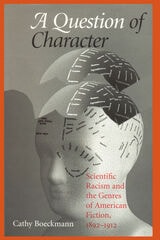
A Question of Character
Scientific Racism and the Genres of American Fiction, 1892-1912Catherine Ann Boeckmann
University of Alabama Press, 2005
Boeckmann links character, literary genre, and science, revealing how major literary works both contributed to and disrupted the construction of race in turn-of-the-century America.
In A Question of Character, Cathy Boeckmann establishes a strong link between racial questions and the development of literary traditions at the end of the 19th century in America. This period saw the rise of "scientific racism," which claimed that the races were distinguished not solely by exterior appearance but also by a set of inherited character traits. As Boeckmann explains, this emphasis on character meant that race was not only a thematic concern in the literature of the period but also a generic or formal one as well.
Boeckmann explores the intersections between race and literary history by tracing the language of character through both scientific and literary writing. Nineteenth-century pseudo-sciences such as phrenology and physiognomy had a vocabulary for discussing racial character that overlapped conceptually with the conventions for portraying race in literature. Through close readings of novels by Thomas Dixon, Mark Twain, William Dean Howells, Charles Chesnutt, and James Weldon Johnson—each of which deals with a black character "passing" as white—Boeckmann shows how this emphasis on character relates to the shift from romantic and sentimental fiction to realism. Because each of these genres had very specific conventions regarding the representation of character, genres often dictated how races could be depicted.
Action Writing
Jack Kerouac's Wild FormMichael Hrebeniak
Southern Illinois University Press, 2008
Action Writing: Jack Kerouac's Wild Form connects the personal and creative development of the Beat generation's famous icon with cultural changes in postwar America. Michael Hrebeniak asserts that Jack Kerouac's "wild form"—self-organizing narratives free of literary, grammatical, and syntactical conventions—moves within an experimental continuum across the arts to generate a Dionysian sense of writing as raw process. Action Writing highlights how Kerouac made concrete his 1952 intimation of "something beyond the novel" by assembling ideas from Beat America, modernist poetics, action painting, bebop, and subterranean oral traditions.
Geared to scholars and students of American literature, Beat studies, and creative writing, Action Writing places Kerouac's writing within the context of the American art scene at midcentury. Reframing the work of Kerouac and the Beat generation within the experimental modernist and postmodernist literary tradition, this probing inquiry offers a direct engagement with the social and cultural history at the foreground of Kerouac's career from the 1940s to the late 1960s.
Anatomy of Murder
Mystery, Detective, and Crime FictionCarl D. Malmgren
University of Wisconsin Press, 2001
Archival Fictions
Materiality, Form, and Media History in Contemporary LiteraturePaul Benzon
University of Massachusetts Press, 2021
Taking up works from Andy Warhol, Kevin Young, Don DeLillo, and Hari Kunzru, Archival Fictions considers how these writers have constructed a speculative history of media technology through formal experimentation. Although media technologies have determined the extent of what can be written, recorded, and remembered in the immediate aftermath of print's hegemony, Paul Benzon argues that literary form provides a vital means for critical engagement with the larger contours of media history. Drawing on approaches from media poetics, film studies, and the digital humanities, this interdisciplinary study demonstrates how authors who engage technology through form continue to imagine new roles for print literature across the late twentieth and early twenty-first centuries.
Art, Theory, Revolution
The Turn to Generality in Contemporary LiteratureMitchum Huehls
The Ohio State University Press, 2022

Book and Verse
A Guide to Middle English Biblical LiteratureJames H. Morey
University of Illinois Press, 2000
Book and Verse is an indispensable guide to the variety and extent of biblical literature in England, exclusive of drama and the Wycliffite Bible that appeared between the twelfth and the fifteenth centuries. Entries provide detailed information on how much of what parts of the Bible appear in Middle English and where this biblical material can be found. Comprehensive indexing by name, keyword, and biblical verse allows a researcher to find, for example, all the occurrences of the Flood Story or of the encounter between Elijah and the Widow of Sarephta. An invaluable resource, Book and Verse provides the first easy access to the "popular Bible" assembled before and after John Wyclif's translation of the Vulgate into English.
Critical Terms for Literary Study, Second Edition
Edited by Frank Lentricchia and Thomas McLaughlin
University of Chicago Press, 1995
Critical Terms for Literary Study is an essential handbook and introduction to the work of literary theory. Covering a broad range of key terms that include popular culture, diversity, imperialism, ethics, desire, class, gender, race, canon, representation, and much more through essays by leading scholars, it provides a concise history of each term alongside a critical exploration of the issues and questions for the field that it raises, followed by demonstrations of reading strategies driven by the term.
Exploring the concepts that shape the way we read, the essays combine to provide an extraordinary introduction to the work of literature and literary study, as the nation's most distinguished scholars put the tools of critical practice vividly to use.
Folklore Genres
Edited by Dan Ben-Amos
University of Texas Press, 1976
The essays in Folklore Genres represent development in folklore genre studies, diverging into literary, ethnographic, and taxonomic questions. The study as a whole is concerned with the concept of genre and with the history of genre theory. A selective bibliography provides a guide to analytical and theoretical works on the topic.
The literary-oriented articles conceive of folklore forms, not as the antecedents of literary genres, but as complex, symbolically rich expressions. The ethnographically oriented articles, as well as those dealing with classification problems, reveal dimensions of folklore that are often obscured from the student reading the folklore text alone. It has long been known that the written page is but a pale reproduction of the spoken word, that a tale hardly reflects the telling. The essays in this collection lead to an understanding of the forms of oral literature as multidimensional symbols of communication and to an understanding of folklore genres as systematically related conceptual categories in culture. What kinship terms are to social structure, genre terms are to folklore. Since genres constitute recognized modes of folklore speaking, their terminology and taxonomy can play a major role in the study of culture and society.
The essays were originally published in Genre (1969–1971); introduction, bibliography, and index have been added to this edition.
Form and Reform
Reading across the Fifteenth CenturyShannon Gayk and Kathleen Tonry
The Ohio State University Press, 2011
Form and Reform: Reading across the Fifteenth Century challenges the idea of any definitive late medieval moment and explores instead the provocatively diverse, notably untidy, and very rich literary culture of the age. These essays from leading medievalists, edited by Shannon Gayk and Kathleen Tonry, both celebrate and complicate the reemergence of the fifteenth century in literary studies. Moreover, this is the first collection to concentrate on the period between 1450 and 1500—the crucial five decades, this volume argues, that must be understood to comprehend the entire century’s engagement with literary form in shifting historical contexts.
Genre And The Invention Of The Writer
Reconsidering the Place of Invention in CompositionAnis Bawarshi
Utah State University Press, 2003
Instead of mastering notions of "good" writing, Bawarshi feels that students gain more from learning how to adapt socially and rhetorically as they move from one "genred" site of action to the next.
Genre Fission
A New Discourse Practice for Culture StudiesMarleen S. Barr
University of Iowa Press, 2000
Barr expands postmodern assumptions about cultural studies by suggesting that "genre fission" is occurring among discrete literary and cultural "types" of events--mainstream novels, science fiction, historical narratives, film, paintings, and museum displays. For her literary insights, Barr turns her attention to such mainstream authors as Saul Bellow, John Updike, Marge Piercy, and John Barth as well as science fiction writers Ursula Le Guin and Octavia Butler and Hispanic American writers Julia Alvarez, Ana Castillo, and Cristina García, among others.
Barr moves from literary to culture studies by addressing such phenomena from contemporary mass culture as the urban landscapes of New York and Los Angeles, Jackie Kennedy, the Star Trek industry, Lynn Redgrave, Amsterdam's red light district, Lorena Bobbitt, and the Apollo astronauts--to provide only a few of the relevant examples. Thus Genre Fission attains what Barr herself designates (in describing the art of Judy Chicago and Lee Bontecou) as "utopian interweavings of difference," crossing numerous boundaries in order to frame a larger territory for exploration.

Genre Matters
Essays in Theory and CriticismEdited by Garin Dowd, Lesley Stevenson, and Jeremy Strong
Intellect Books, 2006
Genre and the Performance of Publics
Mary Jo Reiff
Utah State University Press, 2016
In recent decades, genre studies has focused attention on how genres mediate social activities within workplace and academic settings. Genre and the Performance of Publics moves beyond institutional settings to explore public contexts that are less hierarchical, broadening the theory of how genres contribute to the interconnected and dynamic performances of public life.
Chapters examine how genres develop within publics and how genres tend to mediate performances in public domains, setting up a discussion between public sphere scholarship and rhetorical genre studies. The volume extends the understanding of genres as not only social ways of organizing texts or mediating relationships within institutions but as dynamic performances themselves.
By exploring how genres shape the formation of publics, Genre and the Performance of Publicsbrings rhetoric/composition and public sphere studies into dialogue and enhances the understanding of public genre performances in ways that contribute to research on and teaching of public discourse.
Genre of Autobiography in Victorian Literature
Clinton Machann
University of Michigan Press, 1995
Genre, Race, and the Production of Subjectivity in German Romanticism
Stephanie Galasso
Northwestern University Press, 2024
Late Enlightenment philosophers and writers like Herder, Goethe, and Schiller broke with conventions of form and genre to prioritize an idealized, and racially coded, universality. Newly translated literatures from colonial contexts served as the basis for their evaluations of how to contribute to a distinctly “German” national literary tradition, one that valorized modernity and freedom and thus fortified crucial determinants of modern concepts of whiteness. Through close readings of both canonical and less-studied Romantic texts, Stephanie Galasso examines the intimately entwined histories of racialized subjectivity and aesthetic theory and shows how literary genre is both symptomatic and generative of the cultural violence that underpinned the colonial project.
Poetic expression and its generic conventions continue to exert pressure on the framing and reception of the stories that can be told about interpersonal and structural experiences of oppression. Genre, Race, and the Production of Subjectivity in German Romanticism explores how white subjectivity is guarded by symbolic and material forms of violence.
Genres of the Credit Economy
Mediating Value in Eighteenth- and Nineteenth-Century BritainMary Poovey
University of Chicago Press, 2008
Chronicling the process by which some of our most important conceptual categories were naturalized, Mary Poovey explores complex relationships among forms of writing that are not usually viewed together, from bills of exchange and bank checks, to realist novels and Romantic poems, to economic theory and financial journalism. Taking up all early forms of financial and monetarywriting, Poovey argues that these genres mediated for early modern Britons the operations of a market system organized around credit and debt. By arguing that genre is a critical tool for historical and theoretical analysis and an agent in the events that formed the modern world, Poovey offers a new way to appreciate the character of the credit economy and demonstrates the contribution historians and literary scholars can make to understanding its operations.
Much more than an exploration of writing on and around money, Genres of the Credit Economy offers startling insights about the evolution of disciplines and the separation of factual and fictional genres.

Guidelines on Subject Access to Individual Works of Fiction, Drama, Etc.
American Library Association, 2000
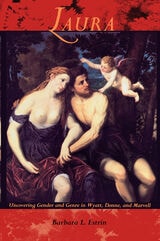
Laura
Uncovering Gender and Genre in Wyatt, Donne and MarvellBarbara L. Estrin
Duke University Press, 1994
Through close readings of the Rime sparse and the works of Wyatt, Donne, and Marvell, Estrin uncovers three Lauras: Laura-Daphne, who denies sexuality; Laura-Eve, who returns the poet’s love; and Laura-Mercury, who reinvents her own life. Estrin claims that in these three guises Laura subverts both genre and gender, thereby introducing multiple desires into the many layers of the poems. Drawing upon genre and gender theories advanced by Jean-François Lyotard and Judith Butler to situate female desire in the poem’s framework, Estrin shows how genre and gender in the Petrarchan tradition work together to undermine the stability of these very concepts.
Estrin’s Laura constitutes a fundamental reconceptualization of the Petrarchan tradition and contributes greatly to the postmodern reassessment of the Renaissance period. In its descriptions of how early modern poets formulate questions about sexuality, society and poetry, Laura will appeal to scholars of the English and Italian Renaissance, of gender studies, and of literary criticism and theory generally.
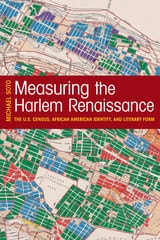
Measuring the Harlem Renaissance
The U.S. Census, African American Identity, and Literary FormMichael Soto
University of Massachusetts Press, 2016
In this provocative study, Michael Soto examines African American cultural forms through the lens of census history to tell the story of how U.S. officialdom—in particular the Census Bureau—placed persons of African descent within a shifting taxonomy of racial difference, and how African American writers and intellectuals described a far more complex situation of interracial social contact and intra-racial diversity. What we now call African American identity and the literature that gives it voice emerged out of social, cultural, and intellectual forces that fused in Harlem roughly one century ago.
Measuring the Harlem Renaissance sifts through a wide range of authors and ideas—from W. E. B. Du Bois, Rudolph Fisher, and Nella Larsen to Zora Neale Hurston, Langston Hughes, and Wallace Thurman, and from census history to the Great Migration—to provide a fresh take on late nineteenth—and twentieth—century literature and social thought. Soto reveals how Harlem came to be known as the “cultural capital of black America,” and how these ideas left us with unforgettable fiction and poetry.
Narratives of Greater Mexico
Essays on Chicano Literary History, Genre, and BordersBy Héctor Calderón
University of Texas Press, 2005
Once relegated to the borders of literature—neither Mexican nor truly American—Chicana/o writers have always been in the vanguard of change, articulating the multicultural ethnicities, shifting identities, border realities, and even postmodern anxieties and hostilities that already characterize the twenty-first century. Indeed, it is Chicana/o writers' very in-between-ness that makes them authentic spokespersons for an America that is becoming increasingly Mexican/Latin American and for a Mexico that is ever more Americanized.
In this pioneering study, Héctor Calderón looks at seven Chicana and Chicano writers whose narratives constitute what he terms an American Mexican literature. Drawing on the concept of "Greater Mexican" culture first articulated by Américo Paredes, Calderón explores how the works of Paredes, Rudolfo Anaya, Tomás Rivera, Oscar Zeta Acosta, Cherríe Moraga, Rolando Hinojosa, and Sandra Cisneros derive from Mexican literary traditions and genres that reach all the way back to the colonial era. His readings cover a wide span of time (1892-2001), from the invention of the Spanish Southwest in the nineteenth century to the América Mexicana that is currently emerging on both sides of the border. In addition to his own readings of the works, Calderón also includes the writers' perspectives on their place in American/Mexican literature through excerpts from their personal papers and interviews, correspondence, and e-mail exchanges he conducted with most of them.
O'Neill's Shakespeare
Normand Berlin
University of Michigan Press, 1993
In O'Neill's Shakespeare , Normand Berlin explores the relationship of William Shakespeare and Eugene O'Neill through detailed, often surprising, intertextual readings of the two great playwrights' work. "Of course, it would have been impossible for O'Neill not to have been influenced by Shakespeare," acknowledges Berlin. But this is an influence of an unusual and extraordinary sort, "a family romance" that transcends their obvious differences—a romance that "takes in all O'Neill's life and art."
In the first book-length study of this crucial literary and dramatic relationship, Berlin probes far beyond the usual listing of allusions and references. This is the exploration of an "essential, basic, even natural" connection, in which Shakespeare is shown to have fundamentally shaped O'Neill's creative imagination. Following O'Neill's career chronologically, Berlin divides his study into two parts. The "first career" (culminating in Mourning Becomes Electra) is explored through recurring themes that evoke Shakespeare: the sea, black and white, and the family. O'Neill's "second career" (from Ah! Wilderness until the last plays) is examined through Shakespearean genre classifications: comedy, history, tragedy, and tragicomedy. Though always grounded in close textual readings, Berlin's analysis spirals outward to encompass O'Neill's artistic and psychological development and touches on the questions of tradition, transcendence, and human nature inevitably raised when such literary connections across history are drawn.
O'Neill's Shakespeare is more than a reminder that Shakespeare continues to haunt Western culture; it is a careful and fascinating analysis of a particular legacy in American drama. The book has insights to offer to specialists in Shakespeare and O'Neill, and to any reader interested in the transmission of ideas through Western culture. Berlin's study of the unconscious and conscious uses of Shakespeare by O'Neill provide a valuable new understanding of O'Neill's artistry. It is also an eloquent, thoughtful account that blends the transcendence of Shakespeare's influence with the particular ways in which every era must refashion Shakespeare so that "the past becomes the present."
On Drama
Boundaries of Genre, Borders of SelfMichael Goldman
University of Michigan Press, 2000
On Edge
Gender and Genre in the Work of Shirley Jackson, Patricia Highsmith, and Leigh BrackettAshley Lawson
The Ohio State University Press, 2024
Honorable Mention, 2025 PCA Emily Toth Award For Best Single Work In Women’s Studies
Finalist, 2025 Mystery Writers of America's Edgar Awards, Best Critical/Biographical Category
Finalist, Bouchercon New Orleans 2025 Anthony Awards, Best Critical/Non-Fiction
Nominated for the 2025 Macavity Awards, Best Mystery-related Nonfiction/Critical
Ashley Lawson’s On Edge presents a new picture of postwar American literature, arguing that biases against genre fiction have unfairly disadvantaged the legacies of authors like Shirley Jackson, Patricia Highsmith, and Leigh Brackett. Each of these women navigated a male-dominated postwar publishing world without compromising their values. Their category-defying treatment of gender roles and genre classifications created suspense in their work that spoke to the tensions of the “Age of Anxiety.” Lawson engages with foundational voices in American literature, genre theory, and feminism to argue that, by merging the dominant mode of literary realism with fantastical or heightened elements, Brackett, Jackson, and Highsmith responded to the big questions of their era with startling and unnerving answers. By elevating genre play to a marker of literary skill, Lawson contends, we can secure these writers a more prominent place within the canon of midcentury American literature and open the door for the recovery of their similarly innovative peers.
Reading the Middle Generation Anew
Culture, Community, and Form in Twentieth-Century American PoetryEric Haralson
University of Iowa Press, 2006
In addition to having worked during the broad middle of the last century, these poets constitute the center of twentieth-century American poetry in the larger sense, refuting invidious connotations of “middle” as coming after the great moderns and being superseded by a proliferating postmodern experimentation. This middle generation mediates the so-called American century and its prodigious body of poetry, even as it complicates historical and aesthetic categorizations.
Taking diverse formal and thematic angles on these poets—deconstructionist, biographical-historical, and more formalist accounts—this book re-examines their between-ness and ambivalence: their various positionings and repositionings in aesthetic, political, and personal matters. The essays study the interplay between these writers and such shifting formations as religious discourse, consumerism, militarism and war, the ideology of America as “nature’s nation,” and U.S. race relations and ethnic conflicts. Reading the Middle Generation Anew also shows the legacy of the middle generation, the ways in which their lives and writings continue to be a shaping force in American poetry. This fresh and invigorating collection will be of great interest to literary scholars and poets.
Revisionary Rhetoric, Feminist Pedagogy, and Multigenre Texts
Julie Jung
Southern Illinois University Press, 2005
In this precise and provocative treatise, Julie Jung augments the understanding and teaching of revision by arguing that the process should entail changing attitudes rather than simply changing texts. Revisionary Rhetoric, Feminist Pedagogy, and Multigenre Texts proposes and demonstrates alternative ways of reading, writing, and teaching that hear silences in such a way as to generate personal, pedagogical, and professional revisions. As both a challenge to prevailing revision pedagogies and an elaboration of contemporary feminist rhetorics, the volume encourages students and instructors to examine their identities as scholars of rhetoric and composition and to question how and why revision is taught.
Jung analyzes feminist texts to identify a revisionary rhetoric that is, at its core, most concerned with creating a space in which to engage productively with issues of difference. This synthesis of feminist theory and revision studies yields a pedagogically useful definition of feminist rhetoric, through which Jung examines the insights afforded by multigenre texts in various related contexts: the academic essay, the discipline of rhetoric and composition studies, feminist composition, and the subfields of English studies including rhetoric and composition, literature, and creative writing. Jung illustrates how multigenre texts demand innovative methods of inquiry because they do not fit the conventions of any single genre. Because genre is inextricably tied to the construction of social identity, she explains, multigenre texts also offer a means for understanding and revising disciplinary identity.
Boldly making a case for the revisionary power of multigenre texts, Jung retheorizes revision as a process of disrupting textual clarity so that differences can be identified, contended with, and perhaps understood. Revisionary Rhetoric, Feminist Pedagogy, and Multigenre Texts makes great strides towards defining feminist rhetoric and ascertaining how revision can be theorized, not just practiced. Jung also provides a multigenre epilogue that explores the usefulness of reconceiving revision as a progression towards wholeness rather than perfection.
Sound and Form in Modern Poetry
Second EditionHarvey Gross and Robert McDowell
University of Michigan Press, 1996
Poet, critic, and editor Robert McDowell has updated this classic text in the light of the poetic and critical developments of the last three decades. Segments on Dickinson, Robinson, Frost, Jeffers, and Lowell, among other poets, have been greatly expanded, and Ashbery, Creeley, Ginsberg, Hall, Kees, Kumin, Levertov, Levine, O'Hara, Plath, Rich, Simpson, and Wilbur added, among others. The epilogue discusses a new generation of poets whose works will likely be read well into the next century-- among others, Thomas M. Disch, Rita Dove, Dana Gioia, Emily Grosholz, Mark Jarman, Molly Peacock, Gjertrud Schnackenberg, Timothy Steele, Mary Swander, and Marilyn Nelson Waniek.
Over the last ten years, the most inspiring topic of conversation and argument among poets and their readers has been the resurgence of narrative and traditional forms. The new Sound and Form in Modern Poetry is a seminal text in this discussion, examining not only this movement but all of the important developments (Dadaism, Surrealism, Imagism, Language Poetry, and the Confessional School) that have defined our poetry in the twentieth century and have set the stage for poetry's continued life in the twenty-first. The original Sound and Form in Modern Poetry enjoyed extensive classroom use as a text; the revised version promises to be even more accessible, and more essential, for years to come.
The late Harvey Gross was Professor of Comparative Literature, State University of New York at Stony Brook.
Robert McDowell is publisher and editor of Story Line Press, and is also poet, critic, translator, fiction writer, and essayist.
Structuring the Void
The Struggle for Subject in Contemporary American FictionJerome Klinkowitz
Duke University Press, 1992
Among the writers Klinkowitz discusses are Richard Brautigan, Kurt Vonnegut, Max Apple, Saul Bellow, Erica Jong, Susan Quist, Gerald Rosen, Rob Swigart, and Grace Paley. He shows how, in the absence of subject matter, these writers persist in the act of structuring—by organizing autobiography as a narrative device, ritualizing national history and popular culture, or formalizing a comic response to a new imaginative state, the state of California. Klinkowitz also considers subjects such as gender and war, which, though they cannot be represented, nevertheless exercise contraints on a writer’s intention to structure.
What emerges from Klinkowitz’s analysis is a clear sense of what today’s fiction—and fiction writing—is about. As such, Structuring the Void will prove invaluable to anyone with an interest in contemporary literature.
Telling Time
Clocks, Diaries, and English Diurnal Form, 1660-1785Stuart Sherman
University of Chicago Press, 1997
Through brilliant readings of Samuel Pepys's diary, Joseph Addison and Richard Steele's daily Spectator, the travel writings of Samuel Johnson and James Boswell, and the novels of Daniel Defoe and Frances Burney, Sherman traces the development of a new way of counting time in prose—the diurnal structure of consecutively dated installments—within the cultural context of the daily institutions which gave it form and motion. Telling Time is not only a major accomplishment for seventeenth- and eighteenth-century literary studies, but it also makes important contributions to current discourse in cultural studies.
The Body of Poetry
Essays on Women, Form, and the Poetic SelfAnnie Finch
University of Michigan Press, 2005
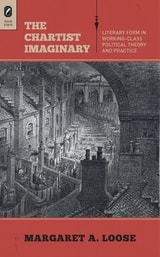
The Chartist Imaginary
Literary Form in Working-Class Political Theory and PracticeMargaret A. Loose
The Ohio State University Press, 2014
The Chartist Imaginary offers close readings of poems and fiction by Chartist figures from Ernest Jones and Thomas Cooper to W. J. Linton, Thomas Martin Wheeler, and Gerald Massey. It also draws on extensive archival research to examine, for the first time, working-class female Chartist poets Mary Hutton, E. L. E., and Elizabeth La Mont. Focusing on the literary form of these works, Loose strongly argues for the political power of the aesthetic in working-class literature.
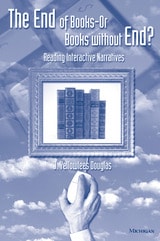
The End of Books--or Books Without End?
Reading Interactive NarrativesJ. Yellowlees Douglas
University of Michigan Press, 2001
The book examines criticism on interactive fiction from both proponents and skeptics and examines similarities and differences between print and hypertext fiction. It looks closely at critically acclaimed interactive works, including Stuart Moulthrop's Victory Garden and Michael Joyce's Afternoon: A Story that illuminate how these hypertext narratives "work." While she sees this as a still-evolving technology and medium, the author identifies possible developments for the future of storytelling from outstanding examples of Web-based fiction and CD-ROM narratives, possibilities that will enable narratives to both portray the world with greater realism an to transcend the boundaries of novels and films, character and plot alike.
Written to be accessible to a wide range of readers, this lively and accessibly-written volume will appeal to those interested in technology and cyberculture, as well as to readers familiar with literary criticism and modern fiction.
J. Yellowlees Douglas is the Director of the William and Grace Dial Center for Written and Oral Communication, University of Florida. She is the author of numerous articles and essays on the subject of hypertext and interactive literature.
The Epic Catalogue
List Form and Reception from Beowulf to Paradise LostEva von Contzen
The Ohio State University Press, 2026
The Familiar Letter as a Literary Genre in the Age of Pushkin
William Mills Todd III
Northwestern University Press, 1999
The Obligation Toward the Difficult Whole
Postmodernist Long PoemsBrian McHale
University of Alabama Press, 2003
Addressing subjects as wide-ranging as angelology, the court masque, pop art, caricature, the cult of the ruin, hip-hop, Spense’'s Irish policy, and the aesthetics of silence, Brian McHale pulls varied threads together to identify a repertoire of postmodernist elements characteristic of the long poems he examines.
As critic Jed Rasula explains, “McHale is wonderfully resourceful in changing the subject from chapter to chapter to fit the poems discussed, and while his approach adheres to the conventions of textual exegesis, the chapters really shine as orchestrations of issues. For instance, James Merrill’s The Changing Light at Sandover works unexpectedly well in raising the subject of found poetry and procedural composition; Melvin Tolso’'s Harlem Gallery and Edward Dorn's Gunslinger are effectively paired to demonstrate the period flavor of pastiche; Geoffrey Hill’s Mercian Hymns and Armand Schwerner’s The Tablets explode the modernist fixation with depth; John Ashbery’s work is given a nuanced reading as proto-theory; Letter to an Imaginary Friend by Thomas McGrath provides a lucid backdrop to raise the question of political efficacy in approaching language poet Bruce Andrews; and Susan Howe's The Europe of Trusts is explored for its intertextual tapestry.”
McHale shows how elements from these long poems overlap, interfere, pull in different directions, jar against, and even contradict each other; and he demonstrates how they also echo, amplify, and reinforce each other. They do not slot smoothly together like pieces in a jigsaw puzzle, but they do form (what else?) a difficult whole.
The Old Formalism
Character and Contemporary American PoetryJonathan Holden
University of Arkansas Press, 1999

The Power of Genre
Adena Rosmarin
University of Minnesota Press, 1986
The Power of Genre was first published in 1986. Minnesota Archive Editions uses digital technology to make long-unavailable books once again accessible, and are published unaltered from the original University of Minnesota Press editions.
The Power of Genre is a radical and systematic rethinking of the relationship between literary genre and critical explanation. Adene Rosmarin shows how traditional theories of genre—whether called "historical," "intrinsic," or "theoretical"—are necessarily undone by their attempts to define genre representationally. Rather, Rosmarin argues, the opening premise of critical argument is always critical purpose or, as E. H. Gombrich has said, function, and the genre or "form" follows the reform. The goal is a relational model that works.
Rosemarin analyzes existing theories of genre — those of Hirsch, Crane, Frye, Todorov, Jauss, and Rader are given particular attention—before proposing her own. These analyses uncover the illogic that plagues even sophisticated attempts to treat genre as a preexistent entity. Rosmarin shows how defining genre pragmatically – as explicitly chosen or devised to serve explicitly critical purposes – solves this problem: a pragmatic theory of genre builds analysis of its metaphors and motives into its program, thereby eliminating theory's traditional need to deny the invented and rhetorical nature of its schemes. A pragmatic theory, however, must be tested not only by its internal cohesion but also by its power to enable practice, and Rosmarin chooses the dramatic monologue, an infamously problematic genre, and its recent relative, the mask lyric, as testing grounds. Both genres—variously exemplified by poems of Browning, Thennyson, Eliot, and Pound—are ex post facto critical constructs that, when defined as such, make closely reasoned sense not only of particular poems but also of their perplexed interpretive histories. Moreover, both genres dwell on the historicity, textuality, and redemptive imperfection of the speaking self. This generic obsession ties the poems to their reception and, finally, to the openended, processes of hermeneutic question-and-answer stressed in Rosmarin's framing theory.
The Rhetoric of the "Other" Literature
W. Ross Winterowd
Southern Illinois University Press, 1990
Using traditional and contemporary rhetorical theory, Winterowd argues that the fiction-nonfiction division of literature is unjustified and destructive.
He would bridge the gap between literary scholars and rhetoricians by including both fiction (imaginative literature) and nonfiction (literature of fact) in the canon. The actual difference in literary texts, he notes, lies not in their factuality but in their potential for eliciting an aesthetic response.
With speech act and rhetorical theory as a basis, Winterowd argues that presentational literature gains its power on the basis of its ethical and pathetic appeal, not because of its assertions or arguments.
Towards the Ethics of Form in Fiction
Narratives of Cultural RemissionLeona Toker
The Ohio State University Press, 2010
Toker is especially interested in cultural remissions such as the carnivalesque—that is, the inverting of standard cultural hierarchies or the blurring of boundaries between normally separated social groups, actors and audiences, self and other. She argues that cultural remissions have the potential not simply to provide a break from the determinacies of our quotidian existence but also to return us to that existence with some alteration of our perceptions, beliefs, and values. Toker contends that the ethical consequences of reading fiction result from features of its aesthetics, particularly what she calls, following the semiotician Louis Hjemslev, “the form of the content”—the patterns arising from the artistic deployment of narrative details. In addition to addressing the carnivalesque discourse of Bakhtin as well as the theory of oppositionality developed by de Certeau and Chambers, she puts theory into practice through detailed analyses of canonical texts by Fielding, Sterne, Austen, Hawthorne, Dickens, Conrad, Joyce, and other writers.
Twenty-One Genres and How to Write Them
Brock Dethier
Utah State University Press, 2013
In the first section, Dethier efficiently presents each genre, providing models; a description of the genres’ purpose, context, and discourse; and suggestions for writing activities or “moves” that writers can use to get words on the page and accomplish their writing tasks. The second section explains these moves, over two hundred of them, in chapters ranging from “Solve Your Process Problems” and “Discover” to “Revise” and “Present.” Applicable to any writing task or genre, these moves help students overcome writing blocks and develop a piece of writing from the first glimmers of an idea to its presentation.
This approach to managing the complexity and challenge of writing in college strives to be useful, flexible, eclectic, and brief—a valuable resource for students learning to negotiate unfamiliar writing situations.

Universal Grammar and Narrative Form
David Herman
Duke University Press, 1995
Following an extensive historical overview of theories about universal grammar, Herman examines Joyce’s Ulysses, Kafka’s The Trial, and Woolf’s Between the Acts as case studies of modernist literary narratives that encode grammatical principles which were (re)fashioned in logic, linguistics, and philosophy during the same period. Herman then uses the interpretation of universal grammar developed via these modernist texts to explore later twentieth-century cultural phenomena. The problem of citation in the discourses of postmodernism, for example, is discussed with reference to syntactic theory. An analysis of Peter Greenaway’s The Cook, The Thief, His Wife, and Her Lover raises the question of cinematic meaning and draws on semantic theory. In each case, Herman shows how postmodern narratives encode ideas at work in current theories about the nature and function of language.
Outlining new directions for the study of language in literature, Universal Grammar and Narrative Form provides a wealth of information about key literary, linguistic, and philosophical trends in the twentieth century.
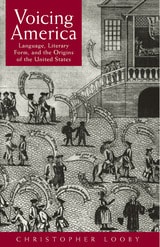
Voicing America
Language, Literary Form, and the Origins of the United StatesChristopher Looby
University of Chicago Press, 1996
Writing Genres
Amy J. Devitt
Southern Illinois University Press, 2008
In Writing Genres, Amy J. Devitt examines genre from rhetorical, social, linguistic, professional, and historical perspectives and explores genre's educational uses, making this volume the most comprehensive view of genre theory today.
Writing Genres does not limit itself to literary genres or to ideas of genres as formal conventions but additionally provides a theoretical definition of genre as rhetorical, dynamic, and flexible, which allows scholars to examine the role of genres in academic, professional, and social communities.
Writing Genres demonstrates how genres function within their communities rhetorically and socially, how they develop out of their contexts historically, how genres relate to other types of norms and standards in language, and how genres nonetheless enable creativity. Devitt also advocates a critical genre pedagogy based on these ideas and provides a rationale for first-year writing classes grounded in teaching antecedent genres.
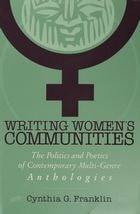
Writing Women's Communities
The Politics and Poetics of Contemporary Multi-Genre AnthologiesCynthia G. Franklin
University of Wisconsin Press, 1997
Beginning in the 1980s, a number of popular and influential anthologies organized around themes of shared identity—Nice Jewish Girls, This Bridge Called My Back, Home Girls, and others—have brought together women’s fiction and poetry with journal entries, personal narratives, and transcribed conversations. These groundbreaking multi-genre anthologies, Cynthia G. Franklin demonstrates, have played a crucial role in shaping current literary studies, in defining cultural and political movements, and in building connections between academic and other communities.
Exploring intersections and alliances across the often competing categories of race, class, gender, and sexuality, Writing Women’s Communities contributes to current public debates about multiculturalism, feminism, identity politics, the academy as a site of political activism, and the relationship between literature and politics.
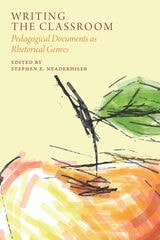
Writing the Classroom
Pedagogical Documents as Rhetorical Genresedited by Stephen E. Neaderhiser
Utah State University Press, 2022
The contributors to this unique collection employ a wide range of methodological frameworks to demonstrate how pedagogical genres—even ones as seemingly straightforward as the class syllabus—have lives extending well beyond the classroom as they become part of how college teachers represent their own academic identities, advocate for pedagogical values, and negotiate the many external forces that influence the act of teaching. Writing the Classroom shines a light on genres that are often treated as two-dimensional, with purely functional purposes, arguing instead that genres like assignment prompts, course proposals, teaching statements, and policy documents play a fundamental role in constructing the classroom and the broader pedagogical enterprise within academia.
Writing the Classroom calls on experienced teachers and faculty administrators to critically consider their own engagement with pedagogical genres and offers graduate students and newer faculty insight into the genres that they may only now be learning to inhabit as they seek to establish their personal teacherly identities. It showcases the rhetorical complexity of the genres written in the service of pedagogy not only for students but also for the many other audiences within academia that have a role in shaping the experience of teaching.
Contributors: Michael Albright, Lora Arduser, Lesley Erin Bartlett, Logan Bearden, Lindsay Clark, Dana Comi, Zack K. De Piero, Matt Dowell, Amy Ferdinandt Stolley, Mark A. Hannah, Megan Knight, Laura R. Micciche, Cindy Mooty, Dustin Morris, Kate Navickas, Kate Nesbit, Jim Nugent, Lori A. Ostergaard, Cynthia Pengilly, Jessica Rivera-Mueller, Christina Saidy, Megan Schoen, Virginia Schwarz, Christopher Toth