Results by title

18 books match the query 'Lord's Supper'
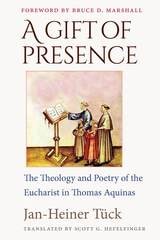
cover of A Gift of Presence: The Theology and Poetry of the Eucharist in Thomas Aquinas

A Gift of Presence

The Theology and Poetry of the Eucharist in Thomas Aquinas

Jan Heiner Tück

Catholic University of America Press, 2018
Jan-Heiner Tück presents a work that explores the sacramental theology, lived spirituality, and Eucharistic poetry of the Church’s doctor communis, St. Thomas Aquinas. Although Aquinas’ Eucharistic poetry has long occupied an important place in the Church’s liturgical prayer and her repertoire of sacred music, the depth of these poems remains hidden until one grasps the rich sacramental theology underlying it. Consequently, Tück first offers a detailed but approachable primer of Aquinas’ theology of the sacraments, before diving deeply into the Angelic Doctor’s theology and poetry of the Eucharist. The Scriptural accounts stand at the heart of the systematic framework developed by Aquinas, and thus significant attention is devoted to showing the harmony between the accounts of Christ’s passion and the detailed exposition of the Summa theologiae. Moreover, the Eucharistic controversies of the ninth and eleventh centuries provide the contrapuntal context in which Aquinas did his thinking, praying, and writing. Not surprisingly, therefore, the response he crafts to these controversies draws upon both speculative powers and contemplative prayer, brought together in the unity of Aquinas’ theology and spirituality. The net result is a twofold treasure for the Church: a careful systematic presentation of Eucharistic theology and the lived devotional expression of the same in the carefully constructed—and now much beloved—stanzas of Pange lingua gloriosi, Lauda Sion, Adoro te devote, etc. By revealing the lively interplay of the saint’s powerful speculative intellect and a heart steeped in love for the Eucharistic Lord, Tück offers a sophisticated exposition of Aquinas’ Eucharistic poetry and the roots it sinks into a wider theological framework. Finally, the contemporary significance and power of Aquinas’ work is drawn out, not only in the rarefied realm of intellectual inquiry but also in the everyday expanse of ordinary life.
[more]
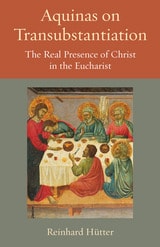
cover of Aquinas on Transubstantiation

Aquinas on Transubstantiation

Reinhard Hutter

Catholic University of America Press, 2019
Aquinas on Transubstantiation treats one of the most frequently mis-understood and mis-represented teachings of Thomas Aquinas—Eucharistic transubstantiation. The study interprets Aquinas’s teaching as an exercise of “holy teaching” (sacra doctrina) that intends to show theologically and back up philosophically the simple yet profound thesis that “transubstantiation” affirms nothing but the truth of Christ’s words at the Last Supper—“This is my body,” “This is my blood.” Yet in order to achieve a contemporary ressourcement of this simple yet profound truth, it is necessary to probe the depths of Thomas Aquinas’s philosophical interpretation of it. For Thomas Aquinas, in regarding the truth of Eucharistic conversion, it is faith that preserves the human intellect from missing or dismissing the mystery announced in Christ’s words. Faith, however, is not intellectually blind, a faith that, as is often erroneously held, is commanded by arbitrary divine dictates to which the will submits in blind obedience. Rather, Aquinas takes faith is sustained, but not constituted, by an intellectual contemplation of the proposed mystery of faith, by faith seeking understanding. Thomas Aquinas unfolds this exercise of understanding guided by faith in the medium of a metaphysical contemplation that affords a profound intellectual appreciation of this central mystery of faith—precisely as mystery. Thomas’s metaphysical contemplation of Eucharistic conversion gestures toward the blinding light of superintelligibility, experienced as the unique darkness that surrounds this sublime mystery of faith. A ressourcement in Thomas Aquinas’s doctrine of transubstantiation also affords an renewed appreciation of the Church’s affirmation of transubstantiation as the most apt term for the interpretation of the mystery of Eucharistic conversion and a greater precision of what is centrally at stake in this mystery in the ongoing ecumenical conversation of this most central Christian teaching. A doctrinally sound, ecumenically informed, and philosophically reflected contemporary Catholic theology cannot afford to ignore or dismiss Aquinas’s surpassing account of Eucharistic conversion.
[more]
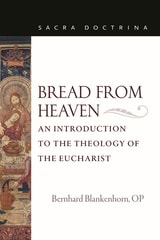
cover of Bread from Heaven: An Introduction to the Theology of the Eucharist

Bread from Heaven

An Introduction to the Theology of the Eucharist

Bernhard Blankenhorn

Catholic University of America Press, 2021
Bread from Heaven offers a contemporary theological synthesis on the Eucharist that brings together classical and critical biblical exegesis, debates on the early history of the Christian liturgy, patristic doctrine, the teachings offered by the Councils of Florence, Trent and Vatican II, and the Church’s lex orandi, all within a framework provided by the Eucharistic theology of Thomas Aquinas. The volume begins with Christ’s Bread of Life discourse in John 6, in light of the Old Testament theme of the manna, and the Synoptic accounts of the Last Supper. These biblical texts offer solid foundation for a theology of Eucharistic sacrifice, presence and Communion. It then continues with a historical and systematic study of the institution of the Eucharist by Christ, with special attention given to the emergence of the first Eucharistic prayers. Then follows a survey of key Christological and ecclesiological themes which undergird Eucharistic theology. The chapters on Eucharistic sacrifice and presence form the heart of the work. Here, the focus moves to key conciliar, patristic and Thomistic insights on these themes. Bread from Heaven clarifies misunderstandings of Eucharistic sacrifice and renders transubstantiation accessible to beginners. Blankenhorn concludes with a study of the consecration, the minister of the Eucharist and the fruits of communion. The chapter on the debate over the words of institution and the epiclesis gives a fresh perspective that integrates both eastern and western tradition. The study of the Eucharistic celebrant strikes a balance between a spirituality of the priest as acting in persona Christi and of the priest as praying in persona ecclesiae. The concluding chapter centers on the Eucharist’s unitive, mystical fruits in the Church. This textbook is ideal for an advanced undergraduate or graduate course on Eucharistic theology. It also seeks to advance the debate on several controversial historical and speculative issues in sacramental theology.
[more]
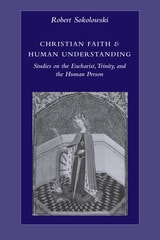
cover of Christian faith & human understanding: studies on the Eucharist, Trinity, and the human person

Christian faith & human understanding

studies on the Eucharist, Trinity, and the human person

Robert Sokolowski

Catholic University of America Press, 2006

In this collection of essays, renowned philosopher Robert Sokolowski illustrates how Christian faith is not an alternative to reason, but rather an enhancement of it.
[more]
cover of Eucharistic Presence: A Study in the Theology of Disclosure

Eucharistic Presence

A Study in the Theology of Disclosure

Robert Sokolowski

Catholic University of America Press, 1994
[more]
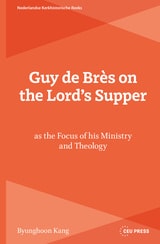
cover of Guy de Brès on the Lord’s Supper as the Focus of his Ministry and Theology

Guy de Brès on the Lord’s Supper as the Focus of his Ministry and Theology

Byunghoon Kang

Central European University Press, 2026

Guy de Bres (ca.1522-1567) was an important figure in the Dutch Reformation. He was the author of the Belgic Confession, which is still among the confessional texts of many Dutch denominations. One of the key points of his choice for Reformed doctrine was the Lord’s Supper. It was ultimately the illegal ministry of this for which he was sentenced to death. This study describes De Bres’ view of the Lord’s Supper as expressed in his writings against the background of the Reformation in the Low Countries. If you would like to order the book for delivery outside of the Netherlands, please email orders@aup.nl
[more]
cover of Heavenly Supper: The Story of Maria Janis

Heavenly Supper

The Story of Maria Janis

Fulvio Tomizza

University of Chicago Press, 1991

It is a winter morning in Venice, in 1622. Muted voices drift through a thin wall next door. Her curiosity aroused, a young woman peers through a crack in the door, only to witness a strange and disturbing sight: a woman and a priest secretly celebrating communion. Troubled by what she sees, she reports the incident at confession. Her revelation leads to the arrest, jailing, and arraignment of the two for heresy before the Venetian Holy Office of the Inquisition.

So begins Fulvio Tomizza's absorbing account of the true story of Maria Janis, a devout peasant woman from the mountains north of Bergamo. Too poor to enter a convent, Maria had set out to serve God by relinquishing the little she had, through renunciation of all food but the bread and wine of communion. Encouraged by the restless village priest Pietro Morali, Maria claimed to have existed in this sanctified state for five years. During this time, she, Morali, and the weaver Pietro Palazzi travel from a little village in the Alps to Rome and then to Venice, where their alleged sacrilege is discovered and they are brought to trial. Both revered as a saint and reviled as a fraud, Maria with her "privilege" inspires and threatens believers within the Church. Combining the historian's precision with the novelist's imagination, Tomizza painstakingly reconstructs her story, crafting a fascinating portrait of sublimated love, ambition, and jealousy.

Heavenly Supper alternates a chronological account of the trial with analyses of each protagonist's life history. Along the way, Tomizza gives voice to the minds and hearts of his characters, allowing them to speak for themselves in their own words. The world he recreates resonates with the fervor of the Counter Reformation when faith and its consequences were rigidly controlled by the Church. As suspenseful as a detective novel, Tomizza's story goes beyond the trial to evoke a panoramic view of seventeenth-century Italian culture.
[more]
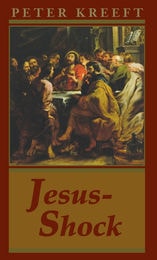
cover of Jesus-Shock

Jesus-Shock

Peter Kreeft

St. Augustine's Press, 2008

Jesus Shock is the second in a series of short works on seminal concerns of the impact that Jesus Christ made in the world. The first work, The Philosophy of Jesus (St. Augustine’s Press, 2007), explored philosophy in light of Jesus, rather than the other way around. The present work investigates the reception Jesus received both in His lifetime and continuously to the present time, not only from His enemies, but from His friends, a reception of shock, astonishment, even disgust.
  Perhaps a few remarks from the book best explains it:

The point of the book:
 The point of the title: Imagine a storm has downed a telephone wire so that everyone who touches it is shocked in every cell of his body. Well, the storm of God’s crazy love has “downed” (incarnated) Jesus, and everyone who touches this “live wire” is shocked in every cell of his soul.
 The question of the book: Why is “Jesus” the most non-neutral, the most controversial, the most embarrassing name in the world? Why is talking about Jesus like talking about sex?
 This whole book is really about a single movie line, the greatest line in the greatest movie in history. Bet you know what it is.
 Jesus-Shock is about the Real Presence of Christ in the Gospels and in the Eucharist. It
is not about the theology of the Real Presence, but about the experience of Him there, and about the experience of everyone in the Gospels who met Him.

 What was the bitterest controversy of the Protestant Reformation, both between Protestants and Catholics and between different Protestant denominations, the one that had both sides calling the other not just heretics but devils?   
 Answer: It was not Justification by Faith, the hallmark of the Reformation, even though that question is about nothing less momentous than how to be saved, how to get to Heaven. It was not the relation between religion and politics, even though that was a matter of life or death (literally, on battlefields and at guillotines and hangings) and not just a matter of truth or falsity, or of good or evil. It was not about the sufficiency of the Bible, or the corruption in the Church, or the relation between the Bible and the Church. It was not about the Pope, and the governance of the Church. It was not about Mary or saints or angels or Purgatory. It was not about the Incarnation or the Trinity or the Atonement.
 It was about the Real Presence of Christ in the Eucharist.

 Jesus-Shock, in addressing this controversy forcefully and faithfully, shows the reasons why to this day the name of “Jesus” stirs up controversy, even revulsion, in polite society. In the true spirit of ecumenism, it also points the way toward a true rapprochement among His modern-day disciples.
[more]
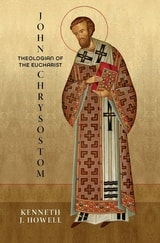
cover of John Chrysostom, Theologian of the Eucharist

John Chrysostom, Theologian of the Eucharist

Kenneth J. Howell

Catholic University of America Press, 2024
Despite the fact that John Chrysostom wrote more on the Eucharist than any other Greek Church Father, there has never been a full treatment of his doctrine in English. In this book, Kenneth Howell brings together a wide array of sources from which he develops a many-sided portrait of Chrysostom’s eucharistic thought. While the Antiochene preacher assumed the real presence and the sacrificial nature of the Eucharist, he focused more on the moral and spiritual implications of communion. At the root of his theology lies the conviction that the Eucharist with its home in the liturgy is the extension of Christ’s incarnate life through space and time. All that Christ accomplished in his life, death, and resurrection is present and available to the communing Christian who stands in union with the angelic hosts in the liturgy of the church. John’s preaching at times reaches encomiastic proportions as he never tires of praising the benefits and power of the Eucharist and he deftly applies the sacrament to the struggle of virtue and vice as he explores both the invitation and the obstacles to communion. Among the moral implications of the Eucharist, John seems to distinguish well between sins arising from human weakness versus malicious dispositions freely chosen. He is especially keen to exhort his hearers to lay aside the remembrance of evil (mnesikakia) done to them in their past lives. Humility and forbearance are two essential virtues in arriving at forgiveness of past injuries. And lack of forgiveness is like greed in that both constitute a turn in on oneself. The Eucharist demands love of neighbor and active ministry to the less fortunate of the world. For John, God is interested in golden souls more than golden chalices.
[more]
cover of On the Body of the Lord

On the Body of the Lord

Albert Albert the Great

Catholic University of America Press, 2017

Albert the Great wrote On the Body of the Lord in the 1270s, making it his final work of sacramental theology. A companion volume to his commentary on the Mass, On the Body of the Lord is a comprehensive discussion of Eucharistic theology. The treatise is structured around six names for the Eucharist taken from the Mass: grace, gift, food, communion, sacrifice, and sacrament. It emerges from the liturgy and is intended to draw the reader back to worship.

The overall movement of the treatise follows the order of God’s wisdom. Albert begins by discussing the Eucharist as a gift flowing from the goodness of the Trinity. He touches on its relation to redemption and the Church, including a rigorous Aristotelian analysis of Eucharistic change and presence before ending with a discussion of Mass rubrics. The most significant theological emphasis is on the Eucharist as food given to feed the people of God.

The style varies to suit the content: certain sections are terse; others are devotional, allowing the reader to enter the saint’s own prayer. Perhaps most characteristically Albertine is an extended meditation that compares the process of digestion to the incorporation of the Christian into the Body of Christ. The mixed style allows this work to integrate rigorous aspects of scholastic thought with a fervent love for God, making On the Body of the Lord one of Albert’s most human as well as one of his most beautiful works.

On the Body of the Lord was well received, particularly in areas that came to be influenced by the devotio moderna. By 1484, three separate Latin editions had been printed, two of which were the inaugural works on new presses. In the following century the Protestant Reformation brought an end to its popularity. On the Body of the Lord is here translated into English for the first time.
[more]
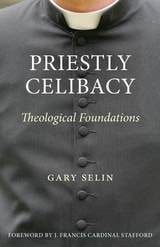
cover of Priestly Celibacy

Priestly Celibacy

Gary B. Selin

Catholic University of America Press, 2016
Pope Francis has called mandatory priestly celibacy a "gift for the Church," but added "since it is not a dogma, the door is always open" to change. As this Church discipline continues to be debated, it is important for Catholics to delve into the theological and not merely pragmatic reasons behind its continuation. Priestly Celibacy: Theological Foundations, therefore, fills a critical gap in the current theological literature on this important topic of ecclesial ministry and life, and also helps to contribute to the advancement of the rather underdeveloped theology of priestly celibacy.
[more]
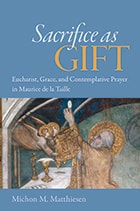
cover of Sacrifice As Gift

Sacrifice As Gift

Michon M. Matthiesen

Catholic University of America Press, 2012
Sacrifice as Gift is a timely presentation of a forgotten vision of eucharistic sacrifice, one that reconfigures the current philosophical and theological divide between sacrifice and gift.
[more]
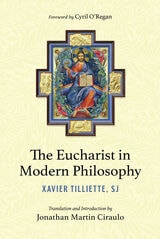
cover of The Eucharist in Modern Philosophy

The Eucharist in Modern Philosophy

Xavier Tilliette

Catholic University of America Press, 2022
The Eucharist in Modern Philosophy is one of the last books written by the renowned Jesuit philosopher Xavier Tilliette (1921-2018), and the first to be translated into English. Jonathan Martin Ciraulo, the translator, also provides an introduction to the thought of Tilliette and the content of this book, while Cyril O’Regan provides the foreword, noting the particular intellectual characteristics of Tilliette and his analysis of eucharistic philosophies. In addition to being known as one of the foremost experts on the German Idealist Friedrich Schelling, Tilliette wrote voluminously on the relationship between modern philosophy and theology, particularly concerning the way in which Christology is central to the development of modern philosophy. In this volume, he extends that project to look at how various philosophers, such as Descartes, Leibniz, Hegel, Blondel, and Marion, as well as poets and mystics, such as de Chardin, Simone Weil, and Paul Claudel, thought extensively about the question of the Eucharist. The result is an enormous diversity of Eucharistic thought, from Descartes’ attempt to justify transubstantiation in light of his philosophical revolution, to Feuerbach’s supposed exposure of the contradiction inherent to sacramentality, to Antonio Rosmini’s eucharistic piety and speculation, to Maurice Blondel’s recovery and expansion of Leibniz’s notion of the substantial bond. Tilliette shows that this philosophical conversation about the Eucharist is a living tradition, as the aporias and failures of one generation provide stimulus for all that follows. Much of the work is largely historical, showing in great detail the context of each particular eucharistic philosophy, but Tilliette also evaluates the relative fruitfulness of the various eucharistic theories for philosophy, theology, and the life of the Church. This book demonstrates that the Eucharist has been, and will likely continue to be, a major impetus for philosophical reflection.
[more]
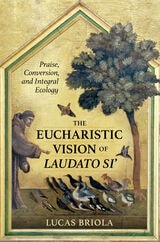
cover of The Eucharistic Vision of Laudato Si: Praise, Conversion, and Integral Ecology

The Eucharistic Vision of Laudato Si

Praise, Conversion, and Integral Ecology

Lucas Briola

Catholic University of America Press, 2022
No other encyclical has generated as much conversation—both Catholic and non-Catholic—as Laudato si’. Often forgotten in these conversations is the theological heart and eucharistic vision of the encyclical and its integral ecology. Even the title of Laudato si’—“Praised be!”—signals the centrality of right praise in caring for our common home. Using Bernard Lonergan’s theology of history, this book unearths the doxological, eucharistic vision that shapes the encyclical’s integral presentation of social and ecological conversion. It offers the first book-length study that recovers the eucharistic nature of Laudato si’. In drawing out the eucharistic vision of Laudato si’, the book accomplishes several feats for the reader. It roots the eucharistic dimensions of the encyclical in the writings of Popes John Paul II and Benedict XVI, showing how Pope Francis develops their thought in notable ways. It introduces Bernard Lonergan’s theology of history, showing how his framework can capture the eucharistic contours of caring for our common home; so too, in light of Laudato si’, does the book expand his theology of history to incorporate both ecological concern and the doxological, eucharistic essence of the church. The book assembles a liturgically shaped, systematic account of the church’s social mission. It joins poles otherwise sundered in a polarized church and world: between worship and justice, between concerns for human life and concerns for the natural world. Realizing the eucharistic vision of Laudato si’ promises much for our contemporary moment. Pope Francis recently observed that the integral ecology of Laudato si’ holds the key for the world’s recovery from the COVID-19 pandemic. The U.S. Catholic Bishops recently launched a Eucharistic Revival that aims to rekindle eucharistic devotion and praxis. The Eucharistic Vision of Laudato Si’: Praise, Conversion, and Integral Ecology supplies a timely study that helps fulfill these intertwined calls.
[more]
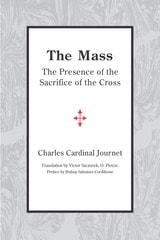
cover of The Mass: The Presence of the Sacrifice of the Cross

The Mass

The Presence of the Sacrifice of the Cross

Charles Cardinal Journet

St. Augustine's Press, 2008
[more]
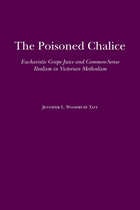
cover of The Poisoned Chalice: Eucharistic Grape Juice and Common-Sense Realism in Victorian Methodism

The Poisoned Chalice

Eucharistic Grape Juice and Common-Sense Realism in Victorian Methodism

Jennifer L. Woodruff Tait

University of Alabama Press, 2011

Examines the introduction of grape juice into the celebration of Holy Communion in the late 19th century Methodist Episcopal Church and reveals how a 1,800-year-old practice of using fermented communion wine became theologically incomprehensible in a mere forty years

This work examines the introduction of grape juice into the celebration of Holy Communion in the late 19th century Methodist Episcopal Church and reveals how a 1,800-year-old practice of using fermented communion wine became theologically incomprehensible in a mere forty years. Through study of denominational publications, influential exegetical works, popular fiction and songs, and didactic moral literature, Jennifer Woodruff Tait charts the development of opposing symbolic associations for wine and grape juice. She argues that 19th century Methodists, steeped in Baconian models of science and operating from epistemological presuppositions dictated by common-sense realism, placed a premium on the ability to perceive reality accurately in order to act morally. They therefore rejected any action or substance that dulled or confused the senses (in addition to alcohol, this included “bad” books, the theatre, stimulants, etc., which were all seen as unleashing unchecked, ungovernable thoughts and passions incompatible with true religion). 
 
This outlook informed Methodist opposition to many popular amusements and behaviors, and they decided to place on the communion table a substance scientifically and theologically pure. Grape juice was considered holy because it did not cloud the mind, and new techniques—developed by Methodist laymen Thomas and Charles Welch—permitted the safe bottling and shipment of the unfermented juice.
 
Although Methodists were not the only religious group to oppose communion wine, the experience of this broadly based and numerous denomination illuminates similar beliefs and actions by other groups.
[more]
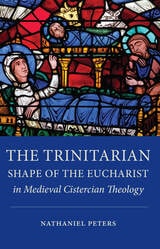
cover of The Trinitarian Shape of the Eucharist in Medieval Cistercian Theology

The Trinitarian Shape of the Eucharist in Medieval Cistercian Theology

Nathaniel Peters

Catholic University of America Press, 2026
William of Saint-Thierry, Isaac of Stella, and Baldwin of Forde created a distinctly Cistercian body of Eucharistic theology in the twelfth century. In this book, Nathaniel Peters offers a scholarly account of that theology and examines the connection between medieval Trinitarian and Eucharistic theology. These Cistercian authors thought that the character of God as a Trinity of persons united in essence provides the structure of the economy of salvation—especially its turning point, the Eucharist. They saw the Eucharist as the place where the ontological union of the Incarnation becomes intimate, personal, and communal. In the Eucharist, God the Father draws those who receive to himself by uniting them to the body and blood of the Son. This unity brings an increase of unity with the Holy Spirit. Once united to the Son and Spirit, the faithful are united to the Father. The Eucharist also connects the meditation, sacrifices, and offering of their own lives to the life of Christ, with which they are offered to the Father. Chapter 1 examines the thought of William of Saint-Thierry, who has the most developed understanding of Eucharistic presence, conversion, and reception. It also treats the connections William draws between Eucharistic reception and meditation on scripture and the passion of Christ. Chapter 2 treats Isaac of Stella, who uses more intellectualist imagery and imagery of the mystical body of Christ. Chapter 3 studies Baldwin of Forde, who argues that the term transubstantiation best describes Eucharistic conversion and emphasizes reception by faith in the truth about Christ. Chapter 5 offers a brief conclusion, with reference to later thinkers who explore the Trinitarian shape of the Eucharist in similar ways.
[more]
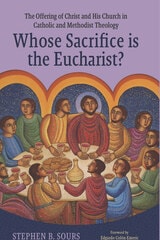
cover of Whose Sacrifice is the Eucharist? The Offering of Christ and His Church in Catholic and Methodist Theology

Whose Sacrifice is the Eucharist? The Offering of Christ and His Church in Catholic and Methodist Theology

Stephen B. Sours

Catholic University of America Press, 2024

This book explores what Catholics and Methodists believe about eucharistic sacrifice. Eucharistic sacrifice refers to the offering that Christ and his church make in the celebration of the Lord’s Supper. It is, therefore, both a Christian doctrine and a church practice. The sacrificial dimension of the sacrament comes both from Christ’s sacrifice on the cross and from his self-offering at the Last Supper in which Christ gives himself to the Father on behalf of his people. “This is my body, which is given for you” (Luke 22:19). The eucharist is a sacrificial meal because in the bread and cup Christians are united to the body and blood of Christ that was sacrificed for them on the cross. Moreover, the resurrected Lord is really present with his people in the eucharist, and while his historic crucifixion is an event in the past, Jesus’ salvation continues and his grace is given to his people in the sacrament, “for this is my blood of the covenant, which is poured out for many for the forgiveness of sins” (Matthew 26:28). Catholics and Methodists believe that Jesus instructs his followers to repeat his words and actions from the Last Supper in their celebration of the eucharist, but a long running assumption is that Catholics and Methodists—following the historic Reformation schism—are deeply divided over eucharistic sacrifice. This book challenges that assumption by analyzing what these churches teach on eucharistic sacrifice from historical, sacramental, liturgical, and ecumenical perspectives. Key figures like Thomas Aquinas and John Wesley help define eucharistic sacrifice in each tradition. Subsequently, authoritative texts such as ecclesial statements, eucharistic prayers, and hymns further specify what Catholics and Methodists believe they are doing when they offer the eucharist to God. Sours argues that far from being divided, Catholics and Methodists have much in common regarding this controversial doctrine.
[more]