Results by title
12 books match the query 'Marty, Martin E.'

A Nation of Behavers
Martin E. Marty
University of Chicago Press, 1980
"This is a book for everyone, more than for the scholar of American religion. . . . Its value is in breadth of vision and new interpretation."—Dean R. Hoge, Theology Today
"As a means of making sense out of the potpourri of competing groups that compose religious America today, A Nation of Behavers is a first-rate tool."—Edward A. Fiske, New York Times
Accounting for Fundamentalisms
The Dynamic Character of MovementsEdited by Martin E. Marty and R. Scott Appleby
University of Chicago Press, 1994
Fundamentalisms Comprehended
Edited by Martin E. Marty and R. Scott Appleby
University of Chicago Press, 1995
Fundamentalisms Observed
Edited by Martin E. Marty and R. Scott Appleby
University of Chicago Press, 1991
The contributors include sociologists, cultural anthropologists, and historians, some of whom have been participant-observers in the groups under consideration. As an analysis of the global resurgence of religion, Fundamentalisms Observed sheds new light on current religious movements and cultures from North America to the Far East.
Fundamentalisms and Society
Reclaiming the Sciences, the Family, and EducationEdited by Martin E. Marty and R. Scott Appleby
University of Chicago Press, 1993
Edited by Martin E. Marty and R. Scott Appleby
Around the world, fundamentalist movements are profoundly
affecting the way we live. Misinformation and misperception
about fundamentalism exacerbate conflicts at home and abroad.
Yet policymakers, journalists, students, and others have
lacked any comprehensive resource on the explosive phenomenon
of fundamentalism. Now the Fundamentalism Project has
assembled an international team of scholars for a multivolume
assessment of the history, scope, sources, character, and
impact of fundamentalist movements within the world's major
religious traditions.
Fundamentalisms and Society shows how fundamentalist
movements have influenced human relations, education, women's
rights, and scientific research in over a dozen nations and
within the traditions of Islam, Judaism, Christianity,
Buddhism, and Hinduism. Drawn from the fields of
anthropology, sociology, history of religion, and history of
science, the contributors cover topics such as the
educational structures of Hindu revivalism, women in
fundamentalist Iran and Pakistan, and the creationist cosmos
of Protestant fundamentalism. In a concluding essay, William
H. McNeill situates contemporary fundamentalisms within a
world historical context.
The Fundamentalism Project, Volume 2
Martin E. Marty and R. Scott Appleby direct the
Fundamentalism Project. Marty, the Fairfax M. Cone
Distinguished Service Professor of the History of Modern
Christianity at the University of Chicago, is the senior
editor of the Christian Century and the author of
numerous books, including the multivolume Modern American
Religion, also published by the University of
Chicago Press. Appleby, a research associate at the
University of Chicago, is the author of “Church and
Age Unite!” The Modernist Impulse in American
Catholicism.
Fundamentalisms and the State
Remaking Polities, Economies, and MilitanceEdited by Martin E. Marty and R. Scott Appleby
University of Chicago Press, 1996
successful have they been in remaking political structures?
To answer this question, the contributors to this volume—
political scientists, historians of religion,
anthropologists, and sociologists—discuss the anti-
abortion movement, Operation Rescue in the United States, the
Islamic war of resistance in Afghanistan, Shi'ite
jurisprudence in Iran, and other issues. The volume
considers the effect that antisecular religious movements
have had over the past twenty-five years on national
economies, political parties, constitutional issues, and
international relations on five continents and within the
traditions of Islam, Christianity, Judaism, Buddhism,
Hinduism, and Sikhism. Marty and Appleby conclude with a
synthetic statement on the fundamentalist impact on polities,
economies, and state security.
The Fundamentalism Project, Volume 3
Martin E. Marty and R. Scott Appleby direct the
Fundamentalism Project. Marty, the Fairfax M. Cone
Distinguished Service Professor of the History of Modern
Christianity at the University of Chicago, is the senior
editor of the Christian Century and the author of
numerous books, including the multivolume Modern American
Religion, also published by the University of
Chicago Press. Appleby, a research associate at the
University of Chicago, is the author of “Church and
Age Unite!” The Modernist Impulse in American
Catholicism.
Modern American Religion, Volume 1
The Irony of It All, 1893-1919Martin E. Marty
University of Chicago Press, 1986
"Marty writes with the highest standards of scholarship and with his customary stylistic grace. No series of books is likely to tell us as much about the religious condition of our own time as "Modern American Religion."—Robert L. Spaeth, Minneapolis Star Tribune
"The wealth of material and depth of insight are beyond reproach. This book will clearly stand as an important meteorological guide to the storm front of modernity as it swept Americans into the twentieth century."—Belden C. Lane, Review of Religions
"Whatever one thinks about Marty's theological or philosophical position as a historian, the charm of his friendly circumspective approach to American religious history is irresistible."—John E. Wilson, Theological Studies
"Marty attempts to impose historical order on the divergent ways a century of Americans have themselves tried to find order in their worlds. . . . [He] meets the challenge deftly. . . . It is a book relevant to our time. . . . Engages the heart and mind jointly."—Andy Solomon, Houston Post
Modern American Religion, Volume 2
The Noise of Conflict, 1919-1941Martin E. Marty
University of Chicago Press, 1991
"He tells the story [of the 1920s and 1930s] with a verve seldom equaled and manages to condense in one volume the results of dozens of specialized monographs. . . . [It] bears the usual hallmarks of a Marty book: a smoothly flowing narrative, passages studded with suggestive insight inviting further research, and apt quotations that capture the gist of complicated issues. . . . [A] splendid book. . . . Deserves a wide readership and undoubtedly will receive it." —James H. Moorhead, Chicago Sunday Tribune
"There is simply no better source, certainly none so engaging, for the interactions of religion and the larger culture in the interwar period." —Robert Booth Fowler, Journal of American History
"[This book is] not merely a history of American religion, but what might better be called a religious history" —David M. Kennedy, New York Times Book Review
Modern American Religion, Volume 3
Under God, Indivisible, 1941-1960Martin E. Marty
University of Chicago Press, 1996
Under God, Indivisible, 1941-1960 is the first book to systematically address religion and the roles it played in shaping the social and political life of mid-century America. A work of exceptional clarity and historical depth, it will interest general readers as well as historians of American and church history.
"The series will become a standard account of the nation's variegated religious culture during the current century. The four volumes, the fruition of decades of research, may rank as much honored Marty's most significant contribution to U.S. studies."—Richard N. Ostling, Time
"When America needs some advice or commentary on the state of modern theology, the person it turns to is Martin Marty."—Publishers Weekly
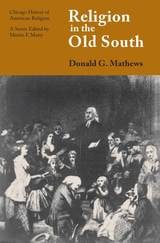
Religion in the Old South
Donald G. Mathews
University of Chicago Press, 1979
"A major achievement—a magnificently provocative contribution to the understanding of the history of religion in America."—William G. McLoughlin, Book Reviews
"A meticulous and well-documented study . . . In the changing connotations of the word 'liberty' lie most of the dilemmas of Southern (and American) history, dilemmas Dr. Mathews analyses with considerable penetration."—Times Literary Supplement
"The most compact and yet comprehensive view of the Old South in its religious dimension that is presently available. This is a pioneering work by one who is widely read in the sources and is creative enough to synthesize and introduce fresh themes. . . . He makes a unique contribution to southern historiography which will act as a corrective upon earlier works. . . . Boldly stated, every library that consults Choice should purchase this volume."—Choice
"Mathews presents us with the findest and grandest history of old southern religion that one could imagine finding in so short a book on so large a topic. . . . Here stands in its own right a masterpiece of regional historiography of religion in America."—William A. Clebsch, Reviews in American History
Religion, Education and the American Experience
Reflections on Religion and the American Public LifeEdith L. Blumhofer
University of Alabama Press, 2002
This collection of provocative and timely essays addresses the ways in which religious and educational institutions have come to define one another and American culture and identity.
Education in America-public and private, from the elementary to the university level-is the subject of urgent, ongoing debates. School vouchers, home schooling, prayer in the classrooms, sex education in the schools, and evolution versus creationism are just a few of the touchstones and flashpoints that have ignited a national dialogue concerning the role of religion in U.S. educational institutions.
The ten major essays assembled here emerged from a series of conferences conducted by the Public Religion Project at the University of Chicago Divinity School, funded by a grant from The Pew Charitable Trust. Written by recognized leaders in the fields of education and religion, the essays address such issues as the role of religious studies programs in tax-supported public universities; the evolving role of the university chaplain; the impact of religious doctrine on literary scholarship and the natural sciences; the college president as a spiritual leader; the secularization of private colleges whose foundations rest in the spiritual mission of a specific church or denomination and, conversely, the obligations, if any, of colleges that have maintained distinct denominational identities toward pluralistic outreach and openness; and an examination of the home schooling movement.
A true "dialogue" designed to inspire readers to rethink, argue, act, and continually converse on the subject, Religion, Education, and the American Experience will appeal to educators, college and university administrators, and boards of trustees, as well as academic libraries and scholars of education and religious studies.
Religion, Politics and the American Experience
Reflections on Religion and American Public LifeEdith L. Blumhofer
University of Alabama Press, 2002
This challenging collection of essays offers a refreshing approach to the troubling--and timely--subject of religion and public policy in America, and the ways in which issues of church and state affect our national identity.
The result of a series of conferences on religion and politics conducted by the Public Religion project at the University of Chicago, funded by a grant from the Pew Charitable Trust, this collection brings together an extraordinarily diverse set of contributors. Represented within its pages are the ideas and opinions of scholars, politicians, and religious leaders with backgrounds in law, politics, history, and divinity, among them Senator Paul Simon of Illinois. With its wide range of critical approaches and varied perspectives, this volume makes a vibrant contribution to the national dialogue on politics and religion.
Chief among the essay topics are the evangelical roots of American political life; early conflicts between Enlightenment thinking and spiritual impulses in developing a national identity; the practical problems that today's politicians face in campaigning; the impact of constitutional and legal language regarding our definitions of religion; and the way in which the media's treatment of our spiriutal life frames our perceptions of it. These thought-provoking essays will inspire readers to rethink, argue, perhaps act, but most importantly, to converse about this timely and important issue.
This volume will have wide cross-disciplinary appeal. Students and scholars of history, religious studies, and political science will find great value within its pages, as will scholars of divinity and law, and members of this general public concerned with the intersection of faith and politics in American life.