Results by title
32 books match the query 'Medieval, 500-1500'
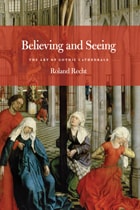
Believing and Seeing
The Art of Gothic CathedralsRoland Recht
University of Chicago Press, 2008
In addition to the great cathedrals of France, Recht explores key religious buildings throughout Europe to reveal how their grand designs supported this profusion of images that made visible the signs of scripture. Metalworkers, for example, fashioned intricate monstrances and reliquaries for the presentation of sacred articles, and technical advances in stained glass production allowed for more expressive renderings of holy objects. Sculptors, meanwhile, created increasingly naturalistic works and painters used multihued palettes to enhance their subjects’ lifelike qualities. Reimagining these works as a link between devotional practices in the late Middle Ages and contemporaneous theories that deemed vision the basis of empirical truth, Recht provides students and scholars with a new and powerful lens through which to view Gothic art and architecture.
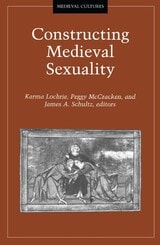
Constructing Medieval Sexuality
Karma Lochrie
University of Minnesota Press, 1997
A groundbreaking examination of sexuality in the Middle Ages.
This collection is the first to be devoted entirely to medieval sexuality informed by current theories of sexuality and gender. It brings together essays from various disciplinary perspectives-literary, theological, philosophical, medical, historical, and art historical-to consider how the Middle Ages defined, regulated, and represented sexual practices and desires.
Always considering sexuality in relation to gender, the body, and identity, the essays explore medieval sexuality as a historical construction produced by and embedded in the cultures and institutions of that period. Examining a range of medieval texts and images, the contributors explore the medieval understanding of sodomy, the historical construction of heterosexuality, the polymorphous erotics of female mysticism, and the intersections of sexuality with race, gender, and religion. This work not only offers new perspectives on the ways in which queer theory might inform our views of sexuality in medieval Europe, but also suggests that medieval constructions of sexuality may offer important contributions to both queer theory and the history of sexuality.These essays, situated in the context of current debates, linger over various definitions of medieval sexuality; they speak to each other in their differences and their similarities to further productive thinking about the sometimes conflicting and always fascinating ways in which the Middle Ages regarded sex and sexuality. Contributors: E. Jane Burns, U of North Carolina; Joan Cadden, U of California, Davis; Michael Camille, U of Chicago; Dyan Elliott, Indiana U; Louise O. Fradenburg, U of California, Santa Barbara; Mark D. Jordan, U of Notre Dame; Steven F. Kruger, CUNY.
Daily Life in Portugal in the Late Middle Ages
A.H. de Oliviera Marques; Translated by S.S. Wyatt
University of Wisconsin Press, 1971
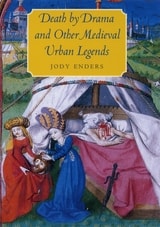
Death by Drama and Other Medieval Urban Legends
Jody Enders
University of Chicago Press, 2002
Was a convicted criminal executed on stage during a beheading scene? Was an unfortunate actor driven insane while playing a madman? Did a theatrical enactment of a crucifixion result in a real one? Did an androgynous young man seduce a priest when portraying a female saint? Enders answers these and other questions while presenting a treasure trove of tales that have long seemed true but are actually medieval urban legends. On topics ranging through politics, religion, marriage, class, and law, these tales, Enders argues, do the cultural work of all urban legends: they disclose the hopes, fears, and anxieties of their tellers. Each one represents a medieval meditation created or dramatized by the theater with its power to blur the line between fiction and reality, engaging anyone who watches, performs, or is represented by it. Each one also raises pressing questions about the medieval and modern world on the eve of the Reformation, when Europe had never engaged more anxiously and fervently in the great debate about what was real, what was pretend, and what was pretense.
Written with elegance and flair, and meticulously researched, Death by Drama and Other Medieval Urban Legends will interest scholars of medieval and Renaissance literature, history, theater, performance studies, and anyone curious about urban legends.
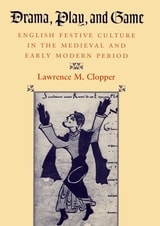
Drama, Play, and Game
English Festive Culture in the Medieval and Early Modern PeriodLawrence M. Clopper
University of Chicago Press, 2001
Drama, Play, and Game demonstrates that the theatrum repudiated by medieval clerics was not "theater" as we understand the term today. Clopper contends that critics have misrepresented Western stage history because they have assumed that theatrum designates a place where drama is performed. While theatrum was thought of as a site of spectacle during the Middle Ages, the term was more closely connected with immodest behavior and lurid forms of festive culture. Clerics were not opposed to liturgical representations in churches, but they strove ardently to suppress May games, ludi, festivals, and liturgical parodies. Medieval drama, then, stemmed from a more vernacular tradition than previously acknowledged-one developed by England's laity outside the boundaries of clerical rule.
Early Medieval Italy
Central Power and Local Society 400-1000Chris Wickham
University of Michigan Press, 1989
Gender and Difference in the Middle Ages
Sharon Farmer
University of Minnesota Press, 2002
Exposes complex intersections between genders and other identities in medieval cultures.
Nothing less than a rethinking of what we mean when we talk about "men" and "women" of the medieval period, this volume demonstrates how the idea of gender-in the Middle Ages no less than now-intersected in subtle and complex ways with other categories of difference. Responding to the insights of postcolonial and feminist theory, the authors show that medieval identities emerged through shifting paradigms-that fluidity, conflict, and contingency characterized not only gender, but also sexuality, social status, and religion. This view emerges through essays that delve into a wide variety of cultures and draw on a broad range of disciplinary and theoretical approaches. Scholars in the fields of history as well as literary and religious studies consider gendered hierarchies in western Christian, Jewish, Byzantine, and Islamic areas of the medieval world.
Contributors: Daniel Boyarin, U of California, Berkeley; Ruth Mazo Karras, U of Minnesota; Mathew Kuefler, San Diego State U; Martha Newman, U of Texas; Kathryn M. Ringrose, U of California, San Diego; Elizabeth Robertson, U of Colorado; Everett Rowson, U of Pennsylvania; Michael Uebel, U of Kentucky; Ulrike Wiethaus, Wake Forest U.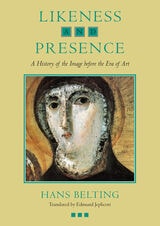
Likeness and Presence
A History of the Image before the Era of ArtHans Belting
University of Chicago Press, 1993
Likeness and Presence looks at the beliefs, superstitions, hopes, and fears that come into play as people handle and respond to sacred
images, and presents a compelling interpretation of the place of the image in Western history.
"A rarity within its genre—an art-historical analysis of iconography which is itself iconoclastic. . . . One of the most intellectually exciting and historically grounded interpretations of Christian iconography." —Graham Howes, Times Literary Supplement
"Likeness and Presence offers the best source to survey the facts of what European Christians put in their churches. . . . An impressively detailed contextual analysis of medieval objects." —Robin Cormack, New York Times Book Review
"I cannot begin to describe the richness or the imaginative grandeur of Hans Belting's book. . . . It is a work that anyone interested in art, or in the history of thought about art, should regard as urgent reading. It is a tremendous achievement."—Arthur C. Danto, New Republic
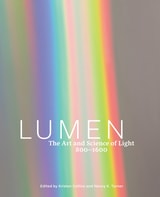
Lumen
The Art and Science of Light, 800–1600Kristen Collins
J. Paul Getty Trust, The, 2024
Through the manipulation of materials, such as gold, crystal, and glass, medieval artists created dazzling light-filled environments, evoking, in the everyday world, the layered realms of the divine. While contemporary society separates science and spirituality, the medieval world harnessed the science of light to better perceive and understand the sacred. From 800 to 1600, the study of astronomy, geometry, and optics emerged as a framework that was utilized by theologians and artists to comprehend both the sacred realm and the natural world.
Through essays written by contributors from the fields of art history, the history of science, and neuroscience, and with more than two hundred illustrations, including glimmering golden reliquaries, illuminated manuscripts, rock crystal vessels, astronomical instruments, and more, Lumen cuts across religious, political, and geographic boundaries to reveal the ways medieval Christian, Jewish, and Islamic artists, theologians, and thinkers studied light. To convey the sense of wonder created by moving light on precious materials, a number of contemporary artworks are placed in dialogue with historic objects.
This volume is published to accompany an exhibition on view at the J. Paul Getty Museum at the Getty Center from September 10 to December 8, 2024.
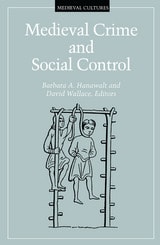
Medieval Crime and Social Control
Barbara A. Hanawalt
University of Minnesota Press, 1998
Uses historical and literary insights to consider crime and punishment in the Middle Ages.
Crime is a matter of interpretation, and never was this truer than in the Middle Ages, when societies faced with new ideas and pressures were continually forced to rethink what a crime was-and what was a crime. This collection undertakes a thorough exploration of shifting definitions of crime and changing attitudes toward social control in medieval Europe.
These essays-by leading specialists in European history and literature-reveal how various forces in medieval society interacted and competed in interpreting and influencing mechanisms for social control. They also demonstrate how well the different methods of history and literature combine to illuminate these developments.The essays show how the play with boundaries between legitimate and illegitimate actions took place not only in laws and courts, but also in the writing of social commentators such as John Fortescue and Jean Gerson, in the works of authors such as William Langland and Geoffrey Chaucer, and in popular literature such as sagas and romances. Drawing on a wide range of historical and literary sources-legal treatises, court cases, statutes, poems, romances, and comic tales-the contributors consider topics including fear of crime, rape and violence against women, revenge and condemnations of crime, learned dispute about crime and social control, and legal and political struggles over hunting rights. Their work shows how medieval society also defined its boundaries in contested spaces such as taverns and forests and in the different rules applying to the behavior and treatment of men and women.Contributors: Christopher Cannon, Oxford U; Elizabeth Fowler, Yale U; Louise O. Fradenburg, U of California, Santa Barbara; Claude Gauvard, Sorbonne; James H. Landman, U of North Texas; William Perry Marvin, Colorado State U; William Ian Miller, U of Michigan; Louise Mirrer, CUNY; Walter Prevenier, U of Ghent.ISBN 0-8166-3168-9 Cloth $49.95xxISBN 0-8166-3169-7 Paper $19.95x268 pages 5 7/8 x 9 JanuaryMedieval Cultures Series, volume 16Translation inquiries: University of Minnesota Press
Medieval Identity Machines
Jeffrey J. Cohen
University of Minnesota Press, 2003
A provocative new approach to medieval culture
In Medieval Identity Machines, Jeffrey J. Cohen examines the messiness, permeability, and perversity of medieval bodies, arguing that human identity always exceeds the limits of the flesh. Combining critical theory with a rigorous reading of medieval texts, Cohen asks if the category “human” isn’t too small to contain the multiplicity of identities. As such, this book is the first to argue for a “posthuman” Middle Ages and to make extensive use of the philosophical writings of Gilles Deleuze to rethink the medieval.
Among the topics that Cohen covers are the passionate bond between men and horses in chivalric training; the interrelation of demons, celibacy, and colonialism in an Anglo-Saxon saint’s life; Lancelot’s masochism as envisioned by Chrétien de Troyes; the voice of thunder echoing from Margery Kempe; and the fantasies that sustained some dominant conceptions of race. This tour of identity—in all its fragility and diffusion—illustrates the centrality of the Middle Ages to theory as it enhances our understanding of self, embodiment, and temporality in the medieval world.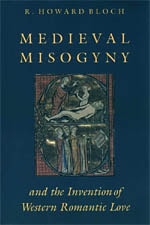
Medieval Misogyny and the Invention of Western Romantic Love
R. Howard Bloch
University of Chicago Press, 1991
Through analyses of a broad range of patristic and medieval texts, Bloch explores the Christian construction of gender in which the flesh is feminized, the feminine is aestheticized, and aesthetics are condemned in theological terms. Tracing the underlying theme of virginity from the Church Fathers to the courtly poets, Bloch establishes the continuity between early Christian antifeminism and the idealization of woman that emerged in the twelfth and thirteenth centuries. In conclusion he explains the likely social, economic, and legal causes for the seeming inversion of the terms of misogyny into those of an idealizing tradition of love that exists alongside its earlier avatar until the current era.
This startling study will be of great value to students of medieval literature as well as to historians of culture and gender.
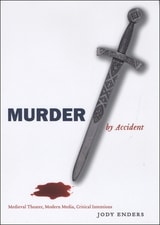
Murder by Accident
Medieval Theater, Modern Media, Critical IntentionsJody Enders
University of Chicago Press, 2009
Over fifty years ago, it became unfashionable—even forbidden—for students of literature to talk about an author’s intentions for a given work. In Murder by Accident, Jody Enders boldly resurrects the long-disgraced concept of intentionality, especially as it relates to the theater.
Drawing on four fascinating medieval events in which a theatrical performance precipitated deadly consequences, Enders contends that the marginalization of intention in critical discourse is a mirror for the marginalization—and misunderstanding—of theater. Murder by Accident revisits the legal, moral, ethical, and aesthetic limits of the living arts of the past, pairing them with examples from the present, whether they be reality television, snuff films, the “accidental” live broadcast of a suicide on a Los Angeles freeway, or an actor who jokingly fired a stage revolver at his temple, causing his eventual death. This book will force scholars and students to rethink their assumptions about theory, intention, and performance, both past and present.
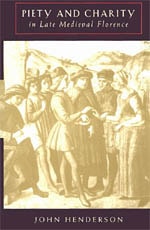
Piety and Charity in Late Medieval Florence
John Henderson
University of Chicago Press, 1997
"[A] long-awaited book. . . . [It is] the most complete survey of confraternities and charity, not only for Florence, but for any Italian city state to date. . . . This book recovers more vividly than other recent works what it meant to be a member of a confraternity in the late middle ages."—Samuel K. Cohn, Jr., Economic History Review
"Henderson offers new and fascinating information. . . . A stimulating and suggestive book that deserves a wide readership." —Gervase Rosser, Times Higher Education Supplement
Prostitution in Medieval Society
The History of an Urban Institution in LanguedocLeah Lydia Otis
University of Chicago Press, 1985
– Catharine R. Stimpson
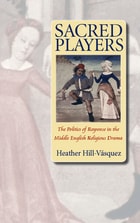
Sacred Players
The Politics of Response in the Middle English Religious DramaHeather Hill-Vásquez
Catholic University of America Press, 2007
Secrets of the English War Bow
Hugh D. H. Soar
Westholme Publishing, 2010
A Complete Recreation of the Deadliest Medieval Arm
Dominating medieval battlefields for more than two centuries but requiring long and arduous practice to command, the English war bow and its battle shaft are the symbols of the rise of British power in Europe. Despite being crafted for hundreds of years and wielded by generations of archers, no example of the war bow—the military version of the longbow—exists, outside of a single broken limb. Now for the first time, expert craftsmen use all available evidence including applied archaeology to unlock the secrets of the English war bow. Historian Hugh D. H. Soar is joined by Mark Stretton, master blacksmith, and Joseph Gibbs, bowyer, in order to demonstrate how a war bow and its associated arrow heads and shafts may have been constructed and used. In addition to showing the complete manufacture of a bow from tree selection to stringing and how specialized arrowheads were forged and attached to shafts, Secrets of the English War Bowprovides information on the actual performance of the war bow, including the bow's effectiveness against various materials and, for the first time, its use against moving targets, since bows were often drawn against mounted soldiers. Armed with this new information, Soar provides an analysis of both successes and failures of the war bow in several important battles. Illustrated in color and black and white, Secrets of the English War Bowprovides an invaluable service for those interested in medieval military history, archery, and technology.
Sisters and Workers in the Middle Ages
Edited by Judith M. Bennett, Elizabeth A. Clark, Jean F. O'Barr, B. Anne Vilen,
University of Chicago Press, 1989
These essays provide a greater understanding of the ways in which gender has played a part in determining relations of power in Western cultures. This volume makes a vital contribution to the current scholarship about women in the Middle Ages.

The Art of Medieval Technology
Images of Noah the ShipbuilderUnger, Richard W.
Rutgers University Press, 1991
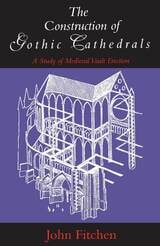
The Construction of Gothic Cathedrals
A Study of Medieval Vault ErectionJohn Fitchen
University of Chicago Press, 1981
In The Construction of Gothic Cathedrals, John Fitchen systematically walks readers through the process of erecting the great edifices of the Gothic era. He explains the building equipment and falsework needed, the actual operations undertaken, and the sequence of these operations as specifically as they can be deduced today. In the absence of contemporary accounts of the techniques used by medieval builders, Fitchen's study brilliantly pieces together clues from manuscript illuminations, pictorial representations, and the fabrics of the building themselves. The result is the clearest picture available of the innovations and techniques that enabled these buildings, which still generate awe today, to rise majestically above the low buildings of their surrounding towns. It's a book that will enthrall readers of history, and one that, as Progressive Architecture noted, "no student of architecture should miss."
The Crooked Stick
A History of the LongbowHugh D. H. Soar
Westholme Publishing, 2004
The Complete Story of a Legendary Weapon
"Spendidly enthusiastic. . . . Soar's book is indispensable."—Bernard Cornwell
"A fascinating study of a forgotten weapon. . . . For centuries the longbow dominated battle, affecting the fates of nations" —Wall Street Journal
"Bowyers, bowhunters, target archers and students of archery history should all find cause for celebration with Hugh Soar's concise but authoritative text." —Traditional BowhunterOn a clear July morning in 1346, a small force approached the walls of Caen for battle. The attackers rode to the field on horseback, banners and pennants fluttering in the light breeze. Behind them marched bowmen in tightly ranked units. At the sound of a crisp battle horn, they halted. A twinge of apprehension rippled through the thousands of Norman defenders as they looked down at the opposing army, for precision archery formation had long since disappeared as a military concept in medieval France. Here was not the expected rabble of unrated bucolics cowed by the might of France; confronting them was a quietly determined group of trained soldiers armed not with the familiar arbalest but with a new and strange weapon of great length. The defenders of Caen were about to meet the English war bow and its deadly battle shaft. For the next 100 years, this weapon, the "crooked stick," would command continental battlefields, etching its fearsome reputation at Crécy, Poitiers, Agincourt, and Verneuil, while establishing England as an international power for the first time.
Although the longbow is best known for its deployment during the Hundred Years' War, its origins lie with ancient Saxon seafighters and Welsh craftsmen, while today the bow is a vibrant part of the traditional archery scene. In The Crooked Stick: A History of the Longbow, historian Hugh D. H. Soar pulls together all of these strings, presenting the engaging story of this most charismatic standoff weapon. After a careful consideration of Neolithic bows and arrows, the author describes the bow's use in the medieval hunt and its associated customs. The longbow made its deepest mark in warfare, however, and the author follows the weapon's development and tactical deployment from the hand-bow of William the Conqueror's campaigns to the continental set-piece battles between England and France. Although soldiers reluctantly gave up the longbow for firearms, its recreational use became immensely popular, particularly during the Regency and Victorian periods. In the twentieth century it appeared as if the longbow would disappear into the fog of legend, but a new interest in traditional craft and expertise gained hold, and the pleasure of using this ancient instrument is now firmly part of archery around the world.
Through a remarkable command of manuscript and printed sources and a judicious use of material evidence, including his own important collection of rare longbows, Hugh Soar establishes the deep connections of this bow to England, Scotland, and Wales. Figures in the past like William Wallace, Edward III, and Henry V appear alongside detailed descriptions of bows, strings, arrows, and arrowheads, while the rise of institutions and craftsmen devoted to the longbow are presented to show how knowledge of this weapon was carried forward across the centuries. Today, those in the sport of archery and military historians will find that The Crooked Stick will enhance their own interests in a weapon of legendary status.
In addition to the illustrated text, the book contains appendices detailing the history and design of bracers, tabs and tips, quivers, and arrowheads associated with the longbow.
The Idea of the Theater in Latin Christian Thought
Augustine to the Fourteenth CenturyDonnalee Dox
University of Michigan Press, 2004
---Margaret Knapp, Arizona State University
"...an elegantly concise survey of the way classical notions of theater have been interpreted in the Latin Middle Ages. Dox convincingly demonstrates that far from there being a single 'medieval' attitude towards theater, there was in fact much debate about how theater could be understood to function within Christian tradition, even in the so-called 'dark ages' of Western culture. This book makes an innovative contribution to studies of the history of the theater, seen in terms of the history of ideas, rather than of practice."
---Constant Mews, Director, Centre for the Study of Religion & Theology, University of Monash, Australia
"In the centuries between St. Augustine and Bartholomew of Bruges, Christian thought gradually moved from a brusque rejection of classical theater to a progressively nuanced and positive assessment of its value. In this lucidly written study, Donnalee Dox adds an important facet to our understanding of the Christian reaction to, and adaptation of, classical culture in the centuries between the Church Fathers and the rediscovery of Aristotle."
---Philipp W. Rosemann, University of Dallas
This book considers medieval texts that deal with ancient theater as documents of Latin Christianity's intellectual history. As an exercise in medieval historiography, this study also examines biases in modern scholarship that seek links between these texts and performance practices. The effort to bring these texts together and place them in their intellectual contexts reveals a much more nuanced and contested discourse on Greco-Roman theater and medieval theatrical practice than has been acknowledged. The book is arranged chronologically and shows the medieval foundations for the Early Modern integration of dramatic theory and theatrical performance.
The Idea of the Theater in Latin Christian Thought will be of interest to theater historians, intellectual historians, and those who work on points of contact between the European Middle Ages and Renaissance. The broad range of documents discussed (liturgical treatises, scholastic commentaries, philosophical tracts, and letters spanning many centuries) renders individual chapters useful to philosophers, aestheticians, and liturgists as well as to historians and historiographers. For theater historians, this study offers an alternative reading of familiar texts which may alter our understanding of the emergence of dramatic and theatrical traditions in the West. Because theater is rarely considered as a component of intellectual projects in the Middle Ages, this study opens a new topic in the writing of medieval intellectual history.

The Place of Narrative
Mural Decoration in Italian Churches, 431-1600Marilyn Aronberg Lavin
University of Chicago Press, 1990
"Like many masterpieces, Lavin's book builds upon a simple idea . . . it is possible to do a computer analysis of . . . visual narratives. . . . This is the first computer-based study of the visual arts of which I am aware that illustrates how those technologies can utterly transform the study of old master art. An extremely important book, one likely to become the most influential recent study of art of this period, The Place of Narrative is also a beautiful artifact."—David Carrier, Leonardo
"Covering over a millennium and dealing with the whole of Italy, Lavin makes pioneering use of new methodology employing a computer database . . . [and] novel terminology to describe the disposition of scenes of church and chapel walls. . . . We should recognize this as a book of high seriousness which reaches out into new areas and which will fruitfully stimulate much thought on a neglected subject of very considerable significance."—Julian Gardner, Burlington Magazine
The Sacred Image East and West
Edited by Robert Ousterhout and Leslie Brubaker
University of Illinois Press, 1995
The Theater of Devotion
East Anglian Drama and Society in the Late Middle AgesGail McMurray Gibson
University of Chicago Press, 1989
The Three Orders
Feudal Society ImaginedGeorges Duby
University of Chicago Press, 1980
The Wandering Scholars
Helen Waddell
University of Michigan Press, 1990
Time, Work, and Culture in the Middle Ages
Jacques Le Goff
University of Chicago Press, 1980
Trade and Romance
Michael Murrin
University of Chicago Press, 2013
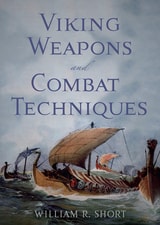
Viking Weapons and Combat Techniques
William R. Short
Westholme Publishing, 2009
A source of enduring fascination, the Vikings are the most famous raiders of medieval Europe. Despite the exciting and compelling descriptions in the Icelandic sagas and other contemporary accounts that have fueled this interest, we know comparatively little about Viking age arms and armor as compared to weapons from other historical periods. We know even less about how the weapons were used. While the sagas provide few specific combat details, the stories are invaluable. They were written by authors familiar with the use of weapons for an audience that, likewise, knew how to use them. Critically, the sagas describe how these weapons were wielded not by kings or gods, but by ordinary men, as part of their everyday lives. Viking Weapons and Combat Techniques provides an introduction to the arms and armor of the people who lived in Northern Europe during the Viking age, roughly the years 793–1066. Using a variety of available sources, including medieval martial arts treatises, and copiously illustrated with images of historical artifacts, battle sites, and demonstrations of modern replicas of Viking weapons, the author and his colleagues at Hurstwic (a Viking-age living history organization) and at the Higgins Armory Sword Guild have reconstructed the combat techniques of the Viking age and what is known about the defensive and offensive weapons of the time in general. Throughout, the author corrects some popular misconceptions about Viking warriors and warfare, such as the belief that their combat techniques were crude and blunt rather than sophisticated. In addition, the book provides an overview of Viking history and culture, focusing on the importance of weapons to the society as well as the Vikings’ lasting impact on Europe through their expeditions of trade and exploration.
Violence and Miracle in the Fourteenth Century
Private Grief and Public SalvationMichael E. Goodich
University of Chicago Press, 1995
Rescue miracles offer a wide range of voices rarely heard in medieval history, from women and children to peasants and urban artisans. They tell of salvation not just from the ravages of nature and war, but from the vagaries of a violent society—crime, unfair judicial practices, domestic squabbles, and communal or factional conflict. The stories speak to a collapse of confidence in decaying institutions, from the law to the market to feudal authority. Particularly, the miraculous escapes documented during the Hundred Years' War, the Italian communal wars, and other conflicts are vivid testimony to the end of aristocratic warfare and the growing victimization of noncombatants.
Miracles, Goodich finds, represent the transcendent and unifying force of faith in a time of widespread distress and the hopeless conditions endured by the common people of the Middle Ages. Just as the lives of the saints, once dismissed as church propaganda, have become valuable to historians, so have rescue miracles, as evidence of an underlying medieval mentalite. This work expands our knowledge of that state of mind and the grim conditions that colored and shaped it.
Wife and Widow in Medieval England
Sue Sheridan Walker, Editor
University of Michigan Press, 1993