Results by title
12 books match the query 'Newman, John Henry, Saint'
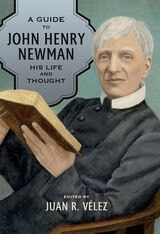
A Guide to John Henry Newman
His Life and ThoughtJuan R. Velez
Catholic University of America Press, 2022
John Henry Newman (1801-1890), renowned thinker and writer, Anglican clergyman and later Roman Catholic priest and cardinal, has had a lasting influence on both Anglicans and Catholics, in the fields of literature, education, and theology. On October 13, 2019, Pope Francis declared him a saint in Rome.
Appealing to both the student and the scholar, A Guide to John Henry Newman provides a wide range of subjects on Newman’s life and thought relevant for our times and complementary to biographies of Newman. The contributors include authors from many different disciplines such as theology, education, literature, history, and philosophy, highlighting the wide range of Newman’s work. These authors offer a positive assessment of Newman’s thought and contribute to the discussion of the recent scholarship of others.
A Guide to John Henry Newman will interest educated readers and professors alike, and serve as a text for college seminars for the purpose of studying Newman.
[more]
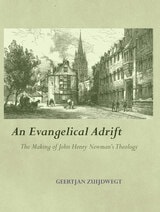
An Evangelical Adrift
The Making of John Henry Newman's TheologyGeertjan Zuijdwegt
Catholic University of America Press, 2022
An Evangelical Adrift is a theological biography of John Henry Newman (1801-1890) that reconstructs the most formative period in his development: the years between his teenage conversion to evangelicalism in 1816 and the beginning of the Tractarian Movement in 1833. By the early 1830s, Newman had explicitly rejected much of the theology he espoused in the late 1810s and early 1820s, and developed a highly original, deeply personal, and quite radical alternative, whose fundamental notions continued to shape his thought in later life. To date, there is neither a historically accurate nor a theologically sophisticated account of this change: the period in which it occurred is neglected, its significance is overlooked, its nature and content are misrepresented, and its scope is narrowed.
Besides being modelled on Newman’s own brief treatment of the period in his autobiographical Apologia pro vita sua (1864), later scholarly accounts are burdened by a persistent assumption that Newman’s catholic sensibility and anti-liberal convictions were constants throughout his life. This assumption was problematized by Frank Turner’s revisionist biography of the Anglican Newman (2002) and the ensuing debate about its reception. Zuijdwegt argues that Turner rightly identified evangelicalism as a key polemical target of the Anglican Newman, but stretched his argument too far by reducing Newman’s self-proclaimed lifelong battle against liberalism as a much later gloss on this earlier history.
The present study offers a compelling alternative to both mainline and revisionist interpretations. Based on detailed historical and theological analysis of the whole range of primary sources (including much neglected published and unpublished material), it meticulously reconstructs Newman’s youthful adoption of, gradual departure from, and theological alternative to evangelicalism. Against most mainline studies, it argues that this was a fundamental transformation, affecting nearly every aspect of Newman’s theology. Against Turner and other revisionists, it argues that this change was the product of careful and consistent theological reasoning and reflection, and that anti-liberalism was just as integral to it as anti-evangelicalism.
[more]
Autobiography
Narrative of TransformationCarolyn A. Barros
University of Michigan Press, 1997
In Autobiography: Narrative of Transformation, Carolyn Barros creates a primer for the study of autobiography, a genre many consider highly problematic. She sees autobiography as a "narrative of transformation"--a text that presents the "before" and "after" of an individual's life. Focusing on autobiography as narrative, of something that "happened to me," Barros highlights the various metamorphoses that are emplotted, bounded, and framed by the author's language and demonstrates that change is the operative metaphor in autobiographical discourse. The study focuses primarily on autobiographies from the rich Victorian period. Thomas Carlyle's Sartor Resartus, as it self-consciously fictionalized the composition of Diogenes Teufelsdröckh's life narrative, provides a striking analog and paradigm for introducing the study and its methodological approach. Barros's major chapters on John Henry Cardinal Newman, John Stuart Mill, Charles Darwin, and Margaret Oliphant detail four very different types of autobiographical transformation -- religious, philosophical, scientific, and literary -- and in Barros's judgment establish benchmarks for considering autobiographies from antiquity to the present. A final chapter discusses autobiography's significance to an individual writer's corpus, to a particular culture, and finally to a history of "narratives of transformation."
[more]
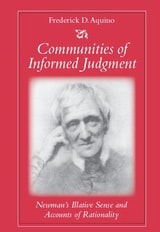
Communities of Informed Judgment
Newman's Illative Sense and Accounts of RationalityFrederick D. Aquino
Catholic University of America Press, 2004
An original contribution to Newman studies, the book has an interdisciplinary focus, drawing from recent work in social epistemology, virtue epistemology, and cognitive science. It also takes up issues relevant to the philosophy of religion, epistemology of religious belief, systematic theology, ecumenical dialogue, and studies in John Henry Newman.
[more]

Fictions of Consciousness
Mill, Newman, and the Reading of Victorian ProseJonathan Loesberg
Rutgers University Press, 1986
Mill, Newman, and the Reading of Victorian Prose
[more]
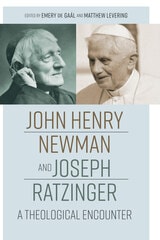
John Henry Newman and Joseph Ratzinger
A Theological EncounterEmery de Gaal
Catholic University of America Press, 2024
This book brings the thought of John Henry Newman into conversation with that of Joseph Ratzinger/Benedict XVI on a number of crucial theological themes. The book begins with a programmatic essay by Tracey Rowland connecting Newman’s approach with that of Ratzinger’s doktorvater Gottlieb Söhngen, along seven instructive paths. The book then delves into central themes of both Newman’s and Ratzinger’s thought, with essays that treat dogmatic development, the relationship of faith and reason, biblical inspiration, mystery, conscience, attentiveness to the “signs of the times,” interculturality and revelation, the Church as the Mystical Body, ecclesial authority, the relationship of faith and natural science, and deification. The essays in the volume come from many of the world’s leading Newman and Ratzinger scholars, with Ratzinger being represented by such experts as Rowland, Emery de Gaál, Aaron Pidel, SJ, Jacob Phillips, Matthew Ramage, and Jeremy Pilch; and Newman by such experts as Frederick D. Aquino, Andrew Meszaros, Marial Corona, Ryan Marr, and Elizabeth A. Huddleston. The Introduction briefly sets the scene for the encounter by describing the German reception of Newman during Ratzinger’s youth in comparison with the much less robust situation in German Newman scholarship today. It is the hope of the editors that this theological encounter will serve to promote and advance both Newman studies and Ratzinger studies in English- and German-speaking lands today.
[more]
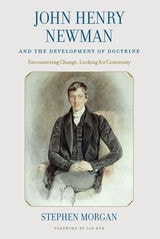
John Henry Newman and the Development of Doctrine
Encountering Change, Looking for ContinuityStephen Morgan
Catholic University of America Press, 2022
John Henry Newman and the Development of Doctrine provides an analysis of the attempts by John Henry Newman to account for the historical reality of doctrinal change within Christianity in the light of his lasting conviction that the idea of Christianity is fixed by reference to the dogmatic content of the deposit of faith. It argues that Newman proposed a series of hypotheses to account for the apparent contradiction between change and continuity, that this series begins much earlier than is generally recognized and that the final hypothesis he was to propose, contained in An Essay on the Development of Christian Doctrine, provides a methodology of lasting theological value and contemporary relevance.
Stephen Morgan establishes the centrality of the problem of change and continuity in theology, to Newman's theological work as an Anglican, its part in his conversion to Catholicism and its contemporary relevance to Catholic theology. It also surveys the major secondary literature relating to the question, with particular reference to those works published within the last fifty years. Additionally, Morgan considers the legacy of the Essay as a tool in Newman’s theology and in the work of later theologians, finally suggesting that it may offer a useful methodological contribution to the contemporary Catholic debate about hermeneutical approaches to the Second Vatican Council and post-conciliar developments in doctrine.
[more]
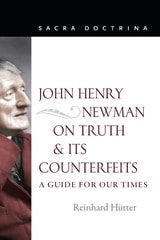
John Henry Newman on Truth and its Counterfeits
A Guide for Our TimesReinhard Hutter
Catholic University of America Press, 2020
Reinhard Hütter’s main thesis in this third volume of the Sacra Doctrina series is that John Henry Newman, in his own context of the nineteenth century, a century far from being a foreign one to our own, faced the same challenges as we do today; the problems then and now differ in degree, not in kind. Hence, Newman's engagement with these problems offers us a prescient and indeed prophetic diagnosis of what these problems or errors, if not corrected, will lead to—consequences which have more or less come to pass—and, furthermore, an alternative way which is at once thoroughly Catholic and holds contemporary relevance.
The introduction offers a survey of Newman’s life and works and each of the subsequent four chapters addresses one significant aspect of Christianity that is not only contested or rejected by secular unbelief, but also has a counterfeit for which not only Christians, but even Catholics have fallen. The counterfeit of conscience is the “conscience” of the sovereign subject (Ch. 1); the counterfeit of faith is the “faith” of one who does not submit to the living authority through which God communicates but rather adheres to the principle of private judgment in matters of revealed religion(Ch.2); the counterfeit of doctrinal development is twofold: (i) paying lip service to development while only selectively accepting its consequences on the grounds of a specious antiquarianism and (ii) invoking development theory to justify all sorts of contemporary changes according to the present Zeitgeist (Ch. 3). Finally, the counterfeit of the university are all those “universities” whose end is not to educate and thereby to perfect the intellect, but rather to feed more efficiently the empire of desire that is informed by the techno-consumerism of today (Ch. 4). The book concludes with an epilogue on Hütter’s journey to Catholicism.
[more]
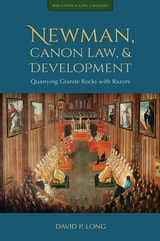
Newman, Canon Law and Development
Quarrying Granite Rocks with RazorsDavid P. Long
Catholic University of America Press, 2024
John Henry Newman is well-known as a theologian, philosopher, historian, writer, University rector, and poet, but can he also be associated with the field of canon law?
When Newman first proposed the possibility of doctrinal development as proof that the Catholic faith was free from corruption and error, he claimed “the Church is declared to be the great and special support of the Truth, her various functionaries are said to be means towards the settlement of diversities and of uncertainty of doctrine, and securing unity of faith.” For Newman, these various functionaries included not only apostles, prophets, evangelists, and pastors, but also theologians and, as is argued in this work, canon lawyers.
While Newman and doctrinal development have become well-explored topics in the field of theology, there has been little scholarship on how Newman’s thoughts on doctrinal development can influence current canon law and Church governance. David Long addresses that lacuna by offering a systematic analysis of Newman’s concept of development within current canonical practice. It starts by tracing Newman’s notions of personal judgment, public discussion, and episcopal moderation, followed by a presentation of the current canonical understanding of the theologian, and finally an application of the connection between Newman’s theory on development and present canonical legislation as it involves the role of the theologian.
By undertaking such an application, and by creating a model for discussion that preserves both development and Tradition, this work humbly proposes a valuable model for understanding the theologian’s contribution within the life of the contemporary Church in ways not previously explored.
[more]
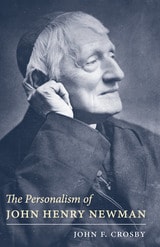
The Personalism of John Henry Newman
John Crosby
Catholic University of America Press, 2014
In The Personalism of John Henry Newman, Crosby shows the reader how Newman finds the life-giving religious knowledge that he seeks. He explores the "heart" in Newman and explains what Newman was saying when he chose as his cardinal's motto, cor ad cor loquitur (heart speaks to heart). He explains what Newman means in saying that religious truth is transmitted not by argument but by "personal influence."
[more]
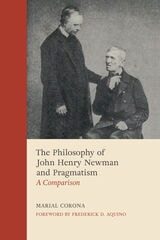
The Philosophy of John Henry Newman and Pragmatism
A ComparisonMarial Corona
Catholic University of America Press, 2023
In recent years, interest in John Henry Newman as a philosopher has gained momentum. This work places his philosophical insights in conversation with philosophers from the pragmatic tradition, particularly with C. S. Peirce, the classical pragmatists, and those who have followed their line, and shows several lines of concurrence. It argues that Newman overcame the modern philosophy of his time by reconnecting to the Aristotelian tradition in a very similar way to how Peirce did it fifty years later and the new pragmatists a century after.
Without claiming that Newman is a pragmatist philosopher, pragmatism is used as a foil, or point of access, to delve into Newman’s philosophy and bring forth the richness of his thought while placing him in the canon of philosophy. This approach deepens the understanding of his philosophical contributions and widens their reach to circles that have previously not engaged with him. Further, this study provides a means to understand pragmatism’s resources from a seldom-used vantage point and perhaps appreciate its fruitfulness in a new way.
Much emphasis is placed in Newman’s texts that refer to his search for and commitment to the truth. The particular nuances of his thought that are brought to light showcase the effective intellectual resources that his writings contain. Newman does not provide ready-made answers to today’s questions, but the way he analyzes and engages with the quandaries of his time can point us to creative and fruitful ways of engaging with those of our times.
[more]
Visions of Queer Martyrdom from John Henry Newman to Derek Jarman
Dominic Janes
University of Chicago Press, 2015
With all the heated debates around religion and homosexuality today, it might be hard to see the two as anything but antagonistic. But in this book, Dominic Janes reveals the opposite: Catholic forms of Christianity, he explains, played a key role in the evolution of the culture and visual expression of homosexuality and male same-sex desire in the nineteenth and twentieth centuries. He explores this relationship through the idea of queer martyrdom—closeted queer servitude to Christ—a concept that allowed a certain degree of latitude for the development of same-sex desire.
Janes finds the beginnings of queer martyrdom in the nineteenth-century Church of England and the controversies over Cardinal John Henry Newman’s sexuality. He then considers how liturgical expression of queer desire in the Victorian Eucharist provided inspiration for artists looking to communicate their own feelings of sexual deviance. After looking at Victorian monasteries as queer families, he analyzes how the Biblical story of David and Jonathan could be used to create forms of same-sex partnerships. Finally, he delves into how artists and writers employed ecclesiastical material culture to further queer self-expression, concluding with studies of Oscar Wilde and Derek Jarman that illustrate both the limitations and ongoing significance of Christianity as an inspiration for expressions of homoerotic desire.
Providing historical context to help us reevaluate the current furor over homosexuality in the Church, this fascinating book brings to light the myriad ways that modern churches and openly gay men and women can learn from the wealth of each other’s cultural and spiritual experience.
[more]