Results by title
14 books match the query 'Newspaper publishing'

American Intelligence
Small-Town News and Political Culture in Federalist New HampshireBen P. Lafferty
University of Massachusetts Press, 2020
Taking up the New Hampshire newspaper industry as its case study, American Intelligence unpacks the ways in which an unprecedented quantity of printed material was gathered, distributed, marketed, and consumed, as well as the strong influence that it had on the shaping of the American political imagination. Ben P. Lafferty also considers the lives of the printers themselves and asks why so many men chose to pursue such a fraught and turbulent profession. This snapshot resonates with the contemporary media-saturated and politically chaotic age.
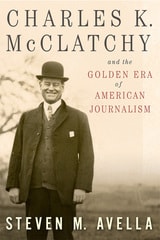
Charles K. McClatchy and the Golden Era of American Journalism
Steven M. Avella
University of Missouri Press, 2016
Charles K. McClatchy was twenty-five when he inherited The Sacramento Bee from his father, and his ensuing career as the paper’s editor extended well beyond the newsroom. Until his death in 1936, McClatchy was a consistent advocate for Progressive politics, a crusader for urban reform, a staunch isolationist, and a voice for Northern California. This biography explores his career as the long-time editor of the Bee in a work that weaves the history of Northern California with that of American newspapers.

Deserted
Life Without Local News in Rural AmericaNick Mathews
University of Illinois Press, 2026
The devastation of local news organizations has left rural areas of the US marooned in information deserts. Nick Mathews offers a boots-on-the-ground examination of the human toll of local news’s erosion by the winds of de-localization and corporate indifference.
It is no secret that ownership transfers, corporate mergers, and hedge fund takeovers have relentlessly consolidated and closed local news organizations. Mathews exposes the impact of that process on journalism, journalists, and news consumers hungry for outlets that tell their stories. A fundamental breakdown within journalism itself, the abandonment of community news has left disgruntled and disconnected locals to piece together news and information themselves. Mathews draws on the personal experiences of news gatherers and consumers to illuminate why local news cannot be scaled. Mass-produced content inevitably severs ties to communities while distant ownership is indifferent to local concerns.
Nuanced and sympathetic, <i>Deserted</i> provides a vivid portrait of the people and places forsaken by journalism’s corporate owners.

E. W. Scripps and the Business of Newspapers
Gerald Baldasty
University of Illinois Press, 1999
Edward Willis Scripps revolutionized the newspaper industry by applying modern business practices. His press empire grew to more than forty newspapers supported by a telegraphic news service and an illustrated news features syndicate. Convinced that big business was corrupting the American press, Scripps resisted supporting his newspapers through advertising. He also aimed them at the working class, an audience virtually ignored by most newspaper publishers of his era.
Drawing on Scripps's business correspondence, Gerald Baldasty provides a portrait of a long-neglected entrepreneurial giant. Maintaining that the press should support the democratic endeavor by informing its largest constituency, Scripps succeeded in creating a string of small, one-penny newspapers that advocated for the common people by crusading for lower streetcar fares, free textbooks for public school children, municipal ownership of utilities, and pure food legislation, among many other causes.
Hedged
How Private Investment Funds Helped Destroy American Newspapers and Undermine DemocracyMargot Susca
University of Illinois Press, 2024
The ultrawealthy largely own and guide the newspaper system in the United States. Through entities like hedge funds and private equity firms, this investor class continues to dismantle the one institution meant to give voice to average citizens in a democracy.
Margot Susca reveals the little-known history of how private investment took over the newspaper industry. Drawing on a political economy of media, Susca’s analysis uses in-depth interviews and documentary evidence to examine issues surrounding ownership and power. Susca also traces the scorched-earth policies of layoffs, debt, cash-outs, and wholesale newspaper closings left behind by private investors and the effects of the devastation on the future of news and information. Throughout, Susca reveals an industry rocked less by external forces like lost ad revenue and more by ownership and management obsessed with profit and beholden to private fund interests that feel no responsibility toward journalism or the public it is meant to serve.
Metro Dailies in the Age of Multimedia Journalism
Mary Lou Nemanic
Temple University Press, 2020
The death of the daily newspaper in the internet age has been predicted for decades. While print newspapers are struggling from drops in advertising and circulation, their survival has been based on original reporting. Instead of a death knell, metro dailies are experiencing an identity crisis—a clash between traditional print journalism’s formality and detail and digital journalism’s informality and brevity.
In Metro Dailies in the Age of Multimedia Journalism, Mary Lou Nemanic provides in-depth case studies of five mid-size city newspapers to show how these publications are adapting to the transition from print-only to multiplatform content delivery—and how newsroom practices are evolving to address this change. She considers the successes when owners allow journalists to manage their newspapers—to ensure production of quality journalism under the protection of newspaper guilds—as well as how layoffs and resource cutbacks have jeopardized quality standards.
Arguing for an integrated approach in which print and online reporting are considered complementary and visual journalism is emphasized across platforms, Nemanic suggests that there is a future for the endangered daily metro newspaper.

Strategic Newspaper Management
Conrad Fink
Southern Illinois University Press, 1988
The time is right for bright, aggressive newspaper managers to influence and prosper, but bleak indeed for those newspapers whose managers lack the requisite knowledge. Using case studies and examples from the business, Fink shows why some newspapers change with the times and surge ahead and why some continue to publish to an eroding market base and fail.
The difference between success and failure, he concludes, is in "long-range planning and in daily operating methodology—in, simply, the professionalism of management at all levels."
The American Newsroom
A History, 1920-1960Will Mari
University of Missouri Press, 2023
The Broken Table
The Detroit Newspaper Strike and the State of American LaborChris Rhomberg
Russell Sage Foundation, 2012
The Business of Newspapers
University of Nevada Press, 1992
The Capital Times
A Proudly Radical Newspaper’s Century Long Fight for Justice and for PeaceJohn Nichols
Wisconsin Historical Society Press, 2017
As Madison’s Capital Times marks its 100th anniversary in 2017, editors Dave Zweifel and John Nichols recall the remarkable history of a newspaper that served as the tribune of Robert M. La Follette and the progressive movement, earned the praise of Franklin Delano Roosevelt for its stalwart opposition to fascism, battled Joe McCarthy during the "Red Scare," championed civil rights, women’s rights, and LGBTQ rights, opposed the Vietnam War and the invasion of Iraq, and stood with Russ Feingold when he cast the only US Senate vote against the Patriot Act. The Capital Times did not do this from New York or Washington but from the middle of America, with a readership of farmers, factory workers, teachers, and shopkeepers who stood by The Cap Times when the newspaper was boycotted, investigated, and attacked for its determination.
At a point when journalism is under assault, when newspapers struggle to survive, and "old media" struggles to find its way in a digital age, The Capital Times remains unbowed—still living up to the description Lord Francis Williams, the British newspaper editor, wrote 50 years ago: "The vast majority of American papers are as dull as weed-covered ditch-water; vast Saharas of cheap advertising with occasional oases of editorial matter written to bring happiness to the Chamber of Commerce and pain and irritation to none; the bland leading the bland.… Just here and there are a few relics of the old fighting muckraking tradition of American journalism, like The Capital Times of Madison."
The Organization of Journalism
Market Models and Practice in a Fraying ProfessionPatrick Ferrucci
University of Illinois Press, 2024
Using rich interviews and participant observation, Patrick Ferrucci examines institutions with funding mechanisms that range from traditional mogul ownership and online-only nonprofits to staff-owned cooperatives and hedge fund control. The variations in market models have frayed the tenets of professionalization, with unique work cultures emerging from each organization’s focus on its mission and the implantation of its own processes and ethical guidelines. As a result, the field of American journalism no longer shares uniform newsgathering practices and a common identity, a break with the past that affects what information we consume today and what the press will become tomorrow.
An inside look at a fracturing profession, The Organization of Journalism illuminates the institution’s expanding impact on newsgathering and the people who practice it.

The Polish Hearst
Ameryka-Echo and the Public Role of the Immigrant PressAnna D. Jaroszynska-Kirchmann
University of Illinois Press, 2015
Anna D. Jaroszyńska-Kirchmann mines seven decades' worth of thoughts expressed by Ameryka-Echo readers to chronicle the ethnic press's role in the immigrant experience. Open and unedited debate harkened back to homegrown journalistic traditions, and Jaroszyńska-Kirchmann opens up the nuances of an editorial philosophy that cultivated readers as content creators. As she shows, ethnic publications in the process forged immigrant social networks and pushed notions of education and self-improvement throughout Polonia. Paryski, meanwhile, built a publishing empire that earned him the nickname ""The Polish Hearst.""
Detailed and incisive, The Polish Hearst opens the door on the long-overlooked world of ethnic publishing and the amazing life of one of its towering figures.
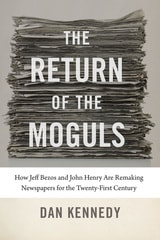
The Return of the Moguls
How Jeff Bezos and John Henry Are Remaking Newspapers for the Twenty-First CenturyDan Kennedy
University Press of New England, 2018