Results by title

35 books match the query 'Papua New Guinea'
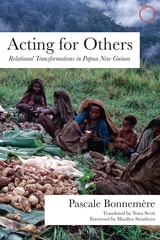
cover of Acting for Others: Relational Transformations in Papua New Guinea

Acting for Others

Relational Transformations in Papua New Guinea

Pascale Bonnemère

HAU, 2018

For the Ankave of Papua New Guinea, men, unlike women, do not reach adulthood and become fathers simply by growing up and reproducing. What fathers—and by extension, men—actually are is a result of a series of relational transformations, operated in and by rituals in which men and women both perform complementary actions in separate spaces. Acting for Others is a tour de force in Melanesian ethnography, gender studies, and theories of ritual. Based on years of fieldwork conducted by the author and her husband and co-ethnographer, this book’s “double view” of the Ankave ritual cycle—from women in the village and from the men in the forest—is novel, provocative, and one of the most incisive analyses of the emergence of ideas of gender in Papua New Guinea since Marilyn Strathern’s The Gender of the Gift.
At the heart of Pascale Bonnemère’s argument is the idea that it is possible for genders to act for and upon one another, and to do so almost paradoxically, by limiting action through the obeying of taboos and other restrictions. With this first English translation by acclaimed French translator Nora Scott, accompanied by a foreword from Marilyn Strathern, Acting for Others brings the Ankave ritual world to new theoretical life, challenging how we think about mutual action, mutual being, and mutual life.
[more]
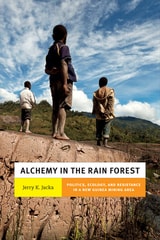
cover of Alchemy in the Rain Forest: Politics, Ecology, and Resilience in a New Guinea Mining Area

Alchemy in the Rain Forest

Politics, Ecology, and Resilience in a New Guinea Mining Area

Jerry K. Jacka

Duke University Press, 2015
In Alchemy in the Rain Forest Jerry K. Jacka explores how the indigenous population of Papua New Guinea's highlands struggle to create meaningful lives in the midst of extreme social conflict and environmental degradation. Drawing on theories of political ecology, place, and ontology and using ethnographic, environmental, and historical data, Jacka presents a multilayered examination of the impacts large-scale commercial gold mining in the region has had on ecology and social relations. Despite the deadly interclan violence and widespread pollution brought on by mining, the uneven distribution of its financial benefits has led many Porgerans to call for further development. This desire for increased mining, Jacka points out, counters popular portrayals of indigenous people as innate conservationists who defend the environment from international neoliberal development. Jacka's examination of the ways Porgerans search for common ground between capitalist and indigenous ways of knowing and being points to the complexity and interconnectedness of land, indigenous knowledge, and the global economy in Porgera and beyond.
 
[more]
cover of Between Culture and Fantasy: A New Guinea Highlands Mythology

Between Culture and Fantasy

A New Guinea Highlands Mythology

Gillian Gillison

University of Chicago Press, 1993

The myths of the Gimi, a people of the Eastern Highlands of Papua New Guinea, attribute the origin of death and misery to the incestuous desires of the first woman or man, as if one sex or the other were guilty of the very first misdeed. Working for years among the Gimi, speaking their language, anthropologist Gillian Gillison gained rare insight into these myths and their pervasive influence in the organization of social life. Hers is a fascinating account of relations between the sexes and the role of myth in the transition between unconscious fantasy and cultural forms.

Gillison shows how the themes expressed in Gimi myths—especially sexual hostility and an obsession with menstrual blood—are dramatized in the elaborate public rituals that accompany marriage, death, and other life crises. The separate myths of Gimi women and men seem to speak to one another, to protest, alter, and enlarge upon myths of the other sex. The sexes cast blame in the veiled imagery of myth and then play out their debate in joint rituals, cooperating in shows of conflict and resolution that leave men undefeated and accord women the greater blame for misfortune.
[more]
cover of Biomedicine in an Unstable Place: Infrastructure and Personhood in a Papua New Guinean Hospital

Biomedicine in an Unstable Place

Infrastructure and Personhood in a Papua New Guinean Hospital

Alice Street

Duke University Press, 2014

Biomedicine in an Unstable Place is the story of people's struggle to make biomedicine work in a public hospital in Papua New Guinea. It is a story encompassing the history of hospital infrastructures as sites of colonial and postcolonial governance, the simultaneous production of Papua New Guinea as a site of global medical research and public health, and people's encounters with urban institutions and biomedical technologies. In Papua New Guinea, a century of state building has weakened already inadequate colonial infrastructures, and people experience the hospital as a space of institutional, medical, and ontological instability.

In the hospital's clinics, biomedical practitioners struggle amid severe resource shortages to make the diseased body visible and knowable to the clinical gaze. That struggle is entangled with attempts by doctors, nurses, and patients to make themselves visible to external others—to kin, clinical experts, global scientists, politicians, and international development workers—as socially recognizable and valuable persons. Here hospital infrastructures emerge as relational technologies that are fundamentally fragile but also offer crucial opportunities for making people visible and knowable in new, unpredictable, and powerful ways.
[more]
cover of Conceiving Cultures: Reproducing People and Places on Nuakata, Papua New Guinea

Conceiving Cultures

Reproducing People and Places on Nuakata, Papua New Guinea

Shelley Mallett

University of Michigan Press, 2003

Conceiving Cultures critically reflects on the ways anthropologists come to understand and represent the people and cultures that they study. These ideas are developed through an ethnographic study that explores notions of the gendered person through knowledge and practices relating to reproductive health on the Massim island of Nuakata in Papua New Guinea. Conceiving Cultures makes explicit anthropology's implicit project to understand the self by way of the other.
Shelley Mallett is Research Fellow at the Key Centre for Women's Health in Society at Melbourne University.
[more]
cover of Conservation Is Our Government Now: The Politics of Ecology in Papua New Guinea

Conservation Is Our Government Now

The Politics of Ecology in Papua New Guinea

Paige West

Duke University Press, 2006

A significant contribution to political ecology, Conservation Is Our Government Now is an ethnographic examination of the history and social effects of conservation and development efforts in Papua New Guinea. Drawing on extensive fieldwork conducted over a period of seven years, Paige West focuses on the Crater Mountain Wildlife Management Area, the site of a biodiversity conservation project implemented between 1994 and 1999. She describes the interactions between those who ran the program—mostly NGO workers—and the Gimi people who live in the forests surrounding Crater Mountain. West shows that throughout the project there was a profound disconnect between the goals of the two groups. The NGOgo workers thought that they would encourage conservation and cultivate development by teaching Gimi to value biodiversity as an economic resource. The villagers expected that in exchange for the land, labor, food, and friendship they offered the conservation workers, they would receive benefits, such as medicine and technology. In the end, the divergent nature of each group’s expectations led to disappointment for both.

West reveals how every aspect of the Crater Mountain Wildlife Management Area—including ideas of space, place, environment, and society—was socially produced, created by changing configurations of ideas, actions, and material relations not only in Papua New Guinea but also in other locations around the world. Complicating many of the assumptions about nature, culture, and development underlying contemporary conservation efforts, Conservation Is Our Government Now demonstrates the unique capacity of ethnography to illuminate the relationship between the global and the local, between transnational processes and individual lives.
[more]
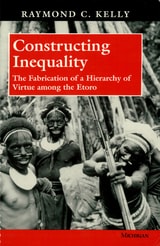
cover of Constructing Inequality: The Fabrication of a Hierarchy of Virtue among the Etoro

Constructing Inequality

The Fabrication of a Hierarchy of Virtue among the Etoro

Raymond C. Kelly

University of Michigan Press, 1993
In Constructing Inequality, Raymond C. Kelly makes a crucial contribution to a central and enduring issue in social theory: the primary source and central locus for the production of inequality in simple (classless) societies. Kelly grounds his thesis in an incisive critique of prior theoretical formulations and a comprehensive analysis of a key ethnographic case, the Etoro of Papua New Guinea.Previous theorists have designated “brideservice” or “simple” societies—in which age, gender, and personal characteristics are the predominant basis of social differentiation—as models of egalitarian societies. But Kelly departs from this view. He evaluates such theories against the relevant data derived from studying the Etoro, and, in so doing, shows that a close examination of the Etoro case reveals basic flaws in both the brideservice model and the theory of social inequality that informs it.Kelly traces the foundations of Etoro social inequality to a male-exclusive shamanic elite’s propagation of a metaphysical doctrine that comprehends reproduction, the spiritual constitution of a person, and the life-cycle transformations of ‘growth, maturation, senescence, and death. Kelly determines that this cosmological system grounds a scheme of social differentiation in which moral evaluation is intrinsically embedded. Social inequality is thus fabricated as a moral hierarchy, or hierarchy of virtue.
[more]
cover of Encompassing Others: The Magic of Modernity in Melanesia

Encompassing Others

The Magic of Modernity in Melanesia

Edward LiPuma

University of Michigan Press, 2001

An engaging, beautifully written account by an ethnographer who lived in the mountains of Papua New Guinea, Encompassing Others is at once a history of the encounter of two cultures and an attempt to challenge theoretically the main concepts that have informed the study of modernity. Going beyond accounts that grasp modernity solely in terms of domination, imperialism, and local resistance, it explores how capitalism, Christianity, and mass commercial culture enchant the senses, create a carnival of new goods, and open up new possibilities for thought and action.
Focusing on the Maring people of Highland New Guinea and on the Westerners who interacted with them, Edward LiPuma presents issues from the perspectives of both sides. We hear the voice of the Anglican priest from San Francisco as well as the most powerful Maring shamans. Further, the book seeks to develop a theory of generations that helps explain how change accelerates and societies take on new directions across generations.
Theoretical, descriptive, but almost entirely free of jargon, this book is intended for all those who are interested in how the West's encompassment of other peoples influences how these others conceive of their past, imagine their future, and experience the present. It will have wide appeal for anthropologists and others concerned with colonialism, globalization, and the formation of the nation-state.
Edward LiPuma is Professor and Chair, Department of Anthropology, University of Miami.
[more]
cover of Explorations into Highland New Guinea, 1930-1935

Explorations into Highland New Guinea, 1930-1935

Michael J. Leahy, edited by Douglas E. Jones, with a foreword by Jane C. Goodale

University of Alabama Press, 1991

In the 1920s and 1930s there were adventures to be lived and fortunes to be made by strong young men in the outback of Australia and the gold fields of New Guinea. This is the diary of five years spent in hot pursuit—not of honor and glory, but of excitement and riches—by one such adventurer, Michael "Mick" Leahy, his brothers Jim and Pat, and friends Mick Dwyer and Jim Taylor. Leahy and his associates explored the unknown interior of New Guinea, seeking gold and making contact for the first time with the aborigines of the interior mountains and valleys.

White man was unknown to these often cannibalistic, always dangerous, aborigines who thought the seekers of yellow in the streams slightly mad, and thus easy prey. The chronicles of their explorations and their hundreds of photographs brought news of these native peoples to the outside world. In doing so, they changed forever our understanding of the human landscape of New Guinea, and carved a place in history for these explorers who, braving the environment in search of gold, found people.
[more]
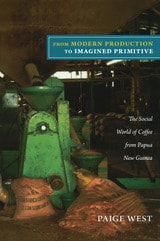
cover of From Modern Production to Imagined Primitive: The Social World of Coffee from Papua New Guinea

From Modern Production to Imagined Primitive

The Social World of Coffee from Papua New Guinea

Paige West

Duke University Press, 2012

In this vivid ethnography, Paige West tracks coffee as it moves from producers in Papua New Guinea to consumers around the world. She illuminates the social lives of the people who produce coffee, and those who process, distribute, market, and consume it. The Gimi peoples, who grow coffee in Papua New Guinea's highlands, are eager to expand their business and social relationships with the buyers who come to their highland villages, as well as with the people working in Goroka, where much of Papua New Guinea's coffee is processed; at the port of Lae, where it is exported; and in Hamburg, Sydney, and London, where it is distributed and consumed. This rich social world is disrupted by neoliberal development strategies, which impose prescriptive regimes of governmentality that are often at odds with Melanesian ways of being in, and relating to, the world. The Gimi are misrepresented in the specialty coffee market, which relies on images of primitivity and poverty to sell coffee. By implying that the "backwardness" of Papua New Guineans impedes economic development, these images obscure the structural relations and global political economy that actually cause poverty in Papua New Guinea.
[more]
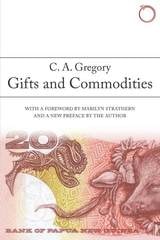
cover of Gifts and Commodities

Gifts and Commodities

C. A. Gregory

HAU, 2015

Christopher A. Gregory’s Gifts and Commodities is one of the undisputed classics of economic anthropology. On its publication in 1982, it spurred intense, ongoing debates about gifts and gifting, value, exchange, and the place of political economy in anthropology.

Gifts and Commodities is, at once, a critique of neoclassical economics and development theory, a critical history of colonial Papua New Guinea, and a comparative ethnography of exchange in Melanesian societies. This new edition includes a foreword by anthropologist Marilyn Strathern and a new preface by the author that discusses the ongoing response to the book and the debates it has engendered, debates that have become more salient in our evermore neoliberal and globalized era.
[more]
cover of Guardians of the Flutes, Volume 1: Idioms of Masculinity

Guardians of the Flutes, Volume 1

Idioms of Masculinity

Gilbert Herdt

University of Chicago Press, 1994
In the first systematic documentation of New Guinea rituals of manhood, Gilbert Herdt places the homosexual customs of the Sambia in their ecological and ideological contexts while exploring what they mean to the individuals who practice them. Raising a host of issues concerning gender identity, hostility between the sexes, and the relationships between myth, culture, and personal experience, Herdt provides a vivid and convincing portrait of how Sambia men experience their sexual development.
[more]
cover of Imacoqwa’s Arrow: On the Biunity of the Sun and Moon in a Papuan Lifeworld

Imacoqwa’s Arrow

On the Biunity of the Sun and Moon in a Papuan Lifeworld

Jadran Mimica

HAU, 2025

A pathbreaking study of Yagwoia cosmological concepts.

In Imacoqwa’s Arrow, Jadran Mimica draws on decades of field research to bring us a rich ethnographic account of myth and meaning in the lifeworlds of the Yagwoia of Papua New Guinea. He focuses especially on the relations of the sun and the moon in Yagwoia understandings of the universe and their own place within it. This is classic terrain in Melanesian ethnography, but Mimica does much more than add to the archive of anthropological accounts of the significance of the sun and the moon for peoples of this part of the world. With extraordinary rigor and reflexivity, he grounds his understanding of Yagwoia concepts in psychoanalytic and phenomenological methods that afford a radically new and revealing translation of these seminal themes in Melanesian mythology and its poetics. This is a major contribution to the hermeneutics of ethnographic translation and theorization.
[more]
cover of Islands of Love, Islands of Risk: Culture and HIV in the Trobriands

Islands of Love, Islands of Risk

Culture and HIV in the Trobriands

Katherine Lepani

Vanderbilt University Press, 2012

The Trobriand Islands of Papua New Guinea have been depicted as a place of sexual freedom ever since these small atolls in the southwest Pacific were made famous by anthropologist Bronislaw Malinowski in the early twentieth century. Today in the era of the HIV/AIDS pandemic, how do Trobrianders respond to public health interventions that link their cultural practices to the risk of HIV? How do they weigh HIV prevention messages of abstinence, fidelity, and condom use against traditional sexual practices that strengthen interclan relationships in a gift economy?
Written by an anthropologist who has direct ties to the Trobriands through marriage and who has been involved in Papua New Guinea's national response to the HIV epidemic since the mid-1990s, Islands of Love, Islands of Risk is an unusual insider ethnography. Katherine Lepani describes in vivid detail the cultural practices of regeneration, from the traditional dance called Wosimwaya to the elaborate exchanges that are part of the mortuary feasts called sagali. Focusing on the sexual freedom of young people, the author reveals the social value of sexual practice. By bringing cultural context and lived experience to the fore, the book addresses the failure of standardized public health programs to bridge the persistent gap between HIV awareness and prevention. The book offers insights on the interplay between global and local understandings of gender, sexuality, and disease and suggests the possibility of viewing sexuality in terms other than risk.
Islands of Love, Islands of Risk illustrates the contribution of ethnographic research methodology in facilitating dialogue between different ways of knowing. As a contemporary perspective on Malinowski's classic accounts of Trobriand sexuality, the book reaffirms the Trobriands' central place in the study of anthropology.
This book is the recipient of the annual Norman L. and Roselea J. Goldberg Prize for the best project in the area of medicine.
[more]
cover of Leviathans at the Gold Mine: Creating Indigenous and Corporate Actors in Papua New Guinea

Leviathans at the Gold Mine

Creating Indigenous and Corporate Actors in Papua New Guinea

Alex Golub

Duke University Press, 2014

Leviathans at the Gold Mine is an ethnographic account of the relationship between the Ipili, an indigenous group in Papua New Guinea, and the large international gold mine operating on their land. It was not until 1939 that Australian territorial patrols reached the Ipili. By 1990, the third largest gold mine on the planet was operating in their valley. Alex Golub examines how "the mine" and "the Ipili" were brought into being in relation to one another, and how certain individuals were authorized to speak for the mine and others to speak for the Ipili. Considering the relative success of the Ipili in their negotiations with a multinational corporation, Golub argues that a unique conjuncture of personal relationships and political circumstances created a propitious moment during which the dynamic and fluid nature of Ipili culture could be used to full advantage. As that moment faded away, social problems in the valley increased. The Ipili now struggle with the extreme social dislocation brought about by the massive influx of migrants and money into their valley.
[more]
cover of Lost Among the Baining: Adventure, Marriage, and Other Fieldwork

Lost Among the Baining

Adventure, Marriage, and Other Fieldwork

Gail Pool

University of Missouri Press, 2015

In the late sixties, Gail Pool and her husband set off for an adventure in New Guinea. He was a graduate student in anthropology; she was an aspiring writer. They prepared, as academics do, by reading, practicing with language tapes, consulting with the nearest thing to experts, and then, excited and optimistic, off they went. But all their research could not prepare them for the reality of life in the jungle. As they warded off gargantuan insects, slogged through seemingly endless mud, and turned on each other in fatigue and frustration, they struggled to somehow connect with their enigmatic hosts, the Baining—a people who showed no desire to be studied.

Sixteen months later they returned home. Despite months of trying, they had not been able to make sense of the Baining’s culture. Worse yet, their lives no longer seemed to make sense. Pool put her journals away. Her husband abandoned the study of anthropology.

Decades later, Pool returned to her journals and found in her jumbled notes the understanding that had eluded her twenty-three–year-old self. Finally, she and her husband returned to New Guinea for a shorter visit and a warm reunion with the tribe that challenged them on so many levels and, Pool now realized, made their journey and lives deeper and richer.

[more]
cover of Malinowski's Kiriwina: Fieldwork Photography 1915-1918

Malinowski's Kiriwina

Fieldwork Photography 1915-1918

Michael W. Young

University of Chicago Press, 1998

Kiriwina, the largest of the Trobriand Islands in eastern Papua New Guinea, is anthropology's "sacred place." It was here that Bronislaw Malinowski conducted the path-breaking fieldwork that enabled him to revolutionize British social anthropology. And it was here that he developed one of anthropology's most important tools: photography.

Malinowski's Kiriwina presents nearly two hundred of Malinowski's previously unpublished photographs, taken between 1915 and 1918, of the Trobriand Islanders. The images are more than embellishments of his ethnography; they are a recreation in striking detail of a distant world. Michael Young, an anthropologist and Malinowski's authorized biographer, has selected the photographs based on one of Malinowski's unpublished studies of the region, and the plan of that abandoned project has helped structure this book.

Divided into fourteen sections, Malinowski's Kiriwina is a series of linked photo-essays based on Trobriand institutions and cultural themes as described by Malinowski. The introductory essay by Young appraises the founding anthropologist's photographic oeuvre, explains the historical circumstances and technical aspects of the images, and puts them in their colonial context. Young illuminates the photographs with quotations from Malinowski's diaries, letters, and field notes, thereby giving a biographical dimension to the collection. Commentaries on the images by contemporary Trobrianders add a further layer of interpretation. The result is a stunning record not only of a fascinating place, but of the mutual relationship between ethnography and the visual.
[more]
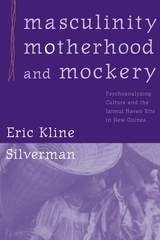
cover of Masculinity, Motherhood, and Mockery: Psychoanalyzing Culture and the Iatmul Naven Rite in New Guinea

Masculinity, Motherhood, and Mockery

Psychoanalyzing Culture and the Iatmul Naven Rite in New Guinea

Eric Kline Silverman

University of Michigan Press, 2001

Masculinity, Motherhood, and Mockery analyzes the relationship between masculinity and motherhood in an Eastern Iatmul village along the Sepik River in Papua New Guinea. It focuses on a metaphorical dialogue between two countervailing images of the body, dubbed by literary theorist Mikhail Bakhtin as the "moral" and the "grotesque." Eastern Iatmul men in Tambunum village idealize an image of motherhood that is nurturing, sheltering, cleansing, fertile, and chaste--in a word, moral. But men also fear an equally compelling image of motherhood that is defiling, dangerous, orificial, aggressive, and carnal--hence, grotesque. Masculinity in Tambunum is a rejoinder both subtle and strident, both muted and impassioned, to these contrary, embodied images of motherhood.
Throughout this work, Eric Silverman details the dialogics of mothering and manhood throughout Eastern Iatmul culture, including in his analysis cosmology and myth; food- and childraising; architecture and canoes; ethnophysiology and sexuality; shame and hygiene; marriage and kinship; and perhaps most significantly, a ceremonial locus classicus in anthropology: the famous Iatmul naven rite. This book provides the first sustained examination of naven since Bateson, presenting new data and interpretations that are based entirely on original, first-hand ethnographic research.
The sustained engagement with anthropological and psychoanalytic theory coupled with a refreshing examination of a famous and still-enigmatic ritual is sure to make multiple contributions to pressing debates in contemporary anthropology and social theory.
Eric Silverman is Associate Professor of Anthropology, DePauw University.
[more]
cover of Pigs That Ate the Garden: A Human Ecology from Papua New Guinea

Pigs That Ate the Garden

A Human Ecology from Papua New Guinea

Peter D. Dwyer

University of Michigan Press, 1990

In The Pigs that Ate the Garden, Peter D. Dwyer examines the subsistence ecology of 109 Etolo people who live on the wet, forested mountain slopes of Papua New Guinea. Dwyer describes the community's method of deliberately placing pigs in gardens so that the pigs depredate the vegetation there. He shows how this practice is actually the community's method of sending a message to itself that serves to resynchronize a switch from sweet potato gardening to sago starch processing. The interrelationships of the different food-producing activities of the Etolo — gardening, hunting, tree-crop cultivation, etc. — are shown to have seasonal rhythms, and these rhythms maximize the Etolo's use of food resources at appropriate times and areas. Dwyer argues that the "shape" of Etolo ecology is ultimately driven by socio-cultural, rather than environmental, forces, and is set within a theoretical frame, concerning processes of communication and change in open systems.
[more]
cover of Pigs That Ate the Garden: A Human Ecology from Papua New Guinea

Pigs That Ate the Garden

A Human Ecology from Papua New Guinea

Peter D. Dwyer

University of Michigan Press, 1990
In The Pigs that Ate the Garden, Peter D. Dwyer examines the subsistence ecology of 109 Etolo people who live on the wet, forested mountain slopes of Papua New Guinea. Dwyer describes the community's method of deliberately placing pigs in gardens so that the pigs depredate the vegetation there. He shows how this practice is actually the community's method of sending a message to itself that serves to resynchronize a switch from sweet potato gardening to sago starch processing. The interrelationships of the different food-producing activities of the Etolo — gardening, hunting, tree-crop cultivation, etc. — are shown to have seasonal rhythms, and these rhythms maximize the Etolo's use of food resources at appropriate times and areas. Dwyer argues that the "shape" of Etolo ecology is ultimately driven by socio-cultural, rather than environmental, forces, and is set within a theoretical frame, concerning processes of communication and change in open systems.
[more]
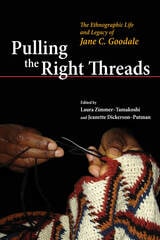
cover of Pulling the Right Threads: The Ethnographic Life and Legacy of Jane C. Goodale

Pulling the Right Threads

The Ethnographic Life and Legacy of Jane C. Goodale

Edited by Laura Zimmer-Tamakoshi and Jeanette Dickerson-Putman

University of Illinois Press, 2007
A tribute to Jane C. Goodale, Pulling the Right Threads discusses the vibrant ethnographer and teacher's principles for mentoring, collaborating, and performing fieldwork. Known for her ethnographic research in the Pacific, development of the Association of Social Anthropology in Oceania, and influence in the anthropology department at Bryn Mawr College, Goodale and other contributors renew the debate in anthropology over the authenticity of field data and representations of other cultures. Together, they take aim at those who claim ethnography is outmoded or false.
[more]
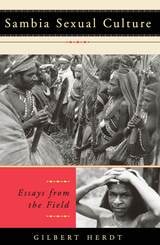
cover of Sambia Sexual Culture: Essays from the Field

Sambia Sexual Culture

Essays from the Field

Gilbert Herdt

University of Chicago Press, 1999

Few cultures have received as much attention in the study of erotic desire, sexuality, and gender as the Sambia of Papua New Guinea. Here, for the first time, is a collection of groundbreaking essays and a new introduction on the Sambia's sexual culture by the renowned anthropologist Gilbert Herdt.

Over the course of 20 years, Herdt made 13 field trips to live with the Sambia in order to understand sexuality and ritual in the context of warfare and gender segregation. Herdt's essays examine Sambia fetish and fantasy, ritual nose-bleeding, the role of homoerotic insemination, the role of the father and mother in the process of identity formation, and the creation of a "third sex" in nature and culture. He also discusses the representation of homosexuality in cross-cultural literature on premodern societies, arguing that scholars have long viewed desires through the tropes of negative western models. Herdt asks us to reconsider the realities and subjective experiences of desires in their own context, and to rethink how the homoerotic is expressed in radically divergent sexual cultures.
[more]
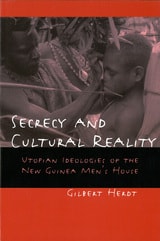
cover of Secrecy and Cultural Reality: Utopian Ideologies of the New Guinea Men's House

Secrecy and Cultural Reality

Utopian Ideologies of the New Guinea Men's House

Gilbert Herdt

University of Michigan Press, 2003
Gilbert Herdt is Director of the Program in Human Sexuality Studies at San Francisco State University, where he is also Professor of Human Sexuality Studies and Anthropology.
[more]
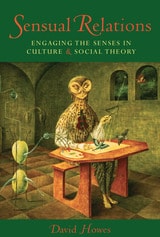
cover of Sensual Relations: Engaging the Senses in Culture and Social Theory

Sensual Relations

Engaging the Senses in Culture and Social Theory

David Howes

University of Michigan Press, 2003

With audacious dexterity, David Howes weaves together topics ranging from love and beauty magic in Papua New Guinea to nasal repression in Freudian psychology and from the erasure and recovery of the senses in contemporary ethnography to the specter of the body in Marx. Through this eclectic and penetrating exploration of the relationship between sensory experience and cultural expression, Sensual Relations contests the conventional exclusion of sensuality from intellectual inquiry and reclaims sensation as a fundamental domain of social theory.
David Howes is Professor of Anthropology, Concordia University, Montreal, Quebec.

[more]
cover of Smoky, the Dog That Saved My Life: The Bill Wynne Story

Smoky, the Dog That Saved My Life

The Bill Wynne Story

Nancy Roe Pimm

Ohio University Press, 2019

World War II soldier Bill Wynne met Smoky while serving in New Guinea, where the dog, who was smaller than Wynne’s army boot, was found trying to scratch her way out of a foxhole. After he adopted her, she served as the squadron mascot and is credited as being the first therapy dog for the emotional support she provided the soldiers. When they weren’t fighting, Bill taught Smoky hundreds of tricks to entertain the troops. Smoky became a war hero herself at an airstrip in Luzon, the Philippines, where she helped save forty airplanes and hundreds of soldiers from imminent attack.

After the war, Bill worked as a Hollywood animal trainer and then returned to his hometown of Cleveland, Ohio. He and Smoky continued to perform their act, even getting their own TV show, How to Train Your Dog with Bill Wynne and Smoky.

Nancy Roe Pimm presents Bill and Smoky’s story to middle-grade readers in delightful prose coupled with rich archival illustrations. Children will love learning about World War II from an unusual perspective, witnessing the power of the bond between a soldier and his dog, and seeing how that bond continued through the exciting years following the war.
[more]
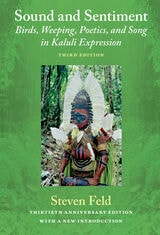
cover of Sound and Sentiment: Birds, Weeping, Poetics, and Song in Kaluli Expression, 3rd edition with a new introduction by the author

Sound and Sentiment

Birds, Weeping, Poetics, and Song in Kaluli Expression, 3rd edition with a new introduction by the author

Steven Feld

Duke University Press, 2012
This thirtieth anniversary edition of Sound and Sentiment makes Steven Feld's landmark, field-defining book available to a new generation of scholars and students. A sensory ethnography set in the rain forest of Papua New Guinea, among the Kaluli people of Bosavi, Sound and Sentiment introduced the anthropology of sound, or the cultural study of sound. After it was first published in 1982, a second edition, incorporating additional field research and a new postscript, was released in 1990. The third edition includes all of the material from the first two editions, along with a substantial new introduction in which Feld discusses Bosavi's recent history and reflects on the challenges it poses for contemporary theory and representation.
[more]
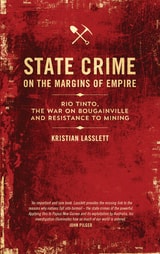
cover of State Crime on the Margins of Empire: Rio Tinto, the War on Bougainville and Resistance to Mining

State Crime on the Margins of Empire

Rio Tinto, the War on Bougainville and Resistance to Mining

Kristian Lasslett

Pluto Press, 2014

This book offers a pioneering window into the elusive workings of state-corporate crime within the mining industry. It follows a campaign of resistance organised by indigenous activists on the island of Bougainville, who struggled to close a Rio Tinto owned copper mine, and investigates the subsequent state-corporate response, which led to the shocking loss of some 10,000 lives.

Drawing on internal records and interviews with senior officials, Kristian Lasslett examines how an articulation of capitalist growth mediated through patrimonial politics, imperial state-power, large-scale mining, and clan-based, rural society, prompted an ostensibly ‘responsible’ corporate citizen, and liberal state actors, to organise a counterinsurgency campaign punctuated with gross human rights abuses.

State Crime on the Margins of Empire represents a unique intervention rooted in a classical Marxist tradition that challenges positivist streams of criminological scholarship, in order to illuminate with greater detail the historical forces faced by communities in the global south caught in the increasingly violent dynamics of the extractive industries.
[more]
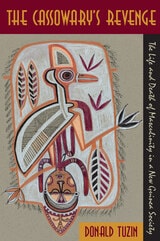
cover of The Cassowary's Revenge: The Life and Death of Masculinity in a New Guinea Society

The Cassowary's Revenge

The Life and Death of Masculinity in a New Guinea Society

Donald Tuzin

University of Chicago Press, 1997

Donald Tuzin first studied the New Guinea village of Ilahita in 1972. When he returned many years later, he arrived in the aftermath of a startling event: the village’s men voluntarily destroyed their secret cult that had allowed them to dominate women for generations. The cult’s collapse indicated nothing less than the death of masculinity, and Tuzin examines the labyrinth of motives behind this improbable, self-devastating act. The villagers' mythic tradition provided a basis for this revenge of Woman upon the dominion of Man, and, remarkably, Tuzin himself became a principal figure in its narratives. The return of the magic-bearing "youngest brother" from America had been prophesied, and the villagers believed that Tuzin’s return "from the dead" signified a further need to destroy masculine traditions.

The Cassowary's Revenge is an intimate account of how Ilahita’s men and women think, emote, dream, and explain themselves. Tuzin also explores how the death of masculinity in a remote society raises disturbing implications for gender relations in our own society. In this light Tuzin's book is about men and women in search of how to value one another, and in today's world there is no theme more universal or timely.
[more]
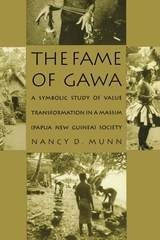
cover of The Fame of Gawa: A Symbolic Study of Value Transformation in a Massim Society

The Fame of Gawa

A Symbolic Study of Value Transformation in a Massim Society

Nancy D. Munn

Duke University Press, 1992
This new edition of the critically acclaimed The Fame of Gawa—originally published in 1986—makes available for the first time this important work in paperback. The Fame of Gawa is concerned with fundamental practices of value creation on Gawa, a small island off the southeast coast of mainland Papua New Guinea, the inhabitants of which participate in the long-distance kula shell exchange ring. Integrating various aspects of the study of society and culture--including the sociocultural construction of space and time, self-other relations and the body, and moral and political problems of hierarchy and equality—Nancy D. Munn shows that it is through achieving fame in the wider inter-island world that the Gawan community asserts its own internal viablity.
[more]
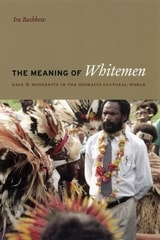
cover of The Meaning of Whitemen: Race and Modernity in the Orokaiva Cultural World

The Meaning of Whitemen

Race and Modernity in the Orokaiva Cultural World

Ira Bashkow

University of Chicago Press, 2006

A familiar cultural presence for people the world over, “the whiteman” has come to personify the legacy of colonialism, the face of Western modernity, and the force of globalization. Focusing on the cultural meanings of whitemen in the Orokaiva society of Papua New Guinea, this book provides a fresh approach to understanding how race is symbolically constructed and why racial stereotypes endure in the face of counterevidence.

While Papua New Guinea’s resident white population has been severely reduced due to postcolonial white flight, the whiteman remains a significant racial and cultural other here—not only as an archetype of power and wealth in the modern arena, but also as a foil for people’s evaluations of themselves within vernacular frames of meaning. As Ira Bashkow explains, ideas of self versus other need not always be anti-humanistic or deprecatory, but can be a creative and potentially constructive part of all cultures.

A brilliant analysis of whiteness and race in a non-Western society, The Meaning of Whitemen turns traditional ethnography to the purpose of understanding how others see us.
[more]
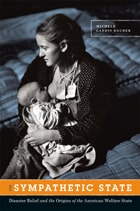
cover of The Sympathetic State: Disaster Relief and the Origins of the American Welfare State

The Sympathetic State

Disaster Relief and the Origins of the American Welfare State

Michele Landis Dauber

University of Chicago Press, 2012
Even as unemployment rates soared during the Great Depression, FDR’s relief and social security programs faced attacks in Congress and the courts on the legitimacy of federal aid to the growing population of poor. In response, New Dealers pointed to a long tradition—dating back to 1790 and now largely forgotten—of federal aid to victims of disaster. In The Sympathetic State, Michele Landis Dauber recovers this crucial aspect of American history, tracing the roots of the modern American welfare state beyond the New Deal and the Progressive Era back to the earliest days of the republic when relief was forthcoming for the victims of wars, fires, floods, hurricanes, and earthquakes.
 
Drawing on a variety of materials, including newspapers, legal briefs, political speeches, the art and literature of the time, and letters from thousands of ordinary Americans, Dauber shows that while this long history of government disaster relief has faded from our memory today, it was extremely well known to advocates for an expanded role for the national government in the 1930s, including the Social Security Act. Making this connection required framing the Great Depression as a disaster afflicting citizens though no fault of their own. Dauber argues that the disaster paradigm, though successful in defending the New Deal, would ultimately come back to haunt advocates for social welfare. By not making a more radical case for relief, proponents of the New Deal helped create the weak, uniquely American welfare state we have today—one torn between the desire to come to the aid of those suffering and the deeply rooted suspicion that those in need are responsible for their own deprivation.
 
Contrary to conventional thought, the history of federal disaster relief is one of remarkable consistency, despite significant political and ideological change. Dauber’s pathbreaking and highly readable book uncovers the historical origins of the modern American welfare state.
[more]
cover of They Make Themselves: Work and Play among the Baining of Papua New Guinea

They Make Themselves

Work and Play among the Baining of Papua New Guinea

Jane Fajans

University of Chicago Press, 1997

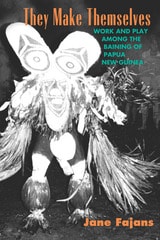
For generations of anthropologists, the Baining people have presented a challenge, because of their apparent lack of cultural or social structure. This group of small-scale horticulturists seems devoid of the complex belief systems and social practices that characterize other traditional peoples of Papua New Guinea. Their daily existence is mundane and repetitive in the extreme, articulated by only the most elementary familial relationships and social connections. The routine of everyday life, however, is occasionally punctuated by stunningly beautiful festivals of masked dancers, which the Baining call play and to which they attribute no symbolic significance.

In a new work sure to evoke considerable repercussions and debate in anthropological theory, Jane Fajans courageously takes on the "Baining Problem," arguing that the Baining define themselves not through intricate cosmologies or social networks, but through the meanings generated by their own productive and reproductive work.
[more]
cover of Ways of Baloma: Rethinking Magic and Kinship From the Trobriands

Ways of Baloma

Rethinking Magic and Kinship From the Trobriands

Mark S. Mosko

HAU, 2017

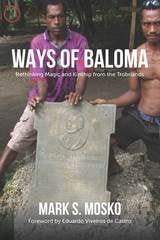
Bronislaw Malinowski’s path-breaking research in the Trobriand Islands shaped much of modern anthropology’s disciplinary paradigm. Yet many conundrums remain. For example, Malinowski asserted that baloma spirits of the dead were responsible for procreation but had limited influence on their living descendants in magic and other matters, claims largely unchallenged by subsequent field investigators, until now. Based on extended fieldwork at Omarakana village—home of the Tabalu “Paramount Chief”—Mark S. Mosko argues instead that these and virtually all contexts of indigenous sociality are conceived as sacrificial reciprocities between the mirror worlds that baloma and humans inhabit. 
 
Informed by a synthesis of Strathern’s model of “dividual personhood” and Lévy-Bruhl’s theory of “participation,” Mosko upends a century of discussion and debate extending from Malinowski to anthropology’s other leading thinkers. His account of the intimate interdependencies of humans and spirits in the cosmic generation and coordination of “life” (momova) and “death” (kaliga) strikes at the nexus of anthropology’s received wisdom, and Ways of Baloma will inevitably lead practitioners and students to reflect anew on the discipline’s multifold theories of personhood, ritual agency, and sociality.
[more]
cover of We Stay the Same: Subsistence, Logging, and Enduring Hopes for Development in Papua New Guinea

We Stay the Same

Subsistence, Logging, and Enduring Hopes for Development in Papua New Guinea

Jason Steadman Roberts

University of Arizona Press, 2024

On a remote island in the South Pacific, the Lavongai have consistently struggled to obtain development through logging and commercial agriculture. Yet many Lavongai still long to move beyond the grind of subsistence work that has seemingly defined their lives on New Hanover, Papua New Guinea, for generations.

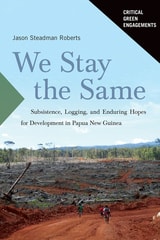
Following a long history of smaller-scale and largely unsuccessful resource development efforts, New Hanover became the site of three multinational-controlled special agricultural and business leases (SABLs) that combined to cover over 75 percent of the island for ninety-nine-year lease terms. These agroforestry projects were part of a national effort to encourage “sustainable” rural development by tapping into the growing global demand for agricultural lands and crops like oil palm and biofuels. They were supposed to succeed where the smaller-scale projects of the past had failed. Unfortunately, these SABLs resulted in significant forest loss and livelihood degradation, while doing little to promote the type of economic development that many Lavongai had been hoping for.

It is within this context that We Stay the Same grounds questions of hope for transformative economic change within Lavongai assessments of the inequitable relationships between global processes of resource development and the local lives that have become increasingly defined by the necessities and failures of these processes. Written in a clear and relatable style for students, We Stay the Same combines ethnographic and ecological research to show how the Lavongai continue to survive and make meaningful lives in a situation where their own hopes for a better future have often been used against them as a mechanism of a more distantly profitable dispossession.
 
[more]
cover of Yali's Question: Sugar, Culture, and History

Yali's Question

Sugar, Culture, and History

Frederick Errington and Deborah Gewertz

University of Chicago Press, 2004

Yali's Question is the story of a remarkable physical and social creation—Ramu Sugar Limited (RSL), a sugar plantation created in a remote part of Papua New Guinea. As an embodiment of imported industrial production, RSL's smoke-belching, steam-shrieking factory and vast fields of carefully tended sugar cane contrast sharply with the surrounding grassland. RSL not only dominates the landscape, but also shapes those culturally diverse thousands who left their homes to work there.

To understand the creation of such a startling place, Frederick Errington and Deborah Gewertz explore the perspectives of the diverse participants that had a hand in its creation. In examining these views, they also consider those of Yali, a local Papua New Guinean political leader. Significantly, Yali features not only in the story of RSL, but also in Jared Diamond's Pulitzer Prize winning world history Guns, Germs, and Steel—a history probed through its contrast with RSL's. The authors' disagreement with Diamond stems, not from the generality of his focus and the specificity of theirs, but from a difference in view about how history is made—and from an insistence that those with power be held accountable for affecting history.
[more]