Results by title
18 books match the query 'Person and offices'
Correspondence on Christology and Grace
Rob Roy McGregor
Catholic University of America Press, 2013
Documents from the Luciferians
In Defense of the Nicene CreedColin M. Whiting
SBL Press, 2019
Six important documents for scholars of early church history
This volume includes English translations of several documents concerning the Luciferians, a group of fourth-century Christians whose name derives from the bishop Lucifer of Cagliari. Documents include a confession of faith written for Emperor Theodosius I and a theological treatise written for his wife by Luciferian clergyman Faustinus, the first English translation of a Luciferian petition to Theodosius that focuses on the persecution the community has suffered, Theodosius’s imperial law in response to the Luciferians, two letters composed by Luciferians that purport to represent correspondence from the bishop Athanasius of Alexandria to Lucifer, and the priest Jerome’s Dialogus adversus Luciferianos. These texts highlight connections between developments in Christian theology and local Christian communities in the course of the fourth century.
Features:
- The first English translation of Faustinus’s Libellus precum
- An overview of the development of late antique theology and Christianity
- An introduction to Luciferian beliefs and the translated texts
Glaphyra on the Pentateuch, Volume 1
Nicholas P. St. Cyril of Alexandria
Catholic University of America Press, 2019
Glaphyra on the Pentateuch, Volume 2
St. Cyril of Alexandria
Catholic University of America Press, 2019
Gospel Jesuses and Other Nonhumans
Biblical Criticism Post-poststructuralismStephen D. Moore
SBL Press, 2017
Essential reading for biblical studies students and scholars interested in cutting-edge critical theory
The current global ecological crisis has prompted a turn to the nonhuman in critical theory. This book breaks new ground in biblical studies as the first to bring nonhuman theory to bear on the gospels and Acts. Nonhuman theory, a confluence of several of the main theoretical streams that have issued forth since the heyday of high poststructuralism, includes affect theory, posthuman animality studies, critical plant studies, object-oriented new materialisms, and assemblage theory. Nonhuman theory dismantles and reassembles the Western concept of “the human” that coalesced during the Enlightenment and testifies to other conceptions of the human and of the nonhuman, not least those found in the canonical gospels and Acts. Stephen D. Moore’s exegetical explorations and defamiliarizations of these overly familiar texts and excavations of their incessantly erased strangeness are the central feature of this provocative book.
Features
- New paths in biblical ecotheology and ecocriticism
- A significant contribution to the analysis of emotions in biblical texts
- Class resource for courses in methods for biblical studies, the gospels, and the Bible and ecology
Jesus and the Gospel Movement
Not Afraid to Be PartnersWilliam Thompson-Uberuaga
University of Missouri Press, 2006
Jesus the Mediator
William Brownsberger
Catholic University of America Press, 2013
Jesus, Interpreted
Matthew J. Ramage
Catholic University of America Press, 2017
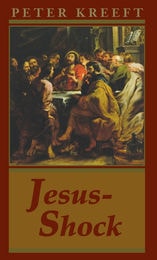
Jesus-Shock
Peter Kreeft
St. Augustine's Press, 2008
Jesus Shock is the second in a series of short works on seminal concerns of the impact that Jesus Christ made in the world. The first work, The Philosophy of Jesus (St. Augustine’s Press, 2007), explored philosophy in light of Jesus, rather than the other way around. The present work investigates the reception Jesus received both in His lifetime and continuously to the present time, not only from His enemies, but from His friends, a reception of shock, astonishment, even disgust.
Perhaps a few remarks from the book best explains it:
The point of the book:
The point of the title: Imagine a storm has downed a telephone wire so that everyone who touches it is shocked in every cell of his body. Well, the storm of God’s crazy love has “downed” (incarnated) Jesus, and everyone who touches this “live wire” is shocked in every cell of his soul.
The question of the book: Why is “Jesus” the most non-neutral, the most controversial, the most embarrassing name in the world? Why is talking about Jesus like talking about sex?
This whole book is really about a single movie line, the greatest line in the greatest movie in history. Bet you know what it is.
Jesus-Shock is about the Real Presence of Christ in the Gospels and in the Eucharist. It
is not about the theology of the Real Presence, but about the experience of Him there, and about the experience of everyone in the Gospels who met Him.
What was the bitterest controversy of the Protestant Reformation, both between Protestants and Catholics and between different Protestant denominations, the one that had both sides calling the other not just heretics but devils?
Answer: It was not Justification by Faith, the hallmark of the Reformation, even though that question is about nothing less momentous than how to be saved, how to get to Heaven. It was not the relation between religion and politics, even though that was a matter of life or death (literally, on battlefields and at guillotines and hangings) and not just a matter of truth or falsity, or of good or evil. It was not about the sufficiency of the Bible, or the corruption in the Church, or the relation between the Bible and the Church. It was not about the Pope, and the governance of the Church. It was not about Mary or saints or angels or Purgatory. It was not about the Incarnation or the Trinity or the Atonement.
It was about the Real Presence of Christ in the Eucharist.
Jesus-Shock, in addressing this controversy forcefully and faithfully, shows the reasons why to this day the name of “Jesus” stirs up controversy, even revulsion, in polite society. In the true spirit of ecumenism, it also points the way toward a true rapprochement among His modern-day disciples.
Knowing Jesus Christ
An Introduction to ChristologyFrancis Selman
Catholic University of America Press, 2026
Selected Prose Works
Commentary on Genesis, Commentary on Exodus, Homily on Our Lord, Letter to PubliusSaint Ephrem the Syrian
Catholic University of America Press, 1994
The Christology of Erasmus
Christ, Humanity, and PeaceTerence J. Martin
Catholic University of America Press, 2024
The Fittingness of the Incarnation
Essays in Analytic Thomistic Philosophy and TheologyDavid Braine, David
Catholic University of America Press, 2025
The Incarnate Lord
Thomas Josepth White, OP
Catholic University of America Press, 2015
The Philosophy of Jesus
Peter Kreeft
St. Augustine's Press, 2007
Amazingly, no one ever seems to have looked at Jesus as a philosopher, or his teaching as philosophy. Yet no one in history has ever had a more radically new philosophy, or made more of a difference to philosophy, than Jesus. He divided all human history into two, into "B.C." and "A.D."; and the history of philosophy is crucial to human history, since philosophy is crucial to man; so how could He not also divide philosophy?
This book (1) looks at Jesus as a complete human being (as well as divine), therefore also as a philosopher; (2) looks at philosophy as Jesus' pre-modern contemporaries did, as a wisdom, a world-view, and a way of life rather than as a super-science (Descartes, Hegel) or as a servant-science (Hobbes, Hume); and (3) looks at philosophy in light of Jesus rather than at Jesus in light of philosophy. It explores the consequences of Etienne Gilson's point that when St. John brought Christianity and Greek philosophy into contact and identified the Messiah the Jews had most deeply sought with the logos that the Greeks had most deeply sought, nothing happened to Christ but something happened to the logos.
This book explores the most radical revolution in the history of philosophy, the differences Jesus made to metaphysics (the philosophy of being), to epistemology (the philosophy of knowing), to anthropology (the philosophy of man), and to philosophical ethics and politics.
And, besides, it has the greatest ending of any philosophy book in a century.
The Reason of Following
Christology and the Ecstatic IRobert P. Scharlemann
University of Chicago Press, 1991
Scharlemann presents a christological phenomenology of the self, tracing the connections between the "I am" of the God who spoke to Moses, the "I am" of Christ, and the "I am" of autonomous self-identification. How, he asks, can the self that spontaneously responds to Jesus' "Follow me!" be compared with the everyday, autonomous self? What is the nature of "following" on the part of those who answer the summons of one whose name is "I am"? Pursuing these questions, Scharlemann develops a christological phenomenology of the self—an account in which following means not the expression of the self in action or reflection but rather self-discovery in another person.
With a deep sense of both culture and philosophy, Scharlemann distinguishes the forms of reason involved in "following" from those in ethics, aesthetics, and other modes of religious philosophic thought. His penetrating readings of nineteenth- and twentieth-century German theological and philosophical traditions provide an introduction to lesser-known thinkers such as Hermann and Picht as well as a profound critique of major figures such as Descartes, Heidegger, Fichte, and Kant.
Finally Scharlemann outlines a program for a more systematic and rounded presentation of what Christian doctrine might mean in the contemporary world. His work will be of interest to students of theology and philosophy alike.
The Roles of Christ's Humanity in Salvation
Insights from Theodore of MopsuestiaFrederick G. McLeod S.J.
Catholic University of America Press, 2005
Three Christological Treatises
Catholic University of America Press, 2014