Results by title
17 books match the query 'Political Theory'
A Government of Laws
Political Theory, Religion, and the American FoundingEllis Sandoz
University of Missouri Press, 2001
In A Government of Laws, which includes a new preface, Ellis Sandoz re-evaluates the traditional understanding of the philosophic and intellectual background of the American founding. Through an exhaustive assessment of Renaissance, medieval, and ancient political philosophy, he shows that the founding fathers were consciously and explicitly seeking to create a political order that would meet the demands of human nature and society. This rigorous and searching analysis of the sources of political and constitutional theory generates an original and provocative approach to American thought and experience.
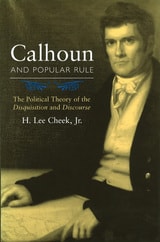
Calhoun and Popular Rule
The Political Theory of the Disquisition and DiscourseH. Lee Cheek, Jr.
University of Missouri Press, 2004
Although John C. Calhoun (1782-1850) remains one of the major figures in American political thought, many of his critics have tried to discredit him as merely a Southern partisan whose ideas were obsolete even during his lifetime. In Calhoun and Popular Rule, H. Lee Cheek, Jr., attempts to correct such misconceptions by presenting Calhoun as an original political thinker who devoted his life to the recovery of a "proper mode of popular rule." He argues that Calhoun had a coherent, systematic view of human nature and society and made a lasting contribution to the theory of constitutionalism and democracy.
Cheek suggests that Calhoun was not a political or philosophical aberration, but an authentic exponent of American constitutionalism. He contends that Calhoun's view of democracy forms part of a philosophy of humankind and politics that has relevance beyond the American experience. Although his idea of popular rule was original, it was also related to earlier attempts in America and elsewhere to limit the power of the majority and protect minority interests. According to Cheek, Calhoun stood in the American political tradition and attempted to rearticulate some of its central elements. He explains Calhoun's idea of the concurrent majority and examines how it has been presented by Calhoun's critics, as well as his followers.
As the first combined evaluation of Calhoun's most important treatises, The Disquisition and The Discourse, this work merges Calhoun's theoretical position with his endeavors to restore the need for popular rule. It also compares Calhoun's ideas with those of other great political thinkers such as Thomas Jefferson and James Madison--while explaining what is truly unique about Calhoun's political thought.
Calhoun's philosophy—his understanding of the need for ethical and political restraint and for institutional means for obtaining concurrence—is still relevant today, especially given the current growing ethnic and cultural conflict of the Western world. Scholars of government, American history, and political thought, as well as those interested in understanding "popular rule" and its theoretical and practical impact on modern American government, will find this groundbreaking work to be of great value.
Deliberate Conflict
Argument, Political Theory, and Composition ClassesPatricia Roberts-Miller
Southern Illinois University Press, 2004
In Deliberate Conflict: Argument, Political Theory, and Composition Classes, Patricia Roberts-Miller argues that much current discourse about argument pedagogy is hampered by fundamental unspoken disagreements over what democratic public discourse should look like. The book’s pivotal question is, In what kind of public discourse do we want our students to engage? To answer this, the text provides a taxonomy, discussion, and evaluation of political theories that underpin democratic discourse, highlighting the relationship between various models of the public sphere and rhetorical theory.
Deliberate Conflict cogently advocates reintegrating instruction in argumentation with the composition curriculum. By linking effective argumentation in the public sphere with the ability to effect social change, Roberts-Miller pushes compositionists beyond a simplistic Aristotelian conception of how argumentation works and offers a means by which to prepare students for active participation in public discourse.

Feminism and Political Theory
Edited by Cass R. Sunstein
University of Chicago Press, 1990
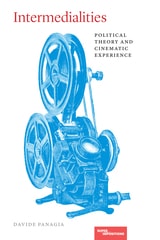
Intermedialities
Political Theory and Cinematic ExperienceDavide Panagia
Northwestern University Press, 2024
Shining new light on our understanding of cinema’s ways of political thinking, Intermedialities: Political Theory and Cinematic Experience puts modern political theory in conversation with the philosophy of film. Davide Panagia argues that there are no natural laws of association that can guarantee a template for democratic participation, as democracy is predicated not on stabilizing foundations but rather on the formation of expansive collectivities and institutions that are responsive to alterability. Instead, democracy requires a relational ontology, one that he elucidates by turning to philosophers of film like Stanley Cavell, Gilles Deleuze, Miriam Hansen, and Jean-Luc Godard—all of whom have articulated a political aesthetic of cinematic experience that is at once aspectual and compositional. Panagia reads these thinkers alongside a countertradition of modern political thought, represented by David Hume, Ludwig Wittgenstein, and Gilbert Simondon. His articulation of cinematic experience thus allows for a political aesthetic that is rooted in the migratory realities of undetermined relations.
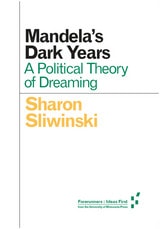
Mandela's Dark Years
A Political Theory of DreamingSharon Sliwinski
University of Minnesota Press, 2015
Inspired by one of Nelson Mandela’s recurring nightmares, Mandela’s Dark Years offers a political reading of dream-life. Sharon Sliwinski guides the reader through the psychology of apartheid, recasting dreaming as a vital form of resistance to political violence, away from a rational binary of thinking.
This short, provocative study blends political theory with clinical psychoanalysis, opening up a new space to consider the politics of reverie.
Forerunners is a thought-in-process series of breakthrough digital works. Written between fresh ideas and finished books, Forerunners draws on scholarly work initiated in notable blogs, social media, conference plenaries, journal articles, and the synergy of academic exchange. This is gray literature publishing: where intense thinking, change, and speculation take place in scholarship.

Political Theory and Praxis
New PerspectivesTerence Ball, Editor
University of Minnesota Press, 1977
Political Theory and Praxis was first published in 1977. Minnesota Archive Editions uses digital technology to make long-unavailable books once again accessible, and are published unaltered from the original University of Minnesota Press editions.
Nine distinguished contributors—philosophers and political scientists at universities and colleges in the United States, Europe, Canada, and Australia—write essays for this volume in political philosophy. The book is dedicated to the memory of Hannah Arendt, the writer and philosopher who died in 1975. The contributors discuss various aspects of the concepts of theory and practice and their interrelationship. All of the essays were written expressly for this volume. In an introduction, Professor Ball, the volume editor, notes that the essays reflect the diversity of conceptions of theory, of practice, and of their conceptual and practical interrelations, and that the contributors explore various ways and byways of approaching the age-old questions of theory and its relation to practice.
Part I: Origins
"On the History of 'Theory' and 'Praxis'," Nicholas Lobkowicz; "Creatures of a Day: Thought and Action in Thucydides,"J. Peter Euben; " Plato and Aristotle: The Unity Versus the Autonomy of Theory and Practice." Terence Ball.Part II: Developments
"Kant on Theory and Practice," Carl Raschke; "Theory and Practice in Hegel and Marx: An Unfinished Dialogue,"Peter Fuss; "The Unity of Theory and Practice: The Science of Marx and Nietzsche," Edward Andrew.Part II: Dilemmas and New Directions
"Hannah Arendt: The Ambiguities of Theory and Practice," Richard J. Bernstein; "Rebels, Beginners, and Buffoons: Politics as Action," Raymond L. Nichols; "How People Change Themselves: The Relationship between Critical Theory and Its Audience," Brian Fay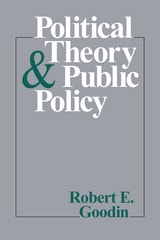
Political Theory and Public Policy
Robert E. Goodin
University of Chicago Press, 1983
Goodin—a political scientist who is also an associate editor of Ethics—shows that empirical and ethical theory can and should guide policy. To be useful, however, these philosophical discussions of public affairs must draw upon actual policy experiences rather than contrived cases. Further, they must reflect the broader social consequences of policies rather than just the dilemmas of personal conscience.
Effectively integrating the literatures of social science, policy science, and philosophy, Goodin provides a theoretically sophisticated yet empirically well-grounded analysis of public policies, the principles underlying them, the institutions shaping them, and the excuses offered for their failures. This analysis is enhanced by the author's discussion of such specific cases as the disposal of nuclear wastes and the priority accorded national defense—cases that illustrate Goodin's theoretical and methodological framework for approaching policy issues.
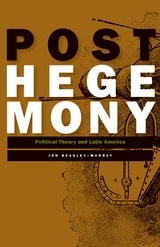
Posthegemony
Political Theory and Latin AmericaJon Beasley-Murray
University of Minnesota Press, 2010
In his thorough examination, Beasley-Murray undoes the dominant narrative of hegemonic projects and counterhegemonic resistance, of civilization and subalternity, to reveal instead a history of failed contracts and unpredicted insurgencies.
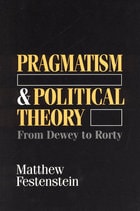
Pragmatism and Political Theory
From Dewey to RortyMatthew Festenstein
University of Chicago Press, 1997
The book's second part traces how Dewey's approach has been differently developed, especially in the work of three contemporary pragmatic thinkers: Richard Rorty, Jurgen Habermas, and Hilary Putnam. This first full-length critical study of the relationship between the pragmatist tradition and political philosophy fills a significant gap in contemporary thought.
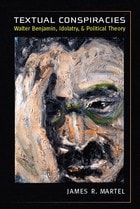
Textual Conspiracies
Walter Benjamin, Idolatry, and Political TheoryJames R. Martel
University of Michigan Press, 2012
“This is a sophisticated and fascinating argument written in a very enjoyably entertaining style. It is hard for me to see how readers initially interested in these texts will not be ‘swept off their feet’ by the core assertions of this author, and the devastatingly comprehensive way in which he demonstrates those arguments.”
—Brent Steele, University of Kansas
In Textual Conspiracies, James R. Martel applies the literary, theological, and philosophical insights of Walter Benjamin to the question of politics and the predicament of the contemporary left. Through the lens of Benjamin’s theories, as influenced by Kafka, of the fetishization of political symbols and signs, Martel looks at the ways in which various political and literary texts “speak” to each other across the gulf of time and space, thereby creating a “textual conspiracy” that destabilizes grand narratives of power and authority and makes the narratives of alternative political communities more apparent.
However, in keeping with Benjamin’s insistence that even he is complicit with the fetishism that he battles, Martel decentralizes Benjamin’s position as the key theorist for this conspiracy and contextualizes Benjamin in what he calls a “constellation” of pairs of thinkers and writers throughout history, including Alexis de Tocqueville and Edgar Allen Poe, Hannah Arendt and Federico García Lorca, and Frantz Fanon and Assia Djebar.
The Ciceronian Tradition in Political Theory
Edited by Daniel J. Kapust and Gary Remer
University of Wisconsin Press, 2021
Individual chapters examine the ways thinkers throughout history, specifically Augustine, John of Salisbury, Thomas More, Machiavelli, Montaigne, Hobbes, Locke, Adam Smith, and Edmund Burke, have engaged with and been influenced by Cicero. A final chapter surveys the impact of Cicero’s ideas on political thought in the second half of the twentieth century. By tracing the long reception of these ideas, the collection demonstrates not only Cicero’s importance to both medieval and modern political theorists but also the comprehensive breadth and applicability of his philosophy.
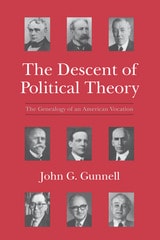
The Descent of Political Theory
The Genealogy of an American VocationJohn G. Gunnell
University of Chicago Press, 1993
Gunnell reconstructs the evolution of the field by locating it within the broader development of political science and American social science in general. During the behavioral revolution that swept political science in the 1950s, the relationship between political theory and political science changed dramatically, relegating theory to the margins of an increasingly empirical discipline. Gunnell demonstrates that the estrangement of political theory is rooted in a much older quarrel: the authority of knowledge versus political theory is rooted in a much older quarrel: the authority of knowledge versus political authority, academic versus public discourse. By disclosing the origin of this dispute, he opens the way for a clearer understanding of the basis and purpose of political theory.
As critical as it is revelatory, this thoughtful book should be read by any one interested in the history of political theory or science—or in the relationship of social science to political practice in the United States.
The Political Theory of The Federalist
David F. Epstein
University of Chicago Press, 1986
In The Political Theory of “The Federalist,” David F. Epstein offers a guide to the fundamental principles of American government as they were understood by the framers of the Constitution. Epstein here demonstrates the remarkable depth and clarity of The Federalist’s argument, reveals its specifically political (not merely economic) view of human nature, and describes how and why the American regime combines liberal and republican values.
“While it is a model of scholarly care and clarity, this study deserves an audience outside the academy. . . . David F. Epstein’s book is a fine demonstration of just how much a close reading can accomplish, free of any flights of theory or fancy references.”—New Republic
“Epstein’s strength lies in two aspects of his own approach. One is that he reads the text with uncommon closeness and sensitivity; the other is an extensive knowledge of the European political thought which itself forms an indispensable background to the minds of the authors.”—Times Literary Supplement
Value, Conflict, and Order
Berlin, Hampshire, Williams, and the Realist Revival in Political TheoryEdward Hall
University of Chicago Press, 2020
Is the purpose of political philosophy to articulate the moral values that political regimes would realize in a virtually perfect world and show what that implies for the way we should behave toward one another? That model of political philosophy, driven by an effort to draw a picture of an ideal political society, is familiar from the approach of John Rawls and others. Or is political philosophy more useful if it takes the world as it is, acknowledging the existence of various morally non-ideal political realities, and asks how people can live together nonetheless?
The latter approach is advocated by “realist” thinkers in contemporary political philosophy. In Value, Conflict, and Order, Edward Hall builds on the work of Isaiah Berlin, Stuart Hampshire, and Bernard Williams in order to establish a political realist’s theory of politics for the twenty-first century. The realist approach, Hall argues, helps us make sense of the nature of moral and political conflict, the ethics of compromising with adversaries and opponents, and the character of political legitimacy. In an era when democratic political systems all over the world are riven by conflict over values and interests, Hall’s conception is bracing and timely.
Vocations Of Political Theory
Jason A. Frank
University of Minnesota Press, 2000
Eminent and emerging thinkers seek to bridge the gap between political thought and political action.
Political Science
Eminent and emerging thinkers seek to bridge the gap between political thought and political action. Written by scholars with a rare sense of the historical and conceptual breadth of politics and theory, the essays in this volume explore possibilities for political theory in a world marked by disorienting political transformations. In doing so, they document and address the character and status of contemporary political theory, its changing place in the academy, and its role in public life. Whether challenging the settlement between political theory and political science, whereby theorists stuck to the "old texts" and left the "real world" to their empirical colleagues, or interrogating the relationship between political theory and political action, these essays expand and elaborate the parameters of political discourse-making their timeliness, relevance, and reach powerfully apparent.Contributors: Mark B. Brown; Wendy Brown, UC Santa Cruz; William E. Connolly, Johns Hopkins U; Thomas L. Dumm, Amherst College; J. Peter Euben, UC Santa Cruz; Russell Arben Fox; Samantha Frost, UC Santa Cruz; Shane Gunster; Jill Locke, Gustavus Adolphus College; David Paul Mandell, Reed College; Lon Troyer; Sheldon S. Wolin; Linda M. B. Zerilli, Northwestern U.Translation Inquiries: University of Minnesota Press
Welfare Reform and Political Theory
Lawrence M. Mead
Russell Sage Foundation, 2005