Results by title
1201 books match the query 'Race relations' and 121 start with a
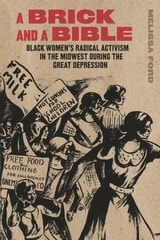
A Brick and a Bible
Black Women's Radical Activism in the Midwest during the Great DepressionMelissa Ford
Southern Illinois University Press, 2022
Uncovering the social revolution led by Black women in the heartland
In this first study of Black radicalism in midwestern cities before the civil rights movement, Melissa Ford connects the activism of Black women who championed justice during the Great Depression to those involved in the Ferguson Uprising and the Black Lives Matter movement. A Brick and a Bible examines how African American working-class women, many of whom had just migrated to “the promised land” only to find hunger, cold, and unemployment, forged a region of revolutionary potential.
A Brick and a Bible theorizes a tradition of Midwestern Black radicalism, a praxis-based ideology informed by but divergent from American Communism. Midwestern Black radicalism that contests that interlocking systems of oppression directly relates the distinct racial, political, geographic, economic, and gendered characteristics that make up the American heartland. This volume illustrates how, at the risk of their careers, their reputations, and even their lives, African American working-class women in the Midwest used their position to shape a unique form of social activism.
Case studies of Detroit, St. Louis, Chicago, and Cleveland—hotbeds of radical activism—follow African American women across the Midwest as they participated in the Ford Hunger March, organized the Funsten Nut Pickers’ strike, led the Sopkin Dressmakers’ strike, and supported the Unemployed Councils and the Scottsboro Boys’ defense. Ford profoundly reimagines how we remember and interpret these “ordinary” women doing extraordinary things across the heartland. Once overlooked, their activism shaped a radical tradition in midwestern cities that continues to be seen in cities like Ferguson and Minneapolis today.
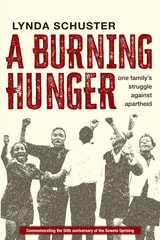
A Burning Hunger
One Family’s Struggle Against ApartheidLynda Schuster
Ohio University Press, 2006
Reissued for the 50th anniversary of the Soweto Uprising, A Burning Hunger reveals how one family’s courage ignited resistance and forever changed South Africa.
If the Mandelas were the generals in the fight for black liberation, the Mashininis were the foot soldiers. Theirs is a story of exile, imprisonment, torture, and loss, but also of dignity, courage, and strength in the face of appalling adversity. Originally published in Great Britain to critical acclaim, A Burning Hunger: One Family’s Struggle Against Apartheid tells a deeply moving human story and is one of the seminal books about the struggle against apartheid.
This family, Joseph and Nomkhitha Mashinini and their thirteen children, became immersed in almost every facet of the liberation struggle—from guerrilla warfare to urban insurrection. Although Joseph and Nomkhitha were peaceful citizens who had never been involved in politics, five of their sons became leaders in the antiapartheid movement. When the students of Soweto rose up in 1976 to protest a new rule making Afrikaans the language of instruction, they were led by charismatic young Tsietsi Mashinini. Scores of students were shot down and hundreds were injured. Tsietsi’s actions on that day set in motion a chain of events that would forever change South Africa, define his family, and transform their lives.
A Burning Hunger shows the human catastrophe that plagued generations of black Africans in the powerful story of one religious and law-abiding Soweto family. Basing her narrative on extensive research and interviews, Lynda Schuster richly portrays this remarkable family and in so doing reveals black South Africa during a time of momentous change.
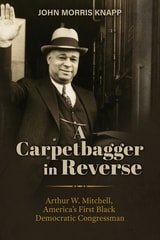
A Carpetbagger in Reverse
Arthur W. Mitchell, America's First Black Democratic CongressmanJohn Morris Knapp
University of Alabama Press, 2025
From Alabama to Congress—Arthur W. Mitchell’s fight for justice rewrote the rules of Black political power.
A Carpetbagger in Reverse offers a landmark reassessment of the life, career, and accomplishments of groundbreaking Congressman Arthur W. Mitchell, the first Black Democrat elected to Congress and the only Black member of Congress during his four terms of service from 1935 to 1943.
Born to former enslaved people in Alabama in 1883, Mitchell studied with Booker T. Washington at Tuskegee Institute and later moved to Washington DC and became a lawyer. He continued his career in Chicago, where the Great Migration had helped transform the city’s South Side into a vibrant, multiracial enclave.
As a congressman, Mitchell helped to create an enduring alliance between Black Americans and the Democratic party. Seeing his primary role as representing the South’s disempowered Black population, his belief that solutions to the region’s racial problems should arise from a new cadre of locally trained leaders brought him into frequent, vituperative conflict with the NAACP, the Republican Party, and the Black press. The first Black lawyer to argue successfully before the Supreme Court, his unanimous victory in Mitchell v. United States would have long-term consequences for the Civil Rights Movement.
A Carpetbagger in Reverse is the first publication significantly based on Mitchell’s papers, an essential and often overlooked source of insights about the development of Black political and culture life in the 1930s and 1940s.
A Chosen People, a Promised Land
Mormonism and Race in Hawai’iHokulani K. Aikau
University of Minnesota Press, 2012
Christianity figured prominently in the imperial and colonial exploitation and dispossession of indigenous peoples worldwide, yet many indigenous people embrace Christian faith as part of their cultural and ethnic identities. A Chosen People, a Promised Land gets to the heart of this contradiction by exploring how Native Hawaiian members of the Church of Jesus Christ of Latter-Day Saints (more commonly known as Mormons) understand and negotiate their place in this quintessentially American religion.
Mormon missionaries arrived in Hawai‘i in 1850, a mere twenty years after Joseph Smith founded the church. Hokulani K. Aikau traces how Native Hawaiians became integrated into the religious doctrine of the church as a “chosen people”—even at a time when exclusionary racial policies regarding black members of the church were being codified. Aikau shows how Hawaiians and other Polynesian saints came to be considered chosen and how they were able to use their venerated status toward their own spiritual, cultural, and pragmatic ends.
Using the words of Native Hawaiian Latter-Day Saints to illuminate the intersections of race, colonization, and religion, A Chosen People, a Promised Land examines Polynesian Mormon articulations of faith and identity within a larger political context of self-determination.
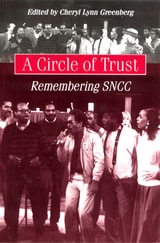
A Circle of Trust
Remembering SNCCGreenberg, Cheryl L
Rutgers University Press, 1998
"The reminiscences and reflections voiced at the SNCC reunion remind us of the remarkable vision and courageous dedication of the civil rights movement of the 1960s. Framed by Cheryl Greenberg's eloquent and probing introduction, the SNCC veterans' comments about the triumphs and limitations of their movement represent a major contribution to the historical literature on race and power in modern America." --Raymond Arsenault, University of South Florida
On the occasion of the SNCC's 25th anniversary, more than 500 people gathered at Trinity College in Connecticut to both celebrate and critique its accomplishments. More than 40 SNCC members tell their stories and reflect on the contributions, limits and legacies of the movement in A Circle of Trust. Engaging in spirited debate with each other, with historians of the movement, and with contemporary political culture more broadly, these former and perpetual activists speak of their vision of a just society and what still remains to be done. With increasing racial tension and the continued debate over integration and separatism in America in the 1990s, the content of this conference is more relevant than ever.
Cheryl Lynn Greenberg begins with an overview of SNCC and introduces each of the chapters of oral history. Participants explore the origins of SNCC, its early adoption of nonviolent protest, its ultimate renunciation of liberal integration and embrace of militant black radicalism, its refusal to repudiate far-left organizations, and controversies over the roles of women in SNCC and society at large. The result is a thoughtful, moving, sometimes acrimonious, sometimes celebratory account of one of the most significant civil rights organizations and its successes and failures.
A City Divided
The Racial Landscape of Kansas City, 1900-1960Sherry Lamb Schirmer
University of Missouri Press, 2002
As the African American population grew in size and assertiveness, whites increasingly identified blacks with those factors that most deprived a given space of its middle-class character. Consequently, African Americans came to represent the antithesis of middle-class values, and the white middle class established its identity by excluding blacks from the urban spaces it occupied.
By 1930, racial discrimination rested firmly on gender and family values as well as class. Inequitable law enforcement in the ghetto increased criminal activity, both real and perceived, within the African American community. White Kansas Citians maintained this system of racial exclusion and denigration in part by “misdirection,” either by denying that exclusion existed or by claiming that segregation was necessary to prevent racial violence. Consequently, African American organizations sought to counter misdirection tactics. The most effective of these efforts followed World War II, when local black activists devised demonstration strategies that targeted misdirection specifically.
At the same time, a new perception emerged among white liberals about the role of race in shaping society. Whites in the local civil rights movement acted upon the belief that integration would produce a better society by transforming human character. Successful in laying the foundation for desegregating public accommodations in Kansas City, black and white activists nonetheless failed to dismantle the systems of spatial exclusion and inequitable law enforcement or to eradicate the racial ideologies that underlay those systems.
These racial perceptions continue to shape race relations in Kansas City and elsewhere. This study demystifies these perceptions by exploring their historical context. While there have been many studies of the emergence of ghettos in northern and border cities, and others of race, gender, segregation, and the origins of white ideologies, A City Divided is the first to address these topics in the context of a dynamic, urban society in the Midwest.
A City within a City
The Black Freedom Struggle in Grand Rapids, MichiganTodd E Robinson
Temple University Press, 2012
A City within a City cogently argues that the post-war political reform championed by local Republicans transformed the city's racial geography, creating a racialized "city within a city," featuring a system of "managerial racism" designed to keep blacks in declining inner-city areas. As Robinson indicates, this bold, provocative framework for understanding race relations in Grand Rapids has broader implications for illuminating the twentieth-century African American urban experience in secondary cities.
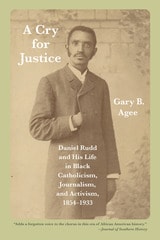
A Cry for Justice
Daniel Rudd and His Life in Black Catholicism, Journalism, and Activism, 1854-1933Gary B. Agee
University of Arkansas Press, 2017
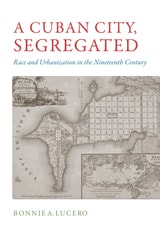
A Cuban City, Segregated
Race and Urbanization in the Nineteenth CenturyBonnie A. Lucero
University of Alabama Press, 2019
Founded as a white colony in 1819, Cienfuegos, Cuba, quickly became home to people of African descent, both free and enslaved, and later a small community of Chinese and other immigrants. Despite the racial, ethnic, and cultural diversity that defined the city’s population, the urban landscape was characterized by distinctive racial boundaries, separating the white city center from the heterogeneous peripheries. A Cuban City, Segregated: Race and Urbanization in the Nineteenth Century explores how the de facto racial segregation was constructed and perpetuated in a society devoid of explicitly racial laws.
Drawing on the insights of intersectional feminism, Bonnie A. Lucero shows that the key to understanding racial segregation in Cuba is recognizing the often unspoken ways specifically classed notions and practices of gender shaped the historical production of race and racial inequality. In the context of nineteenth-century Cienfuegos, gender, race, and class converged in the concept of urban order, a complex and historically contingent nexus of ideas about the appropriate and desired social hierarchy among urban residents, often embodied spatially in particular relationships to the urban landscape.
As Cienfuegos evolved subtly over time, the internal logic of urban order was driven by the construction and defense of a legible, developed, aesthetically pleasing, and, most importantly, white city center. Local authorities produced policies that reduced access to the city center along class and gendered lines, for example, by imposing expensive building codes on centric lands, criminalizing poor peoples’ leisure activities, regulating prostitution, and quashing organized labor. Although none of these policies mentioned race outright, this new scholarship demonstrates that the policies were instrumental in producing and perpetuating the geographic marginality and discursive erasure of people of color from the historic center of Cienfuegos during its first century of existence.
A Decisive Decade
An Insider's View of the Chicago Civil Rights Movement during the 1960sRobert B. McKersie, Foreword by James R. Ralph Jr.
Southern Illinois University Press, 2013
The deeply personal story of a historic time in Chicago, Robert B. McKersie’s A Decisive Decade follows the unfolding action of the Civil Rights Movement as it played out in the Windy City. McKersie’s participation as a white activist for black rights offers a unique, firsthand viewpoint on the debates, boycotts, marches, and negotiations that would forever change the face of race relations in Chicago and the United States at large.
Described within are McKersie’s intimate observations on events as they developed during his participation in such historic occasions as the impassioned marches for open housing in Chicago; the campaign to end school segregation under Chicago Schools Superintendent Benjamin Willis; Operation Breadbasket’s push to develop economic opportunities for black citizens; and dialogs with corporations to provide more jobs for blacks in Chicago. In addition, McKersie provides up close and personal descriptions of the iconic Civil Rights leaders who spearheaded some of the most formative battles of Chicago’s Civil Rights movement, including Dr. Martin Luther King, Jr., Reverend Jesse Jackson, Timuel Black Jr. and W. Alvin Pitcher. The author illumines the tensions experienced by two major institutions in responding to the demands of the civil rights movement: the university and the church. Packed with historical detail and personal anecdotes of these history-making years, A Decisive Decade offers a never-before-seen perspective on one of our nation’s most tumultuous eras.

A Decolonial Feminism
Francoise Verges
Pluto Press, 2021

A Different Hunger
Writings on Black ResistanceA. Sivanandan
Pluto Press, 1991

A Festival of Violence
An Analysis of Southern Lynchings, 1882-1930Stewart Tolnay and E.M. Beck
University of Illinois Press, 1995
practice. Stewart Tolnay and E. M. Beck empirically test competing explanations of the causes of lynching, using U.S. Census and historical voting data and a newly constructed inventory of southern lynch victims. Among their surprising findings: lynching responded to fluctuations in the price of cotton, decreasing in frequency when prices rose and increasing when they fell.
A Fire You Can't Put Out
The Civil Rights Life of Birmingham's Reverend Fred ShuttlesworthAndrew M. Manis
University of Alabama Press, 2001
WINNER, LILLIAN SMITH AWARD
WINNER, JAMES F. SULZBY, JR. AWARD
The fire of freedom that changed Birmingham—and America.
When Fred Shuttlesworth suffered only a bump on the head in the 1956 bombing of his home, members of his church called it a miracle. Shuttlesworth took it as a sign that God would protect him on the mission that had made him a target that night. Standing in front of his demolished home, Shuttlesworth vigorously renewed his commitment to integrate Birmingham's buses, lunch counters, police force, and parks. The incident transformed him, in the eyes of Birmingham's blacks, from an up-and-coming young minister to a virtual folk hero and, in the view of white Birmingham, from obscurity to rabble-rouser extraordinaire.
From his 1956 founding of the Alabama Christian Movement for Human Rights through the historic demonstrations of 1963, driven by a sense of divine mission, Shuttlesworth pressured Jim Crow restrictions in Birmingham with radically confrontational acts of courage. His intensive campaign pitted him against the staunchly segregationist police commissioner Eugene "Bull" Connor and ultimately brought him to the side of Martin Luther King Jr. and to the inner chambers of the Kennedy White House.
First published in 1999, Andrew Manis's award-winning biography of "one of the nation's most courageous freedom fighters" demonstrates compellingly that Shuttleworth's brand of fiery, outspoken confrontation derived from his prophetic understanding of the pastoral role. Civil rights activism was tantamount to salvation in his understanding of the role of Christian minister.
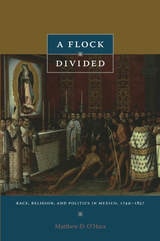
A Flock Divided
Race, Religion, and Politics in Mexico, 1749–1857Matthew D. O Hara
Duke University Press, 2010
O’Hara focuses on interactions between church authorities and parishioners from the late-colonial era into the early-national period, first in Mexico City and later in the surrounding countryside. Paying particular attention to disputes regarding caste status, the category of “Indian,” and the ownership of property, he demonstrates that religious collectivities from neighborhood parishes to informal devotions served as complex but effective means of political organization for plebeians and peasants. At the same time, longstanding religious practices and ideas made colonial social identities linger into the decades following independence, well after republican leaders formally abolished the caste system that classified individuals according to racial and ethnic criteria. These institutional and cultural legacies would be profound, since they raised fundamental questions about political inclusion and exclusion precisely when Mexico was trying to envision and realize new forms of political community. The modes of belonging and organizing created by colonialism provided openings for popular mobilization, but they were always stalked by their origins as tools of hierarchy and marginalization.
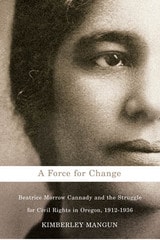
A Force for Change
Beatrice Morrow Cannady and the Struggle for Civil Rights in Oregon, 1912-1936Kimberley Mangun
Oregon State University Press, 2010
A Force for Change is the first full-length study of the life and work of one of Oregon’s most dynamic civil rights activists, African American journalist Beatrice Morrow Cannady. Between 1912 and 1936, Cannady tirelessly promoted interracial goodwill and fought segregation and discrimination.
She gave hundreds of lectures to high school and college students and shared her message with radio listeners across the Pacific Northwest. She was assistant editor, and later publisher, of The Advocate, Oregon’s largest African American newspaper. Cannady was the first black woman to graduate from law school in Oregon, and the first to run for state representative. She held interracial teas in her home in Northeast Portland and protested repeated showings of the racist film The Birth of a Nation. And when the Ku Klux Klan swept into Oregon, she urged the governor to act quickly to protect black Oregonians’ right to live and work without fear. Despite these accomplishments—and many more during her twenty-five-year career—Beatrice Cannady fell into obscurity when she left Oregon in about 1938.
A Force for Change illuminates Cannady’s important role in advocating for better race relations in Oregon in the early decades of the twentieth century. It describes her encounters with the period’s leading black artists, editors, politicians, and intellectuals, including W.E.B. Du Bois, Langston Hughes, A. Philip Randolph, Oscar De Priest, Roland Hayes, and James Weldon Johnson. It dispels the myth that African Americans played little part in Oregon’s history and enriches our understanding of the black experience in Oregon.
A Force for Change is an invaluable resource for students and scholars of women’s history, gender studies, African American history, journalism history, and Pacific Northwest history. It belongs on the shelf of any reader interested in a richer understanding of the civil rights movement in Oregon and across the country.
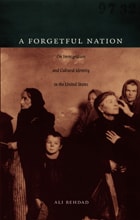
A Forgetful Nation
On Immigration and Cultural Identity in the United StatesAli Behdad
Duke University Press, 2005
Behdad shows how political, cultural, and legal texts have articulated American anxiety about immigration from the Federalist period to the present day. He reads texts both well-known—J. Hector St. John de Crèvecoeur’s Letters from an American Farmer, Alexis de Tocqueville’s Democracy in America, and Walt Whitman’s Leaves of Grass—and lesser-known—such as the writings of nineteenth-century nativists and of public health officials at Ellis Island. In the process, he highlights what is obscured by narratives and texts celebrating the United States as an open-armed haven for everyone: the country’s violent beginnings, including its conquest of Native Americans, brutal exploitation of enslaved Africans, and colonialist annexation of French and Mexican territories; a recurring and fierce strand of nativism; the need for a docile labor force; and the harsh discipline meted out to immigrant “aliens” today, particularly along the Mexican border.
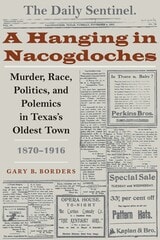
A Hanging in Nacogdoches
Murder, Race, Politics, and Polemics in Texas's Oldest Town, 1870-1916By Gary B. Borders
University of Texas Press, 2006
On October 17, 1902, in Nacogdoches, Texas, a black man named James Buchanan was tried without representation, condemned, and executed for the murder of a white family—all in the course of three hours. Two white men played pivotal roles in these events: Bill Haltom, a leading local Democrat and the editor of the Nacogdoches Sentinel, who condemned lynching but defended lynch mobs, and A. J. Spradley, a Populist sheriff who, with the aid of hundreds of state militiamen, barely managed to keep the mob from burning Buchanan alive, only to escort him to the gallows following his abbreviated trial. Each man's story serves to illuminate a part of the path that led to the terrible parody of justice which lies at the heart of A Hanging in Nacogdoches.
The turn of the twentieth century was a time of dramatic change for the people of East Texas. Frightened by the Populist Party's attempts to unite poor blacks and whites in a struggle for economic justice, white Democrats defended their power base by exploiting racial tensions in a battle that ultimately resulted in the complete disenfranchisement of the black population of East Texas. In telling the story of a single lynching, Gary Borders dramatically illustrates the way politics and race combined to bring horrific violence to small southern towns like Nacogdoches.
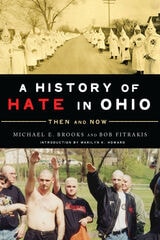
A History of Hate in Ohio
Then and NowMichael E. Brooks and Bob Fitrakis with an introduction by Marilyn K. Howard
The Ohio State University Press, 2021
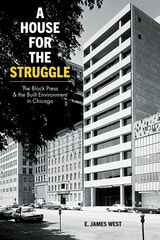
A House for the Struggle
The Black Press and the Built Environment in ChicagoE. James West
University of Illinois Press, 2022
- Winner of the 2023 Michael Nelson Prize of International Association for Media and History (IAMHIST)
- Recipient of the 2022 Jane Jacobs Urban Communication Book Award
- Winner of the 2023 American Journalism Historians Association Book of the Year
- Winner of the 2023 ULCC’s (Union League Club of Chicago) Outstanding Book on the History of Chicago Award
- Recipient of a 2023 Best of Illinois History Superior Achievement award from the Illinois State Historical Society
- Winner of the 2023 BAAS Book Prize (British Association for American Studies)
- Winner of a 2023 The Brinck Book Award and Lecture series (University of New Mexico School of Architecture + Planning)
- Honorable Mention for the 2021-22 RSAP Book Prize (Research Society for American Periodicals)
Buildings once symbolized Chicago's place as the business capital of Black America and a thriving hub for Black media. In this groundbreaking work, E. James West examines the city's Black press through its relationship with the built environment. As a house for the struggle, the buildings of publications like Ebony and the Chicago Defender embodied narratives of racial uplift and community resistance. As political hubs, gallery spaces, and public squares, they served as key sites in the ongoing Black quest for self-respect, independence, and civic identity. At the same time, factors ranging from discriminatory business practices to editorial and corporate ideology prescribed their location, use, and appearance, positioning Black press buildings as sites of both Black possibility and racial constraint.
Engaging and innovative, A House for the Struggle reconsiders the Black press's place at the crossroads where aspiration collided with life in one of America's most segregated cities.
A Life In The Struggle
Ivory Perry and the Culture of OppositionGeorge Lipsitz
Temple University Press, 1995
A Narrative of Events, since the First of August, 1834, by James Williams, an Apprenticed Labourer in Jamaica
James Williams
Duke University Press, 2001
Describing the hard working conditions on plantations and the harsh treatment of apprentices unjustly incarcerated, Williams argues that apprenticeship actually worsened the conditions of Jamaican ex-slaves: former owners, no longer legally permitted to directly punish their workers, used the Jamaican legal system as a punitive lever against them. Williams’s story documents the collaboration of local magistrates in this practice, wherein apprentices were routinely jailed and beaten for both real and imaginary infractions of the apprenticeship regulations.
In addition to the complete text of Williams’s original Narrative, this fully annotated edition includes nineteenth-century responses to the controversy from the British and Jamaican press, as well as extensive testimony from the Commission of Enquiry that heard evidence regarding the Narrative’s claims. These fascinating and revealing documents constitute the largest extant body of direct testimony by Caribbean slaves or apprentices.
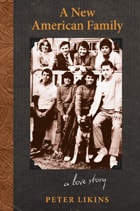
A New American Family
A Love StoryPeter Likins
University of Arizona Press, 2011
This poignant but ultimately empowering memoir tells the story of Peter Likins, his wife Patricia, and the six children they adopted in the 1960s, building a family beset by challenges that ultimately strengthened all bonds. With issues such as inter-racial adoption, mental illness, drug addiction, unwed pregnancy, and homosexuality entwined in their lives, the Likins’ tale isn’t just a family memoir—it’s a story of the American experience, a memoir with a message. With circumstances of race, age, and health making all of their children virtually unadoptable by 1960s standards, Pat and Pete never strayed from the belief that loyalty and love could build a strong family.
Both Pete and Pat have served as teachers. and Pete’s long academic career—holding positions as a professor, dean, provost, and then president—illuminates more than just his personal success. Pete’s professional attainments produce a context for his family story, wherein high achievements in educational, athletic, and financial terms coexist with the joys and sorrows of this exceptional family.
A frank, open account of the difficulties his family faced, this is a brave story, told with unflinching honesty and remarkable compassion. A New American Family is a wonderful narrative of the genesis of a family and a journey to the deepest parts of a father’s heart.
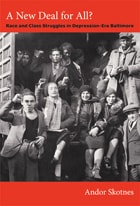
A New Deal for All?
Race and Class Struggles in Depression-Era BaltimoreAndor Skotnes
Duke University Press, 2012
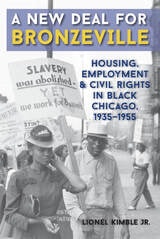
A New Deal for Bronzeville
Housing, Employment, and Civil Rights in Black Chicago, 1935-1955Lionel Kimble Jr.
Southern Illinois University Press, 2015
During the Great Migration of the 1920s and 1930s, southern African Americans flocked to the South Side Chicago community of Bronzeville, the cultural, political, social, and economic hub of African American life in the city, if not the Midwest. The area soon became the epicenter of community activism as working-class African Americans struggled for equality in housing and employment. In this study, Lionel Kimble Jr. demonstrates how these struggles led to much of the civil rights activism that occurred from 1935 to 1955 in Chicago and shows how this working-class activism and culture helped to ground the early civil rights movement. Despite the obstacles posed by the Depression, blue-collar African Americans worked with leftist organizations to counter job discrimination and made strong appeals to New Deal allies for access to public housing. Kimble details how growing federal intervention in local issues during World War II helped African Americans make significant inroads into Chicago’s war economy and how returning African American World War II veterans helped to continue the fight against discrimination in housing and employment after the war. The activism that appeared in Bronzeville was not simply motivated by the “class consciousness” rhetoric of the organized labor movement but instead grew out of everyday struggles for racial justice, citizenship rights, and improved economic and material conditions. With its focus on the role of working-class African Americans—as opposed to the middle-class leaders who have received the most attention from civil rights historians in the past—A New Deal for Bronzeville makes a significant contribution to the study of civil rights work in the Windy City and enriches our understanding of African American life in mid-twentieth-century Chicago.
This publication is partially funded by a grant from Furthermore: a program of the J.M. Kaplan fund.
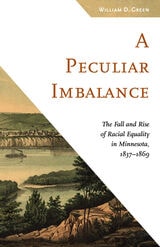
A Peculiar Imbalance
The Fall and Rise of Racial Equality in Minnesota, 1837–1869William D. Green
University of Minnesota Press, 2015
A Peculiar Imbalance is the little-known history of the black experience in Minnesota in the mid-1800s, a time of dramatic change in the region. William D. Green explains how, as white progressive politicians pushed for statehood, black men who had been integrated members of the community, owning businesses and maintaining good relationships with their neighbors, found themselves denied the right to vote or to run for office in those same communities.
As Minnesota was transformed from a wilderness territory to a state, the concepts of race and ethnicity and the distinctions among them made by Anglo-Americans grew more rigid and arbitrary. A black man might enjoy economic success and a middle-class lifestyle but was not considered a citizen under the law. In contrast, an Irish Catholic man was able to vote—as could a mixed-blood Indian—but might find himself struggling to build a business because of the ethnic and religious prejudices of the Anglo-American community. A Peculiar Imbalance examines these disparities, reflecting on the political, social, and legal experiences of black men from 1837 to 1869, the year of black suffrage.
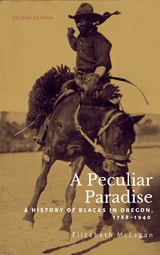
A Peculiar Paradise
A History of Blacks in Oregon, 1788-1940Elizabeth McLagan
Oregon State University Press, 2022
A Peculiar Paradise: A History of Blacks in Oregon 1788–1940 remains the most comprehensive chronology of Black life in Oregon more than forty years after its original publication in 1980. The book has long been a resource for those seeking information on the legal and social barriers faced by people of African descent in Oregon. Elizabeth McLagan’s work reveals how in spite of those barriers, Black individuals and families made Oregon their home, and helped create the state’s modern Black communities. Long out of print, the book is available again through this co-publication with Oregon Black Pioneers, Oregon’s statewide African American historical society. The revised second edition includes additional details for students and scholars, an expanded reading list, a new selection of historic images, and a new foreword by Gwen Carr and an afterword by Elizabeth McLagan.

A Place Called Sweet Shrub
The Second Novel in a TrilogyJane Roberts Wood
University of North Texas Press, 2000
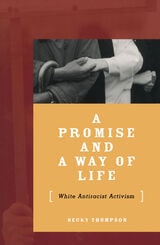
A Promise And A Way Of Life
White Antiracist ActivismBecky Thompson
University of Minnesota Press, 2001
The first in-depth look at white people’s activism in fighting racism during the past fifty years.
Not since the Civil Rights Movement of the 1950s and 1960s, when many white college students went south to fight against Jim Crow laws, has white antiracist activity held the public’s attention. Yet there have always been white people involved in fighting racism. In this passionate work, Becky Thompson looks at white Americans who have struggled against racism, offering examples of both successes and failures, inspirations, practical philosophies, and a way ahead.
A Promise and a Way of Life weaves an account of the past half-century based on the life histories of thirty-nine people who have placed antiracist activism at the center of their lives. Through a rich and fascinating narrative that links individual experiences with social and political history, Thompson shows the ways, both public and personal, in which whites have opposed racism during several social movements: the Civil Rights and Black Power movements, multiracial feminism, the Central American peace movement, the struggle for antiracist education, and activism against the prison industry. Beginning with the diverse catalysts that started these activists on their journeys, this book demonstrates the contributions and limitations of white antiracism in key social justice movements.
Through these stories, crucial questions are raised: Does antiracist work require a repudiation of one’s whiteness or can that identity be transformed through political commitment and alliances? What do white people need to do to undermine white privilege? What would it take to build a multiracial movement in which white people are responsible for creating antiracist alliances while not co-opting people of color?
Unique in its depth and thoroughness, A Promise and a Way of Life is essential for anyone currently fighting racism or wondering how to do so. Through its demonstration of the extraordinary personal and social transformations ordinary people can make, it provides a new paradigm for movement activity, one that will help to incite and guide future antiracist activism.
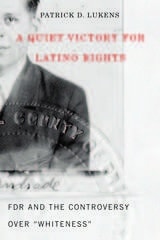
A Quiet Victory for Latino Rights
FDR and the Controversy Over "Whiteness"Patrick D. Lukens
University of Arizona Press, 2012
In 1935 a federal court judge handed down a ruling that could have been disastrous for Mexicans, Mexican Americans, and all Latinos in the United States. However, in an unprecedented move, the Roosevelt administration wielded the power of "administrative law" to neutralize the decision and thereby dealt a severe blow to the nativist movement. A Quiet Victory for Latino Rights recounts this important but little-known story.
To the dismay of some nativist groups, the Immigration Act of 1924, which limited the number of immigrants who could be admitted annually, did not apply to immigrants from Latin America. In response to nativist legal maneuverings, the 1935 decision said that the act could be applied to Mexican immigrants. That decision, which ruled that the Mexican petitioners were not "free white person[s]," might have paved the road to segregation for all Latinos.
The League of United Latin American Citizens (LULAC), founded in 1929, had worked to sensitize the Roosevelt administration to the tenuous position of Latinos in the United States. Advised by LULAC, the Mexican government, and the US State Department, the administration used its authority under administrative law to have all Mexican immigrants—and Mexican Americans—classified as "white." It implemented the policy when the federal judiciary "acquiesced" to the New Deal, which in effect prevented further rulings.
In recounting this story, complete with colorful characters and unlikely bedfellows, Patrick D. Lukens adds a significant chapter to the racial history of the United States.
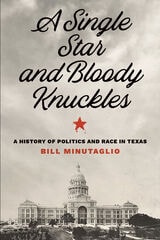
A Single Star and Bloody Knuckles
A History of Politics and Race in TexasBy Bill Minutaglio
University of Texas Press, 2021
For John Nance “Cactus Jack” Garner, there was one simple rule in politics: “You’ve got to bloody your knuckles.” It’s a maxim that applies in so many ways to the state of Texas, where the struggle for power has often unfolded through underhanded politicking, backroom dealings, and, quite literally, bloodshed. The contentious history of Texas politics has been shaped by dangerous and often violent events, and been formed not just in the halls of power but by marginalized voices omitted from the official narratives.
A Single Star and Bloody Knuckles traces the state’s conflicted and dramatic evolution over the past 150 years through its pivotal political players, including oft-neglected women and people of color. Beginning in 1870 with the birth of Texas’s modern political framework, Bill Minutaglio chronicles Texas political life against the backdrop of industry, the economy, and race relations, recasting the narrative of influential Texans. With journalistic verve and candor, Minutaglio delivers a contemporary history of the determined men and women who fought for their particular visions of Texas and helped define the state as a potent force in national affairs.
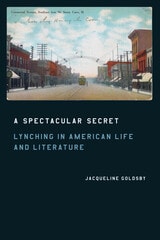
A Spectacular Secret
Lynching in American Life and LiteratureJacqueline Goldsby
University of Chicago Press, 2006
To pursue this argument, Goldsby traces lynching's history by taking up select mob murders and studying them together with key literary works. She focuses on three prominent authors—Ida B. Wells-Barnett, Stephen Crane, and James Weldon Johnson—and shows how their own encounters with lynching influenced their analyses of it. She also examines a recently assembled archive of evidence—lynching photographs—to show how photography structured the nation's perception of lynching violence before World War I. Finally, Goldsby considers the way lynching persisted into the twentieth century, discussing the lynching of Emmett Till in 1955 and the ballad-elegies of Gwendolyn Brooks to which his murder gave rise.
An empathic and perceptive work, A Spectacular Secret will make an important contribution to the study of American history and literature.
A Suitable Enemy
Racism, Migration and Islamophobia in EuropeLiz Fekete
Pluto Press, 2009
Liz Fekete is a leading authority on issues of racism, Islamophobia and national security legislation. A Suitable Enemy draws on sixteen years of research to present a comprehensive overview of EU immigration, asylum, race and security policies.
Fekete argues that at the same time as the EU introduces selective migration policies, it closes its borders against asylum seekers who were the first victims of the growth of the security state which now embraces Muslims. She explores the way in which anti-terrorist legislation has been used to evict undesirable migrants, how deportation policies commodify and de-humanise the most vulnerable and how these go hand in hand with evolving forms of racism, particularly Islamophobia.
At the heart of the book is an examination of xeno-racism -- a non-colour coded form of institutionalised racism -- where migrants who do not assimilate, or who are believed to be incapable of assimilation, are excluded.
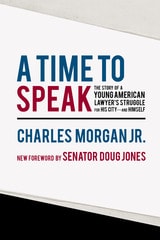
A Time to Speak
The Story of a Young American Lawyer's Struggle for His City—and HimselfCharles Morgan Jr., With a New Foreword by Senator Doug Jones
University of Alabama Press, 2022
Brings back into print a classic account of courage and calamity in the long march toward racial justice in the South, and the nation
On September 15, 1963, a bomb exploded at the Sixteenth Street Baptist Church in Birmingham, Alabama, killing four young Black girls. The very next day, a prominent white lawyer named Charles Morgan Jr. was scheduled to speak at a luncheon held by the Young Men’s Business Club of Birmingham. A well-regarded figure in the city’s legal and business establishment, Morgan had been mentioned frequently as a candidate for political office. To the shock of his longtime friends and associates, Morgan deviated from his planned remarks, instead using his platform to place the blame for the murder of the four young girls squarely on the shoulders of the city’s white middle-class establishment, those seated before him.
As much as his stand was admired nationally, in Birmingham the results were destructive for him personally. Threats against his life and the lives of his family poured in daily by phone and mail, his political career was finished, and he was faced with financial ruin. Within weeks, he moved his family out of the state, and thenceforward committed himself to legal action in the name of racial justice. In 1964, he established the regional office of the ACLU in Atlanta. In the 1964 Supreme Court case Reynolds v. Sims, Morgan successfully argued that districts in state legislatures needed to be of nearly equal size, establishing the principle of “one man, one vote” to effectively end the use of gerrymandering.
A Time to Speak was originally published in 1964, a mere year after Morgan and his family fled Birmingham. The memoir recounts not only his speech, but his entire upbringing and the political, cultural, and social milieus in which he was raised and which gave rise to the cowardice, institutional silence, fear, and hate that those conditions nursed. This new edition features a foreword from US Senator Doug Jones.
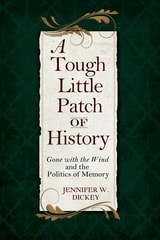
A Tough Little Patch of History
Gone with the Wind and the Politics of MemoryJennifer W. Dickey
University of Arkansas Press, 2014
More than seventy-five years after its publication, Gone with the Wind remains thoroughly embedded in American culture. Margaret Mitchell’s novel and the film produced by David O. Selznick have melded with the broader forces of southern history, southern mythology, and marketing to become, and remain, a cultural phenomenon.
A Tough Little Patch of History (the phrase was coined by a journalist in 1996 to describe the Margaret Mitchell home after it was spared from destruction by fire) explores how Gone with the Wind has remained an important component of public memory in Atlanta through an analysis of museums and historic sites that focus on this famous work of fiction. Jennifer W. Dickey explores how the book and film threw a spotlight on Atlanta, which found itself simultaneously presented as an emblem of both the Old South and the New South. Exhibitions produced by the Atlanta History Center related to Gone with the Wind are explored, along with nearby Clayton County’s claim to fame as “the Home of Gone with the Wind,” a moniker bestowed on the county by Margaret Mitchell’s estate in 1969. There’s a recounting of the saga of “the Dump,” the tiny apartment in midtown Atlanta where Margaret Mitchell wrote the book, and how this place became a symbol for all that was right and all that was wrong with Mitchell’s writing.

A White Side of Black Britain
Interracial Intimacy and Racial LiteracyFrance Winddance Twine
Duke University Press, 2010
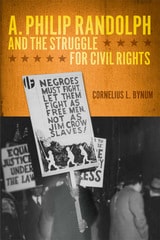
A. Philip Randolph and the Struggle for Civil Rights
Cornelius L. Bynum
University of Illinois Press, 2010
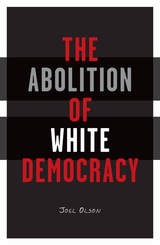
Abolition Of White Democracy
Joel Olson
University of Minnesota Press, 2004
Offers a new way of understanding the tortured relationship between race and democracy in the United States
Racial discrimination embodies inequality, exclusion, and injustice and as such has no place in a democratic society. And yet racial matters pervade nearly every aspect of American life, influencing where we live, what schools we attend, the friends we make, the votes we cast, the opportunities we enjoy, and even the television shows we watch.
Joel Olson contends that, given the history of slavery and segregation in the United States, American citizenship is a form of racial privilege in which whites are equal to each other but superior to everyone else. In Olson’s analysis we see how the tension in this equation produces a passive form of democracy that discourages extensive participation in politics because it treats citizenship as an identity to possess rather than as a source of empowerment. Olson traces this tension and its disenfranchising effects from the colonial era to our own, demonstrating how, after the civil rights movement, whiteness has become less a form of standing and more a norm that cements white advantages in the ordinary operations of modern society. To break this pattern, Olson suggests an “abolitionist-democratic” political theory that makes the fight against racial discrimination a prerequisite for expanding democratic participation.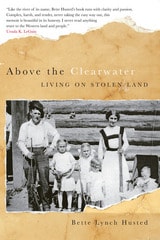
Above the Clearwater
Living on Stolen LandBette Lynch Husted
Oregon State University Press, 2004
Like her father before her, Bette Husted grew up on stolen land. The bench land above the Clearwater River in north-central Idaho had been a home for the Nez Perce Indians until the Dawes Act opened their reservation to settlement in 1895. As a child on the family homestead, Husted felt the presence of the Nez Perce: "But they were always just out of sight, like a smoky shadow behind me that I couldn't quite turn around quickly enough to catch."
Above the Clearwater chronicles her family's history on the land, revealing their joys and sorrows, their triumphs and tragedies. In a series of graceful and moving essays, Husted traces this intimate history, from her Cold War childhood to her struggles as a parent and finally to her life as a woman and teacher in the rural West. Her family's stories echo those of countless other families in the American West: the conflicts with guns, the struggles over land ownership and water rights, the isolation of women, the separations by race and class, the family secrets of mental illness and suicide.
With a powerful, poetic voice, Husted illuminates the tangled relationship between the history of a particular place and the history of the families who inhabit that place over time. As Above the Clearwater explores one family's search for a home on land taken from its original inhabitants, it quietly asks all readers to examine their own homes in the same light.
Accent On Privilege
English Identities & Anglophilia In The U.S.Katharine Jones
Temple University Press, 2001
The political and cultural ties between England and the US act as a backdrop for the identity negotiations of these English people, many of whom do not even consider themselves to be immigrants. This unique exploration of the workings of white privilege offers an important new understanding of the paradoxes of how class, gender, and race are formed in the US and, by implication, in the UK.
Across the Color Line
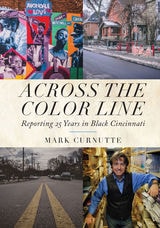
Reporting 25 Years in Black CincinnatiMark Curnutte
Ohio University Press, 2019
Published by the University of Cincinnati Press
Across the Color Line: Reporting 25 Years in Black Cincinnati presents newspaper reporter Mark Curnutte’s stories published in The Cincinnati Enquirer over a twenty-five-year period beginning in 1993. With hard-won insights gained from years of community reporting, Curnutte describes experiences of African-Americans living in Cincinnati through individual and neighborhood profiles, explorations of community institutions, historical perspectives, and issue stories. The anthology tells a sweeping narrative of a city suffering and maturing through turn-of-the-century racial growing pains and increased racial sophistication and diversity. These stories are complimented by excerpts from Curnutte’s personal journal, providing his reflection on his role as a white man and reporter making the intentional decision to work and live across the color line.
Act Like You Know
African-American Autobiography and White IdentityCrispin Sartwell
University of Chicago Press, 1998
There is, Sartwell contends, a fundamental elusiveness to that identity. Whiteness defines itself as normative, as a neutral form of the human condition, marking all other forms of identity as "racial" or "ethnic" deviations. Invisible to itself, white identity seeks to define its essence over and against those other identities, in effect defining itself through opposition and oppression. By maintaining fictions of black licentiousness, violence, and corruption, white identity is able to cast itself as humane, benevolent, and pure; the stereotype fabricates not only the oppressed but the oppressor as well. Sartwell argues that African-American autobiography perceives white identity from a particular and unique vantage point; one that is knowledgeable and intimate, yet fundamentally removed from the white world and thus unencumbered by its obfuscating claims to normativity.
Throughout this provocative work, Sartwell steadfastly recognizes the many ways in which he too is implicated in the formulation and perpetuation of racial attitudes and discourse. In Act Like You Know, he challenges both himself and others to take a long, hard look in the mirror of African-American autobiography, and to find there, in the light of those narratives, the visible features of white identity.
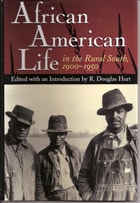
African American Life in the Rural South, 1900-1950
Edited with an introduction by R. Douglas Hurt
University of Missouri Press, 2003
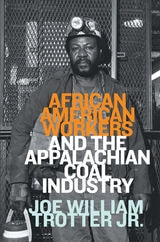
African American Workers and the Appalachian Coal Industry
Joe William Trotter
West Virginia University Press, 2024
This collection brings together nearly three decades of research on the African American experience, class, and race relations in the Appalachian coal industry. It shows how, with deep roots in the antebellum era of chattel slavery, West Virginia’s Black working class gradually picked up steam during the emancipation years following the Civil War and dramatically expanded during the late nineteenth and early twentieth centuries.
From there, African American Workers and the Appalachian Coal Industry highlights the decline of the region’s Black industrial proletariat under the impact of rapid technological, social, and political changes following World War II. It underscores how all miners suffered unemployment and outmigration from the region as global transformations took their toll on the coal industry, but emphasizes the disproportionately painful impact of declining bituminous coal production on African American workers, their families, and their communities. Joe Trotter not only reiterates the contributions of proletarianization to our knowledge of US labor and working-class history but also draws attention to the gender limits of studies of Black life that focus on class formation, while calling for new transnational perspectives on the subject. Equally important, this volume illuminates the intellectual journey of a noted labor historian with deep family roots in the southern Appalachian coalfields.
African Americans and Jews in the Twentieth Century
Studies in Convergence and ConflictEdited by V.P. Franklin, Nancy L. Grant, Harold M. Kletnick, & Genna Rae McNeil
University of Missouri Press, 1998
In 1993 distinguished historian Nancy L. Grant organized "Blacks and Jews: An American Historical Perspective," a conference held at Washington University in St. Louis and dedicated to the exploration of Black-Jewish relations in twentieth-century America. Featuring presentations by historians, sociologists, and political scientists, this conference reflected Grant's devotion to scholarship on multicultural relations and the continuing struggle for racial equality in the United States. After Grant's untimely death in 1995, V. P. Franklin and the other contributors completed the work of readying these essays for publication with the assistance of the coeditors. African Americans and Jews in the Twentieth Century is the culmination of the innovative research and ideas presented at the conference.
In the long struggle to bring social justice to American society, Blacks and Jews have often been close allies. In both the past and the present, however, there has also been serious conflict and competition between the groups in social, economic, and political spheres.
Focusing on the complexity of the relationships between Blacks and Jews in America, these essays examine the convergence and conflict that have characterized Black-Jewish interactions over the past century. African Americans and Jews in the Twentieth Century provides an intellectual foundation for continued dialogue and future cooperative efforts to improve social justice in this society and will be an invaluable resource for the study of race relations in the United States in the twentieth century.
African Americans and the Color Line in Ohio
1915–1930William W. Giffin
The Ohio State University Press, 2005
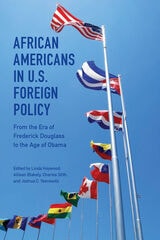
African Americans in U.S. Foreign Policy
From the Era of Frederick Douglass to the Age of ObamaEdited by Linda Heywood, Allison Blakely, Charles Stith, and Joshua C. Yesnowitz
University of Illinois Press, 2015
Groundbreaking and critical, African Americans in U.S. Foreign Policy expands on the scope and themes of recent collections to offer the most up-to-date scholarship to students in a range of disciplines, including U.S. and African American history, Africana studies, political science, and American studies.
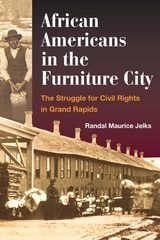
African Americans in the Furniture City
The Struggle for Civil Rights in Grand RapidsRandal Maurice Jelks
University of Illinois Press, 2006
Focusing on the intersection of African Americans' nineteenth-century cultural values and the changing social and political conditions in the first half of the twentieth century, Jelks pays particularly close attention to the religious community's influence during their struggle toward a respectable social identity and fair treatment under the law. He explores how these competing values defined the community's politics as it struggled to expand its freedoms and change its status as a subjugated racial minority.
African Americans in the Reconstruction of Florida, 1865-1877
Joe M. Richardson
University of Alabama Press, 2008
Exploration of African American contributions to the state of Florida during the era of Reconstruction
Despite their shortcomings, “radical” politicians, including African Americans, made worthy contributions to the state of Florida during the era of Reconstruction. Joe Richardson disputes many of the misconceptions about the state’s debt and corruption by exploring how some African American politicians were quite capable and learned their duties quickly. Even more remarkable was the rapidity with which the unlettered ex-slaves absorbed education and adjusted to their status as free men. African Americans in the Reconstruction of Florida delves into the problems encountered by the freed men and traces their successes and failures during the first decade after emancipation.
African-American Mayors
Race, Politics, and the American CityEdited by David R. Colburn and Jeffrey S. Adler
University of Illinois Press, 2001
Once in office, African-American mayors faced vexing challenges. In large and small cities from the Sunbelt to the Rustbelt, black mayors assumed office during economic downturns and confronted the intractable problems of decaying inner cities, white flight, a dwindling tax base, violent crime, and diminishing federal support for social programs. Many encountered hostility from their own parties, city councils, and police departments; others worked against long-established power structures dominated by local business owners or politicians. Still others, while trying to respond to multiple demands from a diverse constituency, were viewed as traitors by blacks expecting special attention from a leader of their own race. All struggled with the contradictory mandate of meeting the increasing needs of poor inner-city residents while keeping white businesses from fleeing to the suburbs.
This is the first comprehensive treatment of the complex phenomenon of African-American mayors in the nation's major urban centers. Offering a diverse portrait of leadership, conflict, and almost insurmountable obstacles, this volume assesses the political alliances that brought black mayors to office as well as their accomplishments--notably, increased minority hiring and funding for minority businesses--and the challenges that marked their careers. Mayors profiled include Carl B. Stokes (Cleveland), Richard G. Hatcher (Gary), "Dutch" Morial (New Orleans), Harold Washington (Chicago), Tom Bradley (Los Angeles), Marion Barry (Washington, D.C.), David Dinkins (New York City), Coleman Young (Detroit), and a succession of black mayors in Atlanta (Maynard Jackson, Andrew Young, and Bill Campbell).Probing the elusive economic dimension of black power, African-American Mayors demonstrates how the same circumstances that set the stage for the victories of black mayors exaggerated the obstacles they faced.