Results by title
9 books match the query 'Recruiting'
All Ages Welcome
Recruiting and Retaining Younger Generations for Library Boards, Friends Groups, and FoundationsLina Bertinelli
American Library Association, 2020
According to 2016 Pew Research Center survey data, Millennials are more likely to have visited a public library in the past year than any other adult demographic. But despite being core library users, millennials and other younger generations are often underrepresented on library boards and library advocacy groups, including Friends groups and Foundations. But you can change that, with the help of this planner’s hands-on worksheets, brainstorming activities, checklists, and expert advice. Using this toolkit from United for Libraries you will
- understand generational differences and commonalities through statistics and analysis of Baby Boomers, Generation X, Millennials and Generation Z/post-Millennials;
- learn how to navigate the challenges of fundraising with the “debt generations” by persuasively answering the question “what’s in it for me?”;
- master the ABCs of recruitment and retention, tailoring them to fit your library;
- craft several customized pitches, giving you confidence no matter the situation or audience;
- discover how to cement buy-in from two key groups, current organization members and your new recruits, thereby ensuring acceptance and enthusiasm all around;
- work towards defining and managing diversity for your advocacy group; and
- use tried and true methods for successful onboarding of volunteers, including a Board Member Orientation Checklist and guidance on mentoring.
Using this resource, libraries of all kinds will be empowered to grow and strengthen their recruitment, retention, and training of Trustees, Friends, and Foundation members.

Antidiscrimination Law and Minority Employment
Recruitment Practices and Regulatory ConstraintsFarrell Bloch
University of Chicago Press, 1994
Defending Diversity
Affirmative Action at the University of MichiganPatricia Gurin, Jeffrey S. Lehman, and Earl Lewis, with Eric L. Dey, Gerald Gurin, and Sylvia Hurtado
University of Michigan Press, 2004
Gender Quotas and Democratic Participation
Recruiting Candidates for Elective Offices in GermanyLouise K. Davidson-Schmich
University of Michigan Press, 2016
Getting a Job
A Study of Contacts and CareersMark Granovetter
University of Chicago Press, 1995
This second edition is updated with a new Afterword and includes Granovetter's influential article "Economic Action and Social Structure: The Problems of Embeddedness."
"Who would imagine that a book with such a prosaic title as 'getting a job' could pose such provocative questions about social structure and even social policy? In a remarkably ingenious and deceptively simple analysis of data gathered from a carefully designed sample of professional, technical, and managerial employees . . . Granovetter manages to raise a number of critical issues for the economic theory of labor markets as well as for theories of social structure by exploiting the emerging 'social network' perspective."—Edward O. Laumann, American Journal of Sociology
"This short volume has much to offer readers of many disciplines. . . . Granovetter demonstrates ingenuity in his design and collection of data."—Jacob Siegel, Monthly Labor Review
"A fascinating exploration, for Granovetter's principal interest lies in utilizing sociological theory and method to ascertain the nature of the linkages through which labor market information is transmitted by 'friends and relatives.'"—Herbert Parnes, Industrial and Labor Relations Review
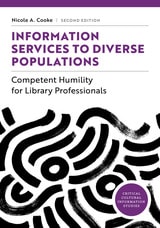
Information Services to Diverse Populations
Competent Humility for Library ProfessionalsNicole A. Cooke
American Library Association, 2026
Foreword by Cynthia Sturgis Landrum
The development of cultural competency skills and social awareness benefits LIS students, their future employers, and the library profession at large―not to mention library customers and society as a whole. Cooke's freshly updated text introduces readers to the contexts and situations that promote the development of empathy and build cultural competence. It marshals cutting edge research and relevant best practices to give readers a strong grasp of the political, social, economic, and technological divides among library patrons. It also covers outreach and library services to diverse populations, how to evaluate such services, and many other key topics. Complete with an updated syllabus, lesson plans, and exercises ready-made for course use, Cooke’s text
- demonstrates why social responsibility is a foundational value of librarianship;
- considers library services to members of marginalized racial or ethnic groups, older adults, people with mental health or physical disabilities, neurodiverse library users, refugees and immigrants, people experiencing homelessness or hunger, those growing up in or experiencing poverty, members of the LGBTQIA+ communities, and people who are incarcerated;
- features a myriad of testimonials drawn from a wide variety of settings that highlight the experiences of library and museum practitioners who are working with diverse populations;
- introduces a new model of cultural competence and cultural humility;
- authoritatively covers such essential concepts as intersectionality, privilege, marginalization, cultural competence, cultural humility, and counter-storytelling along with discussions of how they interplay in the communities that libraries serve;
- explores the impact of overwhelming whiteness of the library profession and what can be done to recruit, welcome, mentor, and retain racially and ethnically diverse library workers; and
- identifies potential employment and networking opportunities related to diversity and social justice in librarianship.
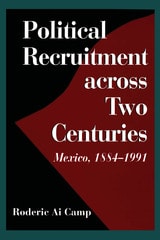
Political Recruitment across Two Centuries
Mexico, 1884-1991By Roderic Ai Camp
University of Texas Press, 1995
During more than twenty years of field research, Roderic Ai Camp built a monumental database of biographical information on more than 3,000 leading national figures in Mexico. In this major contribution to Mexican political history, he draws on that database to present a definitive account of the paths to power Mexican political leaders pursued during the period 1884 to 1992.
Camp’s research clarifies the patterns of political recruitment in Mexico, showing the consequences of choosing one group over another. It calls into question numerous traditional assumptions, including that upward political mobility was a cause of the Mexican Revolution of 1910.
Comparing Mexican practices with those in several East Asian countries also allows Camp to question many of the tenets of political recruitment theory. His book will be of interest to students not only of Mexican politics but also of history, comparative politics, political leadership, and Third World development.
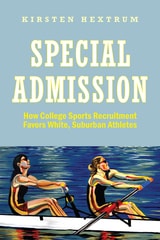
Special Admission
How College Sports Recruitment Favors White Suburban AthletesKirsten Hextrum
Rutgers University Press, 2021
Special Admission contradicts the national belief that college sports provide upward mobility opportunities. Kirsten Hextrum documents how white middle-class youth become overrepresented on college teams. Her institutional ethnography of one elite athletic and academic institution includes over 100 hours of interviews with college rowers and track & field athletes. She charts the historic and contemporary relationships between colleges, athletics, and white middle-class communities that ensure white suburban youth are advantaged in special athletic admissions. Suburban youth start ahead in college admissions because athletic merit—the competencies desired by university recruiters—requires access to vast familial, communal, and economic resources, all of which are concentrated in their neighborhoods. Their advantages increase as youth, parents, and coaches strategically invest in and engineer novel opportunities to maintain their race and class status. Thus, college sports allow white, middle-class athletes to accelerate their racial and economic advantages through admission to elite universities.

The Purposeful Graduate
Why Colleges Must Talk to Students about VocationTim Clydesdale
University of Chicago Press, 2015
The key, he argues, is simple: direct, systematic, and creative programs that engage undergraduates on the question of purpose. Backing up his argument with rich data from a Lilly Endowment grant that funded such programs on eighty-eight different campuses, he shows that thoughtful engagement of the notion of vocational calling by students, faculty, and staff can bring rich rewards for all those involved: greater intellectual development, more robust community involvement, and a more proactive approach to lifelong goals. Nearly every institution he examines—from internationally acclaimed research universities to small liberal arts colleges—is a success story, each designing and implementing its own program, that provides students with deep resources that help them to launch flourishing lives.
Flying in the face of the pessimistic forecast of higher education’s emaciated future, Clydesdale offers a profoundly rich alternative, one that can be achieved if we simply muster the courage to talk with students about who they are and what they are meant to do.