Results by title

19 books match the query 'Semantics (Philosophy)'
cover of A Paradigm for Program Semantics

A Paradigm for Program Semantics

Chris Brink and Ingrid Rewitsky

CSLI, 2001
This book provides a synthesis of four versions of program semantic—srelational semantics, predicate transformer semantics, information systems, and domain theory—showing, through an exhaustive case study analysis, that it is possible to do back-and-forth translation from any of these versions of program semantics into any of the others, and demonstrating that while there are many variations of each, in principle they may be thought of as intertranslatable.
[more]
cover of Algebraic Semantics in Language and Philosophy

Algebraic Semantics in Language and Philosophy

Godehard Link

CSLI, 1997
The philosophical approach of this volume is mainly structuralist, using logical tools to investigate the formal structure of various kinds of objects in our world, as characterised by language and as systematised by philosophy. This volume mainly analyses the structural properties of collections or pluralities (with applications to the philosophy of set theory), homogeneous objects like water, and the semantics and philosophy of events. This book thereby complements algebraic work that has been done on other philosophical entities, i.e. propositions, properties, relations, or situations. Located in the triangle of language, logic and philosophy, this volume is unique in combining the resources of different ¹elds in an interdisciplinary enterprise. Half of the fourteen chapters of this volume are original papers, complementing the collection of the author's previously published essays on the subject.
[more]
cover of Dynamic Conceptual Semantics: A Logico-Philosophical Investigation into Concept Formation and Understanding

Dynamic Conceptual Semantics

A Logico-Philosophical Investigation into Concept Formation and Understanding

Renate Bartsch

CSLI, 1998

Presented in this book is a theory of concept formation and understanding that does not make use of a notion of an innate mental language as a means of concept representation. Instead, experimental concepts are treated semantically as stabilising structuring of growing sets of data, which are sets of experienced satisfaction situations for expressions, and theoretical concepts are based on coherent sets of general sentences held true. There are two kinds of structures to be established: general concepts by means of similarity sets under perspectives and historical concepts. This gives rise to a theory of understanding new situations and expressions by integrating new data into established sets of data salva stability, or by extending the conceptual structure in a metaphorical or metonymical way. The theory provides a way to understand what identity between propositional attitudes amounts to, especially how people can have more or less the same belief.
[more]
cover of Introduction to Natural Language Semantics

Introduction to Natural Language Semantics

Henriëtte de Swart

CSLI, 1998

Semantics is defined as the study of meaning expressed by elements of a language or combinations thereof. Utterances are not just noises or scribbles, they are used to convey information, and they are linked with kinds of events and with states of mind.

This text examines what issues semantics, as a theory of meaning, should address; determining what the meanings of words of the language are and how to semantically combine elements of a language to build up complex meanings. Logical languages are then developed as formal metalanguages to natural language. Subsequent chapters address propositional logic, the syntax and semantics of (first-order) predicate logic as an extension of propositional logic, and Generalized Quantifier theory. Going beyond extensional theory, Henri'tte de Swart relativizes the interpretation of expressions to times to account for verbal tense, time adverbials and temporal connectives and introduces possible worlds to model intensions, modal adverbs and modal auxiliaries.

This broad overview of natural language semantics should cover most of the points addressed in an introductory course. Numerous exercises punctuate each chapter and an example exam based on the materials presented is included, making this volume a perfect textbook and resource for any undergraduate or graduate-level introductory course in semantics.
[more]
cover of Linguistic Individuals

Linguistic Individuals

Almerindo E. Ojeda

CSLI, 1993
The goal of semantics is the insightful identification of the set of meanings that human language can express- the contruction of what has been called the metaphysics of natural language. A formal attempt to contruct such a metaphysics has generally involved identifying a set of individuals referred to as the universe of discourse. Until recently, however, semanticists have had little to say about the structure of this set. Ojeda argues that the structure of the set of linguistic individuals is a mereology, that is, the domain of discourse is made up of kinds and the instantiations of kinds. His argument forms the four main slections of this work. The first examines the semantics of countability (countable stems, number inflection, adjectives of measure, and determiners); the second explores the semantics of uncountability (the individuation of reference, and non-Boolean mass predicates); the third takes up the semantics of nominality (the mereological homogenetiy of mouns and the constraints on nouns in classifier languages); and the last investigates the semantics of the conceptional neauter, a pronominal category discussed by Otto Jesperson. Ojeda's investigations contribute to the characterization of linguistiv individuals and proide for a new basis for the semantics of individuation. Almerindo E. Ojeda is a professor of linguistics at the University of California at Davis. Center for the Study of Language and Information- Lecture Notes, Number 7
[more]
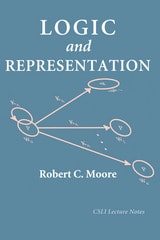
cover of Logic and Representation

Logic and Representation

Robert C. Moore

CSLI, 1993
Logic and Representation brings together a collection of essays, written over a period of ten years, that apply formal logic and the notion of explicit representation of knowledge to a variety of problems in artificial intelligence, natural language semantics, and the philosophy of mind and language. Particular attention is paid to modeling and reasoning about knowledge and belief, including reasoning about one's own beliefs, and the semantics of sentences about knowledge and belief. Robert C. Moore begins by exploring the role of logic in artificial intelligence, considering logic as an analytical tool., as a basis for reasoning systems, and as a programming language. He then looks at various logical analyses of propositional attitudes, including possible-world models, syntactic models, and models based on Russellian propositions. Next Moore examines autoepistemic logic, a logic for modeling reasoning about one's own beliefs. Rounding out the volume is a section on the semantics of natural language, including a survey of problems in semantic representation; a detailed study of the relations among events, situations, and adverbs; and a presentation of a unification-based approach to semantic interpretation. Robert C. Moore is principal scientist of the Artificial Intelligence Center of SRI International.
[more]
cover of Logic, Information and Agency

Logic, Information and Agency

Johan van Benthem

CSLI, 2025

A systematic study of information dynamics that extends beyond what is found in standard logic textbooks.

Everything we do is driven by information, but the dynamic process of acquiring information and adjusting our views based on it has seldom been put at the center place in logic, and there are few textbooks introducing readers to this line of work. The present book introduces the reader to major logical techniques for studying information dynamics and interaction between agents, based on a variety of intuitive scenarios as well as recent research. Readers will learn styles of modeling, as well as the basic features of the new logical systems emanating from this line of work. All the separate strands in the book are brought together in a comprehensive study of information flow and action in games, forming a logic-based complement to standard perspectives in game theory.
 
[more]
cover of Logic, Language, and Meaning, Volume 1: Introduction to Logic

Logic, Language, and Meaning, Volume 1

Introduction to Logic

L. T. F. Gamut

University of Chicago Press, 1990

Although the two volumes of Logic, Language, and Meaning can be used independently of one another, together they provide a comprehensive overview of modern logic as it is used as a tool in the analysis of natural language. Both volumes provide exercises and their solutions.

Volume 1, Introduction to Logic, begins with a historical overview and then offers a thorough introduction to standard propositional and first-order predicate logic. It provides both a syntactic and a semantic approach to inference and validity, and discusses their relationship. Although language and meaning receive special attention, this introduction is also accessible to those with a more general interest in logic.

In addition, the volume contains a survey of such topics as definite descriptions, restricted quantification, second-order logic, and many-valued logic. The pragmatic approach to non-truthconditional and conventional implicatures are also discussed. Finally, the relation between logic and formal syntax is treated, and the notions of rewrite rule, automation, grammatical complexity, and language hierarchy are explained.
[more]
cover of Logic, Language, and Meaning, Volume 2: Intensional Logic and Logical Grammar

Logic, Language, and Meaning, Volume 2

Intensional Logic and Logical Grammar

L. T. F. Gamut

University of Chicago Press, 1990
Although the two volumes of Logic, Language, and Meaning can be used independently of one another, together they provide a comprehensive overview of modern logic as it is used as a tool in the analysis of natural language. Both volumes provide exercises and their solutions.
[more]
cover of Meaning, Intentions, and Argumentation

Meaning, Intentions, and Argumentation

Kepa Korta and Garmendia

CSLI, 2008
What is the relationship between words and reality? Which are the best ways to convince or persuade other people? Besides philosophy and grammar, ancient Greeks developed rhetoric to answer these questions. The twentieth-century brought the birth of semantics and pragmatics for a systematic study of linguistic meaning and linguistic acts. Meaning, Intentions, and Argumentation brings together the work of leading contemporary scholars approaching those issues from various perspectives—from the old disciplines of philosophy and rhetoric to the newest thinking on semantics and pragmatics—to illuminate crucial aspects of meaning, communication, argumentation, and persuasion.
 
 
[more]
cover of Philosophical Remarks

Philosophical Remarks

Ludwig Wittgenstein

University of Chicago Press, 1980

When in May 1930, the Council of Trinity College, Cambridge, had to decide whether to renew Wittgenstein's research grant, it turned to Bertrand Russell for an assessment of the work Wittgenstein had been doing over the past year. His verdict: "The theories contained in this new work . . . are novel, very original and indubitably important. Whether they are true, I do not know. As a logician who likes simplicity, I should like to think that they are not, but from what I have read of them I am quite sure that he ought to have an opportunity to work them out, since, when completed, they may easily prove to constitute a whole new philosophy."

"[Philosophical Remarks] contains the seeds of Wittgenstein's later philosophy of mind and of mathematics. Principally, he here discusses the role of indispensable in language, criticizing Russell's The Analysis of Mind. He modifies the Tractatus's picture theory of meaning by stressing that the connection between the proposition and reality is not found in the picture itself. He analyzes generality in and out of mathematics, and the notions of proof and experiment. He formulates a pain/private-language argument and discusses both behaviorism and the verifiability principle. The work is difficult but important, and it belongs in every philosophy collection."—Robert Hoffman, Philosophy

"Any serious student of Wittgenstein's work will want to study his Philosophical Remarks as a transitional book between his two great masterpieces. The Remarks is thus indispensible for anyone who seeks a complete understanding of Wittgenstein's philosophy."—Leonard Linsky, American Philosophical Association
[more]
cover of Philosophy of Language

Philosophy of Language

Vilém Flusser

University of Minnesota Press, 2016

In 1963 Vilém Flusser presented a series of lectures at the Brazilian Institute of Philosophy (IBF) in São Paulo concerning the philosophy of language. The resulting ten essays would eventually be published in 1965 in the annual magazine of the Brazilian Institute of Technology and Aeronautics (ITA), and published here for the first time in book form. 

Flusser prepared each lecture as a response to the dialogs that followed the preceding lecture, thereby expanding and explicating his philosophy of language in an intense dialogical process. Despite the fact that the other side of the dialogue was not recorded, it becomes clear to the reader that the resulting discussions and polemics generated by the lectures progressively and profoundly changed Flusser’s intended trajectory for the course. This kind of philosophy in fieri was in part the result of a group effort between all of those present, and subsequently synthesized by Flusser in every essay. As a result of this experience, Flusser adopted this dialogic method as an integral part of his future work. 
[more]
cover of Propositional Attitudes: The Role of Content in Logic, Language, and Mind

Propositional Attitudes

The Role of Content in Logic, Language, and Mind

Edited by C. Anthony Anderson and Joseph Owens

CSLI, 1990
These papers treat those issues involved in formulating a logic of propositional attitudes and consider the relevance of the attitudes to the continuing study of both the philosophy of language and the philosophy of mind. C. Anthony Anderson is professor of philosophy and Joseph Owens is assistant professor of philosophy, both at the University of Minnesota.
[more]
cover of Reference and Reflexivity: 2nd Edition

Reference and Reflexivity

2nd Edition

John Perry

CSLI, 2012

In this volume John Perry develops his “reflexive-referential” account of indexicals, demonstratives, and proper names. For this new second edition, Perry has added a new preface and two chapters on the distinction between semantics and pragmatics and on attitude reports. He reveals a coherent and structured family of contents—from reflexive contents that place conditions on their actual utterance to fully incremental contents that place conditions only on the objects of reference—reconciling the legitimate insights of both the referentialist and descriptivist traditions.
[more]
cover of Referencialismo critico: le teoria reflexivo-referencial del significado

Referencialismo critico

le teoria reflexivo-referencial del significado

John Perry

CSLI, 2006

[more]
cover of Situations and Attitudes

Situations and Attitudes

Jon Barwise and John Perry

CSLI, 1983
In this provocative book, Barwise and Perry tackle the slippery subject of "meaning," a subject that has long vexed linguists, language philosophers, and logicians. Meaning does not exist solely within words and sentences but resides largely in the situation and the attitudes brought to it by those involved. The authors present an unusually lucid treatment of important innovations in the field of natural semantics, contending that the standard view of logic (as derived from Frege, Russell, and work in mathematics and logic) is inappropriate for many of the uses to which it has been put by scholars. In Situations and Attitudes they provide the basics of a realistic model-theoretic semantics of natural language, explain the main ideas of the theory, and contrast them with those of competing theories.
[more]
cover of The Linguistic Turn: Essays in Philosophical Method

The Linguistic Turn

Essays in Philosophical Method

Edited by Richard M. Rorty

University of Chicago Press, 1992

The Linguistic Turn provides a rich and representative introduction to the entire historical and doctrinal range of the linguistic philosophy movement. In two retrospective essays titled "Ten Years After" and "Twenty-Five Years After," Rorty shows how his book was shaped by the time in which it was written and traces the directions philosophical study has taken since.

"All too rarely an anthology is put together that reflects imagination, command, and comprehensiveness. Rorty's collection is just such a book."—Review of Metaphysics
[more]
cover of The Semantic Conception of Theories and Scientific Realism

The Semantic Conception of Theories and Scientific Realism

Frederick Suppe

University of Illinois Press, 1989

"An authoritative account of
  the semantic conception of theories by one of its chief developers. Suppe has
  always seen the semantic conception as providing a way of moving beyond empiricist
  philosophies of science. This book provides the definitive account of his views
  not only on the issue of realism, but also on a variety of other issues central
  to the philosophy of science."
  -- Ronald N. Giere, author of Explaining Science: A Cognitive Approach
 
[more]
cover of Words and Contents

Words and Contents

Richard Vallée

CSLI, 2018

The papers collected in Richard Vallée’s Words and Contents span twenty-one years of research. Beginning with referring expressions and later addressing context sensitivity, the book examines how specific words contribute to the contents of utterances and the philosophical issues that surround them. Within these papers, Vallée navigates the discovery and exploration of different modes of expression and perspectives on language.
 
[more]