Results by title
10 books match the query 'Slavic Languages (Other)'

A Modern Ukranian Grammar
George S. N. Luckyj and Jaroslav B. Rudnyckyj
University of Minnesota Press, 1949
A Modern Ukranian Grammar was first published in 1949. Minnesota Archive Editions uses digital technology to make long-unavailable books once again accessible, and are published unaltered from the original University of Minnesota Press editions.
Bosnian, Croatian, Serbian, a Grammar
With Sociolinguistic CommentaryRonelle Alexander
University of Wisconsin Press, 2006
Bosnian, Croatian, Serbian, a Grammar analyzes and clarifies the complex, dynamic language situation in the former Yugoslavia. Addressing squarely the issues connected with the splintering of Serbo-Croatian into component languages, this volume provides teachers and learners with practical solutions and highlights the differences among the languages as well as the communicative core that they all share. The first book to cover all three components of the post-Yugoslav linguistic environment, this reference manual features:
· Thorough presentation of the grammar common to Bosnian, Croatian, and Serbian, with explication of all the major differences
· Examples from a broad range of spoken language and literature
· New approaches to accent and clitic ordering, two of the most difficult points in BCS grammar
· Order of grammar presentation in chapters 1–16 keyed to corresponding lessons in Bosnian, Croatian, Serbian, a Textbook
· "Sociolinguistic commentary" explicating the cultural and political context within which Bosnian, Croatian, and Serbian function and have been defined
· Separate indexes of the grammar and sociolinguistic commentary, and of all words discussed in both

Bosnian, Croatian, Serbian, a Textbook
With Exercises and Basic GrammarRonelle Alexander and Ellen Elias-Bursac
University of Wisconsin Press, 2006
•Classroom exercises designed for both small-group and full-class work, allowing for maximum oral participation
•Reading selections written by Bosnian, Croatian, and Serbian authors especially for this book
•Vocabulary lists for each individual section and full glossaries at the end of the book
•A short animated film, on an accompanying DVD, for use with chapter 15
•Brief grammar explanations after each dialogue, with cross-reference to more detailed grammar chapters in Bosnian, Croatian, Serbian, a Grammar
Available separately, the audio supplement (ISBN 0-299-22110-5) offers audio recordings of all dialogues in Bosnian, Croatian, and Serbian, a Textbook.
Bosnian, Croatian, Serbian, a Textbook
With Exercises and Basic GrammarRonelle Alexander
University of Wisconsin Press, 2010
• All dialogues, exercises, and homework assignments available in Bosnian, Croatian, and Serbian
• Classroom exercises designed for both small-group and full-class work, allowing for maximum oral participation
• Reading selections written by Bosnian, Croatian, and Serbian authors especially for this book
• Vocabulary lists for each individual section and full glossaries at the end of the book
• A short animated film, on an accompanying DVD, for use with chapter 15
• Brief grammar explanations after each dialogue, with a cross-reference to more detailed grammar chapters in the companion book, Bosnian, Croatian, Serbian, a Grammar.
Dayton
The Rise, Decline, and Transition of an Industrial CityAdam A. Millsap
The Ohio State University Press, 2019
Thoroughly researched and engagingly written, Millsap’s book explores the economic background of the region made famous by J. D. Vance’s Hillbilly Elegy. From early twentieth-century optimism, through the Great Depression and post-WWII manufacturing decline, to Dayton now, with its labor-force problems and opioid crisis, Millsap tracks the underlying forces driving the city’s trajectory. Race relations, interstates, suburbanization, climate, crime, geography, and government policies all come into play as Millsap develops a picture of the city, past and present. By examining the past, Millsap proposes a plan for the future, claiming that there is hope for Dayton to thrive again. And if Dayton can rise from its industrial ashes, then perhaps the Rust Belt can shed its stigma and once again become the backbone of American innovation.
Intensive Bulgarian 1
A Textbook and Reference GrammarRonelle Alexander, with the assistance of Olga M. Mladenova
University of Wisconsin Press, 2000
This is the first comprehensive textbook teaching English-speakers to read, write, and speak contemporary Bulgarian. The text is designed to be adaptable for students of varying skill levels and can be taught at a gradual or intensive pace. It is also a much-needed reference grammar of Bulgarian, incorporating the latest research and theories on Bulgarian grammar in accessible layman’s language.
Volume 1 introduces the basic elements of Bulgarian grammar and contains Lessons 1–15, a Bulgarian-English glossary, an English-Bulgarian glossary for beginners, and an appendix of verbal forms. Like many popular language textbooks, the dialogues in Intensive Bulgarian form a continuing dramatic narrative that gradually introduces students to both language and culture. Throughout the text, Bulgarian constructions and phrases are compared with English ones to clarify grammar and idioms.
Lessons include:
o dialogues and sample sentences
o exercises and translation sentences
o basic and supplemental grammar sections
o reading selections
o a glossary for the lesson
o cultural notes.
Together, Volumes 1 and 2 of Intensive Bulgarian provide all the materials necessary for teachers and students to learn lively, modern colloquial Bulgarian, to become familiar with Bulgarian cultural life, and to thoroughly understand Bulgarian grammar. Slavic scholars will also find in Volume 2 both a thorough presentation of the Bulgarian verb system, as traditionally conceived, and a new analysis of this system.
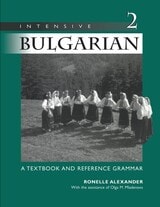
Intensive Bulgarian 2
A Textbook and Reference GrammarRonelle Alexander, with the assistance of Olga M. Mladenova
University of Wisconsin Press, 2000
This is the first comprehensive textbook teaching English-speakers to read, write, and speak contemporary Bulgarian. The text is designed to be adaptable for students of varying skill levels and can be taught at a gradual or intensive pace. It is also a much-needed reference grammar of Bulgarian, incorporating the latest research and theories on Bulgarian grammar in accessible layman’s language.
Volume 2 contains Lessons 16-30 and introduces more complex points of grammar and syntax than Volume 1. It also includes a cumulative Bulgarian-English glossary covering both volumes. Like many popular language textbooks, the dialogues in Intensive Bulgarian form a continuing dramatic narrative that gradually introduces students to both language and culture. Throughout the text, Bulgarian constructions and phrases are compared with English ones to clarify grammar and idioms.
Lessons include:
o dialogues and sample sentences
o exercises and translation sentences
o basic and supplemental grammar sections
o reading selections
o a glossary for the lesson
o cultural notes.
Together, Volumes 1 and 2 of Intensive Bulgarian provide all the materials necessary for teachers and students to learn lively, modern colloquial Bulgarian, to become familiar with Bulgarian cultural life, and to thoroughly understand Bulgarian grammar. Slavic scholars will also find in Volume 2 both a thorough presentation of the Bulgarian verb system, as traditionally conceived, and a new analysis of this system.
Slavic in Head-Driven Phrase Structure Grammar
Edited by Robert D. Borsley and Adam Przepiórkowski
CSLI, 1999
Student Workbook for Discover Romanian
An Introduction to the Language and CultureRodica Bo?oman
The Ohio State University Press, 1995
Student Workbook for Discover Romanian: An Introduction to the Language and Culture by Rodica Bot?oman
Translation as Resistance
Czech and Ukrainian Historical PerspectivesEdited by Zuzana Štastná, Iryna Odrekhivska, and Stanislav Rubáš
Karolinum Press, 2026
In cultures and communities under pressure, whether from a powerful neighbor or a hegemonic ideology, translation becomes a political act. Shaped by the constraints of the moment, both translations and their paratexts are subject to forces that compromise quality or restrict freedom of expression, even as translators seek to bring home the quality and expressive freedom of their originals. In Translation as Resistance, the role translation has played and continues to play in reframing language and power in Czech and Ukrainian cultures is presented and interrogated by Czech and Ukrainian translators.