Results by title
43 books match the query 'Social Security'

Abraham Epstein
The Forgotten Father of Social SecurityPierre Epstein
University of Missouri Press, 2006
Administrative Aspects of Investment-Based Social Security Reform
Edited by John B. Shoven
University of Chicago Press, 2000

Assuring Child Support
An Extension of Social SecurityIrwin Garfinkel
Russell Sage Foundation, 1992

Forever Broke
How Baby Boomers are Bankrupting the Millennial GenerationAndrew Stiles
Templeton Press, 2018
Some of his key findings include:
- U.S. debt is approaching 100 percent of GDP, the highest level since World War II.
- By 2050, debt is on track to reach an unprecedented 145 percent of GDP. Under one pessimistic (but probably more realistic) scenario, CBO estimates that debt could rise to 244 percent of GDP, which means lights out.
- By 2050, federal spending is projected to exceed 29 percent of GDP, levels not seen since the height of World War II. We’re on track to spending more money on baby boomers in retirement than we did to defeat the Nazis.
- Since 1984, the median net worth for households headed by someone under the age of 35 has declined 68 percent. For retirement age households, net worth has increased 42 percent over that same period. The result is the largest generational wealth gap in history. Boomers did better than their kids in early adulthood, and will do better than their kids in retirement.
- As millennials remain childless and single for longer, they face one of the highest tax rates (16.9 percent) for their demographic in the developed world.
Insuring Inequality
Administrative Leadership in Social Security, 1935-54Jerry R. Cates
University of Michigan Press, 1983

Invoking the Invisible Hand
Social Security and the Privatization DebatesRobert Asen
Michigan State University Press, 2009
In Invoking the Invisible Hand Robert Asen scrutinizes contemporary debates over proposals to privatize Social Security. Asen argues that a rights-based rhetoric employed by Social Security's original supporters enabled advocates of privatization to align their proposals with the widely held belief that Social Security functions simply as a return on a worker's contributions and that it is not, in fact, a social insurance program.
By analyzing major debates over a preeminent American institution, Asen reveals the ways in which language is deployed to identify problems for public policy, craft policy solutions, and promote policies to the populace. He shows how debate participants seek to create favorable contexts for their preferred policies and how they connect these policies to idealized images of the nation.
Is It Time to Reform Social Security?
Edward M. Gramlich
University of Michigan Press, 2000

Is Social Security Broke?
A Cartoon Guide to the IssuesBarbara R. Bergmann and Jim Bush
University of Michigan Press, 2000

Making Security Social
Disability, Insurance, and the Birth of the Social Entitlement State in GermanyGreg Eghigian
University of Michigan Press, 2000
Making Sense of Social Security Reform
Daniel Shaviro
University of Chicago Press, 2000
But what is the average person to make of all this? How many Americans know where the money for Social Security benefits really comes from, or who wins and loses from the system's overall operations? Few people understand the current Social Security system in even its broadest outlines. And yet Social Security reform is ranked among the most important social issues of our time.
With Making Sense of Social Security Reform, Daniel Shaviro makes an important contribution to the public understanding of the issues involved in reforming Social Security. His book clearly and straightforwardly describes the current system and the pressures that have been brought to bear upon it, before dissecting and evaluating the various reform proposals. Accessible to anyone who has an interest in the issue, Shaviro's new work is unique in offering a balanced, nonpartisan account.
Old Assumptions, New Realities
Ensuring Economic Security for Working Families in the 21st CenturyRobert D. Plotnick
Russell Sage Foundation, 2011

Penchant for Prejudice
Unraveling Bias in Judicial Decision-MakingLinda G. Mills
University of Michigan Press, 1999

Pension Puzzles
Social Security and the Great DebateMelissa Hardy
Russell Sage Foundation, 2007

Privatizing Social Security
Edited by Martin Feldstein
University of Chicago Press, 1998

Probable Justice
Risk, Insurance, and the Welfare StateRachel Z. Friedman
University of Chicago Press, 2020
Probable Justice traces a history of social insurance from the eighteenth century to today, from the earliest ideas of social accountability through the advanced welfare state of collective responsibility and risk. At the heart of Rachel Z. Friedman’s investigation is a study of how probability theory allows social insurance systems to flexibly measure risk and distribute coverage. The political genius of social insurance, Friedman shows, is that it allows for various accommodations of needs, risks, financing, and political aims—and thereby promotes security and fairness for citizens of liberal democracies.
Risk Aspects of Investment-Based Social Security Reform
Edited by John Y. Campbell and Martin Feldstein
University of Chicago Press, 2001

Safety Net
Welfare and Social Security, 1929-1979Coll, Blanche D
Rutgers University Press, 1995
Beginning with the stock market crash of 1929, Blanche Coll documents the evolution of the federal and state government policymaking for welfare and Social Security, our "safety net." As Coll points out, the policies that determine who is "entitled" to aid, how standard dollar amounts are set, child support responsibilities, the equitable fiscal division between state, federal, and local governments, and the resulting impact on the poorÐÐparticularly women and children of all racesÐÐhave fluctuated throughout the history of welfare.
Coll shows how demographic patterns, the definition of a family, the relative health of the economy, and Presidents' political agendas all deeply affect the system of entitlements to Social Security and welfare, the kernal of the American welfare state.
Safety Net is the only comprehensive history of modern welfare in the United States. Clearly written and unpolemical, it is based on a wealth of primary sources, interviews with key policymakers, and the authoritative analysis of a trained historian who served as a research administrator in the federal government through Democractic and Republican administrations. Saftey Net will be indispensable reading for everyone concerned with contemporary debates about welfare and Social Security.

Social Protection vs. Economic Flexibility
Is There a Tradeoff?Edited by Rebecca M. Blank
University of Chicago Press, 1994
Does tying health insurance to employment limit job mobility? Do housing policies inhibit workers from moving to new jobs in different areas? What are the effects of daycare and maternity leave policies on working mothers? The authors explore these and many other questions in an effort to understand why European unemployment rates are so high compared with the U.S. rate. Through an examination of diverse data sets across different countries, the authors find that social protection programs do not strongly affect labor market flexibility.
A valuable comparison of labor markets and welfare programs, this book demonstrates how social protection policies have affected employment rates around the globe.
Social Security Pension Reform in Europe
Edited by Martin Feldstein and Horst Siebert
University of Chicago Press, 2002
The essays here highlight the problems that the European pension reform process faces and how it differs from that of the United States. This timely volume will significantly enrich the debate on pension reform worldwide.
Social Security Policy in a Changing Environment
Edited by Jeffrey R. Brown, Jeffrey B. Liebman, and David A. Wise
University of Chicago Press, 2009

Social Security Programs and Retirement Around the World
Pension Reforms and the Health Distribution of RetireesEdited by Axel Börsch-Supan and Courtney C. Coile
University of Chicago Press, 2027
A wide-ranging comparative analysis of the effects of pension reforms on health outcomes among retirees.
Pension reforms enacted in many developed economies since the late 1990s have raised statutory retirement ages and reduced benefit generosity, prompting concerns that working longer, especially in physically demanding jobs, could widen health disparities among retirees. Social Security Programs and Retirement Around the World: Pension Reforms and the Health Distribution of Retirees examines whether these reforms have altered the distribution of health outcomes in nine countries—Belgium, Canada, Denmark, Germany, Italy, Japan, the Netherlands, Spain, and the United States. Drawing on harmonized longitudinal data spanning roughly two decades and measuring health along five dimensions—functional, diagnosed, comprehensive, mental, and cognitive—the country studies find a remarkably consistent picture: in every country but the United States, health inequality among retirees has not increased significantly over the period in which benefits fell and retirement ages rose. The United States, in contrast to the other nations, shows rising inequality in functional and comprehensive health, particularly among women. The findings suggest that in most countries, pension reforms have not so far come at the cost of a widening health gap between richer and poorer retirees, although noisy data and the still-short observation window admit the possibility of effects that have yet to fully emerge.
Social Security Programs and Retirement Around the World
The Effects of Pension Reforms on the Income Distribution of RetireesEdited by Axel Börsch-Supan and Courtney C. Coile
University of Chicago Press, 0
A wide-ranging comparative analysis of the effects of pension reforms on the income distribution among retirees.
Pension reforms enacted in many developed economies since the late 1990s increased labor force participation among older workers. Did they also generate greater inequality in retirement income? Social Security Programs and Retirement Around the World: The Effects of Pension Reforms on the Income Distribution of Retirees examines whether these reforms redistributed social security wealth in ways that disproportionately benefited or harmed retirees at different points in the income distribution. The chapters present country-specific analyses for Belgium, Canada, Denmark, France, Germany, Italy, Japan, the Netherlands, Spain, and the United Kingdom. Using microdata and counterfactual simulations, they find a quite varied picture: in six of the ten countries studied, pension reform reduced income inequality among retirees, while in three countries the reforms expanded it. Across countries, benefit-level changes, rather than behavioral responses to altered retirement incentives, account for most of the redistributive impact. In countries that cut benefits uniformly, lower-income retirees suffered more than higher-income retirees due to shorter life expectancies. When new programs supplemented across-the-board cuts with support for lower earners, however, inequality declined.

Social Security Programs and Retirement around the World
Disability Insurance Programs and RetirementEdited by David A. Wise
University of Chicago Press, 2015
The sixth stage of an ongoing research project studying the relationship between social security programs and labor force participation, this volume draws on the work of an eminent group of international economists to consider the extent to which differences in labor force participation across countries are determined by the provisions of disability insurance programs. Presented in an easily comparable way, their research covers twelve countries, including Canada, Japan, and the United States, and considers the requirements of disability insurance programs, as well as other pathways to retirement.
Social Security Programs and Retirement around the World
Fiscal Implications of ReformEdited by Jonathan Gruber and David A. Wise
University of Chicago Press, 2007
Drawing on the work of an international group of noted economists, the editors argue that social security programs provide strong incentives for workers to leave the labor force by retiring and taking the benefits to which they are entitled. By penalizing work, social security systems magnify the increased financial burden caused by aging populations, thus contributing to the insolvency of the system. This book is a model of comparative analysis that evaluates the effects of illustrative policies for countries facing the impending rapid growth of social security benefits. Its insights will help inform one of the most pressing debates.

Social Security Programs and Retirement around the World
Historical Trends in Mortality and Health, Employment, and Disability Insurance Participation and ReformsEdited by David A. Wise
University of Chicago Press, 2012
In nearly every industrialized country, large aging populations and increased life expectancy have placed enormous pressure on social security programs—and, until recently, the pressure has been compounded by a trend toward retirement at an earlier age. With a larger fraction of the population receiving benefits, in coming decades social security in many countries may have to be reformed in order to remain financially viable.
This volume offers a cross-country analysis of the effects of disability insurance programs on labor force participation by older workers. Drawing on measures of health that are comparable across countries, the authors explore the extent to which differences in the labor force are determined by disability insurance programs and to what extent disability insurance reforms are prompted by the circumstances of a country’s elderly population.
Social Security Programs and Retirement around the World
Micro-EstimationEdited by Jonathan Gruber and David A. Wise
University of Chicago Press, 2003
In this volume, the authors turn to a country-by-country analysis of retirement behavior based on micro-data. The result of research compiled by teams in twelve countries, the volume shows an almost uniform correlation between levels of social security incentives and retirement behavior in each country. The estimates also show that the effect is strikingly uniform in countries with very different cultural histories, labor market institutions, and other social characteristics.

Social Security Programs and Retirement around the World
Reforms and Retirement IncentivesEdited by Axel Börsch-Supan and Courtney C. Coile
University of Chicago Press, 2021
The studies in this volume explore how financial incentives to work at older ages have evolved as a result of public pension reforms since 1980 and how these changes have affected retirement behavior. Utilizing a common template to analyze the developments across countries, the findings suggest that social security reforms have strengthened the financial returns to working at older ages and that these enhanced financial incentives have contributed to the rise in late-life employment.

Social Security Programs and Retirement around the World
The Effects of Reforms on Retirement BehaviorEdited by Axel Börsch-Supan and Courtney C. Coile
University of Chicago Press, 2025
A global analysis of the effects of social security reforms on the retirement incentives and labor force trends of older workers.
Employment among older men and women has increased dramatically in recent years, reversing a downward trend in the closing decades of the twentieth century. Social Security Programs and Retirement around the World examines how changing retirement incentives have reshaped labor force participation trends among older workers. The chapters feature country-specific analyses for Belgium, Canada, Denmark, France, Germany, Italy, Japan, Netherlands, Spain, Sweden, the United Kingdom, and the United States. They find that while there is significant heterogeneity across countries, the reforms of recent decades have generally reduced the implicit tax on work at older ages. These changes correlate positively with labor force participation. The studies exploit the variation in the timing and extent of reforms of retirement incentives and employ microeconometric methods to investigate whether this correlation reflects a causal relationship. Policy changes appear to have contributed to rising labor force activity, but other factors like the role of women in the labor force, improved health, and changes in private pensions likely also play important roles.
Social Security Programs and Retirement around the World
The Relationship to Youth EmploymentEdited by Jonathan Gruber and David A. Wise
University of Chicago Press, 2010
Social Security and Retirement around the World
Edited by Jonathan Gruber and David A. Wise
University of Chicago Press, 1998

Social Security
A Fresh Look at Policy AlternativesJagadeesh Gokhale
University of Chicago Press, 2010
Many of us suspect that Social Security faces eventual bankruptcy. But the government projects its future finances using long outdated methods. Employing a more up-to-date approach, Jagadeesh Gokhale here argues that the program faces insolvency far sooner than previously thought.
To assess Social Security’s fate more accurately under current and alternative policies, Gokhale constructs a detailed simulation of the forces shaping American demographics and the economy to project their future evolution. He then uses this simulation to analyze six prominent Social Security reform packages—two liberal, two centrist, and two conservative—to demonstrate how far they would restore the program’s financial health and which population groups would be helped or hurt in the process.
Arguments over Social Security have raged for decades, but they have taken place in a relative informational vacuum; Social Security provides the necessary bedrock of analysis that will prove vital for anyone with a stake in this important debate.

Social Security
The Phony CrisisDean Baker and Mark Weisbrot
University of Chicago Press, 1999
According to the authors of this important new study, the answer to these questions is a resounding no. In Social Security: The Phony Crisis, economists Dean Baker and Mark Weisbrot argue that there is no economic, demographic, or actuarial basis for the widespread belief that the program needs to be fixed.
As the authors emphasize, there is virtually no disagreement about the facts of Social Security's finances, or even the projections for its future. Rather, the Social Security debate has been foundering on misconceptions, confusion, and lack of agreement on the meaning of crucial terms.
The authors also take on related issues: that privatization would help save Social Security, that America has a pressing need to increase its national savings, and that future generations will suffer from the costs—especially for health care—of supporting a growing elderly population.
As New York Times columnist Fred Brock recently wrote, "So-called reform of the Social Security system is looking more and more like a solution in search of a problem." In this accessible and insightful work, Baker and Weisbrot seek to cut through some of the myths and fallacies surrounding this crucial policy issue.
"Dean Baker and Mark Weisbrot have no trouble at all demonstrating that even on highly conservative assumptions about economic growth, the much-forecast insolvency of the Social Security system by about 2030 is most unlikely to happen then, if indeed ever."—The Economist
"The authors challenge basic assumptions with vigor and intelligence. . . . An absolutely relevant and important analysis, presented with force and clarity, that asks, basically, what kind of a nation we really are."—Kirkus Reviews
"Proponents—like George W. Bush—of Social Security privatization . . . typically ignore prospects for a stagnant or falling stock market. In Social Security: The Phony Crisis, [Baker and Weisbrot] show how a falling stock market could place pressure on both future Social Security payments and privatization schemes because earnings from the trust fund could actually fall."—Jeff Madrick, New York Review of Books
States And Labor Markets
edited by John Myles and Jill Quadagno
Temple University Press, 1991
During the last decade worries about population aging, increases in national expenditures for the elderly, and the trend toward early retirement have aroused new concerns about the future of old-age security. Myles and Quadagno have assembled a collection of original essays that examine how different countries have responded to these issues.
The essays in Part I explore the recent politics of old age in Great Britain, Canada, Poland, Scandinavia, West Germany, France, the Netherlands, Japan, and Australia. They demonstrate that while, during the Reagan and Thatcher era, the United States and Great Britain forged debates about old-age policies around a neo-conservative agenda, other countries facing similar matters followed different paths. In Part II, the authors examine how transformations in labor- market practices are gradually altering the status of older workers and with it our conventional understanding of old age.
The reconstruction of the international division of labor, the shift of employment from goods to services, and the adoption of new, knowledge-intensive technologies are changing the economic and political basis of the organization of old age. As we move toward the next century, these essays provide a starting point for a new generation of studies in the political economy of aging.

The Birth of Solidarity
The History of the French Welfare StateFrançois Ewald
Duke University Press, 2020

The Distributional Aspects of Social Security and Social Security Reform
Edited by Martin Feldstein and Jeffrey B. Liebman
University of Chicago Press, 2002
As this volume suggests, the distributional consequences of these proposals are substantially different and may disproportionately affect those groups who depend on social security to avoid poverty in old age. Together, these studies persuasively show that appropriately designed investment-based social security reforms can effectively reduce the long-term burden of an aging society on future taxpayers, increase the expected future income of retirees, and mitigate poverty rates among the elderly.
The Evolution of Retirement
An American Economic History, 1880-1990Dora L. Costa
University of Chicago Press, 1998

The Fabrication of Social Order
A Critical Theory of Police PowerMark Neocleous
Pluto Press, 2000
After an initial exploration of the original relationship between police, state power and the question of order, Neocleous focuses on the ways in which eighteenth century liberalism refined and narrowed the concept of the police, a process which masked the power of capital and broader issues of social control. In doing so he challenges the way liberalism came to define policing solely in terms of the question of crime and the rule of law. This liberal definition created a limited and fundamentally misleading understanding of policing which remains in use today.
In contrast, Neocleous argues for an expanded concept of police, adequate to the expansive set of institutions through which policing takes place. These institutions are concerned not just with the maintenance or reproduction of order, but with its fabrication, especially the fabrication of a social order based on wage labour. This project, he argues, should be understood as the project of social security. Grasping this point allows a fuller understanding of the ways in which the state polices and secures civil society, and how order is fabricated through law and administration.
The Gender Impact of Social Security Reform
Estelle James, Alejandra Cox Edwards, and Rebeca Wong
University of Chicago Press, 2008
The Gender Impact of Social Security Reform compares the gendered outcomes of social security systems in Chile, Argentina, and Mexico, and presents empirical findings from Eastern and Central European transition economies as well as several OECD countries. Women’s positions have improved relative to men in countries where joint pensions have been required, widows who have worked can keep the joint pension in addition to their own benefit, the public benefit has been targeted toward low earners, and women’s retirement age has been raised to equality with that of men. The Gender Impact of Social Security Reform will force economists and policy makers to reexamine the design features that enable social security systems to achieve desirable gender outcomes.

The Return of the Neighborhood as an Urban Strategy
Edited by Michael A. Pagano
University of Illinois Press, 2015
The topics focus on sustainable capital and societal investments in people and firms at the neighborhood level. Proposed solutions cover a range of possibilities for enhancing the quality of life for individuals, households, and neighborhoods. These include everything from microenterprises to factories; from social spaces for collective and social action to private facilities; from affordable housing and safety to gated communities; and from neighborhood public education to cooperative, charter, and private schools.
Contributors: Andy Clarno, Teresa Córdova, Nilda Flores-González, Pedro A. Noguera, Alice O'Connor, Mary Pattillo, Janet Smith, Nik Theodore, Elizabeth S. Todd-Breland, Stephanie Truchan, and Rachel Weber.
The Transformation of Old Age Security
Class and Politics in the American Welfare StateJill Quadagno
University of Chicago Press, 1988
When Markets Fail
Social Policy and Economic ReformEthan B. Kapstein
Russell Sage Foundation, 2002
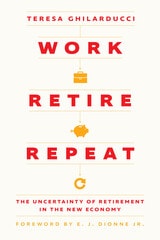
Work, Retire, Repeat
The Uncertainty of Retirement in the New EconomyTeresa Ghilarducci
University of Chicago Press, 2024
A damning portrait of the dire realities of retirement in the United States—and how we can fix it.
While the French went on strike in 2023 to protest the increase in the national retirement age, workers in the United States have all but given up on the notion of dignified retirement for all. Instead, Americans—whose elders face the highest risk of poverty compared to workers in peer nations—are fed feel-good stories about Walmart clerks who can finally retire because a customer raised the necessary funds through a GoFundMe campaign.
Many argue that the solution to the financial straits of American retirement is simple: people need to just work longer. Yet this call to work longer is misleading in a multitude of ways, including its endangering of the health of workers and its discrimination against people who work in lower-wage occupations. In Work, Retire, Repeat, Teresa Ghilarducci tells the stories of elders locked into jobs—not because they love to work but because they must.
But this doesn’t need to be the reality. Work, Retire, Repeat shows how relatively low-cost changes to how we finance and manage retirement will allow people to truly choose how they spend their golden years.

World Crisis Effects on Social Security in Latin America and the Caribbean
Lessons and PoliciesCarmelo Mesa-Lago
University of London Press, 2010