Results by title
16 books match the query 'South Asian Americans'

A Part, Yet Apart
South Asians in Asian AmericaLavina Shankar
Temple University Press, 1998
This construction process parallels the gradual acceptance of the term "Asian American" by peoples primarily of East and Southeast Asian ancestry who found abundant reason to claim a shared identity in dealing with officialdom and an apparently intractable racism in this country. In time, "Asian American" has become a designation of collective pride for a wide range of peoples. In academic institutions and society generally, there are vexed questions about the term's inclusiveness and the dominance of established groups over more recent ones.
A Part, Yet Apart: South Asians in Asian America concerns itself with the extent to which South Asian American are and ought to be included within Asian America -- as that term is applied to academic programs and admission policies; grassroots community organizing and politics more broadly; and critical analyses of cultural products. Taken together these essays form a spirited dialogue on the dilemmas of identity politics, coalition building, and diasporics.
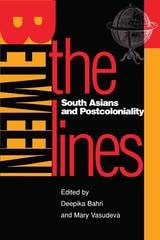
Between the Lines
South Asians and Postcolonialityedited by Deepika Bahri and Mary Vasudeva
Temple University Press, 1996
This ground-breaking collection of new interviews, critical essays, and commentary explores South Asian identity and culture. Sensitive to the false homogeneity implied by "South Asian," "diaspora," "postcolonial," and "Asian American," the contributors attempt to unpack these terms. By examining the social, economic, and historical particularities of people who live "between the lines"—on and between borders—they reinstate questions of power and privilege, agency and resistance. As South Asians living in the United States and Canada, each to some degree must reflect on the interaction of the personal "I," the collective "we," and the world beyond.
The South Asian scholars gathered together in this volume speak from a variety of theoretical perspectives; in the essays and interviews that cross the boundaries of conventional academic disciplines, they engage in intense, sometimes contentious, debate.
Contributors: Meena Alexander, Gauri Viswanathan, Gayatri Chakravorty Spivak, Amritjit Singh, M. G. Vassanji, Sohail Inayatullah, Ranita Chatterjee, Benita Mehta, Sanjoy Majumder, Mahasveta Barua, Sukeshi Kamra, Samir Dayal, Pushpa Naidu Parekh, Indrani Mitra, Huma Ibrahim, Amitava Kumar, Shantanu DuttaAhmed, Uma Parameswaran.
In the series Asian American History and Culture, edited by Sucheng Chan, David Palumbo-Liu, Michael Omi, K. Scott Wong, and Linda Trinh Võ.

Body Evidence
Intimate Violence against South Asian Women in AmericaEdited by Shamita Das Dasgupta
Rutgers University Press, 2007
In Body Evidence, more than twenty scholars and public health professionals uncover the unique challenges faced by victims of violence in intimate spaces . . . within families, communities and trusted relationships in South Asian American communities. Topics include cultural obsession with women's chastity and virginity; the continued silence surrounding intimate violence among women who identify themselves as lesbian, bisexual, or transgender; the consequences of refusing marriage proposals or failing to meet dowry demands; and, ultimately, the ways in which the United States courts often confuse and exacerbate the plights of these women.
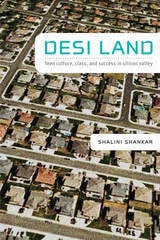
Desi Land
Teen Culture, Class, and Success in Silicon ValleyShalini Shankar
Duke University Press, 2008
Whether discussing instant messaging or arranged marriages, Desi bling or the pressures of the model minority myth, Shankar foregrounds the teens’ voices, perspectives, and stories. She investigates how Desi teens interact with dialogue and songs from Bollywood films as well as how they use their heritage language in ways that inform local meanings of ethnicity while they also connect to a broader South Asian diasporic consciousness. She analyzes how teens negotiate rules about dating and reconcile them with their longer-term desire to become adult members of their communities. In Desi Land Shankar not only shows how Desi teens of different socioeconomic backgrounds are differently able to succeed in Silicon Valley schools and economies but also how such variance affects meanings of race, class, and community for South Asian Americans.
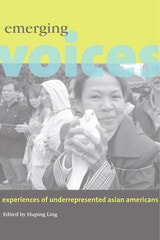
Emerging Voices
Experiences of Underrepresented Asian AmericansLing, Huping
Rutgers University Press, 2008
While a growing number of popular and scholarly works focus on Asian Americans, most are devoted to the experiences of larger groups such as Chinese, Japanese, Korean, Filipino, and Indian Americans. As the field grows, there is a pressing need to understand the smaller and more recent immigrant communities. Emerging Voices fills this gap with its unique and compelling discussion of underrepresented groups, including Burmese, Indonesian, Mong, Hmong, Nepalese, Romani, Tibetan, and Thai Americans.
Unlike the earlier and larger groups of Asian immigrants to America, many of whom made the choice to emigrate to seek better economic opportunities, many of the groups discussed in this volume fled war or political persecution in their homeland. Forced to make drastic transitions in America with little physical or psychological preparation, questions of “why am I here,” “who am I,” and “why am I discriminated against,” remain at the heart of their post-emigration experiences.
Bringing together eminent scholars from a variety of disciplines, this collection considers a wide range of themes, including assimilation and adaptation, immigration patterns, community, education, ethnicity, economics, family, gender, marriage, religion, sexuality, and work.
Here to Stay
Uncovering South Asian American HistoryGeetika Rudra
Rutgers University Press, 2022
In Here to Stay, Geetika Rudra, a second-generation Indian immigrant and American history buff, takes readers on a journey across the country to unearth the little-known histories of earlier generations of South Asian Americans. She visits storied sites such as Oregon’s “Hindoo Alley,” home to many lumber workers at the turn of the century, and Angel Island, California’s immigration hub. She also introduces readers to such inspiring figures as Bhagat Singh Thind, an immigrant who had enlisted in the U.S. Army to serve his adopted country in World War I, but who was later denied citizenship and took his case all the way to the U.S. Supreme Court. In turns both serious and joyful, this book vividly reveals how South Asians have always been a vital part of the American tapestry.

Hip Hop Desis
South Asian Americans, Blackness, and a Global Race ConsciousnessNitasha Tamar Sharma
Duke University Press, 2010
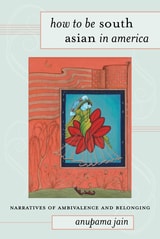
How to Be South Asian in America
Narratives of Ambivalence and BelongingAuthored by anupama jain
Temple University Press, 2011
Providing a useful analysis of and framework for understanding immigration and assimilation narratives, anupama jain's How to Be South Asian in America considers the myth of the American Dream in fiction (Meena Alexander's Manhattan Music), film (American Desi, American Chai), and personal testimonies. By interrogating familiar American stories in the context of more supposedly exotic narratives, jain illuminates complexities of belonging that also reveal South Asians' anxieties about belonging, (trans)nationalism, and processes of cultural interpenetration.
jain argues that these stories transform as well as reflect cultural processes, and she shows just how aspects of identity—gender, sexual, class, ethnic, national—are shaped by South Asians' accommodation of and resistance to mainstream American culture.

Karma Of Brown Folk
Vijay Prashad
University of Minnesota Press, 2001
The popular book challenging the idea of a model minority, now in paperback!
“How does it feel to be a problem?” asked W. E. B. Du Bois of black Americans in his classic The Souls of Black Folk. A hundred years later, Vijay Prashad asks South Asians “How does it feel to be a solution?” In this kaleidoscopic critique, Prashad looks into the complexities faced by the members of a “model minority”-one, he claims, that is consistently deployed as "a weapon in the war against black America."
On a vast canvas, The Karma of Brown Folk attacks the two pillars of the “model minority” image, that South Asians are both inherently successful and pliant, and analyzes the ways in which U.S. immigration policy and American Orientalism have perpetuated these stereotypes. Prashad uses irony, humor, razor-sharp criticism, personal reflections, and historical research to challenge the arguments made by Dinesh D’Souza, who heralds South Asian success in the U.S., and to question the quiet accommodation to racism made by many South Asians. A look at Deepak Chopra and others whom Prashad terms “Godmen” shows us how some South Asians exploit the stereotype of inherent spirituality, much to the chagrin of other South Asians. Following the long engagement of American culture with South Asia, Prashad traces India’s effect on thinkers like Cotton Mather and Henry David Thoreau, Ravi Shankar’s influence on John Coltrane, and such essential issues as race versus caste and the connection between antiracism activism and anticolonial resistance.
The Karma of Brown Folk locates the birth of the “model minority” myth, placing it firmly in the context of reaction to the struggle for Black Liberation. Prashad reclaims the long history of black and South Asian solidarity, discussing joint struggles in the U.S., the Caribbean, South Africa, and elsewhere, and exposes how these powerful moments of alliance faded from historical memory and were replaced by Indian support for antiblack racism. Ultimately, Prashad writes not just about South Asians in America but about America itself, in the tradition of Tocqueville, Du Bois, Richard Wright, and others. He explores the place of collective struggle and multiracial alliances in the transformation of self and community-in short, how Americans define themselves.

Missing
Youth, Citizenship, and Empire after 9/11Sunaina Marr Maira
Duke University Press, 2009
Bringing grounded ethnographic analysis to the critique of U.S. empire, Maira teases out the ways that imperial power affects the everyday lives of young immigrants in the United States. She illuminates the paradoxes of national belonging, exclusion, alienation, and political expression facing a generation of Muslim youth coming of age at this particular moment. She also sheds new light on larger questions about civil rights, globalization, and U.S. foreign policy. Maira demonstrates that a particular subjectivity, the “imperial feeling” of the present historical moment, is linked not just to issues of war and terrorism but also to migration and work, popular culture and global media, family and belonging.
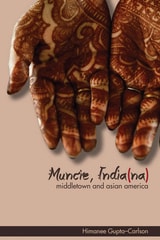
Muncie, India(na)
Middletown and Asian AmericaHimanee Gupta-Carlson
University of Illinois Press, 2018
Negotiating Ethnicity
Second-Generation South Asians Traverse a Transnational WorldPurkayastha, Bandana
Rutgers University Press, 2005
In the continuing debates on the topic of racial and ethnic identity in the United States, there are some that argue that ethnicity is an ascribed reality. To the contrary, others claim that individuals are becoming increasingly active in choosing and constructing their ethnic identities.Focusing on second-generation South Asian Americans, Bandana Purkayastha offers fresh insights into the subjective experience of race, ethnicity, and social class in an increasingly diverse America. The young people of Indian, Pakistani, Bangladeshi, and Nepalese origin that are the subjects of the study grew up in mostly white middle class suburbs, and their linguistic skills, education, and occupation profiles are indistinguishable from their white peers. By many standards, their lifestyles mark them as members of mainstream American culture. But, as Purkayastha shows, their ethnic experiences are shaped by their racial status as neither “white” nor “wholly Asian,” their continuing ties with family members across the world, and a global consumer industry, which targets them as ethnic consumers.”
Drawing on information gathered from forty-eight in-depth interviews and years of research, this book illustrates how ethnic identity is negotiated by this group through choice—the adoption of ethnic labels, the invention of “traditions,” the consumption of ethnic products, and participation in voluntary societies. The pan-ethnic identities that result demonstrate both a resilient attachment to heritage and a celebration of reinvention.
Lucidly written and enriched with vivid personal accounts, Negotiating Ethnicity is an important contribution to the literature on ethnicity and racialization in contemporary American culture.
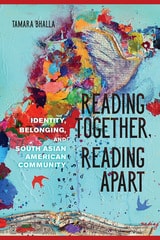
Reading Together, Reading Apart
Identity, Belonging, and South Asian American CommunityTamara Bhalla
University of Illinois Press, 2016
Tamara Bhalla blends a case study with literary and textual analysis to illuminate this phenomenon. Her fascinating investigation considers institutions from literary reviews to the marketplace to social media and other technologies, as well as traditional forms of literary discussion like book clubs and academic criticism. Throughout, Bhalla questions how her subjects' circumstances, desires, and shared race and class, limit the values they ascribe to reading. She also examines how ideology circulating around a body of literature or a self-selected, imagined community of readers shapes reading itself and influences South Asians' powerful, if contradictory, relationship with ideals of cultural authenticity.
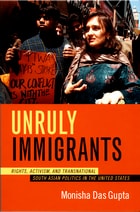
Unruly Immigrants
Rights, Activism, and Transnational South Asian Politics in the United StatesMonisha Das Gupta
Duke University Press, 2006
Das Gupta offers an ethnography of seven South Asian organizations in the northeastern United States, looking at their development and politics as well as the conflicts that have emerged within the groups over questions of sexual, class, and political identities. She examines the ways that women’s organizations have defined and responded to questions of domestic violence as they relate to women’s immigration status; she describes the construction of a transnational South Asian queer identity and culture by people often marginalized by both mainstream South Asian and queer communities in the United States; and she draws attention to the efforts of labor groups who have sought economic justice for taxi drivers and domestic workers by confronting local policies that exploit cheap immigrant labor. Responding to the shortcomings of the state, their communities, and the larger social movements of which they are a part, these groups challenge the assumption that citizenship is the necessary basis of rights claims.
Unseeing Empire
Photography, Representation, South Asian AmericaBakirathi Mani
Duke University Press, 2020
World Next Door
South Asian American LiteratureRajini Srikanth
Temple University Press, 2004
South Asian American literature, with its focus on the multiple geographies and histories of the global dispersal of South Asians, pulls back from a close-up view of the United States to reveal a wider landscape of many nations and peoples.
South Asian American poets, novelists, and playwrights depict the nation as simultaneously discrete and entwined with the urgencies of places as diverse as Bangladesh, Sri Lanka, India, Burma, Pakistan, and Trinidad. Drawing on the cosmopolitan sensibility of scholars like Anthony Appiah, Vinay Dharwadker, Martha Nussbaum, Bruce Robbins, and Amartya Sen, this book exhorts North American residents to envision connectedness with inhabitants of other lands. The world out there arrives next door.