Results by title
20 books match the query 'Space and time in literature'
At the Brink of Infinity
Poetic Humility in Boundless American SpaceJames E. von der Heydt
University of Iowa Press, 2008
From popular culture to politics to classic novels, quintessentially American texts take their inspiration from the idea of infinity. In the extraordinary literary century inaugurated by Ralph Waldo Emerson, the lyric too seemed to encounter possibilities as limitless as the U.S. imagination. This raises the question: What happens when boundlessness is more than just a figure of speech? Exploring new horizons is one thing, but actually looking at the horizon itself is something altogether different. In this carefully crafted analysis, James von der Heydt shines a new light on the lyric craft of Emily Dickinson, Robert Frost, Elizabeth Bishop, and James Merrill and considers how their seascape-vision redefines poetry's purpose.
Emerson famously freed U.S. literature from its past and opened it up to vastness; in the following century, a succession of brilliant, rigorous poets took the philosophical challenges of such freedom all too seriously. Facing the unmarked horizon, Emersonian poets capture—and are captured by—a stark, astringent version of human beauty. Their uncompromising visions of limitlessness reclaim infinity's proper legacy—and give American poetry its edge. Von der Heydt's book recovers the mystery of their world.
Barrio-Logos
Space and Place in Urban Chicano Literature and CultureBy Raúl Homero Villa
University of Texas Press, 2000
Struggles over space and resistance to geographic displacement gave birth to much of Chicano history and culture. In this pathfinding book, Raúl Villa explores how California Chicano/a activists, journalists, writers, artists, and musicians have used expressive culture to oppose the community-destroying forces of urban renewal programs and massive freeway development and to create and defend a sense of Chicano place-identity.
Villa opens with a historical overview that shows how Chicano communities and culture have grown in response to conflicts over space ever since the United States' annexation of Mexican territory in the 1840s. Then, turning to the work of contemporary members of the Chicano intelligentsia such as Helena Maria Viramontes, Ron Arias, and Lorna Dee Cervantes, Villa demonstrates how their expressive practices re-imagine and re-create the dominant urban space as a community enabling place. In doing so, he illuminates the endless interplay in which cultural texts and practices are shaped by and act upon their social and political contexts.
Extinct Lands, Temporal Geographies
Chicana Literature and the Urgency of SpaceMary Pat Brady
Duke University Press, 2002
The history of the American Southwest in large part entails the transformation of lived, embodied space into zones of police surveillance, warehouse districts, highway interchanges, and shopping malls—a movement that Chicana writers have contested from its inception. Brady examines this long-standing engagement with space, first in the work of early newspaper essayists and fiction writers who opposed Anglo characterizations of Northern Sonora that were highly detrimental to Mexican Americans, and then in the work of authors who explore border crossing. Through the writing of Sandra Cisneros, Cherríe Moraga, Terri de la Peña, Norma Cantú, Monserrat Fontes, Gloria Anzaldúa, and others, Brady shows how categories such as race, gender, and sexuality are spatially enacted and created—and made to appear natural and unyielding. In a spatial critique of the war on drugs, she reveals how scale—the process by which space is divided, organized, and categorized—has become a crucial tool in the management and policing of the narcotics economy.
Feminist Fabulation
Space/Postmodern FictionMarleen S. Barr
University of Iowa Press, 1992
Geographies of Flight
Phillis Wheatley to Octavia ButlerWilliam Merrill Decker
Northwestern University Press, 2020
African American writing commonly represents New World topography as a set of entrapments, contesting the open horizons, westward expansion, and individual freedom characteristic of the white, Eurocentric literary tradition. Geographies of Flight: Phillis Wheatley to Octavia Butler provides the first comprehensive treatment of the ways in which African American authors across three centuries have confronted the predicament of inhabiting space under conditions of bondage and structural oppression. William Merrill Decker examines how, in testifying to those conditions, fourteen black authors have sought to transform a national cartography that, well into the twenty-first century, reflects white supremacist assumptions. These writers question the spatial dimensions of a mythic American liberty and develop countergeographies in which descendants of the African diaspora lay claim to the America they have materially and culturally created.
Tracking the testimonial voice in a range of literary genres, Geographies of Flight explores themes of placement and mobility in the work of Phillis Wheatley, Olaudah Equiano, David Walker, Frederick Douglass, Harriet Jacobs, Booker T. Washington, Ida B. Wells-Barnett, W. E. B. Du Bois, Richard Wright, Ralph Ellison, Malcolm X, James Baldwin, Toni Morrison, and Octavia Butler.

Impossible Stories
On the Space and Time of Black Destructive CreationJohn Murillo III
The Ohio State University Press, 2021
Taking as his lens the fragment—fragmented bodies, fragments of memories, fragments of texts—Murillo theorizes new directions for Black identity and cultural production. Combining a critical engagement of physics and metaphysics with innovative readings of Gayl Jones’s Corregidora, Octavia Butler’s Kindred, Toni Morrison’s Beloved, Kiese Laymon’s Long Division, Dionne Brand’s A Map to the Door of No Return, and Paul Beatty’s The Sellout, he offers new ways to think about anti-Black racism and practice Black creativity. Ultimately, in his equally creative and analytical responses to depictions of Black people left out of history and barred from spaces, Murillo argues that through Afro-pessimism, Black people can fight the anti-Black cosmos.
Lost in the Shadow of the Word
Space, Time, and Freedom in Interwar Eastern EuropeBenjamin Paloff
Northwestern University Press, 2016
Scholars of modernism have long addressed how literature, painting, and music reflected the radical reconceptualization of space and time in the early twentieth century—a veritable revolution in both physics and philosophy that has been characterized as precipitating an “epistemic trauma” around the world. In this wide-ranging study, Benjamin Paloff contends that writers in Central and Eastern Europe felt this impact quite distinctly from their counterparts in Western Europe. For the latter, the destabilization of traditional notions of space and time inspired works that saw in it a new kind of freedom. However, for many Central and Eastern European authors, who were writing from within public discourses about how to construct new social realities, the need for escape met the realization that there was both nowhere to escape to and no stable delineation of what to escape from. In reading the prose and poetry of Czech, Polish, and Russian writers, Paloff imbues the term “Kafkaesque” with a complexity so far missing from our understanding of this moment in literary history.
Medieval Practices Of Space
Barbara A. Hanawalt
University of Minnesota Press, 2000
Interprets space and place in the medieval era.
Interprets space and place in the medieval era.
A glance at medieval maps tells us that cartographers of the Middle Ages divided space differently than we do today. In the great mappae mundi, for instance, Jerusalem takes center stage, with an image of the crucified Christ separating one place from another. The architects of medieval cathedrals manipulated space to clarify the roles and status of all who entered. Even in the most everyday context, space was allotted according to gender and class and was freighted with infinitely subtle meanings. The contributors to this volume cross disciplinary and theoretical boundaries to read the words, metaphors, images, signs, poetic illusions, and identities with which medieval men and women used space and place to add meaning to the world.Contributors: Kathleen Biddick, U of Notre Dame; Charles Burroughs, SUNY, Binghamton; Michael Camille, U of Chicago; Tom Conley, Harvard U; Donnalee Dox, U of Arizona; Jody Enders, U of California, Santa Barbara; Valerie K. J. Flint, U of Hull, UK; Andrzej Piotrowski, U of Minnesota; Daniel Lord Smail, Fordham U.Barbara A. Hanawalt is King George III Professor of British History at Ohio State University. Michal Kobialka is associate professor of theatre at University of Minnesota.
My Dark Room
Spaces of the Inner Self in Eighteenth-Century EnglandJulie Park
University of Chicago Press, 2023
In what kinds of spaces do we become most aware of the thoughts in our own heads? In My Dark Room, Julie Park explores places of solitude and enclosure that gave eighteenth-century subjects closer access to their inner worlds: grottos, writing closets, landscape follies, and the camera obscura, that beguiling “dark room” inside which the outside world in all its motion and color is projected. The camera obscura and its dreamlike projections within it served as a paradigm for the everyday spaces, whether in built environments or in imaginative writing, that generated the fleeting states of interiority eighteenth-century subjects were compelled to experience and inhabit.
My Dark Room illuminates the spatial and physical dimensions of inner life in the long eighteenth century by synthesizing material analyses of diverse media, from optical devices and landscape architecture to women’s intimate dress, with close readings of literary texts not traditionally considered together, among them Andrew Marvell’s country house poem Upon Appleton House, Margaret Cavendish’s experimental epistolary work Sociable Letters, Alexander Pope’s heroic verse epistle Eloisa to Abelard, and Samuel Richardson’s novel Pamela. Park also analyzes letters and diaries, architectural plans, prints, drawings, paintings, and more, drawing our attention to the lively interactions between spaces and psyches in private environments. Park’s innovative method of “spatial formalism” reveals how physical settings enable psychic interiors to achieve vitality in lives both real and imagined.
Mysticism and Space
Space and Spatiality in the Works of Richard Rolle, The Cloud of Unknowing Author, and Julian of NorwichCarmel Bendon Davis
Catholic University of America Press, 2008

Provinces of the Mind
The Modern Novel on Provincial TimeVictoria Baena
University of Chicago Press, 2027
How the provinces, rather than cities or capitals, became the key setting dramatized in—but also transformed by—modern novels in English and French.
To be provincial is to mistake one’s narrow milieu for the world: it is to fall prey to an error of scale. But it is also to feel behind, belated, and excluded from the possibilities of the modern world. In this elegant study of the novel “on provincial time,” Victoria Baena argues that the literary geography of “the provinces” played a key role in forging European narratives of modernity.
In the wake of French revolutionaries’ suppression of older provincial identities and as Britain expanded its imperial reach, the provinces were reinvented on various scales: from countryside to small town, from domestic region to faraway colony. Baena brings together Marxist and feminist spatial theory with a close attention to the politics of narrative form in order to show how the remarkably mobile concept of the provinces developed across social and cultural frameworks from 1800 to 1933. Offering new interpretations of novels of the realist tradition—by Honoré de Balzac, George Eliot, Emily Brontë, George Sand, Thomas Hardy, Marcel Proust, Alain-Fournier, James Joyce, and Claude McKay—she shows how the question of representing the provinces transformed the modern novel.
Provinces of the Mind illuminates some of the more pernicious fictions of provincialism. But it also describes, often movingly, the desire no longer to be provincial, along with the ambivalence and alienation that can entail. Ultimately, the book shows how literary critics can use the provinces to translate questions of literary geography across borders. By interrogating the provincialisms of our own time and place, Baena suggests, critics might make a better case for those worth retaining, as well as a better grasp of those to be left behind.
Space as Storyteller
Spatial Jumps in Architecture, Critical Theory, and LiteratureLaura Chiesa
Northwestern University Press, 2016
Text and the City
Essays on Japanese ModernityMaeda Ai
Duke University Press, 2004
Maeda remapped the study of modern Japanese literature and culture in the 1970s and 1980s, helping to generate widespread interest in studying mass culture on the one hand and marginalized sectors of modern Japanese society on the other. These essays reveal the broad range of Maeda’s cultural criticism. Among the topics considered are Tokyo; utopias; prisons; visual media technologies including panoramas and film; the popular culture of the Edo, Meiji, and contemporary periods; maps; women’s magazines; and women writers. Integrally related to these discussions are Maeda’s readings of works of Japanese literature including Matsubara Iwagoro’s In Darkest Tokyo, Nagai Kafu’s The Fox, Higuchi Ichiyo’s Growing Up, Kawabata Yasunari’s The Crimson Gang of Asakusa, and Narushima Ryuhoku’s short story “Useless Man.” Illuminating the infinitely rich phenomena of modernity, these essays are full of innovative, unexpected connections between cultural productions and urban life, between the text and the city.

The Emergence of Social Space
Rimbaud and the Paris CommuneKristin RossForeword by Terry Eagleton
University of Minnesota Press, 1989
Central to her analysis of the Commune as social space and oppositional culture is a close textual reading of Arthur Rimbaud’s poetry. His poems - a common thread running through the book - are one set of documents among many in Ross’s recreation of the Communard experience. Rimbaud, Paul Lafargue, and the social geographer Elisee Reclus serve as emblematic figures moving within and on the periphery of the Commune; in their resistance to the logic and economy of a capitalist conception of work, in their challenge to work itself as a term of identity, all three posed a threat to the existing order. Ross looks at these and other emancipator notions as aspects of Communard life, each with an analogous strategy in Rimbaud’s poetry. Applying contemporary theory to a wealth of little-known archival material, she has written a fresh, persuasive, and original book.
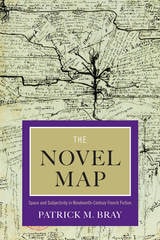
The Novel Map
Space and Subjectivity in Nineteenth-Century French FictionPatrick M. Bray
Northwestern University Press, 2013
Focusing on Stendhal, Gérard de Nerval, George Sand, Émile Zola, and Marcel Proust, The Novel Map: Mapping the Self in Nineteenth-Century French Fiction explores the ways that these writers represent and negotiate the relationship between the self and the world as a function of space in a novel turned map.
With the rise of the novel and of autobiography, the literary and cultural contexts of nineteenth-century France reconfigured both the ways literature could represent subjects and the ways subjects related to space. In the first-person works of these authors, maps situate the narrator within the imaginary space of the novel. Yet the time inherent in the text’s narrative unsettles the spatial self drawn by the maps and so creates a novel self, one which is both new and literary. The novel self transcends the rigid confines of a map. In this significant study, Patrick M. Bray charts a new direction in critical theory.
The Planetary Turn
Relationality and Geoaesthetics in the Twenty-First CenturyEdited by Amy J. Elias and Christian Moraru
Northwestern University Press, 2015
A groundbreaking essay collection that pursues the rise of geoculture as an essential framework for arts criticism, The Planetary Turn shows how the planet—as a territory, a sociopolitical arena, a natural space of interaction for all earthly life, and an artistic theme—is increasingly the conceptual and political dimension in which twenty-first-century writers and artists picture themselves and their work. In an introduction that comprehensively defines the planetary model of art, culture, and cultural-aesthetic interpretation, the editors explain how the living planet is emerging as distinct from older concepts of globalization, cosmopolitanism, and environmentalism and is becoming a new ground for exciting work in contemporary literature, visual and media arts, and social humanities. Written by internationally recognized scholars, the twelve essays that follow illustrate the unfolding of a new vision of potential planetary community that retools earlier models based on the nation-state or political “blocs” and reimagines cultural, political, aesthetic, and ethical relationships for the post–Cold War era.
The Spaces of Violence
James R. Giles
University of Alabama Press, 2006
Exploring the landscapes, cultures, and psychological spaces where violence takes root in contemporary American fiction.
The Spaces of Violence is an insightful work of literary criticism in which James R. Giles investigates the complex relationship between violence and space in contemporary American fiction. Through close readings of novels by influential writers including Russell Banks, Cormac McCarthy, Lewis Nordan, Dorothy Allison, Don DeLillo, Denis Johnson, Sherman Alexie, Robert Stone, and Bret Easton Ellis, Giles demonstrates how violence is shaped by the physical, social, and psychological environments in which it occurs.
Drawing on spatial and cultural theory, Giles argues that these novels inhabit a distinctive "fourthspace," a realm existing at the margins of mainstream society where violence permeates everyday life and destabilizes traditional boundaries of identity, community, and morality. Whether set in rural landscapes, urban centers, suburban communities, football stadiums, or transient spaces such as highways and bus stations, the works examined reveal how environments become intertwined with systems of power, alienation, trauma, and destruction.
The book concludes by extending its analysis to representations of violence within family structures, highlighting the far-reaching effects of social and cultural fragmentation. Offering a sophisticated framework for understanding violence in literature, The Spaces of Violence is an important contribution to contemporary literary and cultural studies.
The West Side of Any Mountain
Place, Space, and EcopoetryJ. Scott Bryson
University of Iowa Press, 2005
Informed in general by current thinking in environmental theory and specifically by the work of cultural geographer Yi-Fu Tuan, The West Side of Any Mountain participates in and furthers this scholarly attention by offering an overarching theoretical framework with which to approach the field.
One area that contemporary theorists have found problematic is the dualistic civilization/wilderness binary that focuses on the divisions between culture and nature, thereby increasing the modern sense of alienation. Tuan’s place-space framework offers a succinct vocabulary for describing the attitudes of ecological poets and other nature writers in a way that avoids setting up an adversarial relationship between place and space. Scott Bryson describes the Tuanian framework and employs it to offer fresh readings of the work of four major ecopoets: Wendell Berry, Joy Harjo, Mary Oliver, and W. S. Merwin.
The West Side of Any Mountain will be of great interest to scholars and teachers working in the field of contemporary nature poetry. It is recommended for nature-writing courses as well as classes dealing with 20th-century poetry, contemporary literary criticism, and environmental theory.
The Written World
Space, Literature, and the Chorological Imagination in Early Modern FranceJeffrey N. Peters
Northwestern University Press, 2018
In analyses of well-known authors such as Corneille, Molière, Racine, and Madame de Lafayette, Peters demonstrates that the apparent absence of physical space in seventeenth-century literary depiction indicates a subtle engagement with, rather than a rejection of, evolving principles of cosmological understanding. Space is not absent in these works so much as transformed in keeping with contemporaneous developments in early modern natural philosophy. The Written World will appeal to philosophers of literature and literary theorists as well as scholars of early modern Europe and historians of science and geography
Verbal Art, Verbal Sign, Verbal Time
Roman JakobsonKrystyna Pomorska and Stephen Rudy, Editors
University of Minnesota Press, 1985
Verbal Art, Verbal Sign, Verbal Time was first published in 1985. Minnesota Archive Editions uses digital technology to make long-unavailable books once again accessible, and are published unaltered from the original University of Minnesota Press editions.
Roman Jakobson, one of the most important thinkers of our century, was bet known for his role in the rise and spread of the structural approach to linguistics and literature. His formative structuralism approach to linguistics and literature. His formative years with the Russian Futurists and subsequent involvement in the Moscow and Prague Linguistic Circles (which he co-founded) resulted in a lifelong devotion to fundamental change in both literary theory and linguistics. In bringing each to bear upon the other, he enlivened both disciplines; if a literary work was to a him a linguistic fact, it was also a semiotic phenomenon - part of the entire universe of signs; and above all, for both language and literature, time was an integral factor, one that produced momentum and change. Jakobson's books and articles, written in many languages and published around the world, were collected in a monumental seven-volume work, Selected Writings (1962 -1984), which has been available only to a limited readership. Not long before his death in 1982, Jakobson brought together this group of eleven essays—Verbal Art, Verbal Sign, Verbal Time — to serve as an introduction to some of his linguistic theories and especially, to his work in poetics.
Jakobson's introductory article and the editor's preface together suggest the range of his work and provide a context for the essays in this book, which fall into three groups. Those in the first section reflect his preoccupation with the dynamic role of time in language and society. Jakobson challenges Saussure's rigid distinction between language as a static (synchronic) system and its historical (diachronic) development - a false opposition, in his view, since it ignores the role of time in the present moment of language. The essays on time counter the notion that structuralism itself, as heir to Saussure's work, has discarded history; in Jakabson's hands, we see a struggle to integrate the two modes. In central group essays, on poetic theory, he shows how the grammatical categories of everyday speech become the expressive, highly charged language of poetry. These essays also deal with the related issues of subliminal and intentional linguistic patterns of poetry. These essays also deal with the related issues of subliminal and intentional linguistic patterns in poetry—areas that are problematic in structural analysis—and provide exemplary readings of Pushkin and Yeats. The last essays, on Mayakovsky and Holderlin, make clear that Jakobson was aware of the essential (and in these instances, tragic) bond between a poet's life and art. The book closes with essays by Linda Waugh, Krystyna Pomorska, and Igor Melchuk that provide a thoughtful perspective on Jakobson's work as a whole.