Results by title
21 books match the query 'Stage-setting and scenery'
American Scenic Design and Freelance Professionalism
David Bisaha
Southern Illinois University Press, 2022
The figure of the American theatrical scenic designer first emerged in the early twentieth century. As productions moved away from standardized, painted scenery and toward individualized scenic design, the demand for talented new designers grew. Within decades, scenic designers reinvented themselves as professional artists. They ran their own studios, proudly displayed their names on Broadway playbills, and even appeared in magazine and television profiles.
American Scenic Design and Freelance Professionalism tells the history of the field through the figures, institutions, and movements that helped create and shape the profession. Taking a unique sociological approach, theatre scholar David Bisaha examines the work that designers performed outside of theatrical productions. He shows how figures such as Lee Simonson, Norman Bel Geddes, Jo Mielziner, and Donald Oenslager constructed a freelance, professional identity for scenic designers by working within their labor union (United Scenic Artists Local 829), generating self-promotional press, building university curricula, and volunteering in wartime service.
However, while new institutions provided autonomy and intellectual property rights for many, women, queer, and Black designers were not always welcome to join the organizations that protected freelance designers’ interests. Among others, Aline Bernstein, Emeline Roche, Perry Watkins, Peggy Clark, and James Reynolds were excluded from professional groups because of their identities. They nonetheless established themselves among the most successful designers of their time. Their stories expand the history of American scenic design by showing how professionalism won designers substantial benefits, yet also created legacies of exclusion with which American theatre is still reckoning.
Architectural Involutions
Writing, Staging, and Building Space, c. 1435-1650Mimi Yiu
Northwestern University Press, 2014
Winner of the MLA Prize for Independent Scholars
Taking the reader on an inward journey from façades to closets, from physical to psychic space, Architectural Involutions offers an alternative genealogy of theater by revealing how innovations in architectural writing and practice transformed an early modern sense of interiority. The book launches from a matrix of related “platforms”—a term that in early modern usage denoted scaffolds, stages, and draftsmen’s sketches—to situate Alberti, Shakespeare, Jonson, and others within a landscape of spatial and visual change.
As the English house underwent a process of inward folding, replacing a logic of central assembly with one of dissemination, the subject who negotiated this new scenography became a flashpoint of conflict in both domestic and theatrical arenas. Combining theory with archival findings, Mimi Yiu reveals an emergent desire to perform subjectivity, to unfold an interior face to an admiring public. Highly praised for its lucid writing, comprehensive supplementary material, and engaging tone, Architectural Involutions was the winner of the 2016 MLA Prize for Independent Scholars.

Computer Scenographics
Darwin Reid Payne
Southern Illinois University Press, 1994
Darwin Reid Payne’s approach to theatrical design is that of a computer advocate and pioneer. With Computer Scenographics, he ushers in a new generation of scenery design by applying state-of-the-art technology to the traditional methods of scenography. Though not a how-to book, Computer Scenographics is a general introduction to, and an affirmation of, the value of computer graphics for both student and working scenographers.
Payne acknowledges that many scenographers would not want to use computers exclusively in the preparation of their designs. Today’s scenographers continue to value the manual skills of drawing and painting, learned and perfected over time, and would not consider abandoning these skills entirely. And it is unlikely that the most powerful computer or most sophisticated software could ever supplant that intimate interaction of hand and mind provided by traditional tools and materials. Nevertheless, Payne’s utilization of the Virtus Walk-Through computer program to facilitate set design expands the tools of the artist to new dimensions.
Aided by 129 illustrations, Payne addresses four major topics: (1) how computer studios are set up; (2) how computers serve as storage for visual ideas and as conceptual tools; (3) how technical information needed for producing a scenographer’s ideas onstage is created with computers; (4) and how modelmaking has been changed by computer-generated three-dimensional possibilities, especially by the introduction of "virtual reality" onto the computer platform.
Czech Theatre Design in the Twentieth Century
Metaphor and Irony RevisitedJoe Brandesky
University of Iowa Press, 2007
Essays by Vera Ptacková, Dennis Christilles, Delbert Unruh, and, Marie Zdenková their full texts restored and reedited for this volume since their initial publication in exhibit catalogs, provide historical and linguistic insights into contemporary Czech scenography as well as comparisons to the major art movements affecting the designers. Brandesky’s informative introductory essay contextualizes the shifting tenets of Czech theatre design. Also included are biographies of the designers, a bibliography, and thirty black-and-white photographs.
The accompanying CD provides access to the vibrant and sophisticated images of the Czech theatrical world: 138 richly colorful paintings and drawings of costumes, models, and set designs and in situ photos of exhibited designs plus 27 color and black-and-white photos of the designers. The CD also includes the full text of the book with links to all the art and to the designers’ biographies. Book and CD together showcase the Czech Republic as a center of international stage design.
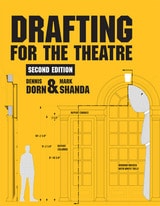
Drafting for the Theatre
Dennis Dorn and Mark Shanda
Southern Illinois University Press, 2012
Early chapters focus on the basics of geometric constructions, orthographic techniques, soft-line sketching applications, lettering, and dimensioning. Later chapters discuss real-life applications of production drawing and ancillary skills such as time and material estimation and shop-drawing nomenclature. Two chapters detail a series of design and shop drawings required to mount a specific design project, providing a guided path through both phases of the design/construction process. Most chapters conclude with one or more worksheets or problems that provide readers with an opportunity to test their understanding of the material presented.
The authors' discussion of universal CAD principles throughout the manuscript provides a valuable foundation that can be used in any computer-based design, regardless of the software. Dorn and Shanda treat the computer as another drawing tool, like the pencil or T-square, but one that can help a knowledgeable drafter potentially increase personal productivity and accuracy when compared to traditional hand-drafting techniques.
Drafting for the Theatre, second edition assembles in one book all the principal types of drawings, techniques, and conventional wisdom necessary for the production of scenic drafting, design, and shop drawings. It is richly illustrated with numerous production examples and is fully indexed to assist students and technicians in finding important information. It is structured to support a college-level course in drafting, but will also serve as a handy reference for the working theatre professional.
From the Score to the Stage
An Illustrated History of Continental Opera Production and StagingEvan Baker
University of Chicago Press, 2013
Looking Into the Abyss
Essays on ScenographyArnold Aronson
University of Michigan Press, 2005
Theater is, first and foremost, a visual art; Looking Into the Abyss examines the ways in which the visual theater affects our understanding of the dramatic event. Arnold Aronson, an internationally prominent historian and theorist of theater set design, opens with an overview of scenographic concepts, including postmodern design and the use of new media in the theater, and continues with analyses of the work of specific designers (including Richard Foreman and David Rockwell) and scenographic responses to playwrights like Chekhov and Tony Kushner. These essays serve to open a dialogue that will bring the physical aspect of theater back into its proper place: an element as integral to the performance as the spoken word, and they will inspire theater-goers to become more aware of their role as seers of the theater.
Arnold Aronson is Professor of Theater, Columbia University. He is author of American Avant-Garde Theatre: A History; Architect of Dreams: The Theatrical Vision of Joseph Urban; American Set Design; and The History and Theory of Environmental Scenography.
Movable Londons
Performance and the Modern CityJulia H Fawcett
University of Michigan Press, 2025
Reading between Designs
Visual Imagery and the Generation of Meaning in The Avengers, The Prisoner, and Doctor WhoBy Piers D. Britton and Simon J. Barker
University of Texas Press, 2003
From the alien worlds of Star Trek to the realistic operating room of ER, the design of sets and costumes contributes not only to the look and mood of television shows, but even more importantly to the creation of memorable characters. Yet, until now, this crucial aspect of television creativity has received little critical attention, despite the ongoing interest in production design within the closely allied discipline of film studies.
In this book, Piers Britton and Simon Barker offer a first analytical study of scenic and costume design for television drama series. They focus on three enduringly popular series of the 1960s—The Avengers, The Prisoner, and Doctor Who—and discuss such topics as the sartorial image of Steed in The Avengers, the juxtaposition of picturesque and fascistic architecture in The Prisoner, and the evolution of the high-tech interior of Doctor Who's TARDIS. Interviews with the series' original designers and reproductions of their original drawings complement the authors' analysis, which sheds new light on a variety of issues, from the discourse of fashion to that of the heritage industry, notions of "Pop" and retro, and the cultural preoccupation with realism and virtual reality.
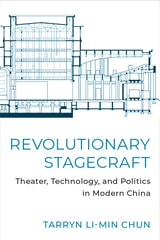
Revolutionary Stagecraft
Theater, Technology, and Politics in Modern ChinaTarryn Li-Min Chun
University of Michigan Press, 2024
2026 NYU Joe Callaway Prize Winner
- 2025 Association for Theatre in Higher Education Outstanding Book Award in Innovative Achievement Winner
- 2024 Theatre Library Association George Freedley Memorial Award Co-Winner
- American Society for Theatre Research Barnard Hewitt Award for Outstanding Research in Theatre History Finalist
Revolutionary Stagecraft draws on a rich corpus of literary, historical, and technical materials to reveal a deep entanglement among technological modernization, political agendas, and the performing arts in modern China. This unique approach to Chinese theater history combines a close look at plays themselves, performance practices, technical theater details, and behind-the-scenes debates over “how to” make theater amid the political upheavals of China’s 20th century. The book begins at a pivotal moment in the 1920s—when Chinese theater artists began to import, use, and write about modern stage equipment—and ends in the 1980s when China's scientific and technological boom began. By examining iconic plays and performances from the perspective of the stage technologies involved, Tarryn Li-Min Chun provides a fresh perspective on their composition and staging. The chapters include stories on the challenges of creating imitation neon, rigging up a makeshift revolving stage, and representing a nuclear bomb detonating onstage.
In thinking about theater through technicity, the author mines well-studied materials such as dramatic texts and performance reviews for hidden technical details and brings to light a number of previously untapped sources such as technical journals and manuals; set design renderings, lighting plots, and prop schematics; and stage technology how-to guides for amateur thespians. This approach focuses on material stage technologies, situating these objects equally in relation to their technical potential, their human use, and the social, political, economic, and cultural forces that influence them. In each of its case studies, Revolutionary Stagecraft reveals the complex and at times surprising ways in which Chinese theater artists and technicians of the 20th century envisioned and enacted their own revolutions through the materiality of the theater apparatus.
Sceno-Graphic Techniques
W. Oren Parker
Southern Illinois University Press, 1987
The first book to bring together the drafting techniques, descriptive geometry, engineering drawing, and graphics of perspective needed to plan and execute a setting for the theatre.
Parker presents these elements in a logical three-part format. “The Language of Lines” offers a study of drafting techniques, conventions, and symbols peculiar to the theatre; “Graphic Solutions” deals with the graphic problem-solving often needed to draw and make the frequent irregular forms of present-day scene design; and “Perspective in the Theatre” treats the two-dimensional perspective of the designer’s sketch and the three-dimensional perspective required for an illusion or stylistic concept.
Space in Performance
Making Meaning in the TheatreGay McAuley
University of Michigan Press, 2000
The book's theoretical and methodological framework is both semiotic and phenomenological, based in part from the seminal work of Anne Ubersfeld, from direct observation of the rehearsal process, and from documentation and analysis of professional performances. The situation of the academic observer in the rehearsal room has much in common with that of the ethnographer in the field, and contemporary ethnographic practice provides a third theoretical and methodological perspective to this study.
Performance studies is an emerging discipline, and it is still evolving appropriate methodologies. The multi-faceted approach adopted here will engage theater and performance studies specialists, those concerned with modes of representation in contemporary culture, and students of theater, semiotics, architecture, set design, acting and performance theory. It also offers a great deal to theater practitioners as well as to spectators interested in deepening their appreciation of theater art. It is written in a simple, accessible way, and the theory always emerges from descriptions of practice.
"An excellent study that imaginatively summarizes, synthesizes, and intelligently critiques a wide range of previous theory and practice while making an important new contribution to the field of theater studies." --Marvin Carlson, City University of New York
Gay McAuley is Director of the Centre for Performance Studies, University of Sydney.
Stage Rigging Handbook, Fourth Edition
Jay O. Glerum and Shane Kelly with a foreword by Mark Shanda
Southern Illinois University Press, 2024
Updating the industry standard stage rigging text for a new generation
First published in 1987 and revised in 1997 and 2007, Stage Rigging Handbook remains the only book in any language that covers the design, operation, and maintenance of stage rigging equipment. Though often unnoticed, these systems are critical in both easing the workload of stage technicians and creating storytelling magic for the audience. This landmark text imparts the foundations for understanding and implementing rigging systems, such that upon completion of the book, the reader is ready to begin hands-on training and practice.
Organized into four sections, the handbook combines research and practical experience to guide riggers through their work. It begins by explaining the construction and care of basic lifting media. Part two analyzes types of rigging systems; then the handbook details the forces that impact rigging, from Newtonian physics to calculating expansive modern systems. Finally, it presents day-to-day best safety practices, including brand new sections on risk assessment and fall protection.
This reorganized and greatly expanded fourth edition of Jay O. Glerum’s industry standard text updates much of the information in the previous editions with the addition of chapters on truss (the framework that supports lighting, screens, and other accessories), motorized chain hoists, hardware, and job safety, including fall protection systems. Award-winning production manager Shane Kelly preserves Glerum’s voice while bringing fresh information to a new generation of riggers, supplementing the text with updated versions of earlier photographs and drawings as well as an additional one hundred illustrations. The handbook facilitates the development of a rigging practice rooted in safety, precision, and professionalism.
Stage Rigging Handbook, Third Edition
Jay O. Glerum
Southern Illinois University Press, 2007
Stagecraft for Nonprofessionals
F. A. Buerki; Revised by Susan J. Christensen
University of Wisconsin Press, 1983
Standby
An Approach to Theatrical DesignJoshua Langman
Southern Illinois University Press, 2022
A groundbreaking philosophy of design for the stage
Standby proposes a practical philosophy of contemporary theatrical design that addresses all design disciplines, all theatrical collaborators, and all forms of theatre, from the traditional to the avant-garde. In a field that is too often dismissed as purely technical, Joshua Langman celebrates design as a transformative force with the power to elevate a performance and enable it to resonate beyond the bounds of its physical production. Beginning with the proposition that design contributes essential layers of meaning to an experience, Standby argues for a unique approach centered on the creation of revelatory theatrical moments.
In a mission to illuminate the soul of the craft, Langman investigates the purposes of design, details the elements of a production concept, uncovers the mechanics of creating meaning, explores the relationship of theatrical design to fine art and art history, and offers practical guidance on designing productions. He also considers what has changed as designers have embraced digital technology and suggests fifteen concrete methods for preserving the magic of live theatre in a digital age. Blending scholarship and storytelling, personal experience and contrarian wisdom, Standby challenges theatre-makers to harness the rich dramatic potential of theatrical design.
For additional information and supplemental materials, please visit www.standbybook.com.
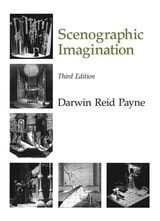
The Scenographic Imagination, Third Edition
Darwin Reid Payne
Southern Illinois University Press, 1993
In this enlarged and thoroughly revised third edition of his widely used text, Darwin Reid Payne explores the principles and philosophies that shape the visual elements of theatre.
Payne sets out to discover who scenographers are and to define their responsibilities. He sees scenographers as not merely craftspersons but artists with "a special vision that spans all the arts." Such artists are in a position to "extend and amplify underlying meanings of the production." The proper goal of beginning scenographers, according to Payne, is one day to be able to approach the job as artists in full command of their craft.
Payne seeks to instill in beginning scenographers a basic core of knowledge: an understanding of theatre history and the development of drama; a knowledge of art history and an understanding of periods and styles of architecture, painting, sculpture, furnishings, and costume; and a familiarity with the principles, techniques, and materials of pictorial and three-dimensional design. This new edition contains 248 illustrations, 38 more than the second edition. Payne’s goal, certainly, is to teach students what to do and how to do it; equally important, however, is Payne’s view that scenographers must know why.
To Payne, "Scenography is an art whose scope is nothing less than the whole world outside the theatre." Scenographers must read not only in their own field but in others as well. Payne has incorporated into his text many suggestions for outside readings, quoting passages and even entire chapters from important works. Stressing research, Payne argues that without knowledge of the literature of their own and related arts, scenographers cannot grow. And that is the emphasis of this book: to present aspiring scenographers with an approach and a set of concepts that will enable them to grow. Toward that end, Payne establishes five priorities, the first of which is to develop in students what he calls "time vision," or the ability to "see" the historical past as a living place with living inhabitants. The second priority is to bring about an awareness that allows students to "see" beneath the surface of objects and events. Third, students must be helped to recognize and appreciate the difference between the "concept of space as it exists outside the theatre and the concept of space as it is used within the theatre." The fourth priority is to ingrain in students an understanding of the importance of imagery to the scenographer, and the final priority is to teach those technical skills necessary to carry out the concepts of the scenographer.
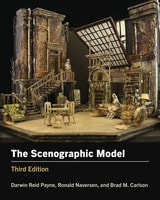
The Scenographic Model
Third EditionDarwin Reid Payne, Ronald Naversen, and Brad M. Carlson
Southern Illinois University Press, 2025
An authoritative guide to modelmaking for theater
This third edition of noted scenographer Darwin Reid Payne’s landmark text builds upon Payne’s theories and exercises to provide a modern exploration of the practice of theatrical modelmaking. With chapters on traditional and contemporary materials, tools, and techniques, the book serves as a foundational guide to understanding the historical, theoretical, and practical aspects of scenographic modelmaking, making it essential for the beginner, generalist, and professional design practitioner.
The volume begins with a brief history of the scenographic model and explores how modelmaking has adapted to changes in materials, technology, and commercial influences over time. It details setting up a safe, productive model-building studio before introducing the types and purposes of various scenographic models. It then instructs the reader in constructing common model elements and accessories. Later chapters explore how the models reveal stage space and create mood and atmosphere through tonal shading and lighting; discuss the use of found objects, collage techniques, and projection models in scenic design; and delve into 3D printing and computer routering. The final chapter provides information on various aspects of photography and image sharing related to design and production communication.
This comprehensive text provides information not just from theater but also from other modeling disciplines and sources, including architecture, film, dioramas, dollhouse modeling, and model railroading. A useful resource for high school, community college, university, and community theater enthusiasts, it is an excellent reference book for theater designers throughout the country.

The Sensible Stage
Staging and the Moving ImageEdited by Bridget Crone
Intellect Books, 2017
This revised and expanded edition includes two new chapters that offer an updated look at how these ideas continue to develop in contemporary art practice.
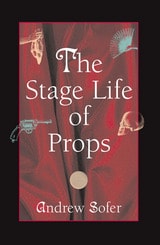
The Stage Life of Props
Andrew Sofer
University of Michigan Press, 2003
Using case studies that explore the Eucharistic wafer on the medieval stage, the bloody handkerchief on the Elizabethan stage, the skull on the Jacobean stage, the fan on the Restoration and early eighteenth-century stage, and the gun on the modern stage, Andrew Sofer reveals how stage props repeatedly thwart dramatic convention and reinvigorate theatrical practice.
While the focus is on specific objects, Sofer also gives us a sweeping history of half a millennium of stage history as seen through the device of the prop, revealing that as material ghosts, stage props are a way for playwrights to animate stage action, question theatrical practice, and revitalize dramatic form.
Andrew Sofer is Assistant Professor of English, Boston College. He was previously a stage director.
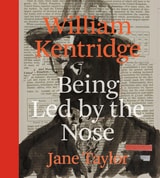
William Kentridge
Being Led by the NoseJane Taylor
University of Chicago Press, 2017
Kentridge has long been admired for his unconventional use of conventional media to produce art that is stunning, evocative, and narratively powerful—and how he works is as important as what he creates. This book is more than just a simple record of The Nose. The opera serves as a springboard into a bracing conversation about how Kentridge’s methods serve his unique mode of expression as a narrative and political artist. Taylor draws on his etchings, sculptures, and drawings to render visible the communication that occurs between his mind and hand as he thinks through the activity of making. Beautifully illustrated in color, William Kentridge offers striking insights about one of the most innovative artists of our present moment.