Results by title
15 books match the query 'Swindlers and swindling'
A Hole in the Ground with a Liar at the Top
Fraud and Deceit in the Golden Age of American MiningDan Plazak
University of Utah Press, 2006
Adventures of Captain Simon Suggs
Late of the Tallapoosa Volunteers; Together with Taking the Census and Other Alabama SketchesJohnson Jones Hooper
University of Alabama Press, 1993
Originally published in 1845, Adventures of Captain Simon Suggs is a series of sketches written in part to parody some the campaign literature of the era. The character, Simon Suggs, with his motto, “it is good to be shifty in a new country,” fully incarnates a backwoods version of the national archetypes now know as the confidence man, the grafter, the professional flim-flam artist supremely skilled in the arts by which a man gets along in the world. This classic volume of good humor is set in the rough-and-tumble world of frontier life and politics.
Crooked Past
The History of a Frontier Mining CampTerrence Cole
University of Alaska Press, 1991
Devil's Game
The Civil War Intrigues of Charles A. DunhamCarman Cumming
University of Illinois Press, 2003
The first book-length study of one of the Civil War's most outlandish and mysterious characters
Devil's Game traces the amazing career of Charles A. Dunham, Civil War spy, forger, journalist, and master of dirty tricks. Writing for a variety of New York papers under alternate names, Dunham routinely faked stories, created new identities, and later boldly cast himself to play those roles. He achieved his greatest infamy when he was called to testify in Washington concerning Abraham Lincoln's assassination. Many parts of Dunham's career remain shadowy, but Cumming offers the first detailed tour of Dunham's convoluted, high-stakes, international deceits, including his effort to sell Lincoln on plans for a raid to capture Jefferson Davis.
Exhaustively researched and unprecedented in depth, this carefully crafted assessment of Dunham's motives, personality, and the complex effects of his schemes changes assumptions about covert operations during the Civil War.
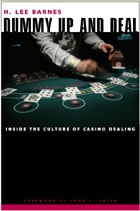
Dummy Up And Deal
Inside The Culture Of Casino DealingH. Lee Barnes
University of Nevada Press, 2011
The glitter and excitement that tourists associate with casinos is only a facade. To the gaming industry's front-line employees, its dealers, the casino is a far less glamorous environment, a workplace full of emotional tension, physical and mental demands, humor and pathos. Author H. Lee Barnes, who spent many years as a dealer in some of Las Vegas's best-known casinos, shows us this world from the point of view of the table-games dealer. Told in the voices of dozens of dealers, male and female, young and old, Dummy Up and Deal takes us to the dealer's side of the table. We observe the "breaking in" that constitutes a dealer's training, where the hands learn the motions of the game while the mind undergoes the requisite hardening to endure long hours of concentration and the demands of often unreasonable and sometimes abusive players. We discover how dealers are hired and assigned to shifts and tables, how they interact with each other and with their supervisors, and how they deal with players—the winners and the losers, the "Sweethearts" and the "Dragon Lady," the tourists looking for a few thrills and the mobsters showing off their "juice." We observe cheaters on both sides of the table and witness the exploits of such high-rollers as Frank Sinatra and Colonel Parker, Elvis's manager. And we learn about the dealers' lives after-hours, how some juggle casino work with family responsibilities while others embrace the bohemian lifestyle of the Strip and sometimes lose themselves to drugs, drink, or sex. It's a life that invites cynicism and bitterness, that can erode the soul and deaden the spirit. But the dealer's life can also offer moments of humor, encounters with generous and kindly players, moments of pride or humanity or professional solidarity. Barnes writes with the candor of a keen observer of his profession, someone who has seen it all—many times—but has never lost his capacity to wonder, to sympathize, or to laugh. Dummy Up and Deal is a colorful insider's view of the casino industry, a fascinating glimpse behind the glitter into the real world of the casino worker.

Enchantment Lake
A Northwoods MysteryMargi Preus
University of Minnesota Press, 2017
Midwest Book Award Winner — Young Adult Fiction
A disturbing call from her great aunts Astrid and Jeannette sends seventeen-year-old Francie far from her new home in New York into a tangle of mysteries. Ditching an audition in a Manhattan theater, Francie travels to a remote lake in the northwoods where her aunts’ neighbors are “dropping like flies” from strange accidents. But are they accidents?
On the shores of Enchantment Lake in the woods of northern Minnesota, something ominous is afoot, and as Francie begins to investigate, the mysteries multiply: a poisoned hotdish, a puzzling confession, eerie noises in the bog, and a legendary treasure said to be under enchantment—or is that under Enchantment, as in under the lake? At the center of everything is a suddenly booming business in cabin sales and a road not everyone wants built.
To a somewhat reluctant northwoods Nancy Drew, the intrigue proves irresistible, especially when it draws her closer to the mysteries at the heart of her own life. What happened to her father? Who and where is her mother? Who is she, and where does her heart lie—in the bustle of New York City or the deep woods of Minnesota? With its gripping story, romantic spirit, and a sly dash of modern-day trouble (including evil realtors and other invasive species), Enchantment Lake will fascinate readers, providing precisely the charm that Margi Preus’s fans have come to expect.
Familiarity Is the Kingdom of the Lost
Dugmore Boetie
Ohio University Press, 2020

Forging Arizona
A History of the Peralta Land Grant and Racial Identity in the WestAnita Huizar-Hernández
Rutgers University Press, 2019
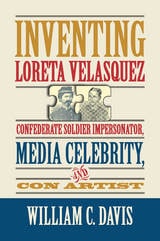
Inventing Loreta Velasquez
Confederate Soldier Impersonator, Media Celebrity, and Con ArtistWilliam C. Davis
Southern Illinois University Press, 2016
This groundbreaking biography reveals a woman quite different from the public persona she promoted. In her bestselling memoir, The Woman in Battle, Velasquez claimed she was an emphatic Confederate patriot, but in fact she never saw combat. Instead, during the war she manufactured bullets for the Union and persuaded her Confederate husband to desert the Army.
After the Civil War ended, she wore many masks, masterminding ambitious confidence schemes worth millions, such as creating a phony mining company, conning North Carolina residents to back her financially in a fake immigration scheme, and attracting investors to build a railroad across western Mexico. With various husbands, Velasquez sought her fortune both in the American West and in the Klondike, though her endeavors cost one husband his life. She also became a social reformer advocating on behalf of better prison conditions, the Cuban revolt against Spain, and the plight of Cuban refugees. Further, Velasquez was one of the first women to venture into journalism and presidential politics. Always a sensational press favorite, she displayed throughout her life an uncanny ability to manipulate popular media and to benefit from her fame in a way that prefigured celebrities of our own time, including using her testimony in a Congressional inquiry about Civil War counterfeiting as a means of promoting her latest business ventures.
So little has been known of Velasquez’s real life that some postmodern scholars have glorified her as a “woman warrior” and used her as an example in cross-gender issues and arguments concerning Hispanic nationalism. Davis firmly refutes these notions by bringing the historical Velasquez to the surface. The genuine story of Velasquez’s life is far more interesting than misguided interpretations and her own fanciful inventions.
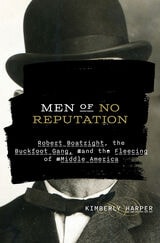
Men of No Reputation
Robert Boatright, the Buckfoot Gang, and the Fleecing of Middle AmericaKimberly Harper
University of Arkansas Press, 2024
Winner, 2025 Missouri Conference on History Book Award
Swindler. Murderer. Scoundrel.
Robert Boatright was one of Middle America’s greatest confidence men. Although little remembered today, his story provides a rare glimpse into America’s criminal past. Working in concert with a local bank and an influential Democratic boss, “this dean of modern confidence men” and his colorful confederacy of con men known as the Buckfoot Gang seemed untouchable. A series of missteps, however, led to a string of court cases across the country that brought Boatright’s own criminal enterprise to an end. And yet, the con continued: Boatright’s successor, John C. Mabray, and his cronies, many of whom had been in the Buckfoot Gang, preyed upon victims across North America in one of the largest midwestern criminal syndicates in history before they were brought to heel.
Like the works of Sinclair Lewis, Boatright’s story exposes a rift in the wholesome midwestern stereotype and furthers our understanding of nineteenth- and twentieth-century American society.
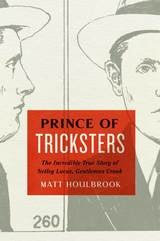
Prince of Tricksters
The Incredible True Story of Netley Lucas, Gentleman CrookMatt Houlbrook
University of Chicago Press, 2016
The lives of Netley Lucas are as flamboyant as they are unlikely. In Prince of Tricksters, Matt Houlbrook picks up the threads of Lucas’s colorful lies and lives. Interweaving crime writing and court records, letters and life-writing, Houlbrook tells Lucas’s fascinating story and, in the process, provides a panoramic view of the 1920s and ’30s. In the restless times after the Great War, the gentlemanly trickster was an exemplary figure, whose tall tales and bogus biographies exposed the everyday difficulties of knowing who and what to trust. Tracing how Lucas both evoked and unsettled the world through which he moved, Houlbrook shows how he prompted a pervasive crisis of confidence that encompassed British society, culture, and politics.
Taking readers on a romp through Britain, North America, and eventually into Africa, Houlbrook confronts readers with the limits of our knowledge of the past and challenges us to think anew about what history is and how it might be made differently.
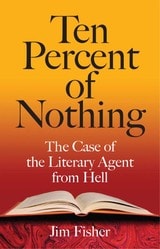
Ten Percent of Nothing
The Case of the Literary Agent from HellJim Fisher
Southern Illinois University Press, 2004
Former FBI agent Jim Fisher upends the genteel racket of fee-based literary agents and vanity publishers in this searing look at the rise and fall of one bogus entrepreneur who systematically swindled thousands of would-be writers out of millions of dollars with promises of having their work turned into salable books. In divulging the details of this colossal and shocking confidence game, Ten Percent of Nothing: The Case of the Literary Agent from Hell exposes a growing and serious crime against writers and a dark, ugly secret about the American publishing industry.
In 1989, Dorothy L. Deering, possessing a high school degree, a recent embezzlement conviction, and no experience as a professional writer, editor, or publisher, began operating a fee-based literary agency out of her garage in Nicholasville, Kentucky. Over the next ten years, she racked up a fortune in reading and marketing fees, learning the business of sham publishing as she went along. Later, as the owner of a vanity press, she bilked 1.5 million dollars out of her clients, masterfully manufacturing dreams of literary success until she was brought to justice by Fisher’s investigative journalism, an FBI probe, and the retaliation and testimonies of numerous victims.
Deering never sold a single manuscript to a major publisher. With the money in her pocket and her clients’ hopes and hard work wrapped up in fraudulent contracts, Deering produced a few copies of four cheaply printed, poorly edited paperbacks. These she used as bait to hoodwink more clients. She was abetted by her husband, Charles, a former car salesman; his son, Daniel, a drug user with a ninth-grade education; and her brother, Bill, a fugitive from the law at the time he headed her vanity press.
By successfully impersonating a literary agent for ten years, Deering operated one of the longest-running confidence games in American history. The financial loss for her clients was devastating, and the heartbreak was extreme. Drawing on victims’ experiences and documents recovered from the Deering venture, Fisher shows how Deering engineered and executed her scam, emphasizing the warning signs of sham agents, crook book doctors, and mendacious publishers.
Ten Percent of Nothing provides essential information for aspiring writers and publishing professionals. Fisher’s findings also prompt new inquiries into the potential licensing of literary agents and the prosecution of interstate scam artists. The volume’s gallery of illustrations includes reproductions of correspondence, newsletters, and advertisements used by the Deering operation.
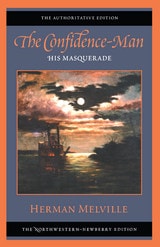
The Confidence-Man
His MasqueradeHerman Melville
Northwestern University Press, 2002
This scholarly edition includes a Historical Note offering a detailed account of the novel's composition, publication, reception, and subsequent critical history. In addition the editors present the twenty-six surviving manuscript leaves and scraps with full transcriptions and analytical commentary.
This scholarly edition aims to present a text as close to the author's intention as surviving evidence permits. Based on collations of both editions publishing during Melville's lifetime, it incorporates 138 emendations made by the present editors. It is an Approved Text of the Center for Editions of American Authors (Modern Language Association of America).
The Confidence-Man
Volume Ten, Scholarly EditionHerman Melville
Northwestern University Press, 1984
This scholarly edition includes a Historical Note offering a detailed account of the novel's composition, publication, reception, and subsequent critical history. In addition the editors present the twenty-six surviving manuscript leaves and scraps with full transcriptions and analytical commentary.
This scholarly edition aims to present a text as close to the author's intention as surviving evidence permits. Based on collations of both editions publishing during Melville's lifetime, it incorporates 138 emendations made by the present editors. It is an Approved Text of the Center for Editions of American Authors (Modern Language Association of America).
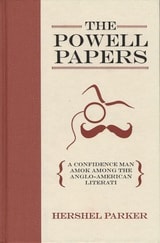
The Powell Papers
A Confidence Man Amok Among the Anglo-American LiteratiHershel Parker
Northwestern University Press, 2011
In 1849—months before the term “confidence man” was coined to identify a New York crook—Thomas Powell (1809–1887), a spherical, monocled, English poetaster, dramatist, journalist, embezzler, and forger, landed in Manhattan. Powell in London had capped a career of grand theft and literary peccadilloes by feigning a suicide attempt and having himself committed to a madhouse, after which he fled England. He had been an intimate of William Wordsworth, Elizabeth Barrett, Robert Browning, Charles Dickens, and a crowd of lesser literary folk.
Thoughtfully bearing what he presented as a volume of Tennyson with a few trifling revisions in the hand of the poet, Powell was embraced by the slavishly Anglophile New York literary establishment, including a young Herman Melville. In two pot-boilers—The Living Authors of England (1849) and The Living Authors of America (1850)—Powell denounced the most revered American author, Washington Irving, for plagiarism; provoked Charles Dickens to vengeful trans-Atlantic outrage and then panic; and capped his insolence by identifying Irving and Melville as the two worst “enemies of the American mind.” For almost four more decades he sniped at Dickens, put words in Melville’s mouth, and survived even the most conscientious efforts to expose him. Long fascinated by this incorrigible rogue, Hershel Parker in The Powell Papers uses a few familiar documents and a mass of freshly discovered material (including a devastating portrait of Powell in a serialized novel) to unfold a captivating tale of skullduggery through the words of great artists and then-admired journalists alike.