Results by title
44 books match the query 'Technical writing'
Academic and Professional Writing in an Age of Accountability
Edited by Shirley Wilson Logan and Wayne H. Slater, with an Afterword by Jessica Enoch and Scott Wible
Southern Illinois University Press, 2018
The first two essays in the book provide a history of the academic and professional writing program at the University of Maryland. Subsequent essays explore successes and challenges in the establishment and development of writing programs at four other major institutions, identify the features of language that facilitate academic and professional communication, look at the ways digital practices in academic and professional writing have shaped how writers compose and respond to texts, and examine the role of assessment in curriculum and pedagogy. An afterword by distinguished rhetoric and composition scholars Jessica Enoch and Scott Wible offers perspectives on the future of academic and professional writing.
This collection takes stock of the historical, rhetorical, linguistic, digital, and evaluative aspects of the teaching of writing in higher education. Among the critical issues addressed are how university writing programs were first established and what early challenges they faced, where writing programs were housed and who administered them, how the language backgrounds of composition students inform the way writing is taught, the ways in which current writing technologies create new digital environments, and how student learning and programmatic outcomes should be assessed.
Aspects of Article Introductions, Michigan Classics Ed.
John M. Swales
University of Michigan Press, 2011
Aspects of Article Introductions has bee reissued to make it more easily available than it has ever been, particularly for the use of university libraries and for younger and newer practitioners and researchers in the rapidly expanding and increasingly global field of EAP.
The original Aspects of Article Introductions appeared in fall 1981 as a ring-bound 90-page monograph. The “publisher” was the Language Studies Unit at the University of Aston in Birmingham. Although essentially an “underground” work, it has remained a relevant part of the short intellectual history of English for Academic Purposes, particularly as genre-based or genre-driven approaches to EAP research and pedagogical practice have become more popular. Its longevity is also a testament to the genre analysis work of John Swales, but in addition, the research article has become the most influential genre in most areas of scholarship, and introductions are at least supposed to be read first and to be designed in such a way as to attract as large readership as possible.
“If I were asked to list the most influential texts in applied linguistics over the last 30 years, John Swales' Aspects of Article Introductions would be in the top three or four. This was a seminal work which not only presented a novel way of analysing texts and a commentary on academic discourse, but one which helped to establish a foundation for the massive interest we see today in describing the structure and features of academic articles. This is not just a text which offers us a glimpse of an intellectual history, but it remains full of fascinating insights and observations about texts and the workings of academic discourse. While the ideas may have evolved and the genre it describes moved on, both the style of writing and the methodology it describes are as fresh and as revealing as anything written on the topic since.” ---Ken Hyland, Hong Kong University
Composing Place
Digital Rhetorics for a Mobile WorldJacob Greene
Utah State University Press, 2022
Greene identifies three emerging “modalities” through which mobile technologies are being used by digital writers. First, to counter dominant discourses in contested spaces; second, to historicize entrenched narratives in iconic spaces; and third, to amplify marginalized voices in mundane spaces. Through these modalities, Greene employs Indigenous philosophies and theories that upend the ways that the discipline has centered placed-based rhetorics, offering digital writers better strategies for using mobile media as a platform for civic deliberation, social advocacy, and political action.
Composing Place offers close analyses of mobile media experiences created by various artists and digital media practitioners, as well as detailed overviews of Greene’s own projects (also accessible through the companion website: www.composingplace.com). These projects include a digital “countertour” of SeaWorld that demonstrates the ways in which the attraction is driven by capitalism; an augmented reality tour of Detroit’s Woodward Avenue; and a mobile advocacy project in Jacksonville, Florida, that demonstrates the inequitable effects of car-centric public infrastructure. Ultimately, by engaging with these theoretical frameworks, rhetorical design principles, and pedagogical practices of mobile writing, readers can utilize the unique affordances of mobile media in various teaching and research contexts.
Designing Multilingual Experiences in Technical Communication
Laura Gonzales
Utah State University Press, 2022
Through grounded case studies of multilingual technical communication projects in the US, Mexico, and Nepal, Laura Gonzales illustrates the multiple tensions at play in transnational research and demonstrates how technical communicators can leverage contemporary translation practices and methodologies to engage in research with multilingual communities that is justice-driven, participatory, and reciprocal.
Designing Multilingual Experiences in Technical Communication is of value to researchers and students across fields who are interested in designing projects alongside multilingual communities from historically marginalized backgrounds.
Eloquent Science
A Practical Guide to Becoming a Better Writer, Speaker and ScientistDavid M. Schultz
American Meteorological Society, 2009
Eloquent Science evolved from a workshop aimed at offering atmospheric science students formal guidance in communications, tailored for their eventual scientific careers. Drawing on advice from over twenty books and hundreds of other sources, this volume presents informative and often humorous tips for writing scientific journal articles, while also providing a peek behind the curtain into the operations of editorial boards and publishers of major journals. The volume focuses on writing, reviewing, and speaking and is aimed at the domain of the student or scientist at the start of her career. The volume offers tips on poster presentations, media communication, and advice for non-native speakers of English, as well as appendices on proper punctuation usage and commonly misunderstood meteorological concepts. A further reading section at the end of each chapter suggests additional sources for the interested reader, and sidebars written by experts in the field offer diverse viewpoints on reference topics.
Environmental Preservation and the Grey Cliffs Conflict
Negotiating Common Narratives, Values, and EthosKristin D. Pickering
Utah State University Press, 2024
Though environmental degradation and unauthorized use threatened the Grey Cliffs recreational lake area to the point that the Corps considered closure, community members valued it highly and wanted to keep it open. The community near this damaged and crime-ridden area needed help rejuvenating its landscape and image, but the Corps and community were sharply divided on how to maintain this beloved geographic space because of the stakeholders’ different cultural backgrounds and values, as well as the narratives used to discuss them. By co-constructing and aligning narratives, values, and ethos over time—a difficult and lengthy process—the Corps and community succeeded, and Grey Cliffs remains open to all. Focusing on field notes, participant interviews, and analysis of various texts created throughout the conflict, Pickering applies rhetorical analysis and a grounded theory approach to regulation, identity, sustainability, and community values to analyze this communication process.
Illustrating the positive change that can occur when governmental organizations and rural communities work together to construct shared values and engage in a rhetoric of relationship that preserves the environment, Environmental Preservation and the Grey Cliffs Conflict provides key recommendations for resolving environmental conflicts within local communities, especially for those working in technical and professional communication, organizational communication, environmental science, and public policy.
Equipping Technical Communicators for Social Justice Work
Theories, Methodologies, and PedagogiesRebecca Walton
Utah State University Press, 2021
For the field of technical and professional communication to maintain its commitment to this work, how social justice intersects with inclusivity through UX, technological, civic, and legal literacies, as well as through community engagement, must be acknowledged. Equipping Technical Communicators for Social Justice Work will be of significance to established scholar-teachers and graduate students, as well as to newcomers to the field.
Contributors: Kehinde Alonge, Alison Cardinal, Erin Brock Carlson, Oriana Gilson, Laura Gonzales, Keith Grant-Davie, Angela Haas, Mark Hannah, Kimberly Harper, Sarah Beth Hopton, Natasha Jones, Isidore Kafui Dorpenyo, Liz Lane, Emily Legg, Nicole Lowman, Kristen Moore, Emma Rose, Fernando Sanchez, Jennifer Sano-Franchini, Adam Strantz, Cana Uluak Itchuaqiyaq, Josephine Walwema, Miriam Williams, Han Yu
Feminist Technical Communication
Apparent Feminisms, Slow Crisis, and the Deepwater Horizon DisasterErin A. Clark
Utah State University Press, 2023
The first book to situate feminisms and technical communication in relationship as the focal point, Feminist Technical Communication traces the thread of feminisms through technical communication’s connection to social justice studies. Clark theorizes “slow crisis,” a concept made readable to technical communicators by apparent feminisms that can help technical communicators readily recognize and address social justice problems. Clark then applies this framework to the Deepwater Horizon Disaster, an extended crisis that has been publicly framed by a traditional view of efficiency that privileges economic impact. Through rich description of apparent feminist information-gathering techniques and a layered analysis this study offers application far beyond this single disaster, making available new crisis-response possibilities that consider the economy without eliding ecological and human health concerns.
Feminist Technical Communication offers a methodological approach to the systematic interrogation of power structures that operate on hidden misogynies. This book is useful to technical communicators, scholars of technical communication and rhetoric, and readers interested in gender studies and public health and is an ideal text for graduate-level seminars focused on feminisms, social justice, and cultural studies.
Forgotten Tribe
Scientists as WritersLisa Emerson
University Press of Colorado, 2017
In The Forgotten Tribe: Scientists as Writers, Lisa Emerson offers an important corrective to the view that scientists are "poor writers, unnecessarily opaque, not interested in writing, and in need of remediation." She argues that scientists are among "the most sophisticated and flexible writers in the academy, often writing for a wider range of audiences (their immediate disciplinary peers, peers in adjacent fields, a broad scientific audience, industry, and a range of public audiences including social media) than most other faculty." Moreover, she notes, the often collaborative and multidisciplinary nature of their work results in writing practices that "may be more socially complex, and require more articulation, mediation, and interpersonal communication, and more use of advanced media and technology than those of faculty in other disciplines."
Drawing on extensive interviews with scientists, Emerson argues that writing scholars have "engaged in a form of cultural appropriation" that has worked against a deeper understanding of the contexts in which scientists work and the considerations they bring to their writing. Emerson grounds her analysis in the voices of scientists in a way that allows us to understand not only how they approach writing but also how we might usefully teach writing in the sciences. The Forgotten Tribe offers a valuable contribution to our understanding of scientific writing, allowing us to hear voices that are seldom included in our discussions of this critical area.
From Lived Experience to the Written Word
Reconstructing Practical Knowledge in the Early Modern WorldPamela H. Smith
University of Chicago Press, 2022
In From Lived Experience to the Written Word, Pamela H. Smith considers how and why, beginning in 1400 CE, European craftspeople began to write down their making practices. Rather than simply passing along knowledge in the workshop, these literate artisans chose to publish handbooks, guides, treatises, tip sheets, graphs, and recipe books, sparking early technical writing and laying the groundwork for how we think about scientific knowledge today.
Focusing on metalworking from 1400–1800 CE, Smith looks at the nature of craft knowledge and skill, studying present-day and historical practices, objects, recipes, and artisanal manuals. From these sources, she considers how we can reconstruct centuries of largely lost knowledge. In doing so, she aims not only to unearth the techniques, material processes, and embodied experience of the past but also to gain insight into the lifeworld of artisans and their understandings of matter.
Handbook for Science Public Information Officers
W. Matthew Shipman
University of Chicago Press, 2015
W. Matthew Shipman’s Handbook for Science Public Information Officers covers all aspects of communication strategy and tactics for members of this growing specialty. It includes how to pitch a story, how to train researchers to navigate interviews, how to use social media effectively, and how to respond to a crisis. The handbook offers a wealth of practical advice while teaching science PIOs how to think critically about what they do and how they do it, so that they will be prepared to take advantage of any situation, rather than being overwhelmed by it.
For all science communicators—whether they’re starting their careers, crossing over from journalism or the research community, or professional communicators looking to hone their PIO skills—Shipman’s Handbook for Science Public Information Officers will become their go-to reference.
Inclusive STEM
Transforming Disciplinary Writing Instruction for a Socially Just FutureHeather M. Falconer
University Press of Colorado, 2025
Key Theoretical Frameworks
Teaching Technical Communication in the Twenty-First CenturyAngela M. Haas
Utah State University Press, 2018
The collection provides a valuable resource for teachers new to translating social justice theories to the classroom by presenting concrete examples related to technical communication. Each contribution adopts a particular theoretical approach, explains the theory, situates it within disciplinary scholarship, contextualizes the approach from the author’s experience, and offers additional teaching applications.
The first volume of its kind, Key Theoretical Frameworks for Teaching Technical Communication in the Twenty-First Century links the theoretical with the pedagogical in order to articulate, use, and assess social justice frameworks for designing and teaching courses in technical communication.
Contributors: Godwin Y. Agboka, Matthew Cox, Marcos Del Hierro, Jessica Edwards, Erin A. Frost, Elise Verzosa Hurley, Natasha N. Jones, Cruz Medina, Marie E. Moeller, Kristen R. Moore, Donnie Johnson Sackey, Gerald Savage, J. Blake Scott, Barbi Smyser-Fauble, Kenneth Walker, Rebecca Walton
Keywords in Technical and Professional Communication
Han Yu
University Press of Colorado, 2024
Pivotal Strategies
Claiming Writing Studies as DisciplineLynn C. Lewis
Utah State University Press, 2024
Because undergraduate degrees in writing studies are relatively new, claiming the discipline has required reinvention and revision at personal and professional levels far different than any other discipline. Suspicions about the viability of the discipline linger in many departments and universities, as well as outside the academy, leading writing studies scholars to develop innovative strategies to deal with covertly hostile attitudes. Within the collection, contributors name explicit claiming strategies from the discipline’s beginnings to the contemporary moment, locating opportune spaces, negotiating identities and fostering resilience, and developing allegiances by foregrounding their embodiment as underrepresented members of academia through a commitment to social justice and equity.
Responding to current conversations on the worth of education with honest stories about the burdens and joys of becoming and being an academic, Pivotal Strategies features a spectrum of voices across racial, gender, class, and age categories. This collection not only makes the discipline more visible but also helps map the contemporary state of writing studies.
Reprogrammable Rhetoric
Critical Making Theories and Methods in Rhetoric and CompositionMichael J. Faris
Utah State University Press, 2022
This collection offers nuanced theoretical perspectives on material and cultural rhetorics alongside practical tutorials for students, researchers, and teachers to explore critical making across traditional areas such as wearable sensors, Arduinos, Twitter bots, multimodal pedagogy, Raspberry Pis, and paper circuitry, as well as underexplored areas like play, gaming, text mining, bots, and electronic monuments.
Designed to be taught in upper division undergraduate and graduate classrooms, these tutorials will benefit non-expert and expert critical makers alike. All contributed codes and scripts are also available on Utah State University Press’s companion website to encourage downloading, cloning, and repurposing.
Contributors: Aaron Beveridge, Kendall Gerdes, Kellie Gray, Matthew Halm, Steven Hammer, Cana Uluak Itchuaqiyaq, John Jones, M.Bawar Khan, Bree McGregor, Sean Morey, Ryan Omizo, Andrew Pilsch, David Rieder, David Sheridan, Wendi Sierra, Nicholas Van Horn
Rhetorical Mediator
Understanding Agency in Indigenous Translation and Interpretation through Indigenous Approaches to UXNora K. Rivera
Utah State University Press, 2023
In places where Indigenous language translation and interpretation are greatly needed, Indigenous language mediators often lack adequate systems to professionalize their field while withstanding Western practices that do not align with their worldviews. Through a “design thinking” methodology based on her work organizing and participating in an Indigenous-focused interpreter and translator conference, Rivera examines testimonios and semi-structured interviews conducted with Indigenous interpreters and translators to emphasize dialogue and desahogo (emotional release) as Indigenous communication practices.
The Rhetorical Mediator advocates for Indigenous language practices that have been sidelined by Western scholarship and systems, helping to create more equitable processes to directly benefit Indigenous individuals and other underrepresented groups. This book benefits specialists, including UX researchers, technical and professional communicators, interpreters and translators, and Indigenous professionals, as well as academics teaching graduate and undergraduate methods, Indigenous rhetoric and translation, and UX courses.
Scientific Style and Format
The CSE Manual for Authors, Editors, and Publishers, Eighth EditionCouncil of Science Editors
University of Chicago Press, 2014
Sojourning in Disciplinary Cultures
A Case Study of Teaching Writing in EngineeringMaureen Mathison
Utah State University Press, 2019
This volume represents the collective experiences and insights of writing consultants involved in the large-scale curriculum reform of the entire College of Engineering; they collaborated closely with faculty members of the various departments and taught writing to engineering students in engineering classrooms. Collaborators developed syllabi that incorporated writing into their courses in meaningful ways, designed lessons to teach various aspects of writing, created assignments that integrated engineering and writing theory and concepts, and worked one-on-one with students to provide revision feedback. Though interactions were sometimes tense, the two groups––writing and engineering––developed a “third culture” that generally placed students at the center of learning.
Sojourning in Disciplinary Cultures provides a guide to successful collaborations with STEM faculty that will be of interest to WPAs, instructors, and a range of both composition scholars and practitioners seeking to understand more about the role of writing and communication in STEM disciplines.
Contributors:
Linn K. Bekins, Sarah A. Bell, Mara K. Berkland, Doug Downs, April A. Kedrowicz, Sarah Read, Julie L. Taylor, Sundy Watanabe
Solving Problems in Technical Communication
Edited by Johndan Johnson-Eilola and Stuart A. Selber
University of Chicago Press, 2012
The field of technical communication is rapidly expanding in both the academic world and the private sector, yet a problematic divide remains between theory and practice. Here Stuart A. Selber and Johndan Johnson-Eilola, both respected scholars and teachers of technical communication, effectively bridge that gap.
Teaching Professional and Technical Communication
A Practicum in a BookTracy Bridgeford
Utah State University Press, 2018
This practicum features chapters by prominent PTC scholars and teachers on rhetoric, style, ethics, design, usability, genre, and other central concerns of PTC programs. Each chapter includes a scenario or personal narrative of teaching a particular topic, provides a theoretical basis for interpreting the narrative, illustrates the practical aspects of the approach, describes relevant assignments, and presents a list of questions to prompt pedagogical discussions.
Teaching Professional and Technical Communication is not a compendium of best practices but instead offers a practical collection of rich, detailed narratives that show inexperienced PTC instructors how to work most effectively in the classroom.
Contributors: Pam Estes Brewer, Eva Brumberger, Dave Clark, Paul Dombrowski, James M. Dubinsky, Peter S. England, David K. Farkas, Brent Henze, Tharon W. Howard, Dan Jones, Karla Saari Kitalong, Traci Nathans-Kelly, Christine G. Nicometo, Kirk St.Amant
Textual Dynamics
Historical & Contemporary Studies OfCharles Bazerman
University of Wisconsin Press, 1991
Invaluable to the new pedagogical field of “writing across the curriculum,” Textual Dynamics of the Professions is also a significant intervention into the studies of rhetoric, writing theory, and the sociology of knowledge.
The Best of Technology Writing 2007
Steven Levy, Editor
University of Michigan Press, 2007
The year’s best writing on tech: a collection as imaginative and compelling as its dynamic subject
“This book is not just an illuminating and instructive guide to our high-tech frontier. It’s also a great testimony to the power of that most ancient of technologies, the written word.”
—Steven Johnson, author of Everything Bad is Good for You
Together the essays in The Best of Technology Writing 2007 capture the versatility and verve of technology writing today. Solicited through an open online nominating process, these pieces explore a wide range of intriguing topics—from “crowdsourcing” to the online habits of urban moms to the digital future of movie production. The Best of Technology Writing 2007 will appeal to anyone who enjoys stellar writing.
Steven Levy is a Senior Editor at Newsweek, where he writes the biweekly column “The Technologist.” One of the most acclaimed and versatile technology writers in the country, Levy has written six books, including The Perfect Thing (about Apple’s iPod) and Hackers, which PC Magazine’s readers voted the best sci-tech book written in the last twenty years. He has written for many publications, including the New Yorker, the New York Times Magazine, Rolling Stone, and Wired.
Featuring contributions from
Kevin Berger
Paul Boutin
Kiera Butler
Joshua Davis
Julian Dibbell
Matt Gaffney
Lori Gottlieb
John Gruber
Jeff Howe
Kevin Kelly
Jaron Lanier
Preston Lerner
Farhad Manjoo
Justin McElroy
Ben McGrath
Katharine Mieszkowski
Emily Nussbaum
Jeffrey M. O’Brien
Larry O’Brien
The Onion
Adam L. Penenberg
John Seabrook
Philip Smith
Aaron Swartz
Clive Thompson
Jeffrey R. Young
digitalculturebooks is an imprint of the University of Michigan Press and the Scholarly Publishing Office of the University of Michigan Library dedicated to publishing innovative and accessible work exploring new media and their impact on society, culture, and scholarly communication. Visit the website at www.digitalculture.org.
The Best of Technology Writing 2008
Clive Thompson, Editor
University of Michigan Press, 2008
"No one covers technology with more insight or panache than Clive Thompson. I can't imagine anyone better qualified to curate this fascinating series."
---Chris Anderson, editor in chief of Wired magazine and author of The Long Tail
"Editor Clive Thompson suggests we are in a ‘golden age of technology journalism.' Reading this collection, one suspects he is right---it sparkles with beautifully written narratives not only about what technology can do for us but what it does to us as people, to our ways of thinking about ourselves, our relationships, and how we envisage our world."
---Sherry Turkle, Director, MIT Initiative on Technology and Self, Massachusetts Institute of Technology
The Best of Technology Writing 2008 proves that technology writing is a bona fide literary genre with some of the most stylish, compelling, and just plain readable work in journalism today.
The third volume in this annual series, The Best of Technology Writing 2008 covers a fascinating mix of topics---from a molecular gastronomist's recipe for the perfect gin and tonic; to "the Mechanism," an ancient Greek artifact that might be the world's first laptop computer; to social media, privacy, and what is possibly the biggest generation gap since rock 'n' roll.
Featuring contributions from
- Ted Allen
- Michael Behar
- Caleb Crain
- Julian Dibbell
- Cory Doctorow
- David Glenn
- Thomas Goetz
- Charles Graeber
- Alex Hutchinson
- Walter Kirn
- Robin Mejia
- Emily Nussbaum
- Ben Paynter
- Jeffrey Rosen
- John Seabrook
- Cass R. Sunstein
digitalculturebooks is an imprint of the University of Michigan Press and the Scholarly Publishing Office of the University of Michigan Library dedicated to publishing innovative and accessible work exploring new media and their impact on society, culture, and scholarly communication. Visit the website at www.digitalculture.org.
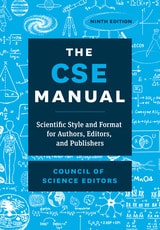
The CSE Manual, Ninth Edition
Scientific Style and Format for Authors, Editors, and PublishersCouncil of Science Editors
University of Chicago Press, 2024
The CSE Manual: Scientific Style and Format for Authors, Editors, and Publishers delivers complete coverage of rules and best practices in scientific publishing. Since 1960, the esteemed Council of Science Editors has offered authoritative guidance on presenting scientific writing more clearly and effectively. In the ninth edition of The CSE Manual, this leading international association offers its most comprehensive recommendations yet, continuing to guide writers and editors through the ever-evolving world of scientific publishing. Available in print and by subscription online.
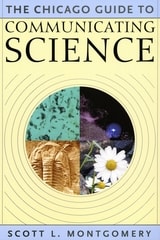
The Chicago Guide to Communicating Science
Scott L. Montgomery
University of Chicago Press, 2002
He also traces the evolution of scientific expression over time, providing a context crucial for understanding the nature of technical communication today. Other chapters take up the topics of writing creatively in science; how to design and use graphics; and how to talk to the public about science. Written with humor and eloquence, this book provides a unique and realistic guide for anyone in the sciences wishing to improve his or her communication skills.
Practical and concise, The Chicago Guide to Communicating Science covers:
*Writing scientific papers, abstracts, grant proposals, technical reports, and articles for the general public
*Using graphics effectively
*Surviving and profiting from the review process
*Preparing oral presentations
*Dealing with the press and the public
*Publishing and the Internet
*Writing in English as a foreign language
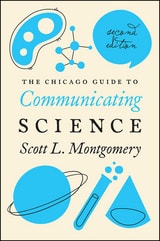
The Chicago Guide to Communicating Science
Second EditionScott L. Montgomery
University of Chicago Press, 2017
For more than a decade, The Chicago Guide to Communicating Science has been the go-to reference for anyone who needs to write or speak about their research. Whether a student writing a thesis, a faculty member composing a grant proposal, or a public information officer crafting a press release, Scott Montgomery’s advice is perfectly adaptable to any scientific writer’s needs.
This new edition has been thoroughly revised to address crucial issues in the changing landscape of scientific communication, with an increased focus on those writers working in corporate settings, government, and nonprofit organizations as well as academia. Half a dozen new chapters tackle the evolving needs and paths of scientific writers. These sections address plagiarism and fraud, writing graduate theses, translating scientific material, communicating science to the public, and the increasing globalization of research.
The Chicago Guide to Communicating Science recognizes that writers come to the table with different needs and audiences. Through solid examples and concrete advice, Montgomery sets out to help scientists develop their own voice and become stronger communicators. He also teaches readers to think about their work in the larger context of communication about science, addressing the roles of media and the public in scientific attitudes as well as offering advice for those whose research concerns controversial issues such as climate change or emerging viruses.
More than ever, communicators need to be able to move seamlessly among platforms and styles. The Chicago Guide to Communicating Science’s comprehensive coverage means that scientists and researchers will be able to expertly connect with their audiences, no matter the medium.
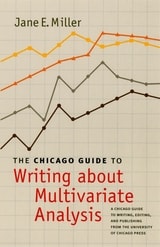
The Chicago Guide to Writing about Multivariate Analysis
Jane E. Miller
University of Chicago Press, 2005
Here, Jane Miller offers much-needed help to academic researchers as well as to analysts who write for general audiences. The Chicago Guide to Writing about Multivariate Analysis brings together advanced statistical methods with good expository writing. Starting with twelve core principles for writing about numbers, Miller goes on to discuss how to use tables, charts, examples, and analogies to write a clear, compelling argument using multivariate results as evidence.
Writers will repeatedly look to this book for guidance on how to express their ideas in scientific papers, grant proposals, speeches, issue briefs, chartbooks, posters, and other documents. Communicating with multivariate models need never appear so complicated again.
The Chicago Guide to Writing about Multivariate Analysis, Second Edition
Jane E. Miller
University of Chicago Press, 2013
The Chicago Guide to Writing about Multivariate Analysis is the book researchers turn to when looking for guidance on how to clearly present statistical results and break through the jargon that often clouds writing about applications of statistical analysis. This new edition features even more topics and real-world examples, making it the must-have resource for anyone who needs to communicate complex research results.
For this second edition, Jane E. Miller includes four new chapters that cover writing about interactions, writing about event history analysis, writing about multilevel models, and the “Goldilocks principle” for choosing the right size contrast for interpreting results for different variables. In addition, she has updated or added numerous examples, while retaining her clear voice and focus on writers thinking critically about their intended audience and objective. Online podcasts, templates, and an updated study guide will help readers apply skills from the book to their own projects and courses.
This continues to be the only book that brings together all of the steps involved in communicating findings based on multivariate analysis—finding data, creating variables, estimating statistical models, calculating overall effects, organizing ideas, designing tables and charts, and writing prose—in a single volume. When aligned with Miller’s twelve fundamental principles for quantitative writing, this approach will empower readers—whether students or experienced researchers—to communicate their findings clearly and effectively.
The Chicago Guide to Writing about Numbers
Jane E. Miller
University of Chicago Press, 2004
Until now. Here, Jane Miller, an experienced research methods and statistics teacher, gives writers the assistance they need. The Chicago Guide to Writing about Numbers helps bridge the gap between good quantitative analysis and good expository writing. Field-tested with students and professionals alike, this book shows writers how to think about numbers during the writing process.
Miller begins with twelve principles that lay the foundation for good writing about numbers. Conveyed with real-world examples, these principles help writers assess and evaluate the best strategy for representing numbers. She next discusses the fundamental tools for presenting numbers—tables, charts, examples, and analogies—and shows how to use these tools within the framework of the twelve principles to organize and write a complete paper.
By providing basic guidelines for successfully using numbers in prose, The Chicago Guide to Writing about Numbers will help writers of all kinds clearly and effectively tell a story with numbers as evidence. Readers and writers everywhere will be grateful for this much-needed mentor.
The Chicago Guide to Writing about Numbers, Second Edition
Jane E. Miller
University of Chicago Press, 2015
Miller, an experienced teacher of research methods, statistics, and research writing, opens by introducing a set of basic principles for writing about numbers, then presents a toolkit of techniques that can be applied to prose, tables, charts, and presentations. Throughout the book, she emphasizes flexibility, showing writers that different approaches work for different kinds of data and different types of audiences.
The second edition adds a chapter on writing about numbers for lay audiences, explaining how to avoid overwhelming readers with jargon and technical issues. Also new is an appendix comparing the contents and formats of speeches, research posters, and papers, to teach writers how to create all three types of communication without starting each from scratch. An expanded companion website includes new multimedia resources such as slide shows and podcasts that illustrate the concepts and techniques, along with an updated study guide of problem sets and suggested course extensions.
This continues to be the only book that brings together all the tasks that go into writing about numbers, integrating advice on finding data, calculating statistics, organizing ideas, designing tables and charts, and writing prose all in one volume. Field-tested with students and professionals alike, this holistic book is the go-to guide for everyone who writes or speaks about numbers.
The Craft of Research
Wayne C. Booth, Gregory G. Colomb, and Joseph M. Williams
University of Chicago Press, 1995
This book is organized into four parts. Part One is a spirited introduction to the distinctive nature, values, and protocols of research. Part Two demystifies the art of discovering a topic. It outlines a wide range of sources, among them personal interests and passions. Parts Three and Four cover the essentials of argument—how to make a claim and support it—and ways to outline, draft, revise, rewrite, and polish the final report. Part Three is a short course in the logic, structure, uses, and common pitfalls of argumentation. The writing chapters in Part Four show how to present verbal and visual information effectively and how to shape sentences and paragraphs that communicate with power and precision.
"A well-constructed, articulate reminder of how important fundamental questions of style and approach, such as clarity and precision, are to all research."—Times Literary Supplement
The Craft of Research, 2nd edition
Wayne C. Booth, Gregory G. Colomb, and Joseph M. Williams
University of Chicago Press, 2003
Like its predecessor, this new edition reflects the way researchers actually work: in a complex circuit of thinking, writing, revising, and rethinking. It shows how each part of this process influences the others and how a successful research report is an orchestrated conversation between a researcher and a reader. Along with many other topics, The Craft of Research explains how to build an argument that motivates readers to accept a claim; how to anticipate the reservations of thoughtful yet critical readers and to respond to them appropriately; and how to create introductions and conclusions that answer that most demanding question, "So what?"
Celebrated by reviewers for its logic and clarity, this popular book retains its five-part structure. Part 1 provides an orientation to the research process and begins the discussion of what motivates researchers and their readers. Part 2 focuses on finding a topic, planning the project, and locating appropriate sources. This section is brought up to date with new information on the role of the Internet in research, including how to find and evaluate sources, avoid their misuse, and test their reliability.
Part 3 explains the art of making an argument and supporting it. The authors have extensively revised this section to present the structure of an argument in clearer and more accessible terms than in the first edition. New distinctions are made among reasons, evidence, and reports of evidence. The concepts of qualifications and rebuttals are recast as acknowledgment and response. Part 4 covers drafting and revising, and offers new information on the visual representation of data. Part 5 concludes the book with an updated discussion of the ethics of research, as well as an expanded bibliography that includes many electronic sources.
The new edition retains the accessibility, insights, and directness that have made The Craft of Research an indispensable guide for anyone doing research, from students in high school through advanced graduate study to businesspeople and government employees. The authors demonstrate convincingly that researching and reporting skills can be learned and used by all who undertake research projects.
New to this edition:
Extensive coverage of how to do research on the internet, including how to evaluate and test the reliability of sources
New information on the visual representation of data
Expanded bibliography with many electronic sources
The Craft of Research, Fifth Edition
Wayne C. Booth, Gregory G. Colomb, Joseph M. Williams, Joseph Bizup, and William T. FitzGerald
University of Chicago Press, 2024
With more than a million copies sold since its first publication, The Craft of Research has helped generations of researchers at every level—from high-school students and first-year undergraduates to advanced graduate students to researchers in business and government. Conceived by seasoned researchers and educators Wayne C. Booth, Gregory G. Colomb, and Joseph M. Williams, this fundamental work explains how to choose significant topics, pose genuine and productive questions, find and evaluate sources, build sound and compelling arguments, and convey those arguments effectively to others.
While preserving the book’s proven approach to the research process, as well as its general structure and accessible voice, this new edition acknowledges the many ways research is conducted and communicated today. Thoroughly revised by Joseph Bizup and William T. FitzGerald, it recognizes that research may lead to a product other than a paper—or no product at all—and includes a new chapter about effective presentations. It features fresh examples from a variety of fields that will appeal to today’s students and other readers. It also accounts for new technologies used in research and offers basic guidelines for the appropriate use of generative AI. And it ends with an expanded chapter on ethics that addresses researchers’ broader obligations to their research communities and audiences as well as systemic questions about ethical research practices.
This new edition will be welcomed by a new and more diverse generation of researchers.
The Craft of Research, Fourth Edition
Wayne C. Booth, Gregory G. Colomb, Joseph M. Williams, Joseph Bizup and William T. FitzGerald
University of Chicago Press, 2016
With more than three-quarters of a million copies sold since its first publication, The Craft of Research has helped generations of researchers at every level—from first-year undergraduates to advanced graduate students to research reporters in business and government—learn how to conduct effective and meaningful research. Conceived by seasoned researchers and educators Wayne C. Booth, Gregory G. Colomb, and Joseph M. Williams, this fundamental work explains how to find and evaluate sources, anticipate and respond to reader reservations, and integrate these pieces into an argument that stands up to reader critique.
The fourth edition has been thoroughly but respectfully revised by Joseph Bizup and William T. FitzGerald. It retains the original five-part structure, as well as the sound advice of earlier editions, but reflects the way research and writing are taught and practiced today. Its chapters on finding and engaging sources now incorporate recent developments in library and Internet research, emphasizing new techniques made possible by online databases and search engines. Bizup and FitzGerald provide fresh examples and standardized terminology to clarify concepts like argument, warrant, and problem.
Following the same guiding principle as earlier editions—that the skills of doing and reporting research are not just for elite students but for everyone—this new edition retains the accessible voice and direct approach that have made The Craft of Research a leader in the field of research reference. With updated examples and information on evaluation and using contemporary sources, this beloved classic is ready for the next generation of researchers.
- Over 700,000 copies sold
- Every step of the academic research process, from the “why” of research through forming the research question, formulating an argument, and revision
- Helpful chapters on research ethics, formulation of writing assignments for teachers, and an appendix of research tools for both off and online
- Clear advice on building a strong argument in an age of false claims
- Careful attention to both the how and why of objective research-based writing
- Easy to follow, time-tested advice
- A must-have for any college or graduate student
The Craft of Research, Third Edition
Wayne C. Booth, Gregory G. Colomb, and Joseph M. Williams
University of Chicago Press, 2008
The Craft of Scientific Communication
Joseph E. Harmon and Alan G. Gross
University of Chicago Press, 2010
The ability to communicate in print and person is essential to the life of a successful scientist. But since writing is often secondary in scientific education and teaching, there remains a significant need for guides that teach scientists how best to convey their research to general and professional audiences. The Craft of Scientific Communication will teach science students and scientists alike how to improve the clarity, cogency, and communicative power of their words and images.
In this remarkable guide, Joseph E. Harmon and Alan G. Gross have combined their many years of experience in the art of science writing to analyze published examples of how the best scientists communicate. Organized topically with information on the structural elements and the style of scientific communications, each chapter draws on models of past successes and failures to show students and practitioners how best to negotiate the world of print, online publication, and oral presentation.
The Idea of a Writing Laboratory
Neal Lerner
Southern Illinois University Press, 2009
The Idea of a Writing Laboratory is a book about possibilities, about teaching and learning to write in ways that can transform both teachers and students.
Author Neal Lerner explores higher education’s rich history of writing instruction in classrooms, writing centers and science laboratories. By tracing the roots of writing and science educators’ recognition that the method of the lab––hands-on student activity—is essential to learning, Lerner offers the hope that the idea of a writing laboratory will be fully realized more than a century after both fields began the experiment.
Beginning in the late nineteenth century, writing instructors and science teachers recognized that mass instruction was inadequate for a burgeoning, “non-traditional” student population, and that experimental or laboratory methods could prove to be more effective. Lerner traces the history of writing instruction via laboratory methods and examines its successes and failures through case studies of individual programs and larger reform initatives. Contrasting the University of Minnesota General College Writing Laboratory with the Dartmouth College Writing Clinic, for example, Lerner offers a cautionary tale of the fine line between experimenting with teaching students to write and “curing” the students of the disease of bad writing.
The history of writing within science education also wends its way through Lerner’s engaging work, presenting the pedagogical origins of laboratory methods to offer educators in science in addition to those in writing studies possibilities for long-sought after reform. The Idea of a Writing Laboratory compels readers and writers to “don those white coats and safety glasses and discover what works” and asserts that “teaching writing as an experiment in what is possible, as a way of offering meaning-making opportunities for students no matter the subject matter, is an endeavor worth the struggle.”
The Scientific Journal
Authorship and the Politics of Knowledge in the Nineteenth CenturyAlex Csiszar
University of Chicago Press, 2018
The Scientific Journal tells the story of how that changed. Alex Csiszar takes readers deep into nineteenth-century London and Paris, where savants struggled to reshape scientific life in the light of rapidly changing political mores and the growing importance of the press in public life. The scientific journal did not arise as a natural solution to the problem of communicating scientific discoveries. Rather, as Csiszar shows, its dominance was a hard-won compromise born of political exigencies, shifting epistemic values, intellectual property debates, and the demands of commerce. Many of the tensions and problems that plague scholarly publishing today are rooted in these tangled beginnings. As we seek to make sense of our own moment of intense experimentation in publishing platforms, peer review, and information curation, Csiszar argues powerfully that a better understanding of the journal’s past will be crucial to imagining future forms for the expression and organization of knowledge.
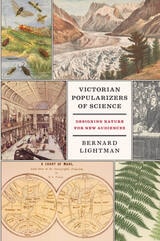
Victorian Popularizers of Science
Designing Nature for New AudiencesBernard Lightman
University of Chicago Press, 2007
Bernard Lightman examines more than thirty of the most prolific, influential, and interesting popularizers of the day, investigating the dramatic lecturing techniques, vivid illustrations, and accessible literary styles they used to communicate with their audience. By focusing on a forgotten coterie of science writers, their publishers, and their public, Lightman offers new insights into the role of women in scientific inquiry, the market for scientific knowledge, tensions between religion and science, and the complexities of scientific authority in nineteenth-century Britain.
Wicked, Incomplete, and Uncertain
User Support in the Wild and the Role of Technical CommunicationJason Swarts
Utah State University Press, 2018
Technical writers traditionally create large volumes of idealized tasks and procedures in help documentation, but this is no longer the only approach, or even the best approach. Shifting responsibility for user support to users via crowdsourcing is a risky alternative. Just as with other mass-collaborative enterprises, contributors to a forum may not be aware of the kind of knowledge they are creating or how their contributions connect with those made by others. Wicked, Incomplete, and Uncertain describes the kinds of writing and help practices in which user forums engage, why users seem to find these forums credible and appealing, and what companies can learn about building user communities to support this form of assistance.
Through investigation of user-forum activities, Swarts identifies a new set of contributions that technical communicators can make—not only by creating content but also by curating content, shaping conversations, feeding information back into the user community, and opening channels of discovery and knowledge creation that can speak to users and software developers alike
Writing Science in Plain English
Anne E. Greene
University of Chicago Press, 2013
Writing Science in Plain English, Second Edition
Anne E. Greene
University of Chicago Press, 2025
Scientific writing is often dry, wordy, and difficult to understand. But, as biologist and experienced teacher of scientific writing Anne E. Greene shows in Writing Science in Plain English, writers from all scientific disciplines can learn to produce clear, concise prose by mastering just a few simple principles. This short, focused guide presents roughly a dozen such principles based on what readers need to understand complex information, including concrete subjects, strong verbs, consistent terms, organized paragraphs, and correct sentence structure. Greene illustrates each principle with real-life examples of both good and bad writing and shows how bad writing might be improved. She ends each chapter with revision exercises (and provides suggested answers in a separate key) so that readers can come away with new writing skills after just one sitting. To help readers understand the grammatical terms used in the book, an appendix offers a refresher course on basic grammar.
For this second edition, Greene has incorporated the latest research on what makes writing effective and engaging and has revised or replaced exercises and exercise keys where needed. She has also added new features that make it easier to navigate the book. A new resource for instructors who use Writing Science in Plain English in their classes is a free, online teacher’s guide. Drawn from Greene’s long experience teaching students how to write science clearly, the teacher’s guide provides additional lectures, assignments, and activities that will inform and enliven any class.
Writing Workplace Cultures
An Archaeology of Professional WritingJim Henry
Southern Illinois University Press, 2000
In Writing Workplace Cultures: An Archaeology of Professional Writing, Jim Henry analyzes eighty-three workplace writing ethnographies composed over seven years in a variety of organizations. He views the findings as so many shards in an archaeology on professional writing at the beginning of the twenty-first century.
These ethnographies were composed by either practicing or aspiring writers participating in a Master’s program in professional writing and editing. Henry solicited the writers' participation in "informed intersubjective research" focused on issues and questions of their own determination. Most writers studied their own workplace, composing "auto-ethnographies" that problematize these workplaces' local cultures even as they depict writing practices within them.
Henry establishes links between current professional writing practices and composition instruction as both were shaped by national economic development and local postsecondary reorganization throughout the twentieth century. He insists that if we accept basic principles of social constructionism, the text demonstrates ways in which writers "write" workplace cultures to produce goods and services whose effects go far beyond the immediate needs of its clients.