Results by title
12 books match the query 'Trojan War'
Euripides and the Poetics of Sorrow
Art, Gender, and Commemoration in Alcestis, Hippolytus, and HecubaCharles Segal
Duke University Press, 1993
Alcestis, Hippolytus, and Hecuba, the three early plays interpreted here, are linked by common themes of violence, death, lamentation and mourning, and by their implicit definitions of male and female roles. Segal shows how these plays draw on ancient traditions of poetic and ritual commemoration, particularly epic song, and at the same time refashion these traditions into new forms. In place of the epic muse of martial glory, Euripides, Segal argues, evokes a muse of sorrows who transforms the suffering of individuals into a "common grief for all the citizens," a community of shared feeling in the theater.
Like his predecessors in tragedy, Euripides believes death, more than any other event, exposes the deepest truth of human nature. Segal examines the revealing final moments in Alcestis, Hippolytus, and Hecuba, and discusses the playwright's use of these deaths--especially those of women--to question traditional values and the familiar definitions of male heroism. Focusing on gender, the affective dimension of tragedy, and ritual mourning and commemoration, Segal develops and extends his earlier work on Greek drama. The result deepens our understanding of Euripides' art and of tragedy itself.
Grafting Helen
The Abduction of the Classical PastMatthew Gumpert
University of Wisconsin Press, 2001
Grafting Helen looks at "classicism"—the privileged rhetorical language for describing cultural origins in the West—as a protracted form of cultural embezzlement. No coin in the realm has been more valuable, more circulated, more coveted, or more counterfeited than the one that bears the face of Helen of Troy. Gumpert uncovers Helen as the emblem for the past as something to be stolen, appropriated, imitated, extorted, and coveted once again.
Tracing the figure of Helen from its classical origins through the Middle Ages, the French Renaissance, and the modern era, Gumpert suggests that the relation of current Western culture to the past is not like the act of coveting; it is the act of coveting, he argues, for it relies on the same strategies, the same defenses, the same denials, and the same delusions.
Iliad, Book 1
Homer
University of Michigan Press, 2002
Nature and Culture in the Iliad
The Tragedy of HectorJames M. Redfield
Duke University Press, 1994
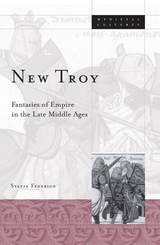
New Troy
Fantasies Of Empire In The Late Middle AgesSylvia Federico
University of Minnesota Press, 2003
Examines the political and literary uses of the Trojan legend in the medieval period
England in the late fourteenth century witnessed a large-scale social revolt, a lingering and seemingly hopeless war with France, and fierce factional conflicts in royal politics and London civic government—struggles in which all parties sought to justify their actions by claiming historical precedent. How the Trojan legend figured in these claims—and in competing assertions of authorial legitimacy, nationhood, and rule in the later Middle Ages—is the complex nexus of history, myth, literature, and identity that Sylvia Federico explores in this ambitious book.
During the late medieval period, many European political and social groups took great pains to associate themselves with the ancient city; the claim on Troy, Federico asserts, was crucial to nationhood and was always a political act. Her book examines the poetry and prose of several late medieval authors, focusing particularly on how Chaucer’s use of the Trojan legend helped to set the terms by which the Ricardian and Lancastrian periods were distinguished, and further helped to establish English literary history as a noble precedent in its own right. Federico’s book affords remarkable insight into the workings of the medieval historical imagination.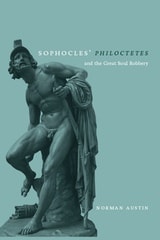
Sophocles' Philoctetes and the Great Soul Robbery
Norman Austin
University of Wisconsin Press, 2011
Norman Austin brings both keen insight and a life-long engagement with his subject to this study of Sophocles’ late tragedy Philoctetes, a fifth-century BCE play adapted from an infamous incident during the Trojan War. In Sophocles’ “Philoctetes” and the Great Soul Robbery, Austin examines the rich layers of text as well as context, situating the play within the historical and political milieu of the eclipse of Athenian power. He presents a study at once of interest to the classical scholar and accessible to the general reader. Though the play, written near the end of Sophocles’ career, is not as familiar to modern audiences as his Theban plays, Philoctetes grapples with issues—social, psychological, and spiritual—that remain as much a part of our lives today as they were for their original Athenian audience.

The Heart of Achilles
Characterization and Personal Ethics in the IliadGraham Zanker
University of Michigan Press, 1996
"[Zanker] investigates altruistic behavior in the epic with professional sophistication but in a way that makes his investigation available to a wide audience from undergraduates to advanced scholars. . . . [A] very useful interpretative study." --Choice
Graham Zanker is Senior Lecturer in Classics, University of Canterbury, New Zealand.
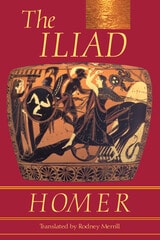
The Iliad
Homer
University of Michigan Press, 2007
nuances of English."
---Stephen G. Daitz, Professor Emeritus of Classics, City University of New York
Rodney Merrill's translation of Homer's Iliad offers a form of English poetry particularly relevant to the epic, producing a strong musical setting that brings many elements of the narrative truly to life. Most notable are the many battle scenes, in which Homer's strong dactylic hexameters make credible the "war-lust" in the deeds of the combatants.
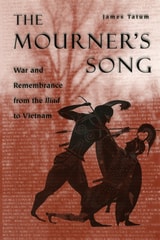
The Mourner's Song
War and Remembrance from the Iliad to VietnamJames Tatum
University of Chicago Press, 2002
Tatum's touchstone throughout is the Iliad, not just one of the earliest war poems, but also one of the most powerful examples of the way poetry can be a tribute to and consolation for what is lost in war. Reading the Iliad alongside later works inspired by war, Tatum reveals how the forms and processes of art convert mourning to memorial. He examines the role of remembrance and the distance from war it requires; the significance of landscape in memorialization; the artifacts of war that fire the imagination; the intimate relationship between war and love and its effects on the ferocity with which soldiers wage battle; and finally, the idea of memorialization itself. Because all survivors suffer the losses of war, Tatum's is a story of both victims and victors, commanders and soldiers, women and men. Photographs of war memorials in Vietnam, France, and the United States beautifully augment his testimonials.
Eloquent and deeply moving, The Mourner's Song will speak to anyone interested in the literature of war and the relevance of the classics to our most pressing contemporary needs.
Troilus and Cressida
William Shakespeare
Arizona Center for Medieval and Renaissance Studies, 2022
One of the most obscure plays in Shakespeare’s canon, Troilus and Cressida may also be the Bard’s darkest comedy. Exploring some of the events of Homer’s Iliad, the play juxtaposes the carnage of the Trojan War with a love story between its two titular characters. Lillian Groag’s translation brings this ancient world to modern audiences. Replacing the archaisms with new and accessible phrasing, Shakespeare’s lines regain their meaning and humor in the twenty-first century. This translation illuminates Troilus and Cressida as one of Shakespeare’s funniest, saddest, and most bitterly modern plays.
This translation of Troilus and Cressida was written as part of the Oregon Shakespeare Festival’s Play On! project, which commissioned new translations of thirty-nine Shakespeare plays. These translations present work from “The Bard” in language accessible to modern audiences while never losing the beauty of Shakespeare’s verse. Enlisting the talents of a diverse group of contemporary playwrights, screenwriters, and dramaturges from diverse backgrounds, this project reenvisions Shakespeare for the twenty-first century. These volumes make these works available for the first time in print—a new First Folio for a new era.
Trojan Women, Helen, Hecuba
Three Plays about Women and the Trojan WarEuripides, Verse translations by Francis Blessington, with introductions and notes
University of Wisconsin Press, 2015
Francis Blessington combines his work as a poet, translator, and teacher of literature and Greek with his theatrical experience to create fresh and faithful verse translations suitable for the stage, the classroom, or the general reader. The three plays are augmented by introductions, notes, and an appendix on elements of Greek tragedy. Blessington glosses historical and mythological terms, identifies Greek themes in the texts, offers literary interpretations, and suggests topics for discussion.

War Music
An Account of Books 1-4 and 16-19 of Homer's IliadChristopher Logue
University of Chicago Press, 2003