Results by title
9 books match the query 'Uncle Tom's cabin'
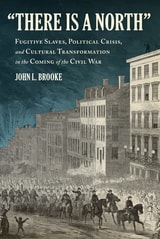
"There Is a North"
Fugitive Slaves, Political Crisis, and Cultural Transformation in the Coming of the Civil WarJohn L. Brooke
University of Massachusetts Press, 2019
How does political change take hold? In the 1850s, politicians and abolitionists despaired, complaining that the "North, the poor timid, mercenary, driveling North" offered no forceful opposition to the power of the slaveholding South. And yet, as John L. Brooke proves, the North did change. Inspired by brave fugitives who escaped slavery and the cultural craze that was Uncle Tom's Cabin, the North rose up to battle slavery, ultimately waging the bloody Civil War.
While Lincoln's alleged quip about the little woman who started the big war has been oft-repeated, scholars have not fully explained the dynamics between politics and culture in the decades leading up to 1861. Rather than simply viewing the events of the 1850s through the lens of party politics, “There Is a North” is the first book to explore how cultural action—including minstrelsy, theater, and popular literature—transformed public opinion and political structures. Taking the North's rallying cry as his title, Brooke shows how the course of history was forever changed.
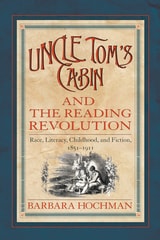
"Uncle Tom's Cabin" and the Reading Revolution
Race, Literacy, Childhood, and Fiction, 1851-1911Barbara Hochman
University of Massachusetts Press, 2011
"Uncle Tom's Cabin" and the Reading Revolution explores a transformation in the cultural meaning of Stowe's influential book by addressing changes in reading practices and a shift in widely shared cultural assumptions. These changes reshaped interpretive conventions and generated new meanings for Stowe's text in the wake of the Civil War.
During the 1850s, men, women, and children avidly devoured Stowe's novel. White adults wept and could not put the book down, neglecting work and other obligations to complete it. African Americans both celebrated and denounced the book. By the 1890s, readers understood Uncle Tom's Cabin in new ways. Prefaces and retrospectives celebrated Stowe's novel as a historical event that led directly to emancipation and national unity. Commentaries played down the evangelical and polemical messages of the book.
Illustrations and children's editions projected images of entertaining and devoted servants into an open-ended future. In the course of the 1890s, Uncle Tom's Cabin became both a more viciously racialized book than it had been and a less compelling one. White readers no longer consumed the book at one sitting; Uncle Tom's Cabin was now more widely known than read. However, in the growing silence surrounding slavery at the turn of the century, Stowe's book became an increasingly important source of ideas, facts, and images that the children of ex-slaves and other free-black readers could use to make sense of their position in U.S. culture.
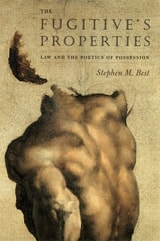
The Fugitive's Properties
Law and the Poetics of PossessionStephen M. Best
University of Chicago Press, 2004
Best also argues that legal principles dealing with fugitives and indebted persons provided a sophisticated precursor to intellectual property law as it dealt with rights in appearance, expression, and other abstract aspects of personhood. In this conception of property as fleeting, indeed fugitive, American law preserved for much of the rest of the century slavery's most pressing legal imperative: the production of personhood as a market commodity. By revealing the paradoxes of this relationship between fugitive slave law and intellectual property law, Best helps us to understand how race achieved much of its force in the American cultural imagination. A work of ambitious scope and compelling cross-connections, The Fugitive's Properties sets new agendas for scholars of American literature and legal culture.
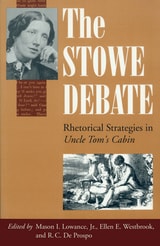
The Stowe Debate
Rhetorical Strategies in "Uncle Tom's Cabin"Mason I. Lowance
University of Massachusetts Press, 1994
The thirteen contributors to this volume enter these debates from a variety of critical perspectives. They address questions of language and ideology, the tradition of the sentimental novel, biblical influences, and the rhetoric of antislavery discourse. As much as they disagree on various points, they share a keen interest in the cultural work that texts can do and an appreciation of the enduring power of Uncle Tom's Cabin.
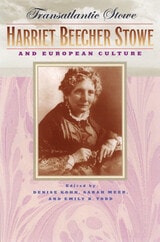
Transatlantic Stowe
Harriet Beecher Stowe and European CultureDenise Kohn
University of Iowa Press, 2006
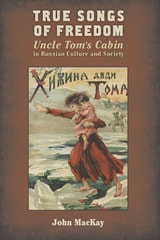
True Songs of Freedom
Uncle Tom’s Cabin in Russian Culture and SocietyJohn MacKay
University of Wisconsin Press, 2013

Uncle Tom's Cabin and the Reading Revolution
Hochman Barbara
University of Massachusetts Press, 2011
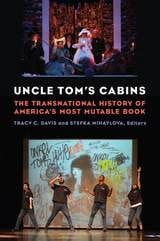
Uncle Tom's Cabins
The Transnational History of America's Most Mutable BookTracy C. Davis and Stefka Mihaylova, Editors
University of Michigan Press, 2018
Throughout these encounters, Stowe’s story of American slavery serves as a paradigm for understanding oppression, selectively and strategically refracting the African American slave onto other iconic victims and freedom fighters. The book brings together performance historians, literary critics, and media theorists to demonstrate how the myriad cultural and political effects of Stowe’s enduring story has transformed it into a global metanarrative with national, regional, and local specificity.
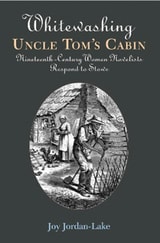
Whitewashing Uncle Tom's Cabin
Nineteenth-Century Women Novelists Respond to StoweJoy Jordan-Lake
Vanderbilt University Press, 2005