Results by title
24 books match the query 'Union'

A Scientist's Guide To Talking With The Media
Practical Advice from the Union of Concerned ScientistsGrossman, Daniel
Rutgers University Press, 2006
In A Scientist's Guide to Talking with the Media, Richard Hayes and Daniel Grossman draw on their expertise in public relations and journalism to empower researchers in a variety of fields to spread their message on their own terms. The authors provide tips on how to translate abstract concepts into concrete metaphors, craft soundbites, and prepare for interviews. For those looking for a higher profile, the authors explain how to become a reporter's trusted source-the first card in the Rolodex-on controversial issues.
A must-read for all scientists, this book shows how it is possible for the discoveries that hibernate in lecture halls and academic journals to reach a broader audience in a way that is accurate and effective.
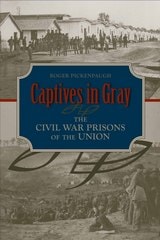
Captives in Gray
The Civil War Prisons of the UnionRoger Pickenpaugh
University of Alabama Press, 2009
“This is a vivid description of conditions and events rarely described: the imprisonment of captured Confederate soldiers during the Civil War. Its many parallels to circumstances in Andersonville are especially intriguing.” —Jimmy Carter, 39th President of the United States
Contains contemporary reports from prisoners and witnesses humanize the grim realities of the POW camps.
Captives in Gray is Civil War prison camp authority Roger Pickenpaugh’s acclaimed and definitive account of the Union’s POW camps. Combining his own extensive research into official records and a rich variety of letters and diaries with the best contemporary scholarship, Pickenpaugh covers every major northern camp.
Because the Union won few victories in 1861 and took few prisoners, the North had time to plan and build prison camps, an opportunity it largely squandered. Pickenpaugh gives illuminating accounts of the role and leadership of thrifty Lieutenant Colonel William Hoffman, the commissary general of prisoners for most of the conflict, and President Abraham Lincoln's secretaries of war, the incompetent Simon Cameron and the malignant Edwin M. Stanton.
Death came in many ways. Soldiers from the Deep South had no experience with extreme cold, and they died by the hundreds each winter. In one memorable freeze, Rock Island, Illinois, saw temperatures between twenty-eight and thirty-one degrees below zero. With insufficient fuel and inadequate shelter, clothing, and blankets, prisoners there and in other camps froze to death. Food rations varied widely. A few Confederates enjoyed better rations than they had in the CSA armies, but the majority supplemented their meager rations by eating rats, dogs, cats, and seagulls.
Poor medical care added to the death toll. Treatment was bad even by the standards of Civil War medicine, often due to Hoffman's reluctance to spend. Prisoners suffered from lice and scurvy, as well as pneumonia, measles, and a variety of fevers. As in both armies, diarrhea and dysentery were chronic. Smallpox epidemics killed many. Poor sanitation and drainage caused 385 deaths at Elmira, New York, in September 1864 alone.
During the war, over 12 percent of rebel prisoners, or 25,976 of the 214,865, died in captivity. Together with his Captives in Blue, Captives in Gray gives the fullest account of the experiences of prisoners of war in the American Civil War.
Choosing Europe?
The European Electorate and National Politics in the Face of UnionCees van der Eijk and Mark N. Franklin
University of Michigan Press, 1996
This is a book about elections to the European Parliament, their failure to legitimate and control the exercise of power in the European Union, and the consequences of this failure for domestic politics in EU member states. It also sheds new light on why voters behave the way they do. The authors examine the 1989 Europe-wide elections with the aid of large-scale surveys fielded in all twelve member countries of the (then) European Community--placing European citizens within their institutional, political, economic, and social contexts. In particular, because three countries held national elections concurrently with the 1989 European elections, the study controls for the presence or absence of a national election context--permitting the authors to investigate electoral behavior in general, not just at European elections. Looking at such behavior while taking account of the strategic contexts within which elections are held has yielded new insights about turnout and party choice, while clarifying the crisis of legitimacy that faces the European Union. The more recent Europe-wide elections of 1994 are used to validate the findings.
This book will be of interest to political scientists interested in elections, the European Union, comparative politics, and political development.
Dividing the Union
Jesse Burgess Thomas and the Making of the Missouri CompromiseMatthew W. Hall
Southern Illinois University Press, 2015
In 1820 the Missouri controversy erupted over the issue of slavery in the newly acquired lands of the Louisiana Purchase. It fell to Jesse Burgess Thomas (1777–1853), a junior U.S. senator from the new state of Illinois, to handle the delicate negotiations that led to the Missouri Compromise. Thomas’s maturity, good judgment, and restraint helped pull the country back from the brink of disunion and created a compromise that held for thirty-four years. In Dividing the Union, Matthew W. Hall examines the legal issues underlying the controversy and the legislative history of the Missouri Compromise while focusing on the aspects of Thomas’s life and character that gave him such influence. The first in-depth biography of Thomas, Hall’s work demonstrates how the legislative battle over the Compromise reflected the underlying nuances of the larger struggle over slavery.
The text of the Missouri Compromise originated from the Northwest Ordinance. Article VI of the Ordinance purported to prohibit slavery in the Northwest Territory, but paradoxically, a provision that assured property rights in another article was used to protect slavery. People in some parts of the Northwest sought to circumvent Article VI by formulating indenture laws and various state constitutional provisions addressing slavery. Pro- and antislavery activists eventually developed quite different interpretations of the relevant language in these documents, making negotiations over slavery in the new territory extremely complicated.
As Hall demonstrates, Thomas was perfectly situated geographically, politically, and ideologically to navigate the Missouri controversy. He was the first speaker of the Indiana Territorial General Assembly, one of the first territorial judges in the Illinois Territory, and the president of the Illinois State Constitutional Convention in 1818. Because the drive for statehood in Illinois was strong, the convention managed to skirt the divisive issue of slavery, due in large part to Thomas’s efforts. That he was never required to clearly articulate his own views on slavery allowed Thomas to maintain a degree of neutrality, and his varied political career gave him the experience necessary to craft a compromise.
Thomas’s final version of the Compromise included shrewdly worded ambiguities that supported opposing interests in the matter of slavery. These ambiguities secured the passage of the Compromise and its endurance until the Kansas-Nebraska Act of 1854. By weaving Thomas’s life story into the history of the Missouri Compromise, Hall offers new insight into both a pivotal piece of legislation and an important, previously overlooked figure in nineteenth-century American politics.

FOR THE UNION
OHIO LEADERS IN THE CIVIL WARKENNETH W. WHEELER
The Ohio State University Press, 1998
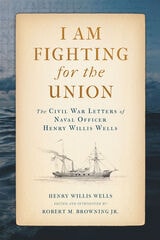
I Am Fighting for the Union
The Civil War Letters of Naval Officer Henry Willis WellsHenry Willis Wells, edited and introduced by Robert M. Browning Jr.
University of Alabama Press, 2023
A young officer’s insightful, detailed and steadfast devotion to the Union Navy—told in his own words.
On May 18, 1862, Henry Willis Wells wrote a letter to his mother telling her in clear terms, “I am fighting for the Union.” Since August 1861, when he joined the US Navy as a master’s mate he never wavered in his loyalty. He wrote to his family frequently that he considered military service a necessary and patriotic duty, and the career that ensued was a dramatic one, astutely and articulately documented by Wells in more than 200 letters home, leaving an invaluable account of daily life in the Union Navy.
Wells joined the navy shortly after the war began, initially on board the Cambridge, attached to the North Atlantic Blockading Squadron, which patrolled the waters of the Chesapeake Bay. He witnessed the Battle of Hampton Roads and the fight between the ironclads CSS Virginia and the USS Monitor. Next, the Cambridge assisted in the blockade of Wilmington, North Carolina. In one instance, the warship chased the schooner J. W. Pindar ashore during her attempt to run the blockade, and Confederate forces captured Henry’s boarding party. After a short prison stay in the infamous Libby Prison in Richmond, his Confederate captors paroled Henry. He travelled back to Brookline, and soon thereafter the Navy Department assigned him to the gunboat Ceres, which operated on the sounds and rivers of North Carolina, protecting army positions ashore. Henry was on board during the Confederate attempt to capture Washington, North Carolina. During this April 1863 attack, Henry was instrumental in the town’s defense, commanding a naval battery ashore during the latter part of the fight.
His exceptional service gained him a transfer to a larger warship, the USS Montgomery, again on the blockade of Wilmington. Later the service assigned him to the Gem of the Sea, part of the East Gulf Blockading Squadron. Through his hard work and professionalism, he finally earned his first command. In September 1864, he became the commanding officer of the Rosalie, a sloop used as a tender to the local warships. Later he commanded the schooner Annie, also a tender. At the end of December 1864, however, the Annie suffered a massive explosion, killing all hands, including Wells. He was twenty-three years old when his life and career ended tragically. Wells’s letters document both his considerable achievements and his frustrations. His challenges, triumphs, and disappointments are rendered with candor. I Am Fighting for the Union is a vital and deeply personal account of a momentous chapter in the history of the Civil War and its navies.
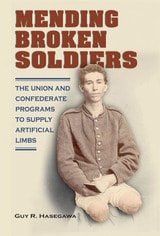
Mending Broken Soldiers
The Union and Confederate Programs to Supply Artificial LimbsGuy R. Hasegawa
Southern Illinois University Press, 2012
Guy R. Hasegawa presents the first volume to explore the wartime provisions made for amputees in need of artificial limbs—programs that were the forebears of modern governmental efforts to assist in the rehabilitation of wounded service members. Hasegawa offers a comprehensive look at the artificial-limb industry, including detailed descriptions of the ingenious designs employed by manufacturers; illustrations and photographs of period prosthetics; accounts of the rapid advancement of medical technology during the Civil War; and in-depth examinations of the companies that manufactured limbs for soldiers and bid for contracts, including at least one still in existence today. An intriguing account of innovation, determination, humanitarianism, and the devastating toll of battle, Mending Broken Soldiers provides a fascinating glimpse into groundbreaking military health programs during the most tumultuous years in American history.
Out in the Union
A Labor History of Queer AmericaMiriam Frank
Temple University Press, 2015
Out in the Union tells the continuous story of queer American workers from the mid-1960s through 2013. Miriam Frank shrewdly chronicles the evolution of labor politics with queer activism and identity formation, showing how unions began affirming the rights of lesbian, gay, bisexual, and transgender workers in the 1970s and 1980s. She documents coming out on the job and in the union as well as issues of discrimination and harassment, and the creation of alliances between unions and LGBT communities.
Featuring in-depth interviews with LGBT and labor activists, Frank provides an inclusive history of the convergence of labor and LGBT interests. She carefully details how queer caucuses in local unions introduced domestic partner benefits and union-based AIDS education for health care workers-innovations that have been influential across the U.S. workforce. Out in the Union also examines organizing drives at queer workplaces, campaigns for marriage equality, and other gay civil rights issues to show the enduring power of LGBT workers.
Secession and the Union in Texas
By Walter L. Buenger
University of Texas Press, 1984
In 1845 Texans voted overwhelmingly to join the Union. They voted just as overwhelmingly to secede in 1861. The story of why and how that happened is filled with colorful characters, such as the aged Sam Houston, and with the southwestern flavor of raiding Comanches, German opponents of slavery, and a border with Mexico.
Texas was unique among the seceding states because of its ambivalence toward secession. Yet for all its uniqueness the story of the secession of Texas has broad implications for the secession movement in general. Despite the local color and the southwestern nature of the state, Texas was more southern than western in 1860. Texans supported the Union or insisted upon secession for reasons common to the South and to the whole nation. Most Texans in 1860 were recent immigrants from southern and border states. They still thought and acted like citizens of their former states. The newness of Texas then makes it a particularly appropriate place from which to draw conclusions about the entire secession movement.
Secession and the Union in Texas is both a narrative of secession in Texas and a case study of the causes of secession in a southern state. Politics play a key role in this history, but politics broadly defined to include the influence of culture, partisanship, ideology, and self-interest. As any study of a mass movement carried out in tense circumstances must be, this is social history as well as political history. It is a study of public hysteria, the pressure for consensus, and the vanishing of a political process in which rational debate about secession and the Union could take place.
Although relying primarily on traditional sources such as manuscript collections and newspapers, a particularly rich source for this study, the author also uses election returns, population shifts over the course of the 1850s, and the breakdown of population within Texas counties to provide a balanced approach.
These sources indicate that Texans were not simply secessionists or unionists. At the end of 1860 Texans ranged from ardent secessionists to equally passionate supporters of the Union. But the majority fell in between these two extremes, creating an atmosphere of ambivalence toward secession which was not erased even by the war.
State of the Union
America in the 1990s, Economic TrendsReynolds Farley
Russell Sage Foundation, 1995
State of the Union
America in the 1990s, Social TrendsReynolds Farley
Russell Sage Foundation, 1995

The Constitutional Convention and Formation of Union
Edited by Winton U. Solberg
University of Illinois Press, 1990
The Federal Future of Europe
From the European Community to the European UnionDusan Sidjanski
University of Michigan Press, 2000
The author argues that federalism is the best antidote to the reemergence of nationalism in Europe. It is also the best guarantee for a peaceful community that balances the claims of national, regional, and local identity against the need for large-scale economies that springs from the forces of globalization, competition, and technical change. The Union preserves diversity within a flexible and innovating European system.
This major study of the development of the European project, informed by a thorough knowledge of the Community and Union over the years and by deep understanding of the relevant literatures in political science and political economy is important for all who study the European Union or work with it as officials and business people.
Dusan Sidjanski is founder and Professor Emeritus of the Department of Political Science, University of Geneva and Professor Emeritus, European Institute. He has authored numerous publications, most recently, The ECE in the Age of Change (United Nations Economic Commission for Europe, United Nations).
The Limits of Sovereignty
Property Confiscation in the Union and the Confederacy during the Civil WarDaniel W. Hamilton
University of Chicago Press, 2006
Americans take for granted that government does not have the right to permanently seize private property without just compensation. Yet for much of American history, such a view constituted the weaker side of an ongoing argument about government sovereignty and individual rights. What brought about this drastic shift in legal and political thought?
Daniel W. Hamilton locates that change in the crucible of the Civil War. In the early days of the war, Congress passed the First and Second Confiscation Acts, authorizing the Union to seize private property in the rebellious states of the Confederacy, and the Confederate Congress responded with the broader Sequestration Act. The competing acts fueled a fierce, sustained debate among legislators and lawyers about the principles underlying alternative ideas of private property and state power, a debate which by 1870 was increasingly dominated by today’s view of more limited government power.
Through its exploration of this little-studied consequence of the debates over confiscation during the Civil War, The Limits of Sovereignty will be essential to an understanding of the place of private property in American law and legal history.
The Limits to Union
Same-Sex Marriage and the Politics of Civil RightsJonathan Goldberg-Hiller
University of Michigan Press, 2004
"The Limits to Union is a superb book about the complexities of recent political struggles over same-sex marriage. Goldberg-Hiller offers a sophisticated account of egalitarian rights advocacy and the reaction it has generated from established majorities animated by a 'new common sense' of exclusionary sovereign authority. The author's analysis is multidimensional and nuanced, but the core argument is bold, important, and well-supported. I recommend it very highly to everyone interested in understanding the character, possibilities, and constraints of civil rights amid our contemporary culture wars."
-Michael McCann, author of Rights at Work: Pay Equity Reform and the Politics of Legal Mobilization
"In this excellent book, Goldberg-Hiller uses Hawaii's experience to examine the interaction between courts and the political system. . . . Relying on briefs, legislative statements, and interviews with activists from both sides of the question, he views this familiar debate . . . through the unfamiliar prism of gay marriage, which allows him to gauge the viability and the pliability of the American civil rights ideal, and how gay and lesbian issues fit (or don't fit) within that ideal."
-Willian Heinzen, New York Law Journal
"Goldberg-Hiller presents the history of the same-sex marriage question since it first sparked debate in Hawaii. He follows the shifting debate through court cases, state propositions, and state and federal legislatures, considering questions about the constitutionality of the Defense of Marriage Act and the concept of equal protection under the law for gays and lesbians. This detailed treatment of the legal issues surrounding same-sex marriages is highly recommended."
-R. L. Abbott, University of Evansville
"[A] valuable contribution to the field, situating the gay marriage debate in broader contexts of theory, law and practice. [S]ame-sex marriage is an important issue...that finds itself caught in the friction points of much larger debates over the nature of rights, the limits of sovereignty and the proper role of courts and law in a democratic society. The Limits to Union should therefore be of interest even to those who do not think of themselves as interested in gay and lesbian rights issues."
-Evan Gerstmann, Loyola Marymount University, Law and Politics Book Review

The Limits to Union
Same-Sex Marriage and the Politics of Civil RightsJonathan Goldberg-Hiller
University of Michigan Press, 2002
"The Limits to Union is a superb book about the complexities of recent political struggles over same-sex marriage. Goldberg-Hiller offers a sophisticated account of egalitarian rights advocacy and the reaction it has generated from established majorities animated by a 'new common sense' of exclusionary sovereign authority. The author's analysis is multidimensional and nuanced, but the core argument is bold, important, and well-supported. I recommend it very highly to everyone interested in understanding the character, possibilities, and constraints of civil rights amid our contemporary culture wars."
-Michael McCann, author of Rights at Work: Pay Equity Reform and the Politics of Legal Mobilization
"In this excellent book, Goldberg-Hiller uses Hawaii's experience to examine the interaction between courts and the political system. . . . Relying on briefs, legislative statements, and interviews with activists from both sides of the question, he views this familiar debate . . . through the unfamiliar prism of gay marriage, which allows him to gauge the viability and the pliability of the American civil rights ideal, and how gay and lesbian issues fit (or don't fit) within that ideal."
-Willian Heinzen, New York Law Journal
"Goldberg-Hiller presents the history of the same-sex marriage question since it first sparked debate in Hawaii. He follows the shifting debate through court cases, state propositions, and state and federal legislatures, considering questions about the constitutionality of the Defense of Marriage Act and the concept of equal protection under the law for gays and lesbians. This detailed treatment of the legal issues surrounding same-sex marriages is highly recommended."
-R. L. Abbott, University of Evansville
"[A] valuable contribution to the field, situating the gay marriage debate in broader contexts of theory, law and practice. [S]ame-sex marriage is an important issue...that finds itself caught in the friction points of much larger debates over the nature of rights, the limits of sovereignty and the proper role of courts and law in a democratic society. The Limits to Union should therefore be of interest even to those who do not think of themselves as interested in gay and lesbian rights issues."
-Evan Gerstmann, Loyola Marymount University, Law and Politics Book Review
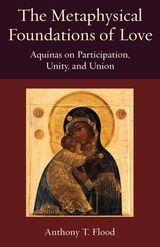
The Metaphysical Foundations of Love
Aquinas on Participation, Unity, and UnionAnthony T. Flood
Catholic University of America Press, 2018
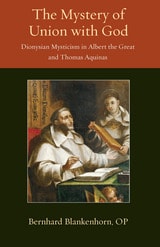
The Mystery of Union with God
Bernhard Blankenhorn
Catholic University of America Press, 2015

The Presence of God and Union with God
Creation, Divine Indwelling Through Grace, Incarnation and the Blessed Vision According to Saint Thomas AquinasGilles Emery, OP
Catholic University of America Press, 2027
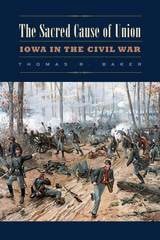
The Sacred Cause of Union
Iowa in the Civil WarThomas R. Baker
University of Iowa Press, 2016
To shed light on how individual Iowans experienced the war, the book profiles six state residents. Three were well-known. Annie Wittenmyer, a divorced woman with roots in Virginia, led the state’s efforts to ship clothing and food to the soldiers. Alexander Clark, a Muscatine businessman and the son of former slaves, eloquently championed the rights of African Americans. Cyrus Carpenter, a Pennsylvania-born land surveyor anxious to make his fortune, served in the army and then headed the state’s Radical Republican faction after the war, ultimately being elected governor.
Three never became famous. Ben Stevens, a young, unemployed carpenter, fought in an Iowa regiment at Shiloh, and then transferred to a Louisiana African American regiment so that he could lead the former slaves into battle. Farm boy Abner Dunham defended the Sunken Road at the Battle of Shiloh, before spending seven grim months in Confederate prison camps. The young Charles Musser faced pressure from his neighbors to enlist and from his parents to remain at home to work on the farm. Soon after he signed on to serve the Union, he discovered that his older brother had joined the Confederate Army. Through the letters and lives of these six Iowans, Thomas Baker shows how the Civil War transformed the state at the same time that Iowans transformed the nation.
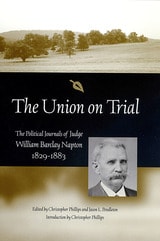
The Union on Trial
The Political Journals of Judge William Barclay Napton, 1829-1883Edited by Christopher Phillips & Jason L. Pendleton. Introduction by Christopher Phillips
University of Missouri Press, 2005
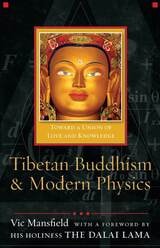
Tibetan Buddhism and Modern Physics
Toward a Union of Love and KnowledgeVic Mansfield
Templeton Press, 2008
Tibetan Buddhism and Modern Physics: Toward a Union of Love and Knowledge addresses the complex issues of dialogue and collaboration between Buddhism and science, revealing connections and differences between the two. While assuming no technical background in Buddhism or physics, this book strongly responds to the Dalai Lama’s “heartfelt plea” for genuine collaboration between science and Buddhism. The Dalai Lama has written a foreword to the book and the Office of His Holiness will translate it into both Chinese and Tibetan.
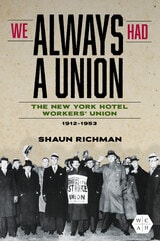
We Always Had a Union
The New York Hotel Workers' Union, 1912-1953Shaun Richman
University of Illinois Press, 2025
From the start, New York’s organized hotel workers experimented with and adapted how they organized and governed members and related to other labor unions. Richman follows union fortunes from early IWW activity through the Communist-led affiliates of the American Federation of Labor in the 1920s and 1930s, the shaping of breakthrough negotiating strategies, and the postwar era. As Richman shows, workers adopted a radicalism and militancy seldom associated with an AFL organization while openly negotiating the Communist Party’s power and influence within the union, until the Party’s eclipse in the 1950s.
An inspiring story of action and perseverance, We Always Had a Union profiles a foundational American labor union and offers lessons for today’s workers and organizers.
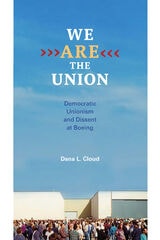
We Are the Union
Democratic Unionism and Dissent at BoeingDana L. Cloud
University of Illinois Press, 2011
We Are the Union is grounded in on-site research and interviews and focuses on the efforts by Unionists for Democratic Change to reform unions from within. Incorporating theory and methods from the fields of organizational communication as well as labor studies, Cloud methodically uncovers and analyzes the goals, strategies, and dilemmas of the dissidents who, while wanting to uphold the ideas and ideals of the union, took up the gauntlet to make it more responsive to workers and less conciliatory toward management, especially in times of economic stress or crisis. Cloud calls for a revival of militant unionism as a response to union leaders' embracing of management and training programs that put workers in the same camp as management, arguing that reform groups should look to the emergence of powerful industrial unions in the United States for guidance on revolutionizing existing institutions and building new ones that truly accommodate workers' needs.