Results by title
11 books match the query 'Virtual reality'
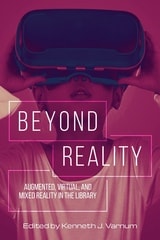
Beyond Reality
Augmented, Virtual, and Mixed Reality in the LibraryKenneth J. Varnum
American Library Association, 2019
Bodies In Technology
Don Ihde
University of Minnesota Press, 2001
An original exploration of the ways cyberspace affects human experience.
New technologies suggest new ideas about embodiment: our "reach" extends to global sites through the Internet; we enter cyberspace through the engines of virtual reality. In this book, a leading philosopher of technology explores the meaning of bodies in technology-how the sense of our bodies and of our orientation in the world is affected by the various information technologies.
Bodies in Technology begins with an analysis of embodiment in cyberspace, then moves on to consider ways in which social theorists have interpreted or overlooked these conditions. An astute and sensible judge of these theories, Don Ihde is a uniquely provocative and helpful guide through contemporary thinking about technology and embodiment, drawing on sources and examples as various as video games, popular films, the workings of e-mail, and virtual reality techniques.Charting the historical, philosophical, and practical territory between virtual reality and real life, this work is an important contribution to the national conversation on the impact technology-and information technology in particular-has on our lives in a wired, global age.
Continental Drift
From National Characters to Virtual SubjectsEmily Apter
University of Chicago Press, 1999
Among the many topics Apter explores are the fate of national literatures in an increasingly transnational literary climate; the volatile stakes of Albert Camus's life and reputation against the backdrop of Algerian civil strife; the use of literary and theatrical productions to "script" national character for the colonies; belly-dancing and aesthetic theory; and the impact of new media on colonial and postcolonial representation, from tourist photography to the videos of Digital Diaspora.
Continental Drift advances debates not just in postcolonial studies, but also in gender, identity, and cultural studies; ethnography; psychoanalysis; and performance studies.
Digital Sensations
Space, Identity, And Embodiment In Virtual RealityKen Hillis
University of Minnesota Press, 1999
Considers the cultural and philosophical assumptions underlying virtual reality, and how the technology affects the real world.
Virtual reality is in the news and in the movies, on TV and in the air. Why is the technology-or the idea—so prevalent precisely now? What does it mean—what does it do—to us? Digital Sensations looks closely at how the “lived” world is affected by representational forms generated by communication technologies, especially digital and optical virtual technologies.
Virtual reality, or VR, is a technological reproduction of the process of perceiving the real, yet that process is filtered through the social realities and embedded cultural assumptions about human bodies and space held by the technology’s creators. Through critical histories of the technologies of vision, light, space, and embodiment, Ken Hillis traces the often contradictory intellectual and metaphysical impulses behind the Western transcendental wish to achieve an ever more perfect copy of the real. He advocates that current and proposed virtual technologies reflect a Western desire to escape the body. Because virtual technologies are new, these histories also address unintended and underconsidered consequences flowing from their rapid dissemination, such as commodifications and the alienation of new forms of surveillance. Exploring topics from VR and other, earlier visual technologies, Hillis’s penetrating perspective on the cultural power of place and space broadens our view of the interplay between social relations and technology.
How We Became Posthuman
Virtual Bodies in Cybernetics, Literature, and InformaticsN. Katherine Hayles
University of Chicago Press, 1999
Hayles relates three interwoven stories: how information lost its body, that is, how it came to be conceptualized as an entity separate from the material forms that carry it; the cultural and technological construction of the cyborg; and the dismantling of the liberal humanist "subject" in cybernetic discourse, along with the emergence of the "posthuman."
Ranging widely across the history of technology, cultural studies, and literary criticism, Hayles shows what had to be erased, forgotten, and elided to conceive of information as a disembodied entity. Thus she moves from the post-World War II Macy Conferences on cybernetics to the 1952 novel Limbo by cybernetics aficionado Bernard Wolfe; from the concept of self-making to Philip K. Dick's literary explorations of hallucination and reality; and from artificial life to postmodern novels exploring the implications of seeing humans as cybernetic systems.
Although becoming posthuman can be nightmarish, Hayles shows how it can also be liberating. From the birth of cybernetics to artificial life, How We Became Posthuman provides an indispensable account of how we arrived in our virtual age, and of where we might go from here.
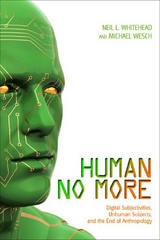
Human No More
Digital Subjectivities, Unhuman Subjects, and the End of AnthropologyNeil L. Whitehead
University Press of Colorado, 2012
Online worlds have recently thrown into question the traditional anthropological conception of place-based ethnography. They break definitions, blur distinctions, and force us to rethink the notion of the "subject." Human No More asks how digital cultures can be integrated and how the ethnography of both the "unhuman" and the "digital" could lead to possible reconfiguring the notion of the "human."
This provocative and groundbreaking work challenges fundamental assumptions about the entire field of anthropology. Cross-disciplinary research from well-respected contributors makes this volume vital to the understanding of contemporary human interaction. It will be of interest not only to anthropologists but also to students and scholars of media, communication, popular culture, identity, and technology.
In the Land of the Unreal
Virtual and Other Realities in Los AngelesLisa Messeri
Duke University Press, 2024
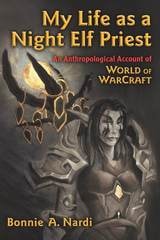
My Life as a Night Elf Priest
An Anthropological Account of World of WarcraftBonnie A. Nardi
University of Michigan Press, 2010
"Ever since the creators of the animated television show South Park turned their lovingly sardonic gaze on the massively multiplayer online game World of Warcraft for an entire episode, WoW's status as an icon of digital culture has been secure. My Life as a Night Elf Priest digs deep beneath the surface of that icon to explore the rich particulars of the World of Warcraft player's experience."
—Julian Dibbell, Wired
"World of Warcraft is the best representative of a significant new technology, art form, and sector of society: the theme-oriented virtual world. Bonnie Nardi's pioneering transnational ethnography explores this game both sensitively and systematically using the methods of cultural anthropology and aesthetics with intensive personal experience as a guild member, media teacher, and magical quest Elf."
—Lisa Nakamura, University of Illinois
World of Warcraft rapidly became one of the most popular online world games on the planet, amassing 11.5 million subscribers—officially making it an online community of gamers that had more inhabitants than the state of Ohio and was almost twice as populous as Scotland. It's a massively multiplayer online game, or MMO in gamer jargon, where each person controls a single character inside a virtual world, interacting with other people's characters and computer-controlled monsters, quest-givers, and merchants.
In My Life as a Night Elf Priest, Bonnie Nardi, a well-known ethnographer who has published extensively on how theories of what we do intersect with how we adopt and use technology, compiles more than three years of participatory research in Warcraft play and culture in the United States and China into this field study of player behavior and activity. She introduces us to her research strategy and the history, structure, and culture of Warcraft; argues for applying activity theory and theories of aesthetic experience to the study of gaming and play; and educates us on issues of gender, culture, and addiction as part of the play experience. Nardi paints a compelling portrait of what drives online gamers both in this country and in China, where she spent a month studying players in Internet cafes.
Bonnie Nardi has given us a fresh look not only at World of Warcraft but at the field of game studies as a whole. One of the first in-depth studies of a game that has become an icon of digital culture, My Life as a Night Elf Priest will capture the interest of both the gamer and the ethnographer.
Bonnie A. Nardi is an anthropologist by training and a professor in the Department of Informatics in the Donald Bren School of Information and Computer Sciences at the University of California, Irvine. Her research focus is the social implications of digital technologies. She is the author of A Small Matter of Programming: Perspectives on End User Computing and the coauthor of Information Ecologies: Using Technology with Heart and Acting with Technology: Activity Theory and Interaction Design.
Cover art by Jessica Damsky
My Mother Was a Computer
Digital Subjects and Literary TextsN. Katherine Hayles
University of Chicago Press, 2005
My Mother Was a Computer explores how the impact of code on everyday life has become comparable to that of speech and writing: language and code have grown more entangled, the lines that once separated humans from machines, analog from digital, and old technologies from new ones have become blurred. My Mother Was a Computer gives us the tools necessary to make sense of these complex relationships. Hayles argues that we live in an age of intermediation that challenges our ideas about language, subjectivity, literary objects, and textuality. This process of intermediation takes place where digital media interact with cultural practices associated with older media, and here Hayles sharply portrays such interactions: how code differs from speech; how electronic text differs from print; the effects of digital media on the idea of the self; the effects of digitality on printed books; our conceptions of computers as living beings; the possibility that human consciousness itself might be computational; and the subjective cosmology wherein humans see the universe through the lens of their own digital age.
We are the children of computers in more than one sense, and no critic has done more than N. Katherine Hayles to explain how these technologies define us and our culture. Heady and provocative, My Mother Was a Computer will be judged as her best work yet.
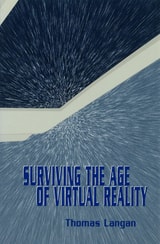
Surviving the Age of Virtual Reality
Thomas Langan
University of Missouri Press, 2000
As the technological phenomenon known as the worldwide web permeates civilization, it creates some cultures and destroys others. In this pioneering book, philosopher Thomas Langan explores "virtual reality"Can inherently contradictory phrase"and the effects of technology on our very being. In our present-day high- technology environment, making simple, everyday decisions is difficult because the virtual world we've created doesn't necessarily operate according to the old "common sense." To retain our intellectual fitness, we must, Langan argues, consider these essential questions: If virtual reality is, in fact, reality, what is this life that we are caught up in? What is being within the context of virtual reality? How can we establish a system for distinguishing truth from fiction?
Although technology minimizes distances between people and makes the information they seek more accessible, it simultaneously blurs the line dividing fact from falsehood and real from virtual. An individual's intellectual survival is threatened as technological advancement challenges our collective understanding of what reality is. Because much of the information that is presented as fact simply works to fulfill a specific agenda, we cannot accept as truth everything that appears on the internet or in the media. To survive, we must learn to manage our lives and resources despite the flood of information we are bombarded with daily.
Addressing the general educated reader, Surviving the Age of Virtual Reality expertly interweaves the worlds of technology and philosophy, pushing the analysis of this technological and human phenomenon to new depths.
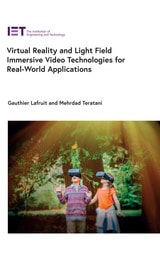
Virtual Reality and Light Field Immersive Video Technologies for Real-World Applications
Gauthier Lafruit
The Institution of Engineering and Technology, 2022