Results by title
30 books match the query 'Virtue'
A Commentary on Plato's Meno
Jacob Klein
University of Chicago Press, 1989
"A major addition to the literature on the Meno and necessary reading for every student of the dialogue."—Alexander Seasonske, Philosophical Review
"There exists no other commentary on Meno which is so thorough, sound, and enlightening."—Choice
Jacob Klein (1899-1978) was a student of Martin Heidegger and a tutor at St. John's College from 1937 until his death. His other works include Plato's Trilogy: Theaetetus, the Sophist, and the Statesman, also published by the University of Chicago Press.
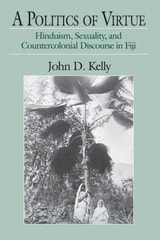
A Politics of Virtue
Hinduism, Sexuality, and Countercolonial Discourse in FijiJohn D. Kelly
University of Chicago Press, 1991
changing conditions of political possibility by examining the
connection between politics and sexual morality in the British
colony of Fiji from 1929 to 1932.
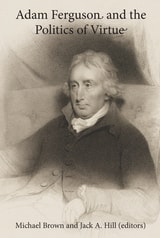
Adam Ferguson and the Politics of Virtue
Jack A. Hill and Michael Brown
Aberdeen University Press, 2023

Before Virtue
Jonathan J. Sanford
Catholic University of America Press, 2015
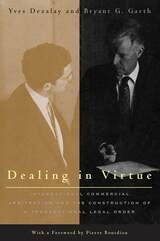
Dealing in Virtue
International Commercial Arbitration and the Construction of a Transnational Legal OrderYves Dezalay and Bryant G. Garth
University of Chicago Press, 1996
Building on Pierre Bourdieu's structural approach, the authors show how an informal, settlement-oriented system became formalized and litigious. Integral to this new legal field is the intense personal competition among arbitrators to gain a reputation for virtue, hoping to be selected for arbitration panels. Since arbitration fees have skyrocketed, this is a high-stakes game.
Using multiple examples, Yves Dezalay and Bryant G. Garth explore how international developments can transform domestic methods for handling disputes and analyze the changing prospects for international business dispute resolution given the growing presence of such international market and regulatory institutions as the EEC, the WTO, and NAFTA.

Edmund Burke and the Discourse of Virtue
Stephen Howard Browne
University of Alabama Press, 2007
"A major accomplishment in the study of Burke." —Choice
More than 200 years after his death, Edmund Burke remains among the most influential conservative writers in the Anglophone world. Burke’s relevance has only grown as the nature of what it means to be a conservative has become hotly contested.
And yet Burke is often discussed more than he is read. Worse, his rhetoric is often pressed into the service of other ideologies. In Edmund Burke and the Discourse of Virtue, Stephen Browne of Pennsylvania State University subjects Burke’s work to the close textual analysis it has never received.
The result of Browne's study is to present Burke and his work in a light that was clearly essential to Burke himself, one that illuminates the link between rhetoric and action that is key to understanding Burke, his career, his work, and his influence on contemporary conservatism.
Readers interested in the development of conversative philosophy, politics, and writing from its earliest roots will value this rare and illuminating work.

Finite Perfection
Reflections on VirtueMichael A. Weinstein
University of Massachusetts Press, 1985
A contemporary account of how virtue can have significance in a world that has lost the certainty of common and collective meanings.
Finite Perfection: Reflections on Virtue is a work of political philosophy and ethical theory in which Michael A. Weinstein develops a rigorous and original account of virtue grounded in the existentialist tradition rather than in classical metaphysics or theology. The book's title captures its central philosophical tension: where classical and religious traditions have often located virtue in relation to an infinite, divine, or transcendent standard of perfection, Weinstein insists on taking seriously the finitude of the human condition—the irreducible limits of time, mortality, and embodied existence—and asking what excellence and virtue can mean for beings who are, by nature, incomplete and bounded.
Weinstein's approach is rooted in the concept of the self-possessed individual—a person who has achieved a kind of integrity and mastery over themselves not through escape from finitude, but through honest acknowledgment and creative embrace of it. Virtue, on this view, is not a transcendence of human limitation but a perfecting of what is possible within it: the best a finite being can be. This framework draws productively on the existentialist tradition (particularly its emphasis on authenticity, self-creation, and the confrontation with mortality), while also engaging with the Aristotelian tradition of virtue ethics and the Nietzschean understanding of self-overcoming.
Throughout its pages, Weinstein brings his characteristic intellectual breadth to bear, moving across political philosophy, ethics, and social theory to construct an account of virtue that is both philosophically rigorous and deeply humane.

Human Goodness
Tuan, Yi-Fu
University of Wisconsin Press, 2008

In Defense of Women
A Bilingual EditionPompeo Colonna
Iter Press, 2024
Pompeo Colonna’s In Defense of Women (1530), presented in this volume in Latin and English translation, is one of several important defenses of women composed in the fifteenth and sixteenth centuries by male advocates of women’s moral and intellectual worth. Known as a cardinal and a warrior, but also as an active participant in sixteenth-century Italian literary circles, Colonna addresses the work to his cousin Vittoria Colonna, the most renowned Italian woman poet of the era, who, he writes, had urged him to undertake it. His Defense not only refutes arguments of women’s inferiority and incapacity but, remarkably, asserts their ability to hold political office and govern. It contains original Latin text and a critical introduction by Franco Minonzio. It also features a foreword by Margaret L. King, as well as a postscript by King, tracing the separate male-authored and female-authored Renaissance defenses of women.

Leo Strauss on Plato’s "Protagoras"
Leo Strauss
University of Chicago Press, 2022
This book offers a transcript of Strauss’s seminar on Plato’s Protagoras taught at the University of Chicago in the spring quarter of 1965, edited and introduced by renowned scholar Robert C. Bartlett. These lectures have several important features. Unlike his published writings, they are less dense and more conversational. Additionally, while Strauss regarded himself as a Platonist and published some work on Plato, he published little on individual dialogues. In these lectures Strauss treats many of the great Platonic and Straussian themes: the difference between the Socratic political science or art and the Sophistic political science or art of Protagoras; the character and teachability of virtue, its relation to knowledge, and the relations among the virtues, courage, justice, moderation, and wisdom; the good and the pleasant; frankness and concealment; the role of myth; and the relation between freedom of thought and freedom of speech.
In these lectures, Strauss examines Protagoras and the sophists, providing a detailed discussion of Protagoras as it relates to Plato’s other dialogues and the work of modern thinkers. This book should be of special interest to students both of Plato and of Strauss.

Like a Captive Bird
Gender and Virtue in PlutarchLunette Warren
Lever Press, 2023
The full extent of Plutarch’s moral educational program remains largely understudied, at least in those aspects pertaining to women and the gendered other. As a result, scholarship on his views on women have differed significantly in their conclusions, with some scholars suggesting that he is overwhelmingly positive towards women and marriage and perhaps even a “precursor to feminism,” and others arguing that he was rather negative on the issue. Like a Captive Bird: Gender and Virtue in Plutarch is an examination of these educational methods employed in Plutarch’s work to regulate the expression of gender identity in women and men. In six chapters, author Lunette Warren analyzes Plutarch’s ideas about women and gender in Moralia and Lives. The book examines the divergences between real and ideal, the aims and methods of moral philosophy and psychagogic practice as they relate to identity formation, and Plutarch’s theoretical philosophy and metaphysics.
Warren argues that gender is a flexible mode of being that expresses a relation between body and soul, and that gender and virtue are inextricably entwined. Plutarch’s expression of gender is also an expression of a moral condition that signifies relationships of power, Warren claims, especially power relationships between the husband and wife. Uncovered in these texts is evidence of a redistribution of power, which allows some women to dominate other women and, in rare cases, men too. Like a Captive Bird offers a unique and fresh interpretation of Plutarch’s metaphysics which centers gender as one of the organizational principles of nature. It is aimed at scholars of Plutarch, ancient philosophy, and ancient gender studies, especially those who are interested in feminist studies of antiquity.

Nature's Virtue
James F. Pontuso
St. Augustine's Press, 2016
Yet virtue seems to be a part of everyday life. What accounts for the kindly relationships between people? Why are most people peaceful, law abiding, and decent? If, as some insist, there is no foundation for virtue, or people act only out of self-interest, how can we explain why so many people are good to each other?
Prestigious scholars, such as Alasdair MacIntyre, After Virtue, James Q. Wilson, The Moral Sense, Steven Pinker, The Better Angels of Our Nature, and Philippa Foot, Natural Goodness, have attempted to answer this question. While these authors make great strides in explaining the character of goodness, their works do not face the problem raised by “anti-foundationalist.” Anti-foundationalist such as Richard Rorty, Friedrich Nietzsche, Martin Heidegger, and the libertarian school of economics maintain that humans lack a capacity for comprehending what is good or bad. For anti-foundationalists there are no higher metaphysical principles that guide behavior. Prescriptive judgments are little more than long-held cultural prejudices fortified by habit so as to seem natural. Therefore, philosophic claims about virtue are little more than guesses about proper conduct.
Nature’s Virtue squarely faces the challenge of anti-foundationalists. The book points out the defects of these ideas. It does so by presenting a contemporary restatement of the case for grounding virtue in Platonic forms or ideas.

On Manly Courage
A Study of Plato's LachesWalter T. Schmid. Foreword by George Kimball Plochmann
Southern Illinois University Press, 1992
Walter T. Schmid offers the first original interpretation of the Laches since Hermann Bonitz in the nineteenth century in the only full-length commentary on the Laches available in English.
Schmid divides the book into five main discussions: the historical background of the dialogue; the relation of form and content in a Platonic dialogue and specific structural and aesthetic features of the Laches; the first half of the dialogue, which introduces the characters and considers the theme of the education of young men; the inquiry with Laches, which examines the traditional Greek conception of military courage; and the inquiry with Nicias in which two nontraditional conceptions of courage are mooted, one closely associated with the sophistic movement in Athens, the other with Socrates himself. Furnishing a detailed paragraph-by-paragraph reading that traces Socrates’ ongoing quest for virtue and wisdom—a wisdom founded in the action of a whole human life—Schmid conclusively shows how and why the Laches fills an important niche in Plato’s moral theory.

Passions and Virtue
Servais Pinckaers
Catholic University of America Press, 2015
Provocations of Virtue
Rhetoric, Ethics, and the Teaching of WritingJohn Duffy
Utah State University Press, 2018
Drawing upon Aristotle’s Nicomachean Ethics and the branch of philosophical inquiry known as “virtue ethics,” Provocations of Virtue calls for the reclamation of “rhetorical virtues” as a core function in the writing classroom. Duffy considers what these virtues actually are, how they might be taught, and whether they can prepare students to begin repairing the broken state of public argument. In the discourse of the virtues, teachers and scholars of writing are offered a common language and a shared narrative—a story that speaks to the inherent purpose of the writing class and to what is at stake in teaching writing in the twenty-first century.
This book is a timely and historically significant contribution to the field and will be of major interest to scholars and administrators in writing studies, rhetoric, composition, and linguistics as well as philosophers and those exploring ethics.

Putting On Virtue
The Legacy of the Splendid VicesJennifer A. Herdt
University of Chicago Press, 2008
Reign of Virtue
Mobilizing Gender in Vichy FranceMiranda Pollard
University of Chicago Press, 1998
Drawing on governmental archives, historical texts, and propaganda, Pollard explores what most historians have ignored: the many ways in which Vichy's politicians used gendered images of work, family, and sexuality to restore and maintain political and social order. She argues that Vichy wanted to return France to an illustrious and largely mythical past of harmony, where citizens all knew their places and fulfilled their responsibilities, where order prevailed. The National Revolution, according to Pollard, replaced the ideals of liberty, equality, and fraternity with work, family, and fatherland, making the acceptance of traditional masculine and feminine roles a key priority. Pollard shows how Vichy's policies promoted the family as the most important social unit of a new France and elevated married mothers to a new social status even as their educational, employment, and reproductive rights were strictly curtailed.
Resilience and the virtue of fortitude
Aquinas in Dialogue with the Psychosocial SciencesCraig Steven Titus
Catholic University of America Press, 2006
Rhetoric, Technology, and the Virtues
Jared S. Colton
Utah State University Press, 2018
Rhetoric, Technology, and the Virtues argues that virtue ethics supports postmodern criticisms of rational autonomy and universalism while also enabling a discussion of the actual ethical behaviors that digital users form through their particular communicative ends and various rhetorical purposes. Authors Jared Colton and Steve Holmes extend Aristotle’s hexis framework through contemporary virtue ethicists and political theorists whose writing works from a tacit virtue ethics framework. They examine these key theorists through a range of case studies of digital habits of human users, including closed captioning, trolling, sampling, remixing, gamifying for environmental causes, and using social media, alongside a consideration of the ethical habits of nonhuman actors.
Tackling a needed topic with clarity and defined organization, Rhetoric, Technology, and the Virtues carefully synthesizes various strands of ethical thinking, convincingly argues that virtue ethics is a viable framework for digital rhetoric, and provides a practical way to assess the changing hexeis encountered across the network of ethical situations in the digital world.
Sex and Virtue
An Introduction to Sexual Ethics (Catholic Moral Thought, Volume 2)John S. Grabowski
Catholic University of America Press, 2003

Suspect Citizens
Women, Virtue, and Vice in Backlash PoliticsJocelyn Boryczka
Temple University Press, 2012
What drives the cycle of backlashes against women’s ongoing struggle for equality, freedom, and inclusion in American politics? In her innovative and provocative book, Suspect Citizens, Jocelyn Boryczka presents a feminist conceptual history that shows how American politics have largely defined women in terms of their reproductive and socializing functions. This framework not only denies women full citizenship, but also devalues the active political engagement of all citizens who place each other and their government under suspicion.
Developing the gendered dynamics of virtue and vice, Boryczka exposes the paradox of how women are perceived as both virtuous moral guardians and vice-ridden suspect citizens capable of jeopardizing the entire nation’s exceptional future. She uses wide-ranging examples from the Puritans and contemporary debates over sex education to S&M lesbian feminists and the ethics of care to show how to move beyond virtue and vice to a democratic feminist ethics.
Suspect Citizens advances a politics of collective responsibility and belonging.

The Good Life in the Scientific Revolution
Descartes, Pascal, Leibniz, and the Cultivation of VirtueMatthew L. Jones
University of Chicago Press, 2006
Amid the unrest, dislocation, and uncertainty of seventeenth-century Europe, readers seeking consolation and assurance turned to philosophical and scientific books that offered ways of conquering fears and training the mind—guidance for living a good life.
The Good Life in the Scientific Revolution presents a triptych showing how three key early modern scientists, René Descartes, Blaise Pascal, and Gottfried Leibniz, envisioned their new work as useful for cultivating virtue and for pursuing a good life. Their scientific and philosophical innovations stemmed in part from their understanding of mathematics and science as cognitive and spiritual exercises that could create a truer mental and spiritual nobility. In portraying the rich contexts surrounding Descartes’ geometry, Pascal’s arithmetical triangle, and Leibniz’s calculus, Matthew L. Jones argues that this drive for moral therapeutics guided important developments of early modern philosophy and the Scientific Revolution.

The Lost Soul of American Politics
Virtue, Self-Interest, and the Foundations of LiberalismJohn Patrick Diggins
University of Chicago Press, 1986

The Perspective of Morality
Philosophical Foundations of Thomistic Virtue EthicsMartin Rhonheimer
Catholic University of America Press, 2011
The Politics of Virtue
Is Abortion Debatable?Elizabeth Mensch and Alan Freeman
Duke University Press, 1993
Returning to the years leading up to Roe v. Wade, Mensch and Freeman detail the role of religion and its relationship to the emerging politics of abortion. Discussing primarily the natural law tradition associated with Catholicism and the Protestant ethical tradition, the authors focus most sharply on the 1960s in which the present terms of the abortion debate were set. In a skillful analysis, they identify a variety of factors that directed and shaped the debate--including, among others, the haunting legacy of Nazism, the moral challenge of the civil rights movement, the "God is dead" discourse, school prayer and Bible reading, Harvey Cox's The Secular City, the Berrigans and Vietnam, the animal rights movement, and the movement of the church-going population away from mainstream Protestant tradition toward evangelical fundamentalism. By criticizing the rhetoric employed by both the "pro-choice" and "pro-life" camps, Mensch and Freeman reveal the extent to which forces on either side of the issue have failed to respond to relevant concerns. Since Roe v. Wade, the authors charge, public debate has seemed to concede the moral high ground to the "pro-life" position, while the "pro-choice" rhetoric has appeared to defend an individual's legal right to do moral wrong. Originally published as a special issue of The Georgia Law Review (Spring 1991), this revised and expanded edition will be welcomed by all those frustrated by the impasse of debates so central to our nation's moral life.

Virtue and Venom
Catalogs of Women from Antiquity to the RenaissanceGlenda McLeod
University of Michigan Press, 1991

Virtue and Venom
Catalogs of Women from Antiquity to the RenaissanceGlenda McLeod
University of Michigan Press, 1991
Virtue, Fortune, and Faith
A Genealogy of FinanceMarieke de Goede
University of Minnesota Press, 2005
Vocation to Virtue
Christian Marriage as a Consecrated LifeKent Lasnoski
Catholic University of America Press, 2014

Wit, Virtue, and Emotion
British Women's Enlightenment RhetoricElizabeth Tasker Davis
Southern Illinois University Press, 2022
Women’s persuasion and performance in the Age of Enlightenment
Over a century before first-wave feminism, British women’s Enlightenment rhetoric prefigured nineteenth-century feminist arguments for gender equality, women’s civil rights, professional opportunities, and standardized education. Author Elizabeth Tasker Davis rereads accepted histories of seventeenth- and eighteenth-century British rhetoric, claiming a greater variety and power of women’s rhetoric. This recovery of British women’s performative and written roles as speakers, spectators, authors, and readers in diverse venues counters the traditional masculine model of European Enlightenment rhetoric. Davis broadens women’s Enlightenment rhetorics to include highly public venues such as theaters, clubs, salons, and debating societies, as well as the mediated sites of the periodical essay, the treatise on rhetorical theory, and women’s written proposals, plans, defenses and arguments for education. Through these sites, women’s rhetorical postures diverged from patriarchal prescriptions rather to deliver protofeminist persuasive performances of wit, virtue, and emotion.
Davis examines context, the effects of memory and gendering, and the cultural sites and media of women’s rhetoric to reveal a fuller ecology of British Enlightenment rhetoric. Each chapter covers a cultural site of women’s rhetorical practice—the court, the stage, the salon, and the printed page. Applying feminist rhetorical theory, Davis documents how women grasped their rhetorical ability in this historical moment and staged a large-scale transformation of British women from subalterns to a vocal counterpublic in British society.