Results by title
22 books match the query 'Volume 6'
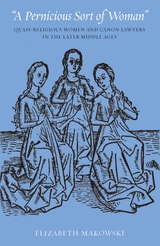
A Pernicious Sort of Woman
Quasi-Religious Women and Canon Lawyers in the Later Middle Ages (Studies in Medieval and Early Modern Canon Law, Volume 6)Elizabeth Makowski
Catholic University of America Press, 2005
Bach Perspectives, Volume 6
J. S. Bach's Concerted Ensemble Music, The OuvertureEdited by Gregory Butler
University of Illinois Press, 2005
The sixth volume in the Bach Perspectives series opens with Joshua Rifkin's seminal study of the early source history of the B-minor orchestral suite. Rifkin elaborates on his discovery that the work in its present form for solo flute goes back to an earlier version in A minor, ostensibly for solo violin. He also takes the discovery as the point of departure for a wide-ranging discussion of the origins and extent of Bach's output in the area of concerted ensemble music.
In other essays, Jeanne Swack presents an enlightening comparison of Georg Phillip Telemann's and Bach's approach to the French overture as concerted movements in their church cantatas. Steven Zohn views the B-minor orchestral suite from the standpoint of the "concert en ouverture." In addition, Zohn responds to Rifkin by suggesting Bach may have scored the early version of the B-minor orchestral suite for flute.
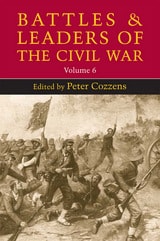
Battles and Leaders of the Civil War, Volume 6
Edited by Peter Cozzens
University of Illinois Press, 2001
Crime and Justice, Volume 6
An Annual Review of ResearchEdited by Michael Tonry and Norval Morris
University of Chicago Press Journals, 1985

Empires of Hygiene, Volume 6
Judith Farquhar and Marta E. Hanson, eds.
Duke University Press, 0
Featuring a variety of topics and methods, essays in Empires of Hygiene compare the disease that is physically suffered to that which is scientifically classified and identified as a social problem. Diseases such as leprosy and STDs, which have biomedical identities in Western settings but in Asia emerge as inseparable from certain colonial regimes, are examined. Spermatorrhea—a disease that compromises the male body’s ability to reproduce—is discussed in relation to the disarray of the Chinese Republic during the mid-twentieth century. The collection also addresses imperial themes of prewar Japan in the literary works of Mori Rintaro and Shimazaki Tison.
Contributors. Warwick Anderson, Michael Bourdaghs, Judith Farquhar, Marta Hanson, Thomas LaMarre, Philippa Levine, Hugh Shapiro, Nathan Sivin
Handbook of Middle American Indians, Volume 6
Social AnthropologyRobert Wauchope, series editor; Manning Nash, volume editor
University of Texas Press, 1967
Social Anthropology is the sixth volume in the Handbook of Middle American Indians, published in cooperation with the Middle American Research Institute of Tulane University under the general editorship of Robert Wauchope (1909–1979). The volume editor is Manning Nash (1924–2001), Professor of Anthropology at the Center for Study of Economic Development and Cultural Change, University of Chicago.
This volume provides a synthetic and comparative summary of native ethnography and ethnology of Mexico and Central America, written by authorities in a number of broad fields: the native population and its identification, agricultural systems and food patterns, economies, crafts, fine arts, kinship and family, compadrinazgo, local and territorial units, political and religious organizations, levels of communal relations, annual and fiesta cycles, sickness, folklore, religion, mythology, psychological orientations, ethnic relationships, and topics of especial modern significance such as acculturation, nationalization, directed change, urbanization and industrialization.
The articles rely on the accumulated ethnography of the region, but instead of being essentially historical in treatment, they aim toward generalizations about the uniformities and varieties of culture, society, and personality found in Middle America. The collection is an invaluable reference work on Middle America and a provocative guide to scholars engaged in furthering understanding of humans and society.
The Handbook of Middle American Indians was assembled and edited at the Middle American Research Institute of Tulane University with the assistance of grants from the National Science Foundation and under the sponsorship of the National Research Council Committee on Latin American Anthropology.
Japanese/Korean Linguistics, Volume 6
Edited by Ho-min Sohn and John Haig
CSLI, 1997
NBER International Seminar on Macroeconomics 2009, Volume 6
Edited by Lucrezia Reichlin and Kenneth West
University of Chicago Press, 2010

Ocean Yearbook, Volume 6
Edited by Elisabeth Mann Borgese and Norton Ginsburg
University of Chicago Press, 1987

Playwrights for Tomorrow
A Collection of Plays, Volume 6Arthur H. Ballet, EditorIntroduction by Arthur H. Ballet
University of Minnesota Press, 1969
Playwrights for Tomorrow was first published in 1969. Minnesota Archive Editions uses digital technology to make long-unavailable books once again accessible, and are published unaltered from the original University of Minnesota Press editions.
Three plays are published in this sixth volume of a series of collections of plays by dramatists who have participated in an experimental program conducted by the Office for Advanced Drama Research (O.A.D.R.), University of Minnesota. Dr. Arthur H. Ballet, editor of the series, is the director of the program.
The plays in this volume are The Thing Itself by Arthur Sainer, The Marriage Test by Jonathan Gillman, and The End of the World; or, Fragments from a Work in Progress by Keith Neilson. In an introduction Dr. Ballet briefly describes the O.A.D.R. program and comments on the three plays.
Of Mr. Sainer and his play Dr. Ballet writes: "Arthur Sainer represents a new wave in theatrical writing, the semi-improvisational piece which really takes on life only in production, but which also speaks with a voice as old and honorable as theatre itself. The Firehouse Theatre, with its unique and skillful dedication to innovative theatre, brought The Things Itself to exciting production for enthusiastic audiences." Jonathan Gillman's The Marriage Test is, he writes, "a rare and sparkling work for the stage: a classic farce." On the third play and its author he comments: "The End of the World by Keith Neilson was the first play provided with facilities under the O.A.D.R. outside the Minneapolis-St. Paul area in an attempt to see if the program could work at long distance as well as it has at home. The play, the playwright, and the O.A.D.R. were blessed with a wonderful company, theatre, and audience at the Playhouse in the Park, Cincinnati, Ohio, and above all with a dedicated and talented director in Brooks Jones. Neilson is a continuous creator in theatre."
Selected Papers, Volume 6
The Mathematical Theory of Black Holes and of Colliding Plane WavesS. Chandrasekhar
University of Chicago Press, 1991
Chandrasekhar has selected papers that trace the development of his ideas and that present aspects of his work not fully covered in the books he has periodically published to summarize his research in each area.

States at War, Volume 6
The Confederate States Chronology and a Reference Guide for South Carolina in the Civil WarEdited by Richard F. Miller
University Press of New England, 2018
Supplement to the Handbook of Middle American Indians, Volume 6
EthnologyVictoria Reifler Bricker, general editor; John D. Monaghan, volume editor, with the assistance of Barbara W. Edmonson
University of Texas Press, 2000
In 1981, UT Press began to issue supplemental volumes to the classic sixteen-volume work, Handbook of Middle American Indians. These supplements are intended to update scholarship in various areas and to cover topics of current interest. Supplements devoted to Archaeology, Linguistics, Literatures, Ethnohistory, and Epigraphy have appeared to date.
In this Ethnology supplement, anthropologists who have carried out long-term fieldwork among indigenous people review the ethnographic literature in the various regions of Middle America and discuss the theoretical and methodological orientations that have framed the work of areal scholars over the last several decades. They examine how research agendas have developed in relationship to broader interests in the field and the ways in which the anthropology of the region has responded to the sociopolitical and economic policies of Mexico and Guatemala. Most importantly, they focus on the changing conditions of life of the indigenous peoples of Mesoamerica. This volume thus offers a comprehensive picture of both the indigenous populations and developments in the anthropology of the region over the last thirty years.
The Best American Newspaper Narratives, Volume 6
Gayle Reaves
University of North Texas Press, 2019

The Collected Letters of Thomas and Jane Welsh Carlyle
October 1831–September 1833, Volume 6Charles Richard Sanders
Duke University Press, 0

The Correspondence of Michael Faraday
1860-1867, Volume 6Frank A.J.L. James
The Institution of Engineering and Technology, 2011
The Diary of Calvin Fletcher, Volume 6
1857-1860Gayle Thornbrough
Indiana Historical Society Press, 1978
The Middle Works of John Dewey, Volume 6
Journal Articles, Book Reviews, Miscellany in the 1910-1911 Period, and How We ThinkJohn Dewey. Edited by Jo Ann Boydston
Southern Illinois University Press, 2008
William James, remarking in 1909 on the differences among the three leading spokesmen for pragmatism—himself, F. C. S. Schiller, and John Dewey—said that Schiller’s views were essentially “psychological,” his own, “epistemological,” whereas Dewey’s “panorama is the widest of the three.”
The two main subjects of Dewey’s essays at this time are also two of the most fundamental and persistent philosophical questions: the nature of knowledge and the meaning of truth. Dewey’s distinctive analysis is concentrated chiefly in seven essays, in a long, significant, and previously almost unknown work entitled “The Problem of Truth,” and in his book How We Think. As a whole, the 1910–11 writings illustrate especially well that which the Thayers identify in their Introduction as Dewey’s “deepening concentration on questions of logic and epistemology as contrasted with the more pronounced psychological and pedagogical treatment in earlier writings.”
The Papers of James Madison, Volume 6
1 January 1783-30 April 1783James Madison
University of Chicago Press, 1969
The Talmud of the Land of Israel, Volume 6
TerumotJacob Neusner, General Editor
University of Chicago Press, 1987
University of Chicago Readings in Western Civilization, Volume 6
Early Modern Europe: Crisis of AuthorityEdited by Eric Cochrane, Charles M. Gray, and Mark Kishlansky
University of Chicago Press, 1987
Individual volumes provide essential background reading for courses covering specific eras and periods. The complete nine-volume series is ideal for general courses in history and Western civilization sequences.
Winterthur Portfolio, Volume 6
Edited by Ian M. G. Quimby
University of Chicago Press, 1978