Results by title
43 books match the query 'Volume II'

A History of Chicago, Volume II
From Town to City 1848-1871Bessie Louise Pierce
University of Chicago Press, 1940
Originally conceived as a centennial history of Chicago, the project became, under the guidance of renowned historian Bessie Louise Pierce, a definitive, three-volume set describing the city’s growth—from its humble frontier beginnings to the horrors of the Great Fire, the construction of some of the world’s first skyscrapers, and the opulence of the 1893 World’s Fair. Pierce and her assistants spent over forty years transforming historical records into an inspiring human story of growth and survival.
Rich with anecdotal evidence and interviews with the men and women who made Chicago great, all three volumes will now be available for the first time in years. A History of Chicago will be essential reading for anyone who wants to know this great city and its place in America.
“With this rescue of its history from the bright, impressionable newspapermen and from the subscription-volumes, Chicago builds another impressive memorial to its coming of age, the closing of its first ‘century of progress.’”—E. D. Branch, New York Times (1937)
A History of Missouri (V2)
Volume II, 1820 to 1860Perry McCandless
University of Missouri Press, 2000
With a newly revised bibliography, A History of Missouri: Volume II, 1820 to 1860 covers the turbulent years of Missouri's adolescence—from statehood to the outset of the Civil War.
A History of the Crusades, Volume II
The Later Crusades, 1189-1311Series Edited by Kenneth M. Setton; Volume Edited by Wolff and Hazard
University of Wisconsin Press, 1969
A History of the Swedish People
Volume II: From Renaissance to RevolutionVilhelm Moberg
University of Minnesota Press, 2005
African Successes, Volume II
Human CapitalEdited by Sebastian Edwards, Simon Johnson, and David N. Weil
University of Chicago Press, 2016
The second volume in the series, African Successes: Human Capital turns the focus toward Africa’s human capital deficit, measured in terms of health and schooling. It offers a close look at the continent’s biggest challenges, including tropical disease and the spread of HIV.
Aquatic and Wetland Plants of Northeastern North America, Volume II
A Revised and Enlarged Edition of Norman C. Fassett's A Manual of Aquatic Plants, Volume II: Angiosperms: MonocotyledonsGarrett E. Crow and C. Barre Hellquist
University of Wisconsin Press, 2000
This is by far the best and most comprehensive manual and illustrated guide to native and naturalized vascular plants—ferns, conifers, and flowering plants—growing in aquatic and wetland habitats in northeastern North America, from Newfoundland west to Minnesota and south to Virginia and Missouri. Published in two volumes, this long-awaited work completely revises and greatly expands Norman Fassett’s 1940 classic A Manual of Aquatic Plants, yet retains the features that made Fassett’s book so useful.
Features include:
* coverage of 1139 plant species, 1186 taxa, 295 genera, 109 families
* more than 600 pages of illustrations, and illustrations for more than 90% of the taxa
* keys for each species include references to corresponding illustrations
* habitat information, geographical ranges, and synonomy
* a chapter on nuisance aquatic weeds
* glossaries of botanical and habitat terms
* a full index for each volume
Wetland ecologists, botanists, resource managers, public naturalists, and environmentalists concerned with the preservation of wetland areas, which are increasingly threatened, will welcome this clear, workable, and comprehensive guide.
Asia in the Making of Europe, Volume II
A Century of Wonder. Book 1: The Visual ArtsDonald F. Lach
University of Chicago Press, 1970
The rise to world dominance of the Western nations in modern times and the rapid industrial growth of the West, which outpaced the East in technical and military achievements, have led to a historical eclipse of the ancient and brilliant cultures of Asia.
Historican Donald F. Lach, in his influential scholarly work, Asia in the Making of Europe, points out that an eclipse is never permanent, that this one was never total, and that there was a period in early modern times when Asia and Europe were close rivals in brilliance and mutual influence.
Asia in the Making of Europe, Volume II
A Century of Wonder. Book 2: The Literary ArtsDonald F. Lach
University of Chicago Press, 1994
Volume I: The Century of Discovery brings together "everything that a European could know of India, Southeast Asia, China, and Japan, from printed books, missionary reports, traders' accounts and maps" (The New York Review of Books). Volume II: A Century of Wonder examines the influence of that vast new body of information about Asia on the arts, institutions, literatures, and ideas of sixteenth-century Europe.
Asia in the Making of Europe, Volume II
A Century of Wonder. Book 3: The Scholarly DisciplinesDonald F. Lach
University of Chicago Press, 1994
Volume I: The Century of Discovery brings together "everything that a European could know of India, Southeast Asia, China, and Japan, from printed books, missionary reports, traders' accounts and maps" (The New York Review of Books). Volume II: A Century of Wonder examines the influence of that vast new body of information about Asia on the arts, institutions, literatures, and ideas of sixteenth-century Europe.
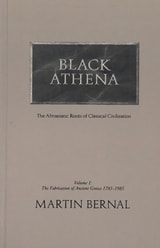
Black Athena
Afroasiatic Roots of Classical Civilization, Volume II: The Archaeological and Documentary EvidenceBernal, Martin
Rutgers University Press, 1991
This volume is the second in a projected four-part series concerned with the competition between two historical models for the origins of Greek civilization. The model current today is the Aryan Model, according to which Greek culture arose as the result of the conquest from the north by Indo-European speakers or "Aryans" of the native "pre-Hellenes." The Ancient Model, which was the model maintained in Classical Greece, held that the native population of Greece had initially been civilized by Egyptian and Phoenician colonists and that more Near Eastern culture had been introduced to Greece by Greeks studying in Egypt and Southwest Asia. In these and later volumes, Martin Bernal proposes a Revised Ancient Model. According to this, the Indo-European aspects of Greek language and culture should be recognized as fundamental and the considerable non-Indo-European elements should be seen largely as Egyptian and Levantine additions to this basis.
Volume II is concerned with the archaeological and documentary evidence for contacts between Egypt and the Levant on the one hand and the Aegean on the other, during the Bronze Age from c. 3400 B.C. to c. 1100 B.C. These approaches are supplemented by information from later Greek myths, legends, religious cults, and language. The author concludes that contact between the two regions was far more extensive and influential than is generally believed. In the introduction to this volume, Bernal also responds to some reviews and criticisms of Volume I of Black Athena.
Martin Bernal is Professor of Government at Cornell University.
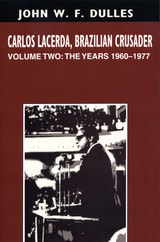
Carlos Lacerda, Brazilian Crusader
Volume II: The Years 1960-1977By John W. F. Dulles
University of Texas Press, 1991
From reviews of Volume I:
"Brazilian Crusader is no doubt the best biography yet produced on Lacerda and the second volume . . . is certainly worth waiting for."
—Luso-Brazilian Review
Journalist and spectacularly successful governor, Carlos Lacerda was Brazil's foremost orator in the 20th century and its most controversial politician. He might have become president in the 1960s had not the military taken over.
In the first volume, John F. W. Dulles paints a portrait of a rebellious youth, who had the willfulness of his prominent father and who crusaded for Communism before becoming its most outspoken foe. Recalling Lacerda's rallying cry, "Brazil must be shaken up," Dulles traces the career of the journalist whose unsparing attacks on the men in power led authorities to imprison him and employ thugs who pummeled him physically. Lacerda's spirited oratory helped him become Brazil's most popular congressman, but it scared the rulers of Brazil, who prohibited the broadcast of his speeches after he returned from exile in 1956. Their effort to deprive him of his mandate stirred the entire nation and culminated in one of the most dramatic sessions ever held in the Chamber of Deputies.
In the second and final volume, Dulles explores the political and private life of Lacerda from 1960, when he became governor of Brazil's Guanabara state, until his death in 1977. Dulles focuses particularly on the years 1960 to 1968, in which Lacerda played a central role in some of the most drastic political changes that Brazil has experienced in this century.
Lacerda's story ranges from the headlines constantly generated by his political attacks and journalistic sensationalism to private moments of personal tragedy. In telling his story, Dulles draws on hundreds of interviews, as well as extensive research in press archives, Lacerda's public papers, and the private collections of Lacerda's family and associates. This material paints a compelling portrait of an honest administrator who alienated top figures in politics, the press, and the military.
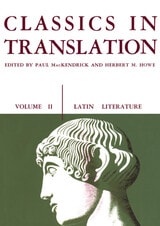
Classics in Translation, Volume II
Latin LiteratureEdited by Paul L. MacKendrick and Herbert M. Howe
University of Wisconsin Press, 1959
Here, translated into modern English, are the works of literature, history, science, oratory, and philosophy that constitute the mainstream of Roman thought and continue to influence world civilizations. This volume includes:
· Complete translations of Plautus’ The Haunted House, Terence’s Woman from Andros, Seneca’s Medea, and the Deeds of the Deified Augustus.
· Selections from Vergil’s Georgics and Aeneid, the poems of Catullus, Horace’s Odes, Ovid’s Metamorphoses and Fasti, the Satyricon of Petronius, and the Sixth Satire of Juvenal.
· Selections from Lucretius’ On the Nature of Things, Cicero’s speeches and philosophical works, and Quintilian’s The Training of the Orator.
· Selections from histories by Sallust, Livy’s History of Rome, Tacitus’ Annals and Germania, and letters of Pliny the Younger.
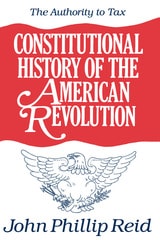
Constitutional History of the American Revolution, Volume II
The Authority To TaxJohn Phillip Reid
University of Wisconsin Press, 1987
John Phillip Reid addresses the central constitutional issues that divided the American colonists from their English legislators: the authority to tax, the authority to legislate, the security of rights, the nature of law, the foundation of constitutional government in custom and contractarian theory, and the search for a constitutional settlement.

Double Quartet, Volume II
Nathaniel Mackey
Duke University Press, 2027

Economics of Means-Tested Transfer Programs in the United States, Volume II
Edited by Robert A. Moffitt
University of Chicago Press, 2016
These two volumes update the earlier Means-Tested Transfer Programs in the United States with a discussion of the many changes in means-tested government programs and the results of new research over the past decade. While some programs that experienced falling outlays in the years prior to the previous volume have remained at low levels of expenditure, many others have grown, including Medicaid, the Earned Income Tax Credit, the Supplemental Nutrition Assistance Program, and subsidized housing programs. For each program, the contributors describe its origins and goals, summarize its history and current rules, and discuss recipients’ characteristics and the types of benefits they receive.
This is an invaluable reference for researchers and policy makers that features detailed analyses of many of the most important transfer programs in the United States.

Fashion and Ethics
Critical Studies in Fashion and Beauty, Volume IIEdited by Efrat Tseëlon
Intellect Books, 2014
With essays that problematize issues such as ethical fashion’s self-appointed morality, the first-world notion that the environment should take priority over human development, the conflict between business profit and ethics, the unintended agendas involved in consuming green cosmetics or ethical culinary trends, and the discursive strategies of denial of the extreme cruelty in the procurement of animal skin and fur for use in fashion, Fashion and Ethics applies its uncompromising scrutiny to all areas of fashion. Throughout, the volume forces readers to confront the question: Does ethical fashion go deep enough into challenging unethical behavior or is it just a charade of good intentions?
Form and Meaning in Language, Volume II
Papers on Discourse and PragmaticsCharles J. Fillmore
CSLI, 2020
Divided into four parts, the papers collected in Volume II explore language in use; semantics and pragmatics; text and discourse; and language in society.

Hospitality, Volume II
Jacques Derrida
University of Chicago Press, 2024
Hospitality reproduces a two-year seminar series delivered by Jacques Derrida at the École des hautes études en sciences sociales in Paris between 1995 and 1997. In these lectures, Derrida asks a series of related questions about responsibility and “the foreigner”: How do we welcome or turn away the foreigner? What does the idea of the foreigner reveal about kinship and the state, particularly in relation to friendship, citizenship, migration, asylum, assimilation, and xenophobia? Central to his project is a rigorous distinction between conventional, finite hospitality, with its many conditions, and the aspirational idea of hospitality as something offered unconditionally to the stranger. This volume collects the second year of the seminar, which considers an Islamic problematic of hospitality, the relevance of forgiveness, and the work of Emmanuel Levinas.
In the Eastern Fluted Point Tradition
Volume IIEdited by Joseph A. M. Gingerich
University of Utah Press, 2017

International Trade Law Through the Cases
Volume IIJulian Arato, Joseph Weiler, Kathleen Claussen, Sungjoon Cho
Michigan Publishing Services, 2027
International trade law is a manifold. It comprises a wide array of international legal instruments designed to discipline states in their regulation of cross-border trade, including primarily trade in goods and services but also intellectual property, digital trade, and even investment. The study of international trade law requires choices. As the title of this book suggests, the choice of this particular book is to study international trade law through the cases—in particular the robust case law of the WTO. The theory behind our approach is rather that developing a firm foundation in the law and jurisprudence of the WTO will provide a student with the tools to confidently and competently analyze any international trade instrument on their own. The focus here is primarily (though not exclusively) on the law of the WTO, but the goal is to learn the key concepts and disciplines of international trade law writ large.
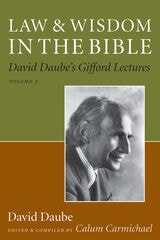
Law and Wisdom in the Bible
David Daube's Gifford Lectures, Volume IIDavid Daube
Templeton Press, 2010
"That over forty years after they were delivered these famous but unavailable Gifford Lectures should be published is occasion for celebration. Once again we hear Daube’s voice, patient and probing, as he turns over, tests, pushes fresh inquiries, and finds new insights. No man has had such a subtle sense of scriptural texts matched by such a supple sense of the practices and peculiarities of human beings engaged in the legal process. Law and Wisdom in the Bible is classic Daube." mdash;John T. Noonan Jr., United States Circuit Judge
David Daube (1909–99) was known for his unique and sophisticated research on Roman law, biblical law, Jewish Law, and medical ethics. In Law and Wisdom in the Bible, the first published collection of his 1964 Gifford Lectures, Daube derives from his complex understanding of biblical texts both ancient and contemporary notions about wisdom, justice, and education.
In addressing these and other profound issues, Daube crosses traditional disciplinary boundaries and bridges the
gap between humanism and religion, especially with regard to Christianity and Judaism. With his sophisticated understanding of Talmudic law and literature, his thinking, which is on full display in these lectures, revolutionized prevailing perceptions about the New Testament.
Perjury and Pardon, Volume II
Jacques Derrida
University of Chicago Press, 2023
Perjury and Pardon is a two-year seminar series given by Jacques Derrida at the École des hautes études en sciences sociales in Paris during the late 1990s. In these sessions, Derrida focuses on the philosophical, ethical, juridical, and political stakes of the concept of responsibility. His primary goal is to develop what he calls a “problematic of lying” by studying diverse forms of betrayal: infidelity, denial, false testimony, perjury, unkept promises, desecration, sacrilege, and blasphemy.
This volume covers the seminar’s second year when Derrida explores the political dimensions of forgiveness and repentance. Over eight sessions, he discusses Hegel, Augustine, Levinas, Arendt, and Benjamin as well as Bill Clinton’s impeachment and Nelson Mandela and Desmond Tutu’s testimonies before the Truth and Reconciliation Commission. The seminars conclude with an extended reading of Henri Thomas’s 1964 novel Le Parjure.
Publications of the Astronomical Observatory of the University of Michigan
Volume IIDetroit Observatory
University of Michigan Press, 1916

Selected Plays, Volume II
August Strindberg
University of Minnesota Press, 2012
This second volume of the great Swedish writer August Strindberg’s plays begins with To Damascus I (1898), the first of a trilogy. It mirrors his own departure from the naturalism he had explored in several of his earlier works, as he set forth on a spiritual odyssey. Crimes and Crimes (1899), from the beginning of his symbolist mode, is a lighter take on the themes in To Damascus I. The first of a two-part play, Dance of Death I (1900) depicts a dysfunctional marriage. A Dream Play (1901), which is one of Strindberg’s most influential, shows reality converted into a dream; many critics consider it his greatest play. In 1907, Strindberg founded the Intimate Theater in Stockholm; The Ghost Sonata (1907) and The Pelican (1907), which were written for its opening, are two examples of a chamber play, a genre that Strindberg helped to originate.
The Aesthetics of Resistance, Volume II
A Novel, Volume 2Peter Weiss
Duke University Press, 2020
Volume II, initially published in 1978, opens with the unnamed narrator in Paris after having retreated from the front lines of the Spanish Civil War. From there, he moves on to Stockholm, where he works in a factory, becomes involved with the Communist Party, and meets Bertolt Brecht. Featuring the narrator's extended meditations on paintings, sculpture, and literature, the novel teems with characters, almost all of whom are based on historical figures. Throughout, the narrator explores the affinity between political resistance and art—the connection at the heart of Weiss's novel. Weiss suggests that meaning lies in embracing resistance, no matter how intense the oppression, and that we must look to art for new models of political action and social understanding. The Aesthetics of Resistance is one of the truly great works of postwar German literature and an essential resource for understanding twentieth-century German history.

The Beast and the Sovereign, Volume II
Jacques Derrida
University of Chicago Press, 2011

The Biology of Human Starvation
Volume IIAncel Keys
University of Minnesota Press, 1950
The Biology of Human Starvation was first published in 1950. Minnesota Archive Editions uses digital technology to make long-unavailable books once again accessible, and are published unaltered from the original University of Minnesota Press editions.
With great areas of the world battling the persistent and basic problem of hunger, this work constitutes a major contribution to needed scientific knowledge. The publication is a definitive treatise on the morphology, biochemistry, physcology, psychology, and medical aspects of calorie undernutrition, cachexia, starvation, and rehabilitation in man.
Presented critically and systematically are the fact and theory from the world literature, including the evidence from World War II and the finding of the Minnesota Starvation Experiment (1944*1946). Pertinent experiments and field and clinical observations to 1949 are covered.
The extensive original research involved was conducted at the University of Minnesota Laboratory of Physiological Hygiene, which Dr. Keys heads. The authors, all of the laboratory staff, were assisted in preparation of the work by Ernst Simonson, Samuel Wells and Angie Sturgeon Skinner.

The Collected Works of William Howard Taft, Volume II
Political Issues and Outlooks: Speeches Delivered Between August 1908 and February 1909David H. Burton
Ohio University Press, 2001
The second volume of The Collected Works of William Howard Taft is dedicated to the speeches and writings that displayed his thinking in the autumn of 1908 and the following winter.
At this time he was campaigning for the presidency against the well-known William Jennings Bryan, and in Taft’s writings is evidence of the contrast in style between Taft and Bryan and between Taft and his predecessor, Teddy Roosevelt. as well. Although uncomfortable with campaigning, he thoughtfully addresses the concerns of the day that framed the election, including race, the Philippines, and socialism.
Political Issues and Outlooks also contains speeches made after the election and leading up to his inauguration as the twenty-seventh president of the United States. Introduced by a commentary from the general series editor Professor David H. Burton, the second volume of The Collected Works of William Howard Taft is a revealing look at the machinations of United States politics at the beginning of the twentieth century and a glimpse into the mind of one of the century’s most influential political architects.
The Complete Works of Robert Browning, Volume II
With Variant Readings And AnnotationsRobert Browning
Ohio University Press, 1971
In seventeen volumes, copublished with Baylor University, this acclaimed series features annotated texts of all of Robert Browning’s known writing. The series encompasses autobiography as well as influences bearing on Browning’s life and career and aspects of Victorian thought and culture.
Volume II contains Browning’s play, Strafford: An Historical Tragedy (1837), and the long poem, Sordello (1840). Strafford was Browning’s first play, based on the tragic life of Thomas Wentworth, Earl of Strafford. The editors note that the play had only four performances, “undoubtedly due… to its esoteric subject and bad acting.” Sordello is a fictionalized version of the life of Sordello da Goito, a 13th century Italian troubadour. The poem itself was famously known for being “difficult.”
As always in this acclaimed series, a complete record of textual variants is provided, as well as extensive explanatory notes.
The Correspondence of Richard Price, Volume II
March 1778–February 1786D. O. Thomas, ed.
Duke University Press, 1983
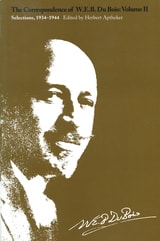
The Correspondence of W.E.B. Du Bois, Volume II
Selections, 1934–1944W.E.B. Du Bois
University of Massachusetts Press, 1997
Scholar, author, editor, teacher, reformer, and civil rights leader, W.E.B. Du Bois (1868–1963) was a major figure in American life and one of the earliest proponents of equality for black Americans. He was a founder and leader of the Niagara Movement, the NAACP, and the Pan-African Movement; a progenitor of the 1920s Harlem Renaissance; an advocate of anticolonialism, anti-imperialism, unionism, and equality for women; and a champion of the rights of oppressed people around the world.
The three-volume Correspondence of W.E.B. Du Bois offers a unique perspective on Du Bois's experiences and views. In recognition of the significance of the Correspondence, the final volume was named a Best Book of the Year by the New York Times Book Review.
Herbert Aptheker has provided an introduction and notes to each volume, illuminating the circumstances and identifying the personalities involved in the correspondence. A long time friend and colleague of Du Bois, Aptheker is a well-known historian of the African American experience. In 1939 and again in 1969, he won the history award given by the Association for the Study of Negro Life and History. Among his most prominent works are American Negro Slave Revolts and the three-volume Documentary History of the Negro People in the United States.
The Death Penalty, Volume II
Jacques Derrida
University of Chicago Press, 2017
Of central importance in this second volume is Kant’s explicit justification of the death penalty in the Metaphysics of Morals. Thoroughly deconstructing Kant’s position—which holds the death penalty as exemplary of the eye-for-an-eye Talionic law—Derrida exposes numerous damning contradictions and exceptions. Keeping the current death penalty in the United States in view, he further explores the “anesthesial logic” he analyzed in volume one, addressing the themes of cruelty and pain through texts by Robespierre and Freud, reading Heidegger, and—in a fascinating, improvised final session—the nineteenth-century Spanish Catholic thinker Donoso Cortés. Ultimately, Derrida shows that the rationality of the death penalty as represented by Kant involves an imposition of knowledge and calculability on a fundamental condition of non-knowledge—that we don’t otherwise know what or when our deaths will be. In this way, the death penalty acts out a phantasm of mastery over one’s own death.
Derrida’s thoughts arrive at a particular moment in history: when the death penalty in the United States is the closest it has ever been to abolition, and yet when the arguments on all sides are as confused as ever. His powerful analysis will prove to be a paramount contribution to this debate as well as a lasting entry in his celebrated oeuvre.
The Global Encyclopaedia of Informality, Volume II
Understanding Social and Cultural ComplexityEdited by Alena Ledeneva
University College London, 2018
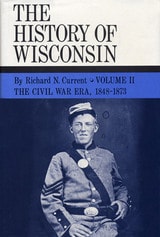
The History of Wisconsin, Volume II
Civil War Era, 1848-1873Richard N. Current
Wisconsin Historical Society Press, 1976
This second volume in the History of Wisconsin series introduces us to the first generation of statehood, from the conversion of prairie and forests into farmland to the development of cities and industry. In addition, this volume presents a synthesis of the Civil War and Reconstruction era in Wisconsin. Scarcely a decade after entering the Union, the state was plunged into the nationwide debate over slavery, the secession crisis, and a war in which 11,000 "Badger Boys in Blue" gave their lives. Wisconsin's role in the Civil War is chronicled, along with the post-war years. Complete with photographs from the Historical Society's collections, as well as many pertinent maps, this book is a must-have for anyone interested in this era of Wisconsin's history.
The Ice Broken, volume II
Puritan Influences on the Netherlands in the Seventeenth CenturyCentral European University Press, 2026

The Old Regime and the Revolution, Volume II
Notes on the French Revolution and NapoleonAlexis de Tocqueville
University of Chicago Press, 2001
With his monumental work The Old Regime and the Revolution, Alexis de Tocqueville (1805–59)—best known for his classic Democracy in America—envisioned a multivolume philosophical study of the origins of modern France that would examine the implications of French history on the nature and development of democratic society. Volume I, which covered the eighteenth-century background to the Revolution, was published to great acclaim in 1856. On the continuation of this project, he wrote: "When this Revolution has finished its work, [this volume] will show what that work really was, and what the new society which has come from that violent labor is, what the Revolution has taken away and what it has preserved from that old regime against which it was directed."
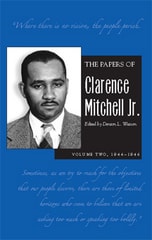
The Papers of Clarence Mitchell Jr., Volume II
1944–1946Clarence Mitchell Jr.
Ohio University Press, 2005
Clarence Mitchell Jr. was the driving force in the movement for passage of civil rights laws in America. The foundation for Mitchell’s struggle was laid during his tenure at the Fair Employment Practice Committee, where he led implementation of President Roosevelt’s policy barring racial discrimination in employment in the national defense and war industry programs. Mitchell’s FEPC reports and memoranda chart the beginning of the modern civil rights movement.
The first two volumes of a projected five-volume documentary edition of The Papers of Clarence Mitchell Jr. illuminate the FEPC’s work as a federal affirmative-action agency and the government’s struggle to enforce the nation’s antidiscrimination policy in industry, federal agencies, and labor unions.
Subsequent volumes will trace Mitchell’s successive enlistment of seven presidents in establishing and enforcing a permanent national nondiscrimination policy. Through his efforts, Congress passed the 1957, 1960, and 1964 Civil Rights Acts prohibiting discrimination in public accommodations, federal spending, and employment based on race, color, sex, and national origin; the 1965 Voting Rights Act; and the 1968 Fair Housing Act.
Editor Denton L. Watson introduces and annotates Mitchell’s writings, providing context and insight for students and scholars of civil rights history, government, law, and sociology.
Theory of African Music, Volume II
Gerhard Kubik
University of Chicago Press, 2010
In this second volume, Kubik explores a variety of topics, including Yoruba chantefables, the musical Kachamba family of Malawˆ i, and the cognitive study of African rhythm. Drawing on his remarkable ability to make cross-cultural comparisons, Kubik illuminates every facet of the African understanding of rhythm, from timing systems to elementary pulsation. His analysis of tusona ideographs in Luchazi culture leads to an exploration of African space/time concepts that synthesizes his theories of art, rhythm, and culture.
Featuring a large number of photographs and accompanied by a compact disc of Kubik’s own recordings, Theory of African Music, Volume II, will be an invaluable reference for years to come.
Tolkien Studies
An Annual Scholarly Review, Volume IIMichael D.C. Drout
West Virginia University Press, 2005
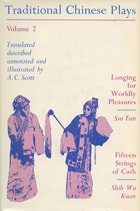
Traditional Chinese Plays, Volume II
A.C. Scott
University of Wisconsin Press, 1972
The world of traditional Chinese drama can be at once fascinating and bewildering to the uninitiated Western observer. Attuned to his own dramatic conventions, he is hard put to apprehend the delicate fusion of poetry, music, and subtle gesture which is the essence of Chinese theatre. Because of these difficulties, the task of translating traditional Chinese drama must go far beyond the conventional literary treatment and evoke the entire world of stagecraft and directing.
Longing for Worldly Pleasures (Ssu Fan) is a lyric monologue in which a young Buddhist laments the waning of her youth in the seclusion of the convent. The brief piece involves a complexity of mood which makes it an actor’s tour de force, undertaken only by the most highly skilled performers.
Fifteen Strings of Cash (Shih Wu Kuan), a much longer play, is a comic murder mystery satirizing bureaucratic ineptitude in the administration of justice. The comic lead role of Lou the Rat is a virtuoso part which illustrates the intricate mimetic art of the traditional comic actor and was the play’s main appeal to Chinese audiences.

Union Pacific
Volume II, 1894-1969Maury Klein
University of Minnesota Press, 2006

WORKS OF APHRA BEHN
VOLUME II, LETTERS BETWEEN A NOBLEMAN ANAPHRA BEHN
The Ohio State University Press, 1993
Zion in the Valley, Volume II
The Jewish Community of St. Louis, Volume II, The Twentieth CenturyWalter Ehrlich
University of Missouri Press, 2002