Results by title
14 books match the query 'Western films'
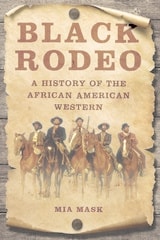
Black Rodeo
A History of the African American WesternMia Mask
University of Illinois Press, 2023
A first-of-its kind survey, Black Rodeo illuminates the figure of the Black cowboy while examining the intersection of African American film history and the western.
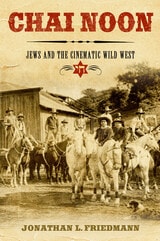
Chai Noon
Jews and the Cinematic Wild WestJonathan L. Friedmann
University of Wisconsin Press, 2025
This volume joins other reconsiderations of outsider and minority representations in Westerns to offer a more nuanced view of the genre. Friedmann engages with larger themes of Jewish identity in popular film, including depictions of race, ethnicity, and foreignness. He also identifies similar concerns within the invention and creation of the imaginary West writ large in American culture. The juxtapositions prove to be both unexpected and intuitively understandable.
Cowboys As Cold Warriors
The Western And U S HistoryStanley Corkin
Temple University Press, 2004
Films discussed include: My Darling Clementine, Red River, Duel in the Sun, Pursued, Fort Apache, Broken Arrow, The Gunfighter, High Noon, Shane, The Searchers, Gunfight at the OK Corral, The Magnificent Seven, The Alamo, Lonely Are the Brave, Ride the High Country, and The Man Who Shot Liberty Valance.
Cowboys and Caudillos
Frontier Ideology of the AmericasTom R. Sullivan
University of Wisconsin Press, 1990
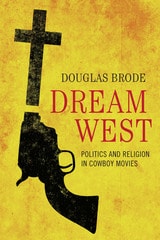
Dream West
Politics and Religion in Cowboy MoviesBy Douglas Brode
University of Texas Press, 2013
While political liberals celebrated the end of “cowboy politics” with the election of Barack Obama to the presidency, political conservatives in the Tea Party and other like-minded groups still vociferously support “cowboy” values such as small government, low taxes, free-market capitalism, and the right to bear arms. Yet, as Douglas Brode argues in this paradigm-shifting book, these supposedly cowboy or “Old West” values hail not so much from the actual American frontier of the nineteenth century as from Hollywood’s portrayal of it in the twentieth century. And a close reading of Western films and TV shows reveals a much more complex picture than the romanticized, simplistic vision espoused by the conservative right.
Examining dozens of Westerns, including Gunfight at the O.K. Corral, Red River, 3:10 to Yuma (old and new), The Wild Ones, High Noon, My Darling Clementine, The Alamo, and No Country for Old Men, Brode demonstrates that the genre (with notable exceptions that he fully covers) was the product of Hollywood liberals who used it to project a progressive agenda on issues such as gun control, environmental protection, respect for non-Christian belief systems, and community cohesion versus rugged individualism. Challenging us to rethink everything we thought we knew about the genre, Brode argues that the Western stands for precisely the opposite of what most people today—whether they love it or hate it—believe to be the essential premise of “the only truly, authentically, and uniquely American narrative form.”
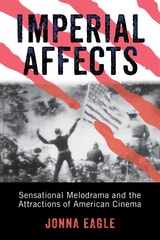
Imperial Affects
Sensational Melodrama and the Attractions of American CinemaEagle, Jonna
Rutgers University Press, 2017
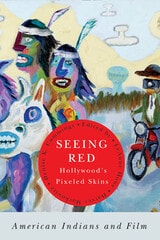
Seeing Red—Hollywood's Pixeled Skins
American Indians and FilmLeAnne Howe
Michigan State University Press, 2013
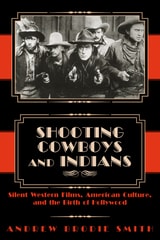
Shooting Cowboys and Indians
Silent Western Films, American Culture, and the Birth of HollywoodAndrew Brodie Smith
University Press of Colorado, 2003
Tracing the western from its hazy silent-picture origins in the 1890s to the advent of talking pictures in the 1920s, Smith examines the ways in which silent westerns contributed to the overall development of the film industry.
Focusing on such early important production companies as Selig Polyscope, New York Motion Picture, and Essanay, Smith revises current thinking about the birth of Hollywood and the establishment of Los Angeles as the nexus of filmmaking in the United States. Smith also reveals the role silent westerns played in the creation of the white male screen hero that dominated American popular culture in the twentieth century.
Illustrated with dozens of historic photos and movie stills, this engaging and substantive story will appeal to scholars interested in Western history, film history, and film studies as well as general readers hoping to learn more about this little-known chapter in popular filmmaking.
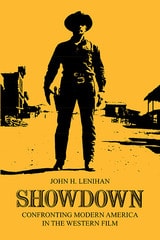
Showdown
Confronting Modern America in the Western FilmJohn H. Lenihan
University of Illinois Press, 1980
[brings] new levels of scholarship and sophistication to the study of
western films.... Should prove useful in the classroom, both for social
history and film history courses. It will introduce readers to a new way
to view some of the old horse operas that they had once taken for granted
as fluffy entertainment."
-- Western American Literature
'"The best of the recent
books to deal with Westerns produced since World War II --- in fact, probably
the best recent study of the Western."
-- Journal of the West
"Recommended for the
student of film and the hardcore film buff. The rest of you will be surprised,
delighted, perhaps even angered by some of the conclusions Lenihan has
come to."
-- Film World

The Cowboy Hero & Its Audience
Popular Culture As Market Derived ArtAlf H. Walle
University of Wisconsin Press, 2000
Using the history of the cowboy story from 1820 to 1970 as an extended example, Alf H. Walle combines popular culture scholarship with marketing theory to provide a hybrid analysis. Wall examines major authors and genres of Western American literature and film; he also explores why certain respected authors were unable to significantly impact the cowboy story even though their innovations were embraced by later generations. Finally Wall provides a hybrid analysis combining business and popular culture theory in an overarching analysis.
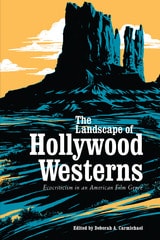
The Landscape of Hollywood Westerns
Ecocriticism in an American Film GenreCarmichael, Deborah A
University of Utah Press, 2006
The essays in this volume scrutinize the special place of nature and landscape in films—including silent, documentary, and feature length film—that are specifically American and Western. The films discussed here go beyond the stereotypical sagebrush setting. Although many of the films closely fit the standard conventions of the Western, others demonstrate the fluidity of the genre. The wildness of the western environment as a central fact of the American mythos encompasses far more than a brief period of national history or a specific geographical location.
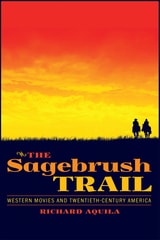
The Sagebrush Trail
Western Movies and Twentieth-Century AmericaRichard Aquila
University of Arizona Press, 2015
The book is divided into three parts. Part 1 traces the birth and growth of Westerns from 1900 through the end of World War II. Part 2 focuses on a transitional period in Western movie history during the two decades following World War II. Finally, part 3 shows how Western movies reflected the rapid political, social, and cultural changes that transformed America in the 1960s and the last decades of the twentieth century.
The Sagebrush Trail explains how Westerns evolved throughout the twentieth century in response to changing times, and it provides new evidence and fresh interpretations about both Westerns and American history. These films offer perspectives on the past that historians might otherwise miss. They reveal how Americans reacted to political and social movements, war, and cultural change. The result is the definitive story of Western movies, which contributes to our understanding of not just movie history but also the mythic West and American history. Because of its subject matter and unique approach that blends movies and history, The Sagebrush Trail should appeal to anyone interested in Western movies, pop culture, the American West, and recent American history and culture.
The mythic West beckons but eludes. Yet glimpses of its utopian potential can always be found, even if just for a few hours in the realm of Western movies. There on the silver screen, the mythic West continues to ride tall in the saddle along a “sagebrush trail” that reveals valuable clues about American life and thought.
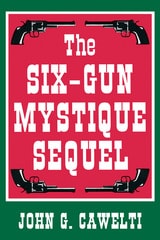
The Six-Gun Mystique Sequel
John G. Cawelti
University of Wisconsin Press, 1999
In this expanded version, Cawelti revises his analysis of the structural characteristics of the Western novel and film, synthesizing much of the rich discussion of the Western genre that has appeared since The Six-Gun Mystique's original publication. To this structural analysis he adds a new account of the genre's history and its relationship to the myths of the West that have played such an influential role in American history. The Six-Gun Mystique Sequel concludes with an exploration of the continuing influence of Western themes and symbols on many aspects of postmodern American culture, and an assessment of the critical tradition that has developed around the Western genre. The appendices of the book are also revised and expanded to include useful lists of the most important Western novels and films, as well as the best critical and historical studies of different aspects of the genre.
Westerns
Making the Man in Fiction and FilmLee Clark Mitchell
University of Chicago Press, 1996
Few genres are so closely identified with America as the Western. In this wide-ranging examination of the Western and its appeal, Lee Clark Mitchell ranges from the novels of James Fenimore Cooper to Louis L'Amour, and from classic films like Stagecoach to spaghetti Westerns like A Fistful of Dollar to show how Westerns helped assuage a series of crises in American culture. This landmark book shows that the Western owes its perennial appeal not to unchanging conventions but to the deftness with which it responds to the obsessions and fears of its audience. And no obsession, Lee Mitchell argues, has figured more prominently in the Western than what it means to be a man.