Results by title
6 books match the query 'Women in medicine'
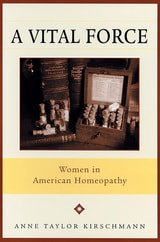
A Vital Force
Women in American HomeopathyKirschmann, Anne Taylor
Rutgers University Press, 2003
Homeopathy, as a medical system, presented a significant institutional and economic challenge to conventional medicine in the nineteenth century. Although contemporary critics portrayed homeopathic physicians as part of a sect whose treatment of disease was beyond the pale of acceptable medical practice, homeopathy was in many ways similar to established medicine. Anne Taylor Kirschmann explores the strategic choices and consequences for women practitioners. Not only were female homeopaths respected within their communities, they also enjoyed considerable professional advantages not available to women within regular medicine.
A Vital Force: Women in American Homeopathy offers a new interpretation of women’s roles in modern medicine. Kirschmann strengthens and clarifies the history of homeopathic women physicians and creates a framework of comparison to “regular,” or orthodox, physicians. Women medical practitioners chose homeopathy in dramatic numbers from the mid-nineteenth through the early twentieth centuries, although the reasons for this preference varied over time. Linked to social reform movements in the nineteenth century, anti-modernism in the late nineteenth and early twentieth, and countercultural ideals of the 1960s and 1970s, women's advocacy of homeopathy has been intertwined with broad social and cultural issues in American society.
Changing the Culture of Academic Medicine
Perspectives of Women FacultyLinda H. Pololi
Dartmouth College Press, 2010
My Life's Travels and Adventures
An Eighteenth-Century Oculist in the Ottoman Empire and the European HinterlandRegina Salomea Pilsztynowa
Iter Press, 2020
This edition brings the entirety of this personal and idiosyncratic memoir to English for the first time.
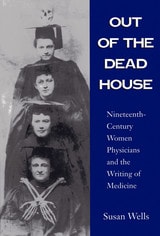
Out of the Dead House
Nineteenth-Century Women Physicians and the Writing of MedicineSusan Wells
University of Wisconsin Press, 2001
Susan Wells combines studies of medical genres, such as the patient history or the diagnostic conversation, with discussions of individual writers. The women she discusses include Ann Preston, the first woman dean of a medical college; Hannah Longshore, a successful practitioner who combined conventional and homeopathic medicine; Rebecca Crumpler, the first African American woman physician to publish a medical book; and Mary Putnam Jacobi, writer of more than 180 medical articles and several important books. Wells shows how these women learned to write, what they wrote, and how these texts were read.
Out of the Dead House also documents the ways that women doctors influenced medical discourse during the formation of the modern profession. They invented forms and strategies for medical research and writing, including methods of using survey information, taking patient histories, and telling case histories. Out of the Dead House adds a critical episode to the developing story of women as producers and critics of culture, including scientific culture.
Women Physicians and Professional Ethos in Nineteenth-Century America
Carolyn Skinner
Southern Illinois University Press, 2014
Women physicians in nineteenth-century America faced a unique challenge in gaining acceptance to the medical field as it began its transformation into a professional institution. The profession had begun to increasingly insist on masculine traits as signs of competency. Not only were these traits inaccessible to women according to nineteenth-century gender ideology, but showing competence as a medical professional was not enough. Whether women could or should be physicians hinged mostly on maintaining their femininity while displaying the newly established standard traits of successful practitioners of medicine.
Women Physicians and Professional Ethos provides a unique example of how women influenced both popular and medical discourse. This volume is especially notable because it considers the work of African American and American Indian women professionals. Drawing on a range of books, articles, and speeches, Carolyn Skinner analyzes the rhetorical practices of nineteenth-century American women physicians. She redefines ethos in a way that reflects the persuasive efforts of women who claimed the authority and expertise of the physician with great difficulty.
Descriptions of ethos have traditionally been based on masculine communication and behavior, leaving women’s rhetorical situations largely unaccounted for. Skinner’s feminist model considers the constraints imposed by material resources and social position, the reciprocity between speaker and audience, the effect of one rhetor’s choices on the options available to others, the connections between ethos and genre, the potential for ethos to be developed and used collectively by similarly situated people, and the role ethos plays in promoting social change. Extending recent theorizations of ethos as a spatial, ecological, and potentially communal concept, Skinneridentifies nineteenth-century women physicians’ rhetorical strategies and outlines a feminist model of ethos that gives readers a more nuanced understanding of how this mode of persuasion operates for all speakers and writers.
Women and Health in America, 2nd Ed.
Historical ReadingsJudith W. Leavitt
University of Wisconsin Press, 1999