Results by title
476 books match the query 'World War, 1939-1945' and 51 start with a
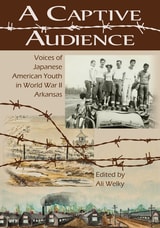
A Captive Audience
Voices of Japanese American Youth in World War II ArkansasAli Welky
Butler Center for Arkansas Studies, 2015
Intended for young-adult readers, this book explores important dimensions of Arkansas and U.S. history, including human rights and what it means to be an American.
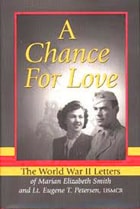
A Chance for Love
The World War II Letters of Marian Elizabeth Smith and Lt. Eugene T. Petersen, USMCREugene Peterson
Michigan State University Press, 1998
In mid-February 1944 Marian Elizabeth Smith, a young Wisconsin woman, met Marine Corps Lieutenant Eugene T. Petersen on the passenger train, El Capitan, as it made its 42-hour run from Los Angeles to Chicago. After a brief acquaintance, he left the United States to join the Third Marine Division on Guam and eventually to take part in the battle for Iwo Jima in February and March of 1945. The collected letters of their subsequent 18-month correspondence reveal much about wartime life at home and abroad. This correspondence represents a time capsule of current events as Smith and Petersen discuss Franklin Roosevelt, the United Nations, internationalism, popular movies, the French aviator and poet Antoine de St. Exupery, the comic strip Barnaby, and the frustrations of dealing with sometimes less-than- enlightened parents. The loss of Marian's brother during the bombing of Ploesti, Rumania, in June 1944, brought Petersen and Smith closer together, and after hundreds of letters the "chance for love" Marian had suggested early in their correspondence evolved into a marriage that has endured for more than half a century.
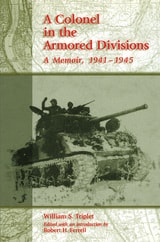
A Colonel in the Armored Divisions
A Memoir, 1941-1945William S. Triplet, Edited by Robert H. Ferrell
University of Missouri Press, 2001
In this fascinating memoir William S. Triplet continues the saga begun in his earlier book, A Youth in the Meuse-Argonne: A Memoir, 1917-1918. After serving in World War I, Triplet chose to become a career military man and entered West Point. Upon graduation in 1924, his assignments were routine—to regiments in the Southwest and in Panama or as an officer in charge of Reserve Officers' Training Corps units or of men sent to a tank school. All this changed, however, when a new war opened in Europe.
From 1940 to1942, Triplet was assigned to the Infantry Board at Fort Benning, Georgia, where he engaged in testing new weapons and machines for the expanding army. He became a full colonel in December 1942. After leaving Benning he received posts with four armored forces: the Thirteenth Armored Division forming in the United States, an amphibious tank and troop carrier group training at Fort Ord, California, and the Second and Seventh Armored Divisions in Europe. His extraordinary abilities as a tank commander became evident in the Seventh Armored, where he took over a four-thousand-man unit known as Combat Command A. He was soon moving from triumph to triumph as he led his unit into Germany. Here was much room for professional judgment and decision, and the colonel was in his element. In the war's last days Triplet and his men fought their way to the Baltic, preventing many German troops from joining in the defense of Berlin against the advancing Soviet army.
Although Triplet was recommended for brigadier general, Dwight D. Eisenhower believed the U.S. Army had enough generals to finish the war; thus, the indomitable Triplet served out the few remaining years of his career as a colonel. After retiring in 1954, Triplet moved to Leesburg, Virginia, where he soon began to mull over his military experiences. Fascinated by the history he had witnessed, engaged by the attraction of writing about it, he recorded his memories with a combination of verve, thoughtfulness, and harsh judgments concerning ranking officers he considered incompetent— generals not excluded.
Through his annotations, Robert H. Ferrell provides the historical context for Triplet's experiences. Well written and completely absorbing, A Colonel in the Armored Divisions provides readers the rare opportunity to see firsthand what a real professional in the U.S. Army thought about America's preparation for and participation in the war against Germany and Japan.
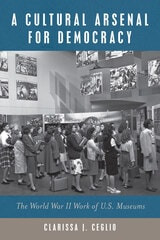
A Cultural Arsenal for Democracy
The World War II Work of US MuseumsClarissa J. Ceglio
University of Massachusetts Press, 2022
Unsurprisingly, exhibitions served as the primary vehicle through which museums, large and small, engaged their publics with wartime topics with fare ranging from displays on the cultures of Allied nations to "living maps" that charted troop movements and exhibits on war preparedness. Clarissa J. Ceglio chronicles debates, experiments, and collaborations from the 1930s to the immediate postwar years, investigating how museums re-envisioned the exhibition as a narrative medium and attempted to reconcile their mission with new modes of storytelling.
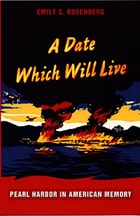
A Date Which Will Live
Pearl Harbor in American MemoryEmily S. Rosenberg
Duke University Press, 2005
Rosenberg considers the emergence of Pearl Harbor’s symbolic role within multiple contexts: as a day of infamy that highlighted the need for future U.S. military preparedness, as an attack that opened a "back door" to U.S. involvement in World War II, as an event of national commemoration, and as a central metaphor in American-Japanese relations. She explores the cultural background that contributed to Pearl Harbor’s resurgence in American memory after the fiftieth anniversary of the attack in 1991. In doing so, she discusses the recent “memory boom” in American culture; the movement to exonerate the military commanders at Pearl Harbor, Admiral Husband Kimmel and General Walter Short; the political mobilization of various groups during the culture and history "wars" of the 1990s, and the spectacle surrounding the movie Pearl Harbor. Rosenberg concludes with a look at the uses of Pearl Harbor as a historical frame for understanding the events of September 11, 2001.
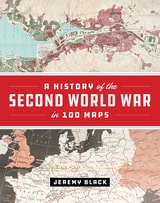
A History of the Second World War in 100 Maps
Jeremy Black
University of Chicago Press, 2020
The First World War was marked by an exceptional expansion in the use and production of military cartography. But World War II took things even further, employing maps, charts, reconnaissance, and the systematic recording and processing of geographical and topographical information on an unprecedented scale. As Jeremy Black—one of the world’s leading military and cartographic historians—convincingly shows in this lavish full-color book, it is impossible to understand the events and outcomes of the Second World War without deep reference to mapping at all levels. In World War II, maps themselves became the weapons.
A History of the Second World War in 100 Maps traces how military cartography developed from simply recording and reflecting history to having a decisive impact on events of a global scale. Drawing on one hundred key maps from the unparalleled collections of the British Library and other sources—many of which have never been published in book form before--Jeremy Black takes us from the prewar mapping programs undertaken by both Germany and the United Kingdom in the mid-1930s through the conflict’s end a decade later. Black shows how the development of maps led directly to the planning of the complex and fluid maneuvers that defined the European theater in World War II: for example, aerial reconnaissance photography allowed for the charting of beach gradients and ocean depths in the runup to the D-Day landings, and the subsequent troop movements at Normandy would have been impossible without the help of situation maps and photos. In the course of the conflict, both in Europe and the Pacific, the realities of climate, terrain, and logistics—recorded on maps—overcame the Axis powers. Maps also became propaganda tools as the pages of Time outlined the directions of the campaigns and the Allies dropped maps from their aircraft.
In this thrilling and unique book, Jeremy Black blends his singular cartographic and military expertise into a captivating overview of World War II from the air, sea, and sky, making clear how fundamental maps were to every aspect of this unforgettable global conflict.
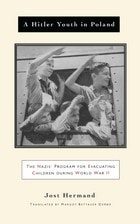
A Hitler Youth in Poland
The Nazi Children's Evacuation Program During World War IIJost Hermand
Northwestern University Press, 1997
During the Nazi era, millions of German children between the ages of seven and sixteen were taken from their homes and sent to Hitler Youth paramilitary camps to be toughened up and taught how to be "German." Separated from their families and sent to the far-flung corners of Europe, these children often endured incredible abuse by the adults in charge. In this memoir, Jost Hermand, a cultural critic and historian who spent much of his youth in five different camps, writes about his experiences as a small, unathletic boy thrown into a "wolf pack" governed by brutalization, dreary routine, and sadism.
Intelligent and persuasive, A Hitler Youth in Poland should be read by anyone interested in psychology or the history of everyday life in Hitler's Germany and the mental scars of adults born during the Nazi regime.
A Holocaust Controversy
The Treblinka Affair in Postwar FranceSamuel Moyn
Brandeis University Press, 2005
A Jewish Kapo in Auschwitz
History, Memory, and the Politics of SurvivalTuvia Friling
Brandeis University Press, 2014
A Marine Dive-bomber Pilot at Guadalcanal
John Howard McEniry
University of Alabama Press, 1987
This book chronicles the World War II experiences of the author, who served as a Marine Corps pilot in the South Pacific. Colonel McEniry describes the organization and deployment of a Marine dive-bombing squadron (VMSB-132) in the early days of the war and follows the squadron through its actions in November and December of 1942.
The participation by the squadron in the naval battle of Guadalcanal, November 12-15, 1942, is related in detail and includes the personal experiences of the author on several bombing missions. This battle, described by Admiral Ernest J. King, the Chief of Naval Operations, as “the fiercest naval battle ever fought,” resulted in the loss by the Japanese of two battleships, ten transport ships, and numerous cruisers and destroyers.
A Match Made in Hell
The Jewish Boy and the Polish Outlaw Who Defied the NazisLarry Stillman, from the testimony of Morris Goldner
University of Wisconsin Press, 2003
When Moniek (Morris) Goldner and his family were uprooted from their Polish farming village during a German action, the child-sized sixteen-year-old fled into the forests. He eventually met up with his father, who had also escaped, and together they managed to survive until a former friend betrayed the pair. Wounded and left for dead beneath his father’s murdered body, Goldner was rescued by the enigmatic outlaw Jan Kopec, who was also in hiding, looking for ways to profit from his criminal expertise.
For eighteen months Kopec hid the boy with him, moving from one area to another, often staying in hideouts he had fashioned years earlier. At first Kopec trained Goldner simply to serve as his accomplice in robberies and black market activities. But before long he pushed the training to a whole new level, making it possible for him to sell Goldner’s services to a shadowy resistance group which was becoming interested in the daring young saboteur.
And through it all, these two disparate personalities—the quiet, small-framed boy and the stocky, callous mercenary—forged an remarkable friendship and co-dependency born of need and desperation in a hellish time and place.
A Nation’s Undesirables
Mixed-Race Children and Whiteness in the Post-Nazi EraTracey Owens Patton
The Ohio State University Press, 2024
An innovative investigation of the entangled histories of race, transnational adoption, and post-Nazi Germany.
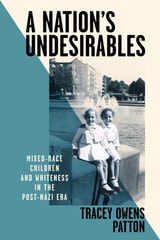
In a moving blend of family history and cutting-edge scholarship, Tracey Owens Patton’s A Nation’s Undesirables synthesizes work in rhetorical postmemory studies, critical adoption studies, Afrofuturism, and more to tell the story of her mother and aunt, Lore and Lilli. Two of thousands of children born to white German women and Black American men after World War II, the twins moved to the United States at age seven, where their mother renounced her parental rights and put them into the adoption system. They did not see her again for fifty-two years.Patton takes up the twins’ story and their reckoning with their mixed-race, Black German identity to disrupt standard narratives around World War II, Black experiences in Germany, and race and adoption. Combining family interviews, historical artifacts, and autoethnographic reflection, Patton composes a new narrative of women and Black German children in the postwar era. In examining the systemic racism of Germany’s efforts to move children like Lore and Lilli out of the country—and the suppression of German women’s bodily autonomy—Patton amplifies the once unacknowledged identities of these Black German children to broaden our understanding of citizenship, racism, and sexism after World War II.

A People's History of the Second World War
Resistance Versus EmpireDonny Gluckstein
Pluto Press, 2012
A People's History of the Second World War unearths the fascinating history of the war as fought 'from below'. Until now, the vast majority of historical accounts have focussed on the conflict between the Allied and Axis powers for imperialist mastery. Donny Gluckstein shows that in fact between 1939 and 1945 two distinct wars were fought – one ‘from above’ and one ‘from below’.
Using examples from countries under the Nazi heel, in the colonies and within the Axis and Allied camps, Gluckstein brings to life the very different struggle of the people's and resistance movements which proliferated during the war. He shows how they fought not just fascism, but colonialism and empire, and were betrayed by the Allies at the war’s end.
This book will fundamentally challenge our understanding of the Second World War – both about the people who fought it and the reasons for which it was fought.
A Private War
An American Code Officer in the Belgian CongoRobert Laxalt
University of Nevada Press, 1998
In this vivid memoir, Laxalt recalls his service during WWII as a code officer in the Belgian Congo. In this remote jungle outpost, a secret war was being fought for control of the world’s future. Deep in the Congo lay a mine that produced a little-known substance called uranium, and for reasons no one then understood, the Allies and the Germans were struggling ferociously to control this mine and its ore. The cloth edition is a limited numbered, signed edition.
A Promise at Sobibór
A Jewish Boy’s Story of Revolt and Survival in Nazi-Occupied PolandPhilip “Fiszel” Bialowitz, with Joseph Bialowitz; Foreword by Wladyslaw Bartoszewski
University of Wisconsin Press, 2012
A Promise at Sobibór is the story of Fiszel Bialowitz, a teenaged Polish Jew who escaped the Nazi gas chambers. Between April 1942 and October 1943, about 250,000 Jews from European countries and the Soviet Union were sent to the Nazi death camp at Sobibór in occupied Poland. Sobibór was not a transit camp or work camp: its sole purpose was efficient mass murder. On October 14, 1943, approximately half of the 650 or so prisoners still alive at Sobibór undertook a daring and precisely planned revolt, killing SS officers and fleeing through minefields and machine-gun fire into the surrounding forests, farms, and towns. Only about forty-two of them, including Fiszel, are known to have survived to the end of the war.
Philip (Fiszel) Bialowitz, now an American citizen, tells his eyewitness story here in the real-time perspective of his own boyhood, from his childhood before the war and his internment in the brutal Izbica ghetto to his harrowing six months at Sobibór—including his involvement in the revolt and desperate mass escape—and his rescue by courageous Polish farmers. He also recounts the challenges of life following the war as a teenaged displaced person, and his eventual efforts as a witness to the truth of the Holocaust.
In 1943 the heroic leaders of the revolt at Sobibór, Sasha Perchersky and Leon Feldhendler, implored fellow prisoners to promise that anyone who survived would tell the story of Sobibór: not just of the horrific atrocities committed there, but of the courage and humanity of those who fought back. Bialowitz has kept that promise.
Best Books for General Audiences, selected by the American Association for School Libraries
Best Books for High Schools, selected by the American Association for School Libraries
Best Books for Special Interests, selected by the Public Library Association
A Reckoning
Philippine Trials of Japanese War CriminalsSharon W. Chamberlain
University of Wisconsin Press, 2019
Chamberlain highlights the differing views of Filipinos and Japanese about the trials. The Philippine government aimed to show its commitment to impartial proceedings with just outcomes. In Japan, it appeared that defendants were selected arbitrarily, judges and prosecutors were biased, and lower-ranking soldiers were punished for crimes ordered by their superior officers. She analyzes the broader implications of this divergence as bilateral relations between the two nations evolved and contends that these competing narratives were reimagined in a way that, paradoxically, aided a path toward postwar reconciliation.
A Rescuer's Story
Pastor Pierre-Charles Toureille in Vichy FranceTela Zasloff
University of Wisconsin Press, 2014
This is the story of a Holocaust rescuer, Pierre Toureille, a French Protestant pastor whose efforts resulted in the rescue of hundreds of refugees, most of them Jewish. Inspired by his Huguenot heritage, Pastor Toureille participated in international Protestant church efforts to combat Nazism during the 1930s and headed a major refugee aid organization in Vichy France during World War II. After the war, Pastor Toureille was honored by the Jewish organization Yad Vashem as one of the "Righteous Among the Nations."
In telling Toureille’s story, Tela Zasloff also depicts the wide-ranging network of Protestant pastors and lay people in southern French villages who participated in an aggressive rescue effort. She delves into their motivations, including their heritage as members of a religious minority. Toureille’s rescue work under the Vichy regime, partly official and then increasingly clandestine as the war progrressed. was a crucial part of the French non-violent "spiritual resistance" against Nazism.
A World in Flames
A Concise Military History of World War IIMartha Byrd
University of Alabama Press, 2008
An essential, accessible guide to the greatest conflict in human history.
A World in Flames by Martha Byrd offers a clear, compelling, and comprehensive chronicle of World War II, guiding readers through the defining battles, strategies, and turning points that reshaped the modern world. Emphasizing the military history of the conflict, Byrd structures the narrative as a battle‑by‑battle survey, covering major campaigns including Stalingrad, Omaha Beach, and the Battle of the Atlantic, each presented with clarity and precision.
Beginning with the prelude to war and the rising tensions across Europe and Asia, the book traces Germany’s swift subjugation of Holland, Belgium, and France before shifting to Britain’s determined resistance. As the conflict expands, Byrd explores Japan’s entry into the war, the rapid advances across the Pacific, and the United States’ pivotal role in reversing Axis momentum.
Byrd’s accessible style makes complex military operations understandable without sacrificing depth, offering readers both a broad overview and meaningful detail. Maps, campaign analyses, and vivid summaries of naval, air, and ground operations provide context for the global scale of the conflict. From the brutal Eastern Front to the island‑hopping campaigns of the Pacific, the book highlights the strategic decisions and human costs that defined the war’s progression.
Concluding with the collapse of Axis power and the war’s final climactic battles in Europe and the Pacific, A World in Flames stands as an excellent introduction for readers seeking a concise but thorough account of World War II—one praised for its balance of readability, accuracy, and narrative drive.
A Young Palestinian's Diary, 1941–1945
The Life of Sami 'AmrTranslated, annotated, and with an introduction by Kimberly Katz
University of Texas Press, 2009
Writing in his late teens and early twenties, Sāmī ‘Amr gave his diary an apt subtitle: The Battle of Life, encapsulating both the political climate of Palestine in the waning years of the British Mandate as well as the contrasting joys and troubles of family life. Now translated from the Arabic, Sāmī's diary represents a rare artifact of turbulent change in the Middle East.
Written over four years, these ruminations of a young man from Hebron brim with revelations about daily life against a backdrop of tremendous transition. Describing the public and the private, the modern and the traditional, Sāmī muses on relationships, his station in life, and other universal experiences while sharing numerous details about a pivotal moment in Palestine's modern history. Making these never-before-published reflections available in translation, Kimberly Katz also provides illuminating context for Sāmī's words, laying out biographical details of Sāmī, who kept his diary private for close to sixty years. One of a limited number of Palestinian diaries available to English-language readers, the diary of Sāmī ‘Amr bridges significant chasms in our understanding of Middle Eastern, and particularly Palestinian, history.
A-Train
Memoirs of a Tuskegee AirmanCharles W. Dryden
University of Alabama Press, 1997
A moving personal account of a man’s flight for freedom—above the clouds and beyond prejudice—by one of the first Tuskegee airmen.
A-Train is the story of one of the black Americans who, during World War II, graduated from Tuskegee (AL) Flying School and served as a pilot in the Army Air Corps’ 99th Pursuit Squadron. Charles W. Dryden presents a fast-paced, balanced, and personal account of what it was like to prepare for a career traditionally closed to African Americans, how he coped with the frustrations and dangers of combat, and how he, along with many fellow black pilots, navigators, bombardiers, and crewmen, emerged with a magnificent war record.
Under the command of Colonel Benjamin O. Davis Jr., the Tuskegee airmen fought over North Africa, Sicily, and Europe, escorting American bomber crews who respected their "no-losses" record. Some were shot down, many of them were killed or captured by the enemy, and several won medals of valor and honor. But the airmen still faced great barriers of racial prejudice in the armed forces and at home. As a member of that elite group of young pilots who fought for their country overseas while being denied civil liberties at home, Dryden presents an eloquent story that will touch every reader.
Advertising at War
Business, Consumers, and Government in the 1940sInger L. Stole
University of Illinois Press, 2012
Using archival sources, newspapers accounts, and trade publications, Stole demonstrates that the war elevated and magnified the seeming contradictions of advertising and allowed critics of these practices one final opportunity to corral and regulate the institution of advertising. Exploring how New Dealers and consumer advocates such as the Consumers Union battled the advertising industry, Advertising at War traces the debate over two basic policy questions: whether advertising should continue to be a tax-deductible business expense during the war, and whether the government should require effective standards and labeling for consumer products, which would render most advertising irrelevant. Ultimately the postwar climate of political intolerance and reverence for free enterprise quashed critical investigations into the advertising industry. While advertising could be criticized or lampooned, the institution itself became inviolable.
After the Fall
War and Occupation in Irène Némirovsky's Suite françaiseNathan Bracher
Catholic University of America Press, 2010
Against Their Will
The History and Geography of Forced Migrations in the USSRPavel Polian
Central European University Press, 2003
Air Officer Commanding
Hugh Dowding, Architect of the Battle of BritainJohn T. LaSaine
University Press of New England, 2018
Air Power in War
Arthur W. Tedder
University of Alabama Press, 2010
Arthur Tedder, who was knighted and raised to the peerage for his contributions to the Allied victory in World War II, served in the British air force in World War I and played an important role in professionalizing and organizing British air forces between the two world wars. During World War II, he held a succession of increasingly vital air force posts.
In addition to his achievements as Air Commander-in-Chief in the North African theater early in the war, Tedder’s most lasting contribution was as Deputy Supreme Commander under Dwight D. Eisenhower. He deserves much credit for keeping the Allied command functioning and harmonious. He was also the architect of the successful air strategy Eisenhower adopted for the Normandy invasion of 1944, which departed from both the British and American existing doctrine and models by concentrating on German rail systems rather than on either civilian or industrial targets.
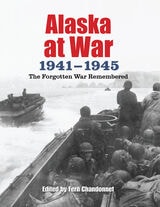
Alaska at War, 1941-1945
The Forgotten War RememberedEdited by Fern Chandonnet
University of Alaska Press, 2007
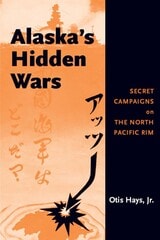
Alaska's Hidden Wars
Secret Campaigns on the North Pacific RimOtis Hays Jr.
University of Alaska Press, 2004
Alaska's Hidden Wars tells the story of the war in the North Pacific, a story of savage weather, isolation, and sacrifice.
Two island chains, the Aleutians and the Kuriles, became the focus of a series of major campaigns that pitted the Americans against the Japanese. Alaska's Hidden Wars chronicles the role of Japanese-American intelligence specialists and reveals a Japanese eyewitness account of the defense of Attu. Two virtually unknown aspects of the North Pacific war are also exposed: the brutal North Pacific weather and the imprisonment of American airmen in Kamchatka.
In 1942, the Japanese raided Dutch Harbor in the Aleutian Islands and occupied the islands of Kiska and Attu. The Americans mounted a vigorous campaign, and the Japanese retreated to the Kuriles. For the next two years, the Americans launched air raids and fleet bombardments, while American soldiers maintained lonely outposts along Aleutian coasts. But in 1945, when Japan finally surrendered, the Kuriles were taken, not by the waiting Americans, but by the Soviets.
Alaska's Hidden Wars is a fast-moving history that brings declassified archival sources to light and draws the reader into the lonely, bitter war fought in the North Pacific.
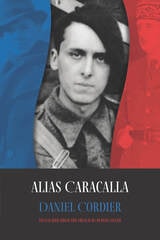
Alias Caracalla
Daniel Cordier
Swan Isle Press, 2024
Daniel Cordier’s fascinating, intimate memoir is a major contribution to our understanding of the fraught and historic relations between General Charles de Gaulle’s Free French and the fractious resistance movements under the Occupation during World War II. As the first young secretary to legendary Jean Moulin, one of the leaders of Conseil National de la Résistance, Cordier recounts Moulin’s tense negotiations to bring together the resistance movements and persuade them to join forces under de Gaulle’s banner between 1942 and ‘43. Cordier was a lookout on the fateful day the National Resistance Council was created, confirming de Gaulle’s legitimacy in the eyes of the French people and, crucially, in the eyes of Roosevelt and the Allied leadership. Later in life, Cordier penned his first-hand account of his role in the creation of Jean Moulin’s secretariat in Lyon and then Paris. Alias Caracalla is a brave and passionate story of action and self-discovery in times of war, with a sensitive and nuanced translation by Rupert Swyer.

America Lost and Found
An English Boy's Wartime Adventure in the New WorldAnthony Bailey
University of Chicago Press, 2000
"An original, sensitively told story in which the perspectives of the child are carefully remembered. . . . Bailey's book speaks, with gentle eloquence, not only to those who remember being boys, but to everyone who would seek to protect children from the hurts and ravagings that ordinary life can inflict, to say nothing of war." —Richard Montague, Newsday
"No doubt Tony Bailey owed America something for its hospitality during those anxious years, and with this book he has amply repaid the debt." —Joseph McLellan, Washington Post
"An exquisitely controlled, quietly amusing and moving story." —Publishers Weekly
"As tender as it is truthful, and as amusing as it is unpretentious." —John Russell, New York Times Book Review
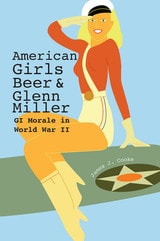
American Girls, Beer, and Glenn Miller
GI Morale in World War IIJames J. Cooke
University of Missouri Press, 2016
As World War II dawned in Europe, General George C. Marshall, the new Army Chief of Staff, had to acknowledge that American society—and the citizens who would soon become soldiers—had drastically changed in the previous few decades. Almost every home had a radio, movies could talk, and driving in an automobile to the neighborhood soda fountain was part of everyday life. A product of newly created mass consumerism, the soldier of 1940 had expectations of material comfort, even while at war. Historian James J. Cooke presents the first comprehensive look at how Marshall’s efforts to cheer soldiers far from home resulted in the enduring morale services that the Army provides still today.
Marshall understood that civilian soldiers provided particular challenges and wanted to improve the subpar morale services that had been provided to Great War doughboys. Frederick Osborn, a civilian intellectual, was called to head the newly formed morale branch, which quickly became the Special Services Division. Hundreds of on-post movie theaters showing first-run movies at reduced prices, service clubs where GIs could relax, and inexpensive cafeterias were constructed. The Army Exchange System took direction under Brigadier General Joseph Byron, offering comfort items at low prices; the PX sold everything from cigarettes and razor blades to low-alcohol beer in very popular beer halls.
The great civic organizations—the YMCA, the Salvation Army, the Jewish Welfare Board, and others—were brought together to form the United Service Organizations (USO). At USO Camp Shows, admired entertainers like Bob Hope, Bing Crosby, and Frances Langford brought home-style entertainment to soldiers within the war zones. As the war heightened in intensity, the Special Service Companies grew to over forty in number, each containing more than one hundred enlisted men. Trained in infantry skills, soldiers in the companies at times would have to stop showing movies, pick up their rifles, and fight.
The Special Services Division, PX, and USO were crucial elements in maintaining GI morale, and Cooke’s work makes clear the lasting legacy of these efforts to boost the average soldier’s spirits almost a century ago. The idea that as American soldiers serve abroad, they should have access to at least some of the comforts of home has become a cultural standard.
American Rhetoric in the New Deal Era, 1932-1945
A Rhetorical History of the United States, Volume VIIThomas Benson
Michigan State University Press, 2006
The New Deal era is hard to define with precision—in time or in ideology. Some historians use New Deal to designate the intense period of domestic reform legislation of the first Franklin Delano Roosevelt administration, 1933–37. Others confine discussion of the era to the legislation of 1933, and identify another wave of legislation in 1935 as a Second New Deal. Most of the essays in this book focus on the prewar period, with glimpses that look forward to the rhetoric of the approach to and engagement in World War II.
American Theater in the Culture of the Cold War
Producing and Contesting Containment, 1947-1962Judith M. Melton
University of Iowa Press, 1998
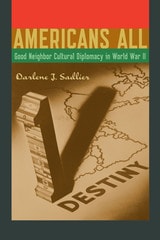
Americans All
Good Neighbor Cultural Diplomacy in World War IIBy Darlene J. Sadlier
University of Texas Press, 2012
Cultural diplomacy—“winning hearts and minds” through positive portrayals of the American way of life—is a key element in U.S. foreign policy, although it often takes a backseat to displays of military might. Americans All provides an in-depth, fine-grained study of a particularly successful instance of cultural diplomacy—the Office of the Coordinator of Inter-American Affairs (CIAA), a government agency established by President Franklin D. Roosevelt in 1940 and headed by Nelson A. Rockefeller that worked to promote hemispheric solidarity and combat Axis infiltration and domination by bolstering inter-American cultural ties.
Darlene J. Sadlier explores how the CIAA used film, radio, the press, and various educational and high-art activities to convince people in the United States of the importance of good neighbor relations with Latin America, while also persuading Latin Americans that the United States recognized and appreciated the importance of our southern neighbors. She examines the CIAA’s working relationship with Hollywood’s Motion Picture Society of the Americas; its network and radio productions in North and South America; its sponsoring of Walt Disney, Orson Welles, John Ford, Gregg Toland, and many others who traveled between the United States and Latin America; and its close ties to the newly created Museum of Modern Art, which organized traveling art and photographic exhibits and produced hundreds of 16mm educational films for inter-American audiences; and its influence on the work of scores of artists, libraries, book publishers, and newspapers, as well as public schools, universities, and private organizations.
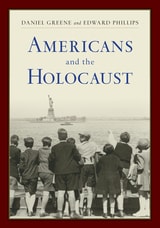
Americans and the Holocaust
A ReaderDaniel Greene
Rutgers University Press, 2021
Americans and the Holocaust explores these enduring questions by gathering together more than one hundred primary sources that reveal how Americans debated their responsibility to respond to Nazism. Drawing on groundbreaking research conducted for the United States Holocaust Memorial Museum’s Americans and the Holocaust exhibition, these carefully chosen sources help readers understand how Americans’ responses to Nazism were shaped by the challenging circumstances in the United States during the 1920s, 1930s, and 1940s, including profound economic crisis, fear of communism, pervasive antisemitism and racism, and widespread isolationism.
Collecting newspaper and magazine articles, popular culture materials, and government records, Americans and the Holocaust is a valuable resource for students and historians seeking to shed light on this dark era in world history.
To explore further, visit the United States Holocaust Memorial Museum's digital exhibit, available here: https://exhibitions.ushmm.org/americans-and-the-holocaust
Published in association with the United States Holocaust Memorial Museum.
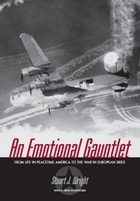
An Emotional Gauntlet
From Life in Peacetime America to the War in European SkiesStuart J. Wright
University of Wisconsin Press, 2008
In recounting the harrowing conditions and horrors of bombing missions over Europe, An Emotional Gauntlet emphasizes the interpersonal relationships within the crew and the spirit these men shared. Corky's crew served under Operations Officer Major James Stewart (the Hollywood movie star.) They often returned from arduous bombing missions to sleep in half-empty huts—their friends in other planes had not been so lucky. Pilot Jack Nortridge regularly assured his crew, "If you fly with me, I'm going to bring you home." This book is a testament to their strength and determination.
And Yet I Still Have Dreams
A Story of Certain LonelinessJoanna Wiszniewicz
Northwestern University Press, 2004
The book provides a connection to seldom discussed aspects of the Holocaust: the gulf between rich and poor Jews and how this translated into everyday survival; the refusal by Alex to see himself or Jews in general as heroes or victims; his own self-absorption as a teen in the ghetto; and his "priviliged" family's near-indifference to the suffering of those around them. Alex paints a picture of complex and diverse Jewish society in prewar Poland, revealing how, many years later and despite his determine to leave it in the past, the burdens of memory--and the dreams--linger.
Anthropological Intelligence
The Deployment and Neglect of American Anthropology in the Second World WarDavid H. Price
Duke University Press, 2008
Anthropological Intelligence is based on interviews with anthropologists as well as extensive archival research involving many Freedom of Information Act requests. Price looks at the role played by the two primary U.S. anthropological organizations, the American Anthropological Association and the Society for Applied Anthropology (which was formed in 1941), in facilitating the application of anthropological methods to the problems of war. He chronicles specific projects undertaken on behalf of government agencies, including an analysis of the social effects of postwar migration, the design and implementation of OSS counterinsurgency campaigns, and the study of Japanese social structures to help tailor American propaganda efforts. Price discusses anthropologists’ work in internment camps, their collection of intelligence in Central and South America for the FBI’s Special Intelligence Service, and their help forming foreign language programs to assist soldiers and intelligence agents. Evaluating the ethical implications of anthropological contributions to World War II, Price suggests that by the time the Cold War began, the profession had set a dangerous precedent regarding what it would be willing to do on behalf of the U.S. government.
Anti-Japan
The Politics of Sentiment in Postcolonial East AsiaLeo T. S. Ching
Duke University Press, 2019
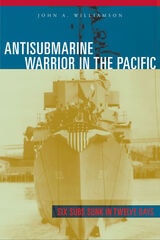
Antisubmarine Warrior in the Pacific
Six Subs Sunk in Twelve DaysJohn A. Williamson
University of Alabama Press, 2005
A commanding firsthand account of the most successful antisubmarine campaign in U.S. Naval History.
The USS England was a 1200-ton, 306-foot, long-hull destroyer escort. Commissioned into service in late 1943 and dispatched to the Pacific the following February, the England and its crew, in one 12-day period in 1944, sank more submarines than any other ship in U.S. naval history: of the six targets attacked, all six were destroyed. For this distinction, legendary in the annals of antisubmarine warfare, the ship and her crew were honored with the Presidential Unit Citation.
After convoying in the Atlantic, John A. Williamson was assigned to the England—first as its executive officer, then as its commanding officer—from the time of her commissioning until she was dry-docked for battle damage repairs in the Philadelphia Naval Yard fifteen months later. Besides being a key participant in the remarkable antisubmarine actions, Williamson commanded the England in the battle of Okinawa, where she was attacked by kamikaze planes.
Williamson narrates his memoir with authority and authenticity, describes naval tactics and weaponry precisely, and provides information gleaned from translations of the orders from the Japanese high command to Submarine Squadron 7. The author details the challenges of communal life aboard ship and explains the intense loyalty that bonds crew members for life. Ultimately, Williamson offers a compelling portrait of himself, an inexperienced naval officer who, having come of age in Alabama during the Depression, rose to become the most successful World War II antisubmarine warfare officer in the Pacific.

Arab Responses to Fascism and Nazism
Attraction and RepulsionBy Israel Gershoni
University of Texas Press, 2014
The first book to present an analysis of Arab response to fascism and Nazism from the perspectives of both individual countries and the Arab world at large, this collection problematizes and ultimately deconstructs the established narratives that assume most Arabs supported fascism and Nazism leading up to and during World War II. Using new source materials taken largely from Arab memoirs, archives, and print media, the articles reexamine Egyptian, Syrian, Lebanese, Palestinian, and Iraqi responses in the 1930s and throughout the war.
While acknowledging the individuals, forces, and organizations that did support and collaborate with Nazi Germany and fascist Italy, Arab Responses to Fascism and Nazism focuses on the many other Arab voices that identified with Britain and France and with the Allied cause during the war. The authors argue that many groups within Arab societies—elites and non-elites, governing forces, and civilians—rejected Nazism and fascism as totalitarian, racist, and, most important, as new, more oppressive forms of European imperialism. The essays in this volume argue that, in contrast to prevailing beliefs that Arabs were de facto supporters of Italy and Germany—since “the enemy of my enemy is my friend”—mainstream Arab forces and currents opposed the Axis powers and supported the Allies during the war. They played a significant role in the battles for control over the Middle East.

Architects of Globalism
Building a New World Order during WWIIPatrick J. Hearden
University of Arkansas Press, 2002
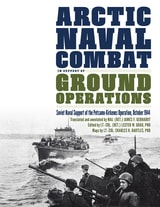
Arctic Naval Combat in Support of Ground Operations
Soviet Naval Support of the Petsamo-Kirkenes Operation, October 1944James F Gebhardt
University of Alaska Press, 2025
The largest Arctic battle on record, involving 133,500 Soviets and 45,000 Germans and Quisling Norwegians, the Petsamo-Kirkenes Operation sought to liberate the northernmost part of Norway from German occupation during World War II. The Soviet navy played a previously unrecognized crucial role in the operation by providing fire support and transportation, as well as conducting raids and combat landings on the enemy-held coast. The harsh Arctic environment, including extreme cold, ice, and limited daylight, posed significant challenges to the Soviet and German forces. Despite these hardships, the Soviet forces achieved their objectives, defeated the German Army, and successfully liberated the area.
Arctic Naval Combat in Support of Ground Operations is a powerful companion to Gebhardt’s previous translation, The Petsamo-Kirkenes Operation: Soviet Breakthrough and Pursuit in the Arctic, October 1944, which details this operation’s ground offensive. Providing a starting point for the study and understanding of combined arms and services combat in the Arctic, an increasingly important and accessible part of the planet where military concerns are rapidly expanding, this work is a valuable addition to the literature of World War II military history and a significant additional perspective on the Soviet military.
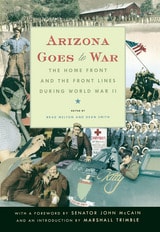
Arizona Goes to War
The Home Front and the Front Lines during World War IIBrad Melton
University of Arizona Press, 2003
Arizona Goes to War takes readers back to a time when military installations sprang up all over the state as thousands of airmen arrived to train in Arizona's clear desert skies, and when soldiers destined for North Africa came to get their first taste of desert sands. In its pages, readers will learn not only of the green recruits who passed through Arizona, but also of the state's Native Americans who registered for the draft in record numbers, of Japanese Americans unjustly incarcerated in desert detention centers, and of ordinary citizens who did their bit for the war effort. Included in the book are some of World War II's most incredible stories, such as the testing of tank engines in Arizona dust storms for the North Africa campaign, the interrogation of Japanese consular diplomats from Honolulu at the Triangle T Guest Ranch near Dragoon, and the escape of 25 German POWs from a detention camp outside of Phoenix—called the greatest escape by Axis prisoners from a U.S. compound during the war. A separate chapter pays tribute to Arizona's war heroes: not only Silvestre Herrera, but also fighter ace Grant Turley, Midway hero John C. Butler, and Pima Indian Ira Hayes, who helped raise the flag on Iwo Jima. A host of profiles and sidebars bring people and events of the wartime era to life, and a useful appendix provides a traveler's guide to Arizona's World War II sites.
World War II may have transformed Arizona more than it did any other state; not only did Arizona's industry blossom, its population did as well when servicemen who had been stationed there returned to put down stakes. Arizona Goes to War recaptures the glory and spirit of that era and reminds us that the people who lived through those years are well worth commemorating.
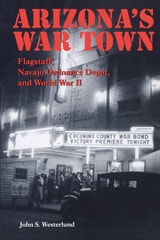
Arizona's War Town
Flagstaff, Navajo Ordnance Depot, and World War IIJohn S. Westerlund
University of Arizona Press, 2003
A clearing in the ponderosa pine forest called Volunteer Prairie met the military's criteria for a munitions depot—open terrain, a cool climate, plentiful water, and proximity to a railroad—and it was also sufficiently inland to be safe from the threat of coastal invasion. Constructing a depot of 800 ammunition bunkers, each the size of a 2,000-square-foot home, called for a force of 8,000 laborers, and Flagstaff became a boom town overnight as construction workers and their families poured in from nearby Indian reservations and as far away as the Midwest and South. More than 2,000 were retained as permanent employees—a larger workforce than Flagstaff's total pre-war employment roster.
As Westerlund's portrait of wartime Flagstaff shows, prosperity brought unanticipated consequences: racism simmered beneath the surface of the town as ethnic groups were thrown together for the first time; merchants called a city-wide strike to protest emerging union activity; juvenile delinquency rose dramatically; Flagstaff women entered the workforce in unprecedented numbers, altering local mores along with their own plans for the future; meanwhile, hundreds of sailors and marines arrived at Arizona State Teachers College to participate in the Navy's "V-12" program. Whether recounting the difficulty of 3,500 Navajo and Hopi employees adjusting to life off the reservation or the complaints of townspeople that Austrian POWs-transferred to the depot to ease the labor shortage-were treated too well, Westerlund shows that the construction and maintenance of the facility was far more than a military matter.
Navajo Ordnance Depot remained operational to support wars in Korea, Vietnam, and the Persian Gulf, and today Camp Navajo provides storage for thousands of deactivated ICBM motors. But in recounting its early days, Westerlund has skillfully blended social and military history to vividly portray not only a city's transitional years but also the impact of military expansion on economic and community development in the American West.
Arky
The Saga of the USS ArkansasRay Hanley
Butler Center for Arkansas Studies, 2015
Arrows in the Dark (Volumes 1 and 2)
David Ben-Gurion, the Yishuv Leadership, and Rescue Attempts during the HolocaustTuvia Friling; Translated by Ora Cummings
University of Wisconsin Press, 2005
Art in a Disrupted World
Poland 1939–1949Agata Pietrasik
Museum of Modern Art in Warsaw, 2020
Employing an accessible, essayistic style, Pietrasik offers a new look at life in the ten years following the outbreak of World War II and features artists—including Marian Bogusz, Jadwiga Simon-Pietkiewicz, and Józef Szajna—whose work has not yet found substantial audiences in the English-speaking world. Her reading of the art and artists of this period strives to capture their autonomous artistic language and poses critical questions about the ability of traditional art history writing to properly accommodate artworks created in direct response to traumatic experiences.
Artists, Intellectuals, and World War II
The Pontigny Encounters at Mount Holyoke College, 1942-1944Christopher E. G. Benfey
University of Massachusetts Press, 2006
Sixty years ago, at the height of World War II, an extraordinary series of gatherings took place at Mount Holyoke College in western Massachusetts. During the summers of 1942–1944, leading European figures in the arts and sciences met at the college with their American counterparts for urgent conversations about the future of human civilization in a precarious world.
Two Sorbonne professors, the distinguished medievalist Gustave Cohen and the existentialist philosopher Jean Wahl, organized these “Pontigny” sessions, named after an abbey in Burgundy where similar symposia had been held in the decades before the war. Among the participants—many of whom were Jewish or had Jewish backgrounds—were the philosophers Hannah Arendt and Rachel Bespaloff, the poets Marianne Moore and Wallace Stevens, the anthropologist Claude Lévi-Strauss and the linguist Roman Jakobson, and the painters Marc Chagall and Robert Motherwell.
In this collection of original essays, Stanley Cavell and Jacques Derrida lead an international group of scholars—including Jed Perl, Mary Ann Caws, Jeffrey Mehlman, and Elisabeth Young-Bruehl—in assessing the lasting impact and contemporary significance of Pontigny-en- Amérique. Rachel Bespaloff, a tragic figure who wrote a major work on the Iliad, is restored to her rightful place beside Arendt and Simone Weil. Anyone interested in the “intellectual resistance” of Francophone intellectuals and artists, and the inspiring support from such American figures as Stevens and Moore, will want to read this pioneering work of scholarship and historical re-creation.
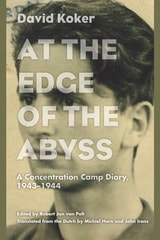
At the Edge of the Abyss
A Concentration Camp Diary, 1943-1944David Koker; Edited by Robert Jan van Pelt; Translated from the Dutch by Michiel Horn and John Irons
Northwestern University Press, 2012
Finalist for 2012 National Jewish Book Award in the Holocaust category
David Koker's diary is one of the most notable accounts of life in a German concentration camp written by a Jew during the years of the Holocaust. First brought to attention when the Dutch historian Jacob Presser-Koker's history teacher in high school-quoted from Koker's diary in his monumental history, published in English as The Destruction of the Dutch Jews (1968), the diary itself became a part of the Dutch literary canon when it was published in 1977 as Dagboek geschreven in Vught (Diary Written in Vught). It has remained in print ever since, and is notable for its literary qualities, weaving poetry and powerful observations of the emotional life of a camp prisoner, including reflections after an in-person visit by Heinrich Himmler. Surprisingly, the book has never before been translated into English.
During his time in the Vught concentration camp, the 21-year-old David recorded on an almost daily basis his observations, thoughts, and feelings. He mercilessly probed the abyss that opened around him and, at times, within himself. David's diary covers almost a year, both charting his daily life in Vught as it developed over time and tracing his spiritual evolution as a writer. Until early February 1944, David was able to smuggle some 73,000 words from the camp to his best friend Karel van het Reve, a non-Jew.
With an informative introduction, annotation, and list of dramatis personae by Robert Jan van Pelt, At the Edge of the Abyss offers an immediate and wholly original look into the life of a concentration camp prisoner.
Athene Palace
Hitler's "New Order" Comes to RumaniaR. G. Waldeck
University of Chicago Press, 2013