Results by title
295 books match the query 'Zoology' and 30 start with a
A Country So Full of Game
The Story of Wildlife in IowaJames J. Dinsmore
University of Iowa Press, 1994
Based on a thorough search of hundreds of primary sources ranging from chronicles of military expeditions to field reports by early naturalists, first-person accounts by fur traders and hunters to up-to-date county checklists, A Country So Full of Game examines the dramatic encounters of humans with elk, black bears, passenger pigeons, bobcats, prairie-chickens, otters, and many more. Each chapter discusses the animal's status and distribution when explorers first arrived in Iowa, how it was hunted or trapped, how this exploitation affected its population, and what its current status is both in Iowa and nationally. Enhanced by Mark Müller's distinctive drawings, commissioned for this book, the anecdotes evoke a sense of loss and wonder at the magic abundance of Iowa's wildlife.
Iowa has been changed more than, perhaps, any other state. We can mourn the disappearance of the bison and mountain lion while we marvel at the recent success of the wild turkey and white-tailed deer. Listening to James Dinsmore tell the story of wildlife in Iowa can open a window onto the future as other areas of our planet are increasingly altered by humans. A Country So Full of Game will allow all naturalists, both amateur and professional, hunter and biologist, to appreciate and learn from Iowa's diverse wild heritage.
A History of Oregon Ornithology
From Territorial Days to the Rise of BirdingAlan L. Contreras
Oregon State University Press, 2022
Editors Alan Contreras, Vjera Thompson, and Nolan Clements have assembled chapters exploring the differences and interplay between the amateur and professional study of birds, along with discussions of early birding societies, notable observers, and ornithological studies. It includes significant chapters on Charles Bendire, William L. Finley, Ira Gabrielson, Stanley Jewett, and David B. Marshall. It also notes the sometimes-overlooked contributions of women to our expanding knowledge of western birds. Special attention is paid to the development of seabird observation, the impact of the Internet, and the rise of digital resources for bird observers.
Intended for readers interested in the history of Oregon, the history of scientific explorations in the west, and the origins of modern birding and field ornithology, A History of Oregon Ornithology offers a detailed and entertaining tour of how birds were first observed and studied by explorers in what is now Oregon.
A Little Queer Natural History
Josh L. Davis
University of Chicago Press, 2024
From a pair of male swans raising young to splitgill mushrooms with over 23,000 mating types, sex in the natural world is wonderfully diverse. Josh L. Davis considers how, for many different organisms—animals, plants, and fungi included—sexual reproduction and sex determination rely on a surprisingly complex interaction among genes, hormones, environment, and chance. As Davis introduces us to fascinating biological concepts like parthenogenesis (virgin birth), monoecious plants (individuals with separate male and female flowers), and sex-reversed genitals, we see turtle hatchlings whose sex is determined by egg temperature; butterflies that embody male and female biological tissue in the same organism; and a tomato that can reproduce three different ways at the same time. Davis also reveals animal and plant behaviors in nature that researchers have historically covered up or explained away, like queer sex among Adélie penguins or bottlenose dolphins, and presents animal behaviors that challenge us to rethink our assumptions and prejudices. Featuring fabulous sex-fluid fishes and ant, wasp, and bee queens who can choose both how they want to have sex and the sex of their offspring, A Little Queer Natural History offers a larger lesson: that the diversity we see in our own species needs no justification and represents just a fraction of what exists in the natural world.
A Manual of the Mammalia
An Homage to Lawlor’s “Handbook to the Orders and Families of Living Mammals”Douglas A. Kelt and James L. Patton
University of Chicago Press, 2020
The taxonomy of recent mammals has lately undergone tremendous revision, but it has been decades since the last update to Timothy E. Lawlor’s acclaimed identification guide the Handbook to the Orders and Families of Living Mammals. Integrating the latest advances in research, Douglas A. Kelt and James L. Patton provide this long-overdue update in their new, wholly original work, A Manual of the Mammalia.
Complemented by global range maps, high-resolution photographs of skulls and mandibles by Bill Stone, and the outstanding artwork of Fiona Reid, this book provides an overview of biological attributes of each higher taxon while highlighting key and diagnostic characters needed to identify skulls and skins of all recent mammalian orders and most families. Kelt and Patton also place taxa in their currently understood supra-familial clades, and discuss current challenges in higher mammal taxonomy. Including a comprehensive review of mammalian anatomy to provide a foundation for understanding all characters employed throughout, A Manual of the Mammalia is both a user-friendly handbook for students learning to identify higher mammal taxa and a uniquely comprehensive, up-to-date reference for mammalogists and mammal-lovers from across the globe.
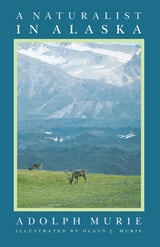
A Naturalist in Alaska
Adolph Murie
University of Arizona Press, 1990
"A fascinating study of the life cycles of the animals of Alaska and their inter-relationships. One venturing to capture something of the true beauty of Alaska and its fauna will probably find it in this book."—Journal of the West
"This book should be considerable aid to those who wish to preserve some of the great natural treasures still remaining in Alaska in the face of the inevitable pressures of a growing population. The writing is absolutely first rate. Highly recommended."—Library Journal
A Systematic Study of The Lizards of The Deppei Group (Genus Cnemidophorus) in Mexico and Guatemala
By William E. Duellman and John Wellman
University of Michigan Press, 1960
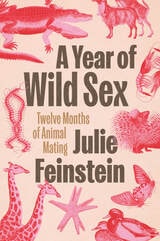
A Year of Wild Sex
Twelve Months of Animal MatingJulie Feinstein
University of Chicago Press, 2026
An eye-opening, unexpected year of animals' most intimate encounters.
It was a chance meeting with mating silverfish behind her bathroom cabinet that made biologist Julie Feinstein more curious about, well, the birds and the bees. How do other animals have sex? How do turtles do it? Or starfish without obvious sex organs? What about dangerous animals, like alligators? Or those historically associated with sex, like an oyster or a stork? What if all the animals that we see in zoos, TV ads, and children’s books, she wondered, had sex lives as seemingly strange as those of silverfish?
Feinstein’s humorous, accessible, and deeply researched text answers these and other questions on nature’s most surprising sexual behaviors, including firefly suitors bearing nutritious “nuptial gifts” and post-copulatory slug penis amputations. She raises an eyebrow at all the mammals—from goats to giraffes—that incorporate urine into courtship. She explains the complex interactions of amorous cockroaches and their equally complex genitalia. She laments that dyeing poison dart frog tadpoles sometimes commit cannibalism for a better shot at growing up and then, eventually, coupling up. In this little black book of animal sex, Feinstein guides readers through the year, drawing connections that illuminate the associations between animals’ mating behaviors and our monthly calendars. She details some animals’ peak bursts of activity, such as Atlantic white shrimp spawning in July, porcupines breeding in October, and bald eagles, decorators extraordinaires, working on their nests in December. Scorpions enter whimsically under the astrological sign of Scorpio in November, and when a holiday nears, she explains the mating nitty-gritty of species with deep cultural connections to a specific day, like New Year storks, Thanksgiving turkeys, or Christmas reindeer. Presenting a pair of animals for each month, Feinstein offers an entertaining and illuminating Noah’s ark and a year of wacky, unbelievable, truly wild sex.
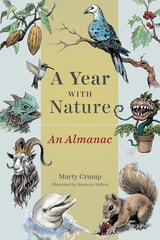
A Year with Nature
An AlmanacMarty Crump
University of Chicago Press, 2018
With Crump, we mark the publication of classics like Carson’s Silent Spring and White’s Charlotte’s Web, and even the musical premiere of Tchaikovsky’s Swan Lake. We note the discovery of the structure of DNA and the mountain gorilla, the rise of citizen science projects, and the work of people who’ve shaped how we view and protect nature—from Aristotle to E. O. Wilson. Some days feature US celebrations, like National Poinsettia Day and National Cat Day; others highlight country-specific celebrations, like Australia’s Wombat Day and Thailand’s Monkey Buffet Festival, during which thousands of macaques feast on an ornately arranged spread of fruits and vegetables. Crump also highlights celebrations that span borders, from World Wildlife Conservation Day to International Mountain Day and global festivities for snakes, sea turtles, and chocolate. Interweaving fascinating facts on everything from jellyfish bodies to monthly birth flowers with folkloric entries featuring the Loch Ness Monster, unicorns, and ancient Greek, Roman, and Egyptian mythology, the almanac is as exhaustive as it is enchanting.
A Year with Nature celebrates the wonder and beauty of our natural world as we have expressed it in visual arts, music, literature, science, natural history, and everyday experience. But more than this, the almanac’s vignettes encourage us to contemplate how we can help ensure that future generations will be able to enjoy the landscapes and rich biodiversity we so deeply cherish.
About Method
Experimenters, Snake Venom, and the History of Writing ScientificallyJutta Schickore
University of Chicago Press, 2017
About Method shows that methodological advancement throughout history has not been simply a steady progression toward better, more sophisticated and improved methodologies of experimentation. Rather, it was a progression in awareness of the obstacles and limitations that scientists face in developing strategies to probe the myriad unknown complexities of nature. The first long-term history of this development and of snake venom research, About Method offers a major contribution to integrated history and philosophy of science.
Acoustic Communication in Insects and Anurans
Common Problems and Diverse SolutionsH. Carl Gerhardt and Franz Huber
University of Chicago Press, 2002
H. Carl Gerhardt and Franz Huber address these questions among many others, drawing on research from bioacoustics, behavior, neurobiology, and evolutionary biology to present the first integrated approach to the study of acoustic communication in insects and anurans. They highlight both the common solutions that these very different groups have evolved to shared challenges, such as small size, ectothermy (cold-bloodedness), and noisy environments, as well as the divergences that reflect the many differences in evolutionary history between the groups. Throughout the book Gerhardt and Huber also provide helpful suggestions for future research.

Across the Bridge
Understanding the Origin of the VertebratesHenry Gee
University of Chicago Press, 2018
As Gee shows, even as scientific advances have falsified a variety of theories linking these groups, the extant relatives of vertebrates are too few for effective genetic analysis. Moreover, the more we learn about the species that do remain—from sea-squirts to starfish—the clearer it becomes that they are too far evolved along their own courses to be of much use in reconstructing what the latest invertebrate ancestors of vertebrates looked like. Fossils present yet further problems of interpretation. Tracing both the fast-changing science that has helped illuminate the intricacies of vertebrate evolution as well as the limits of that science, Across the Bridge helps us to see how far the field has come in crossing the invertebrate-to-vertebrate divide—and how far we still have to go.

Advances in the Zoology of Tapeworms, 1950-1970
Robert A. Wardle
University of Minnesota Press, 0
This volume is a sequel to the comprehensive study by Professors Robert A. Wardle and James A. McLeod, The Zoology of Tapeworms, published by the University of Minnesota Press in 1952. The new book is based on research and publications which have become available since the earlier volume was published.
While much of the information in the earlier book was devoted to the identification, description, and classification of families, genera, and species, research efforts in the last two decades have been focused in new directions. Although some researchers have been engaged in revising the original classification in the light of new findings, others have been exploring specificity, serology, and genetics, and have undertaken studies of host-parasite relationships, pathogenesis, and therapeutics in the treatment of tapeworm infestation. These investigations have been facilitated by laboratory techniques which were not available for earlier studies.Following introductory chapters on the recent expansion of tapeworm research and the phylogeny of tapeworms, the authors devote a chapter each to 21 orders of tapeworms. The material is based on a survey of the literature including more than 2,000 papers on tapeworm zoology published since 1950. Chapters on laboratory propagation and on therapeutics complete the text, and there is an extensive list of references. Many drawings illustrate the text.
Albertus Magnus On Animals V1 2
A Medieval Summa Zoologica Revised EditionKenneth F. Kitchell Jr.and Irven Michael Resnick
The Ohio State University Press, 2018
In his work De animalibus, Albert integrated the vast amount of information on nature that had come down to him in previous centuries: the exposition of Michael Scotus’s translation from the Arabic of Aristotle’s books on the natural world (Books 1–19), Albert’s own revisions to Aristotle’s teachings (Books 20–21), and a “dictionary” of animals appropriated largely from the De natura rerum of Thomas of Cantimpré (Books 22–26). Albert’s comprehensive treatise on living things was acknowledged as the reputable authority in biology for almost five hundred years.
In this translated and annotated edition, Kenneth F. Kitchell Jr. and Irven Michael Resnick illuminate the importance of this work, allowing Albert’s magnum opus to be better understood and more widely appreciated than ever before. Broken into two volumes (Books 1–10 and 11–26),Albertus Magnus On Animals is a veritable medieval scientific encyclopedia, ranging in topics from medicine, embryology, and comparative anatomy to women, hunting and everyday life, commerce, and much more—an essential work for historians, medievalists, scientists, and philosophers alike.
Albertus Magnus On Animals V1
A Medieval Summa Zoologica Revised EditionAlbertus Magnus, Edited by Kenneth F. Kitchell Jr.and Irven Michael Resnick
The Ohio State University Press, 2018
In his work De animalibus, Albert integrated the vast amount of information on nature that had come down to him in previous centuries: the exposition of Michael Scotus’s translation from the Arabic of Aristotle’s books on the natural world (Books 1–19), Albert’s own revisions to Aristotle’s teachings (Books 20–21), and a “dictionary” of animals appropriated largely from the De natura rerum of Thomas of Cantimpré (Books 22–26). Albert’s comprehensive treatise on living things was acknowledged as the reputable authority in biology for almost five hundred years.
In this translated and annotated edition, Kenneth F. Kitchell Jr. and Irven Michael Resnick illuminate the importance of this work, allowing Albert’s magnum opus to be better understood and more widely appreciated than ever before. Broken into two volumes (Books 1–10 and 11–26),Albertus Magnus On Animals is a veritable medieval scientific encyclopedia, ranging in topics from medicine, embryology, and comparative anatomy to women, hunting and everyday life, commerce, and much more—an essential work for historians, medievalists, scientists, and philosophers alike.
Albertus Magnus On Animals V2
A Medieval Summa Zoologica Revised EditionAlbertus Magnus, Edited by Kenneth F. Kitchell Jr.and Irven Michael Resnick
The Ohio State University Press, 2019
In his work De animalibus, Albert integrated the vast amount of information on nature that had come down to him in previous centuries: the exposition of Michael Scotus’s translation from the Arabic of Aristotle’s books on the natural world (Books 1–19), Albert’s own revisions to Aristotle’s teachings (Books 20–21), and a “dictionary” of animals appropriated largely from the De natura rerum of Thomas of Cantimpré (Books 22–26). Albert’s comprehensive treatise on living things was acknowledged as the reputable authority in biology for almost five hundred years.
In this translated and annotated edition, Kenneth F. Kitchell Jr. and Irven Michael Resnick illuminate the importance of this work, allowing Albert’s magnum opus to be better understood and more widely appreciated than ever before. Broken into two volumes (Books 1–10 and 11–26),Albertus Magnus On Animals is a veritable medieval scientific encyclopedia, ranging in topics from medicine, embryology, and comparative anatomy to women, hunting and everyday life, commerce, and much more—an essential work for historians, medievalists, scientists, and philosophers alike.
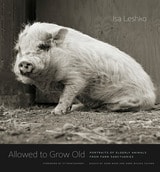
Allowed to Grow Old
Portraits of Elderly Animals from Farm SanctuariesIsa Leshko
University of Chicago Press, 2019
Isa Leshko shows us, brilliantly, with this collection of portraits. To create these portraits, she spent hours with her subjects, gaining their trust and putting them at ease. The resulting images reveal the unique personality of each animal. It’s impossible to look away from the animals in these images as they unforgettably meet our gaze, simultaneously calm and challenging. In these photographs we see the cumulative effects of the hardships of industrialized farm life, but also the healing that time can bring, and the dignity that can emerge when farm animals are allowed to age on their own terms.
Each portrait is accompanied by a brief biographical note about its subject, and the book is rounded out with essays that explore the history of animal photography, the place of beauty in activist art, and much more. Open this book to any page. Meet Teresa, a thirteen-year-old Yorkshire Pig, or Melvin, an eleven-year-old Angora Goat, or Tom, a seven-year-old Broad Breasted White Turkey. You’ll never forget them.
America's Snake
The Rise and Fall of the Timber RattlesnakeTed Levin
University of Chicago Press, 2016
Yet most of us have never seen a timber rattler. Though they’re found in thirty-one states, and near many major cities, in contemporary America timber rattlesnakes are creatures mostly of imagination and innate fear.
Ted Levin aims to change that with America’s Snake, a portrait of the timber rattlesnake, its place in America’s pantheon of creatures and in our own frontier history—and of the heroic efforts to protect it against habitat loss, climate change, and the human tendency to kill what we fear. Taking us from labs where the secrets of the snake’s evolutionary history are being unlocked to far-flung habitats whose locations are fiercely protected by biologists and dedicated amateur herpetologists alike, Levin paints a picture of a fascinating creature: peaceable, social, long-lived, and, despite our phobias, not inclined to bite. The timber rattler emerges here as emblematic of America and also, unfortunately, of the complicated, painful struggles involved in protecting and preserving the natural world.
A wonderful mix of natural history, travel writing, and exemplary journalism, America’s Snake is loaded with remarkable characters—none more so than the snake at its heart: frightening, perhaps; endangered, certainly; and unquestionably unforgettable.
Among Penguins
A Bird Man in AntarcticaNoah Strycker
Oregon State University Press, 2011
The year he graduated from college, 22-year-old Noah Strycker was dropped by helicopter in a remote Antarctic field camp with two bird scientists and a three months’ supply of frozen food. His subjects: more than a quarter million penguins.
Compact, industrious, and approachable, the Adélie Penguins who call Antarctica home visit their breeding grounds each Antarctic summer to nest and rear their young before returning to sea. Because of long-term studies, scientists may know more about how these penguins will adjust to climate change than about any other creature in the world.
Bird scientists like Noah are less well known. Like the intrepid early explorers of Antarctica, modern scientists drawn to the frozen continent face an utterly inhospitable landscape, one that inspires, isolates, and punishes.
With wit, curiosity, and a deep knowledge of his subject, Strycker recounts the reality of life at the end of the Earth—thousand-year-old penguin mummies, hurricane-force blizzards, and day-to-day existence in below freezing temperatures—and delves deep into a world of science, obsession, and birds.
Among Penguins weaves a captivating tale of penguins and their researchers on the coldest, driest, highest, and windiest continent on Earth. Birders, lovers of the Antarctic, and fans of first-person adventure narratives will be fascinated by Strycker’s book.
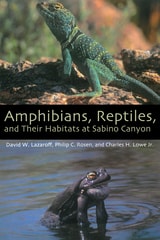
Amphibians, Reptiles, and Their Habitats at Sabino Canyon
David W. Lazaroff, Philip C. Rosen, and Charles H. Lowe, Jr.
University of Arizona Press, 2006
In this first publication to describe Sabino Canyon’s biota in scientific detail, three expert authors pool their knowledge to provide a detailed discussion of ecological change—especially as a consequence of drought, flooding, the introduction of exotic species, and direct human impact. Suburbia has arrived on the canyon’s doorstep, and human visitation has soared, inalterably affecting the area. Of particular concern, breeding habitats for amphibians were profoundly altered by flash flooding in Sabino’s streams following the 2003 Aspen Fire, which ravaged large parts of the Santa Catalina Mountains. The book contains richly detailed accounts of the 57 species found at Sabino—25 snakes, 17 lizards, 8 toads and frogs, 6 turtles, and 1 salamander—emphasizing their local ecology and the behavior likely to be witnessed by visitors. Physical descriptions and numerous photographs—many in color—facilitate identification. Up-to-date distribution maps provide an essential baseline against which future researchers can measure change.
Amphibians, Reptiles, and Their Habitats at Sabino Canyon is essential for anyone who seeks to understand this desert oasis, how it has changed, and how it may change in the future. Written with minimal technical jargon to make it as useful to students and visitors as it will be to scientists and resource managers, it makes a vital contribution to our understanding of creatures underfoot whose habitat we seek to share.
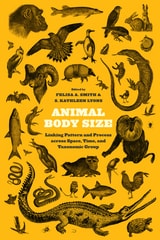
Animal Body Size
Linking Pattern and Process across Space, Time, and Taxonomic GroupEdited by Felisa A. Smith and S. Kathleen Lyons
University of Chicago Press, 2013
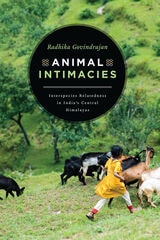
Animal Intimacies
Interspecies Relatedness in India's Central HimalayasRadhika Govindrajan
University of Chicago Press, 2018
Built on extensive ethnographic fieldwork in the mountain villages of India’s Central Himalayas, Radhika Govindrajan’s book explores the number of ways that human and animal interact to cultivate relationships as interconnected, related beings. Whether it is through the study of the affect and ethics of ritual animal sacrifice, analysis of the right-wing political project of cow-protection, or examination of villagers’ talk about bears who abduct women and have sex with them, Govindrajan illustrates that multispecies relatedness relies on both difference and ineffable affinity between animals. Animal Intimacies breaks substantial new ground in animal studies, and Govindrajan’s detailed portrait of the social, political and religious life of the region will be of interest to cultural anthropologists and scholars of South Asia as well.

Animal Minds
Donald R. Griffin
University of Chicago Press, 1992
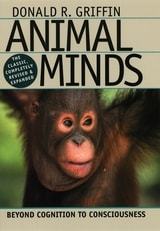
Animal Minds
Beyond Cognition to ConsciousnessDonald R. Griffin
University of Chicago Press, 2001
With this new edition of his classic book, which he has completely revised and updated, Griffin moves beyond considerations of animal cognition to argue that scientists can and should investigate questions of animal consciousness. Using examples from studies of species ranging from chimpanzees and dolphins to birds and honeybees, he demonstrates how communication among animals can serve as a "window" into what animals think and feel, just as human speech and nonverbal communication tell us most of what we know about the thoughts and feelings of other people. Even when they don't communicate about it, animals respond with sometimes surprising versatility to new situations for which neither their genes nor their previous experiences have prepared them, and Griffin discusses what these behaviors can tell us about animal minds. He also reviews the latest research in cognitive neuroscience, which has revealed startling similarities in the neural mechanisms underlying brain functioning in both humans and other animals. Finally, in four chapters greatly expanded for this edition, Griffin considers the latest scientific research on animal consciousness, pro and con, and explores its profound philosophical and ethical implications.
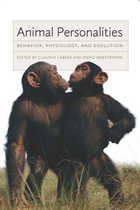
Animal Personalities
Behavior, Physiology, and EvolutionEdited by Claudio Carere and Dario Maestripieri
University of Chicago Press, 2013
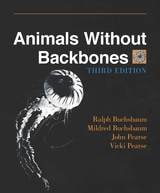
Animals Without Backbones
An Introduction to the InvertebratesRalph Buchsbaum, Mildred Buchsbaum, John Pearse, and Vicki Pearse
University of Chicago Press, 1987
This new edition has been completely rewritten and redesigned, but it retains the same clarity and careful scholarship that have earned this book its continuing readership for half a century. It is even more lavishly illustrated than earlier editions, incorporating many new drawings and photographs. Informative, concise legends that form an integral part of the text accompany the illustrations. The text has been updated to include findings from recent research. Eschewing pure morphology, the authors use each group of animals to introduce one or more biological principles.
In recent decades, courses and texts on invertebrate zoology at many universities have been available only for advanced biology majors specializing in this area. The Third Edition of Animals Without Backbones remains an ideal introduction to invertebrates for lower-level biology majors, nonmajors, students in paleontology and other related fields, junior college and advanced high school students, and the general reader who pursues the rewarding study of the natural world.
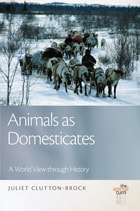
Animals as Domesticates
A World View through HistoryJuliet Clutton-Brock
Michigan State University Press, 2012
Drawing on the latest research in archaeozoology, archaeology, and molecular biology, Animals as Domesticates traces the history of the domestication of animals around the world. From the llamas of South America and the turkeys of North America, to the cattle of India and the Australian dingo, this fascinating book explores the history of the complex relationships between humans and their domestic animals. With expert insight into the biological and cultural processes of domestication, Clutton-Brock suggests how the human instinct for nurturing may have transformed relationships between predator and prey, and she explains how animals have become companions, livestock, and laborers. The changing face of domestication is traced from the spread of the earliest livestock around the Neolithic Old World through ancient Egypt, the Greek and Roman empires, South East Asia, and up to the modern industrial age.
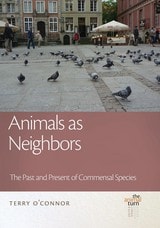
Animals as Neighbors
The Past and Present of Commensal AnimalsTerry O'Connor
Michigan State University Press, 2013
In this fascinating book, Terry O’Connor explores a distinction that is deeply ingrained in much of the language that we use in zoology, human-animal studies, and archaeology—the difference between wild and domestic. For thousands of years, humans have categorized animals in simple terms, often according to the degree of control that we have over them, and have tended to see the long story of human-animal relations as one of increasing control and management for human benefit. And yet, around the world, species have adapted to our homes, our towns, and our artificial landscapes, finding ways to gain benefit from our activities and so becoming an important part of our everyday lives. These commensal animals remind us that other species are not passive elements in the world around us but intelligent and adaptable creatures. Animals as Neighbors shows how a blend of adaptation and opportunism has enabled many species to benefit from our often destructive footprint on the world. O’Connor investigates the history of this relationship, working back through archaeological records. By requiring us to take a multifaceted view of human-animal relations, commensal animals encourage a more nuanced understanding of those relations, both today and throughout the prehistory of our species.
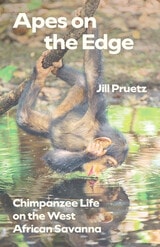
Apes on the Edge
Chimpanzee Life on the West African SavannaJill Pruetz
University of Chicago Press, 2025
Fongoli chimpanzees are unique for many reasons. Their female hunters are the only apes that regularly hunt with tools, seeking out tiny bush babies with wooden spears. Unlike most other chimps, these apes fear neither water nor fire, using shallow pools to cool off in the Senegalese heat. Up to 90 percent of their home range burns annually—the result of human hunting or clearing for gold mining—and Fongoli chimpanzees have learned to predict the movement of such fires and to avoid them.
The study of Fongoli chimps is also unique. While most primate research occurs in isolated reserves, Fongoli chimpanzees live alongside humans, and as primatologist and anthropologist Jill Pruetz reports, this shared habitat creates both challenges and opportunities. The issues faced by Fongoli chimpanzees—particularly food scarcity and environmental degradation—are also issues faced by their human neighbors. This connection is one reason Pruetz, who has studied Fongoli apes for over two decades, created the nonprofit Neighbor Ape in 2008 to provide for the welfare of the humans who share their landscape with apes. It is also why Pruetz decided to write this book, the first to offer readers a view of these chimps’ lives and to explain the specific conservation efforts needed to help them. Incorporating stories from Pruetz’s time in the field, including the compelling rescue of a young chimp from poachers, Apes on the Edge opens a fascinating window into primate research, conservation, and the inner workings of a very special population of our closest nonhuman relatives.
Apes on the Edge
Chimpanzee Life on the West African SavannaJill Pruetz
University of Chicago Press, 2025
A moving story of survival and an eye-opening introduction to an extraordinary community of chimps and people.
Fongoli chimpanzees are unique for many reasons. Their female hunters are the only apes that regularly hunt with tools, seeking out tiny bush babies with wooden spears. Unlike most other chimps, these apes fear neither water nor fire, using shallow pools to cool off in the Senegalese heat. Up to 90 percent of their home range burns annually—the result of human hunting or clearing for gold mining—and Fongoli chimpanzees have learned to predict the movement of such fires and to avoid them.
The study of Fongoli chimps is also unique. While most primate research occurs in isolated reserves, Fongoli chimpanzees live alongside humans, and as primatologist and anthropologist Jill Pruetz reports, this shared habitat creates both challenges and opportunities. The issues faced by Fongoli chimpanzees—particularly food scarcity and environmental degradation—are also issues faced by their human neighbors. This connection is one reason Pruetz, who has studied Fongoli apes for over two decades, created the nonprofit Neighbor Ape in 2008 to provide for the welfare of the humans who share their landscape with apes. It is also why Pruetz decided to write this book, the first to offer readers a view of these chimps’ lives and to explain the specific conservation efforts needed to help them. Incorporating stories from Pruetz’s time in the field, including the compelling rescue of a young chimp from poachers, Apes on the Edge opens a fascinating window into primate research, conservation, and the inner workings of a very special population of our closest nonhuman relatives.
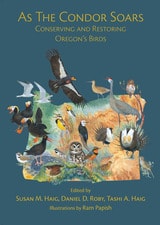
As the Condor Soars
Conserving and Restoring Oregon's BirdsSusan M. Haig
Oregon State University Press, 2022
The essays collected in As the Condor Soars focus on the role that ornithologists have played in research, management, and conservation debates across the state over the past century. Contributors to this volume discuss new developments in the study of birds, from sophisticated tracking devices to the evolving connections between ornithologists and artists. Readers also learn about the important role of citizen scientists in saving our treasured birds. These essays provide hope for species recovery, despite environmental threats, when scientists and the public work together. They also offer to other regions examples of adaptive management learned through these efforts.
This full-color book is beautifully illustrated by noted Oregon Coast artist Ram Papish and includes over eighty stunning photographs donated by some of the state’s finest nature photographers. Fifty capsule biographies of noted Oregon avian scientists round out the inspirational stories about the monumental efforts that have taken shape in recent decades. Accessibly written for scientists and laypeople alike, As the Condor Soars is a gift to everyone who cares about the conservation and restoration of Oregon’s birds.