Results by title
33 books match the query 'sixties'
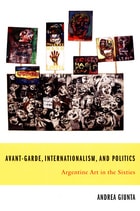
Avant-Garde, Internationalism, and Politics
Argentine Art in the SixtiesAndrea Giunta
Duke University Press, 2007
The renowned Argentine art historian and critic Andrea Giunta analyzes projects specifically designed to internationalize Argentina’s art and avant-garde during the 1960s: the importation of exhibitions of contemporary international art, the sending of Argentine artists abroad to study, the organization of prize competitions involving prestigious international art critics, and the export of exhibitions of Argentine art to Europe and the United States. She looks at the conditions that made these projects possible—not least the Alliance for Progress, a U.S. program of “exchange” and “cooperation” meant to prevent the spread of communism through Latin America in the wake of the Cuban Revolution—as well as the strategies formulated to promote them. She describes the influence of Romero Brest, prominent art critic, supporter of abstract art, and director of the Centro de Artes Visuales del Instituto Tocuato Di Tella (an experimental art center in Buenos Aires); various group programs such as Nueva Figuración and Arte Destructivo; and individual artists including Antonio Berni, Alberto Greco, León Ferrari, Marta Minujin, and Luis Felipe Noé. Giunta’s rich narrative illuminates the contentious postwar relationships between art and politics, Latin America and the United States, and local identity and global recognition.
Black America in the Shadow of the Sixties
Notes on the Civil Rights Movement, Neoliberalism, and PoliticsClarence Lang
University of Michigan Press, 2015
Blues Music in the Sixties
A Story in Black and WhiteUlrich Adelt
Rutgers University Press, 2010
In the 1960s, within the larger context of the civil rights movement and the burgeoning counterculture, the blues changed from black to white in its production and reception, as audiences became increasingly white. Yet, while this was happening, blackness--especially black masculinity--remained a marker of authenticity. Crossing color lines and mixing the beats of B.B. King, Eric Clapton, and Janis Joplin; the Newport Folk Festival and the American Folk Blues Festival; and publications such as Living Blues, Ulrich Adelt discusses these developments, including the international aspects of the blues. He highlights the performers and venues that represented changing racial politics and addresses the impact and involvement of audiences and cultural brokers.
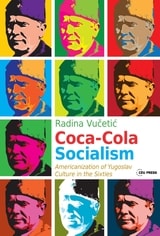
Coca-Cola Socialism
Americanization of Yugoslav Culture in the SixtiesRadina Vucetic
Central European University Press, 2018
This book is about the Americanization of Yugoslav culture and everyday life during the nineteen-sixties. After falling out with the Eastern bloc, Tito turned to the United States for support and inspiration. In the political sphere the distance between the two countries was carefully maintained, yet in the realms of culture and consumption the Yugoslav regime was definitely much more receptive to the American model. For Titoist Yugoslavia this tactic turned out to be beneficial, stabilising the regime internally and providing an image of openness in foreign policy.
Coca-Cola Socialism addresses the link between cultural diplomacy, culture, consumer society and politics. Its main argument is that both culture and everyday life modelled on the American way were a major source of legitimacy for the Yugoslav Communist Party, and a powerful weapon for both USA and Yugoslavia in the Cold War battle for hearts and minds.
Radina Vučetić explores how the Party used American culture in order to promote its own values and what life in this socialist and capitalist hybrid system looked like for ordinary people who lived in a country with communist ideology in a capitalist wrapping. Her book offers a careful reevaluation of the limits of appropriating the American dream and questions both an uncritical celebration of Yugoslavia’s openness and an exaggerated depiction of its authoritarianism.
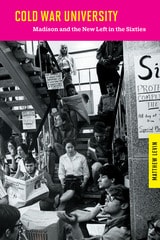
Cold War University
Madison and the New Left in the SixtiesMatthew Levin
University of Wisconsin Press, 2013
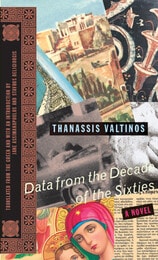
Data from the Decade of the Sixties
A NovelThanassis Valtinos
Northwestern University Press, 2000
Just as Greece today struggles to adapt to a shifting political landscape, so Greece in the 1960s was convulsed by the collision of tradition and cultural transformation. In Data from the Decade of the Sixties, Valtinos assembles voices, stories, and news clips that capture the transformation of Greece, the monarchy giving way to a republic via dictatorship, the industrialization of its agricultural society, and the replacement of arranged marriages with love matches.
The many voices in this tour de force coalesce in a bricolage of documents: personal letters between friends and family, news reports, advertisements, and other written ephemera. As governments fall, sexologists, fortune-tellers, garage owners, and lonely matrons advertise their specialties and fantasies in want ads, while the young and lonely find escape within the cheap novels, movies, and gossip columns that enliven their barren existence.
Together these testimonies illuminate the tumult of 1960s Greece, where generations and values clash and Greek society struggles to adapt. Valtinos captures the pulse of a decade, portraying the spirit of the century in Greece and throughout the world.
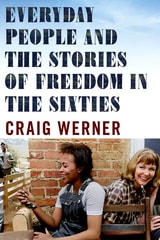
Everyday People and the Stories of Freedom in the Sixties
Craig Werner
University of Massachusetts Press, 2027
Showing that the most important figures of the 1960s were not always the most famous ones
Just weeks back from Vietnam, guitarist Larry Lee stood on stage at Woodstock alongside Jimi Hendrix, but he isn’t given more than a glance in the festival’s documentary. In Selma, Alabama, in March 1965, an eight-year-old girl named Sheyann Webb wrote her own obituary before joining the march across the Edmund Pettus Bridge. She survived Bloody Sunday, swept off the bridge in the arms of Hosea Williams as state troopers on horseback swung bullwhips and clubs. These are just a couple of the regular people at the heart of Craig Werner’s sweeping, mosaic history of the 1960s; it is their stories, not those of the icons, that give the era its deeper meaning.
In Everyday People and the Stories of Freedom in the Sixties, Werner assembles a rich and kaleidoscopic portrait of a decade in which Americans across the entire political spectrum claimed freedom as their cause. Moving beyond familiar myths and simplified narratives, he reveals a period defined by three interlocking realities: everything was open to change, everything seemed to happen at once, and everyone believed their vision of freedom was the one worth fighting for.
Bringing together stories too often told in isolation—the Civil Rights Movement, Vietnam, the global Cold War, the women’s movement, and the intertwined worlds of sex, drugs, and rock 'n' roll—Werner integrates the experiences of African Americans, women, Native Americans, Latinx communities, LGBTQ people, and immigrants into a single, propulsive narrative. Music, film, art, and fashion are not treated as colorful backdrops but as central forces in the making of political and social change. This book illuminates the economic, political, technological, and cultural forces that shaped the 1960s and continue to influence the present. It is a history of a decade told not from the top down, but from the ground up, by the people who lived it.
Supplemental materials for readers, students, and instructors are available on the publisher’s website, including full citations, playlists, images, and thematic sections on the Global Sixties, science and technology, religion, literature, music, film, visual art, and major figures and events.
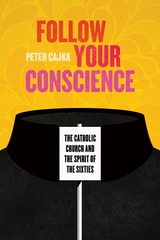
Follow Your Conscience
The Catholic Church and the Spirit of the SixtiesPeter Cajka
University of Chicago Press, 2021
Peter Cajka’s erudite book shows how even staunch Catholics were transformed by the maelstrom of the American Sixties, turning away from powerful and corrupt institutions and toward the inner moral compass provided by their own consciences.
What is your conscience? Is it, as Peter Cajka asks in this provocative book, “A small, still voice? A cricket perched on your shoulder? An angel and devil who compete for your attention?” Going back at least to the thirteenth century, Catholics viewed their personal conscience as a powerful and meaningful guide to align their conduct with worldly laws. But, as Cajka shows in Follow Your Conscience, during the national cultural tumult of the 1960s, the divide between the demands of conscience and the demands of the law, society, and even the church itself grew increasingly perilous. As growing numbers of Catholics started to consider formerly stout institutions to be morally hollow—especially in light of the Vietnam War and the church’s refusal to sanction birth control—they increasingly turned to their own consciences as guides for action and belief. This abandonment of higher authority had radical effects on American society, influencing not only the broader world of Christianity, but also such disparate arenas as government, law, health care, and the very vocabulary of American culture. As this book astutely reveals, today’s debates over political power, religious freedom, gay rights, and more are all deeply infused by the language and concepts outlined by these pioneers of personal conscience.
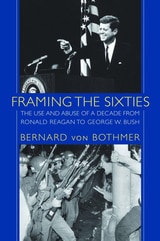
Framing the Sixties
The Use and Abuse of a Decade from Ronald Reagan to George W. BushBernard von Bothmer
University of Massachusetts Press, 2010
Over the past quarter century, American liberals and conservatives alike have invoked memories of the 1960s to define their respective ideological positions and to influence voters. Liberals recall the positive associations of what might be called the “good Sixties”—the “Camelot” years of JFK, the early civil rights movement, and the dreams of the Great Society—while conservatives conjure images of the “bad Sixties”—a time of urban riots, antiwar protests, and countercultural revolt.
In Framing the Sixties, Bernard von Bothmer examines this battle over the collective memory of the decade primarily through the lens of presidential politics. He shows how four presidents—Ronald Reagan, George H. W. Bush, Bill Clinton, and George W. Bush—each sought to advance his political agenda by consciously shaping public understanding of the meaning of “the Sixties.” He compares not only the way that each depicted the decade as a whole, but also their commentary on a set of specific topics: the presidency of John F. Kennedy, Lyndon Johnson's “Great Society” initiatives, the civil rights movement, and the Vietnam War.
In addition to analyzing the pronouncements of the presidents themselves, von Bothmer draws on interviews he conducted with more than one hundred and twenty cabinet members, speechwriters, advisers, strategists, historians, journalists, and activists from across the political spectrum—from Julian Bond, Daniel Ellsberg, Todd Gitlin, and Arthur Schlesinger to James Baker, Robert Bork, Phyllis Schlafly, and Paul Weyrich.
It is no secret that the upheavals of the 1960s opened fissures within American society that have continued to affect the nation's politics and to intensify its so-called culture wars. What this book documents is the extent to which political leaders, left and right, consciously exploited those divisions by “framing” the memory of that turbulent decade to serve their own partisan interests.
Growing Up in a Land Called Honalee
The Sixties in the Lives of American ChildrenJoel P. Rhodes
University of Missouri Press, 2017
Because the preadolescent years are, according to the child development researchers, the most formative, Joel P. Rhodes focuses on the cohort born between 1956 and 1970 who have never been quantitatively defined as a generation, but whose preadolescent world was nonetheless quite distinct from that of the “baby boomers.” Rhodes examines how this group understood the historical forces of the 1960s as children, and how they made meaning of these forces based on their developmental age. He is concerned not only with the immediate imprint of the 1960s on their young lives, but with how their perspective on the era influenced them as adults.
Happy Days and Wonder Years
The Fifties and the Sixties in Contemporary Cultural PoliticsMarcus, Daniel
Rutgers University Press, 2004
From Ronald Reagan's image as a Fifties Cold Warrior to Bill Clinton's fandom for Elvis Presley and John F. Kennedy, politicians have invoked the Fifties and the Sixties to connect to their public. Marcus shows how films, television, music, and memoirs have responded to the political nostalgia of today, and why our entertainment remains immersed in reruns, revivals, and references to earlier times. This book offers a new understanding of how politics and popular culture have influenced our notions of the past, and how events from long ago continue to shape our understanding of the present day.
In Visible Movement
Nuyorican Poetry from the Sixties to SlamUrayoan Noel
University of Iowa Press, 2014
The first book-length study specifically devoted to Nuyorican poetry, In Visible Movement is unique in its historical and formal breadth, ranging from the foundational poets of the 1960s and 1970s to a variety of contemporary poets emerging in and around the Nuyorican Poets Cafe “slam” scene of the 1990s and early 2000s. It also unearths a largely unknown corpus of poetry performances, reading over forty years of Nuyorican poetry at the intersection of the printed and performed word, underscoring the poetry’s links to vernacular and Afro-Puerto Rican performance cultures, from the island’s oral poets to the New York sounds and rhythms of Latin boogaloo, salsa, and hip-hop. With depth and insight, Urayoán Noel analyzes various canonical Nuyorican poems by poets such as Pedro Pietri, Victor Hernández Cruz, Miguel Algarín, Miguel Piñero, Sandra María Esteves, and Tato Laviera. He discusses historically overlooked poets such as Lorraine Sutton, innovative poets typically read outside the Nuyorican tradition such as Frank Lima and Edwin Torres, and a younger generation of Nuyorican-identified poets including Willie Perdomo, María Teresa Mariposa Fernández, and Emanuel Xavier, whose work has received only limited critical consideration. The result is a stunning reflection of how New York Puerto Rican poets have addressed the complexity of identity amid diaspora for over forty years.

Jazz in the sixties
the expansion of musical resources and techniquesMichael J. Budds
University of Iowa Press, 1990
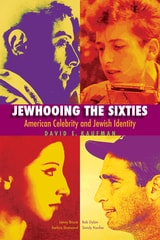
Jewhooing the Sixties
American Celebrity and Jewish Identity—Sandy Koufax, Lenny Bruce, Bob Dylan, and Barbra StreisandDavid E. Kaufman
Brandeis University Press, 2012
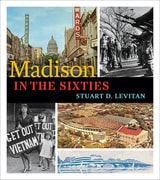
Madison in the Sixties
Stuart D. Levitan
Wisconsin Historical Society Press, 2018
Landmark civil rights laws were passed. Pivotal campus protests were waged. A spring block party turned into a three-night riot. Factor in urban renewal troubles, a bitter battle over efforts to build Frank Lloyd Wright’s Monona Terrace, and the expanding influence of the University of Wisconsin, and the decade assumes legendary status.
In this first-ever comprehensive narrative of these issues—plus accounts of everything from politics to public schools, construction to crime, and more—Madison historian Stuart D. Levitan chronicles the birth of modern Madison with style and well-researched substance. This heavily illustrated book also features annotated photographs that document the dramatic changes occurring downtown, on campus, and to the Greenbush neighborhood throughout the decade. Madison in the Sixties is an absorbing account of ten years that changed the city forever.
Memories of a Gay Catholic Boyhood
Coming of Age in the SixtiesJohn D'Emilio
Duke University Press, 2022
Memories of a Gay Catholic Boyhood is D’Emilio’s coming-of-age story in which he takes readers from his working-class Bronx neighborhood to an elite Jesuit high school in Manhattan to Columbia University and the political and social upheavals of the late 1960s. He shares his personal experiences of growing up in a conservative, tight-knit, multigenerational family, how he went from considering entering the priesthood to losing his faith and coming to terms with his same-sex desires. Throughout, D’Emilio outlines his complicated relationship with his family while showing how his passion for activism influenced his decision to use research, writing, and teaching to build a strong LGBTQ movement.
This is not just John D’Emilio’s personal story; it opens a window into how the conformist baby boom decade of the 1950s transformed into the tumultuous years of radical social movements and widespread protest during the 1960s. It is the story of what happens when different cultures and values collide and the tensions and possibilities for personal discovery and growth that emerge. Intimate and honest, D’Emilio’s story will resonate with anyone who has had to chart their own path in a world they did not expect to find.

New Left, New Right, and the Legacy of the Sixties
Paul Lyons
Temple University Press, 1996
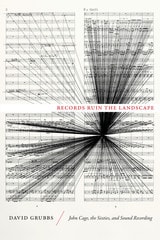
Records Ruin the Landscape
John Cage, the Sixties, and Sound RecordingDavid Grubbs
Duke University Press, 2014
In their day, few of these works circulated in recorded form. By contrast, contemporary listeners can encounter this music not only through a flood of LP and CD releases of archival recordings but also in even greater volume through Internet file sharing and online resources. Present-day listeners are coming to know that era's experimental music through the recorded artifacts of composers and musicians who largely disavowed recordings. In Records Ruin the Landscape, Grubbs surveys a musical landscape marked by altered listening practices.
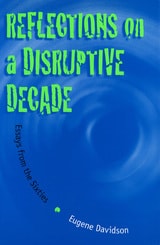
Reflections on a Disruptive Decade
Essays from the SixtiesEugene Davidson
University of Missouri Press, 2000
As editor of Modern Age in the 1960s, Eugene Davidson introduced each quarterly issue with a thought-provoking contemplation of one or another of the decade's dizzying events. Gathered together here for the first time, the essays in Reflections on a Disruptive Decade present an intellectual conservative's perspective on an era which, because it underscores so many of the political divisions still with us today, continues to hold our fascination.
Davidson deals with the marvelous but confused realm of post-1945 international politics, in which the American people faced a new enemy, one often baffling and terrifying. The Cuban missile crisis was probably the most uncertain moment in foreign policy during this century. Although the crisis was resolved without bloodshed, there was intense danger of irrationality, for the Russians foolhardily had sent nuclear missiles to Cuba.
Other topics Davidson addresses are the Civil Rights movement, the policies and programs of Lyndon Johnson's Great Society, and the East-West battles of ideology and arms in Europe, Vietnam, and the Middle East. With remarkable shrewdness, Davidson illuminates many contradictions and excesses of the decade's liberal ascendancy, and presciently detects signs pointing to a resurgence of the nation's conservative forces.
Although more than thirty years have passed, Davidson's essays still contain great clarity, and his appraisals are still keen. Reflections on a Disruptive Decade is a truly remarkable addition to the work of this distinguished scholar.
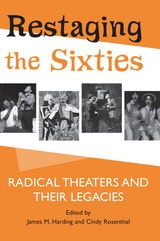
Restaging the Sixties
Radical Theaters and Their LegaciesEdited by James M. Harding and Cindy Rosenthal
University of Michigan Press, 2006
The volume explores how creations such as the Living Theatre's Paradise Now and the Performance Group’s Dionysus in 69 overlapped with political interests that, in the late 1960s, highlighted the notion of social collectives as a radical alternative to mainstream society. Situating theatrical practice within this socio-political context, the book considers how radical theaters sought to redefine the relationship between theater and political activism, and how, as a result, they challenged the foundations of theater itself.
James M. Harding is Associate Professor of English at Mary Washington University. His other books include Not the Other Avant-Garde: The Transnational Foundations of Avant-Garde Performance.
Cindy Rosenthal is Associate Professor of Theatre Studies, Hofstra University.
“A useful introduction to an eclectic period of experimental theater, providing portraits of the major political theaters and engaging with new vigor many of the era’s familiar aesthetic and ideological concerns. The writers offer a provocative history of theater’s attraction to (and occasional anxiety over) activism.”
--Marc Robinson, Yale University
Revisiting the Sixties
Interdisciplinary Perspectives on America's Longest DecadeEdited by Laura Bieger and Christian Lammert
Campus Verlag, 2013
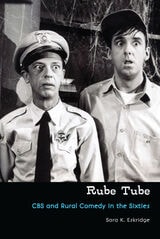
Rube Tube
CBS and Rural Comedy in the SixtiesSara K. Eskridge
University of Missouri Press, 2022

Sights On The Sixties
Tischler, Barbara L.
Rutgers University Press, 1992
Barbara Tischler's goal is to understand the historical and cultural legacy of the 1960s. During the Gulf War, as politicians advocated positions and strategies, they made simplistic comparisons with the '60s. Such comparisons reinforced our need to understand that decade more clearly. With these papers Tischler brings together a group of scholars from a variety of disciplines, including American Studies, anthropology, film studies, history, literature, sociology, and theater. She notes how their contributions, taken separately and together, transcend the "good sixties/bad sixties" typology that has pervaded past analyses of the period. Several authors deal with movement leaders and great events, but the majority write about lesser-known events and people, to add depth and balance to our understanding of the decade.
1. Multi-disciplinary collection
2. Emphasis on less well-known events of the period
3. Presents balanced picture of the decade
Sin in the Sixties
Maria C. Morrow
Catholic University of America Press, 2016
The Art of Return
The Sixties and Contemporary CultureJames Meyer
University of Chicago Press, 2019
In this innovative work, James Meyer turns to art criticism, theory, memoir, and fiction to examine the fascination with the long sixties and contemporary expressions of these cultural memories across the globe. Meyer draws on a diverse range of cultural objects that reimagine this revolutionary era stretching from the 1950s to the 1970s, including reenactments of civil rights, antiwar, and feminist marches, paintings, sculptures, photographs, novels, and films. Many of these works were created by artists and writers born during the long Sixties who were driven to understand a monumental era that they missed. These cases show us that the past becomes significant only in relation to our present, and our remembered history never perfectly replicates time past. This, Meyer argues, is precisely what makes our contemporary attachment to the past so important: it provides us a critical opportunity to examine our own relationship to history, memory, and nostalgia.
The Disobedient Generation
Social Theorists in the SixtiesEdited by Alan Sica and Stephen Turner
University of Chicago Press, 2005
The Disobedient Generation collects newly written autobiographies by an international cross-section of well-known sociologists, all of them "children of the '60s." It illuminates the human experience of living through that decade as apprentice scholars and activists, encountering the issues of class, race, the Establishment, the decline of traditional religion, feminism, war, and the sexual revolution. In each case the interlinked crises of young adulthood, rapid change, and nascent professional careers shaped this generation's private and public selves. This is an intensely personal collective portrait of a generation in a time of struggle.
The Ohio State University in the Sixties
The Unraveling of the Old OrderWilliam J. Shkurti
The Ohio State University Press, 2016
Just a year earlier the campus seemed immune to such disruptions. President Nixon considered it safe enough to plan an address at commencement. Yet a year later the campus erupted into a spasm of violent protest exceeding even that of traditional hot spots like Berkeley and Wisconsin. How could conditions have changed so dramatically in just a few short months?
Using contemporary news stories, long overlooked archival materials, and first-person interviews, The Ohio State University in the Sixties explores how these tensions built up over years, why they converged when they did and how they forever changed the university.
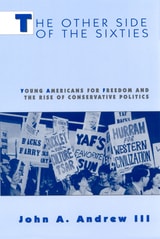
The Other Side of the Sixties
Young Americans for Freedom and the Rise of Conservative PoliticsAndrew III, John A
Rutgers University Press, 1997
The Politics of Social Change
From the Sixties to the Present Through the Eyes of a GenerationLarry M. Bartels and Katherine J. Cramer
University of Chicago Press, 2026
How did we get to this point in American politics? Drawing on insights from an unprecedented decades-long study of ordinary Americans’ political lives, this book tells the story of how, why, and when our politics fractured.
Few time periods have been as defined by waves of monumental social change as the United States during the 1960s. Even today, almost sixty years later, the era is often depicted as a triumph of social progress. Yet, as Larry M. Bartels and Katherine J. Cramer show in The Politics of Social Change, it was Americans’ diverse reactions to the milestone events of the time—from the welcoming, to the fiercely resistant, to the largely oblivious—that planted the seeds of our current political turmoil.
Their masterful analysis draws on a unique historical resource: the longest-running systematic tracking of individual Americans’ political attitudes and behavior ever attempted. The study began in 1965 when researchers interviewed hundreds of high school students across the country and then periodically reinterviewed them over the next three decades. Bartels and Cramer supplement this historical record with in-depth interviews with dozens of the original students, painting a detailed picture of the generation’s individual and collective political development. By tracing the responses of the Class of ’65 to major events of their political lifetimes—including the Civil Rights and Women’s Rights movements, the Vietnam War, the shifting role of religion, escalating economic inequality, immigration, and the rise of Donald Trump—Bartels and Cramer shed new light on the evolution of public opinion and the unsteady progress of American democracy.
The Sixties and the World Event, Volume 36
Christopher Connery and Hortense Spillers, eds.
Duke University Press, 0
Contributors to this issue represent a wide range of disciplines, from Latin American studies and sociology to political theory and literary criticism. They bring a global perspective to the social and political legacy of the 1960s, touching on the Caribbean, Latin America, the former USSR, China, and France, as well as the United States. One contributor presents a reexamination of Latin American armed struggles in the 1960s that foregrounds the relatively positive influence of these struggles on present-day Latin American society and politics. Another contributor translates a seminal essay on José Martí written by one of Cuba’s foremost intellectuals in the mid-1960s, when the course of the Cuban revolution was still uncertain. Yet another contributor considers the forces that have sought to neutralize the struggles and negate the gains of the African American liberation movement in the 1960s American South.
Contributors. John Beverley, Anthony Bogues, Christopher Connery, Roberto Fernández Retamar, Wlad Godzich, Boris Kagarlitsky, Nina Power, Hortense Spillers, Silvia D. Spitta, Alberto Toscano
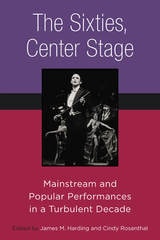
The Sixties, Center Stage
Mainstream and Popular Performances in a Turbulent DecadeEdited by James M. Harding and Cindy Rosenthal
University of Michigan Press, 2017
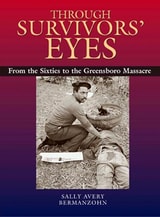
Through Survivors' Eyes
From the Sixties to the Greensboro MassacreSally Avery Bermanzohn
Vanderbilt University Press, 2003
In passionate first-person accounts, Through Survivors' Eyes tells the story of six remarkable people who set out to change the world. The survivors came of age as the "protest generation," joining the social movements of the 1960s and 1970s. They marched for civil rights, against war, for textile and healthcare workers, and for black power and women's liberation. As the mass mobilizations waned in the mid-1970s, they searched for a way to continue their activism, studied Marxism, and became communists.
Nelson Johnson, who grew up on a farm in eastern North Carolina in a family proud of its African American heritage, settled in Greensboro in the 1960s and became a leader of the Black Liberation Movement and a decade later the founder of the Faith Community Church. Willena Cannon, the daughter of black sharecroppers, witnessed a KKK murder as a child and was spurred to a life of activism. Her son, Kwame Cannon, was only ten when he saw the Greensboro killings. Marty Nathan, who grew up the daughter of a Midwestern union organizer and came to the South to attend medical school, lost her husband to the Klan/Nazi gunfire. Paul Bermanzohn, the son of Jewish Holocaust survivors, was permanently injured during the shootings. Sally Avery Bermanzohn, a child of the New York suburbs who came south to join the Civil Rights Movement, watched in horror as her friends were killed and her husband was wounded.
Through Survivors' Eyes is the story of people who abandoned conventional lives to become civil rights activists and then revolutionaries. It is about blacks and whites who united against Klan/Nazi terror, and then had to overcome unbearable hardship, and persist in seeking justice. It is also a story of one divided southern community, from the protests of black college students of the late 1960s to the convening this January of a Truth and Community Reconciliation Project (on the South African model) intended to reassess the Massacre.
Utopia Limited
The Sixties and the Emergence of the PostmodernMarianne DeKoven
Duke University Press, 2004
DeKoven rigorously analyzes a broad array of cultural and political texts important in the sixties—from popular favorites such as William S. Burroughs’s Naked Lunch to political manifestoes including The Port Huron Statement, the founding document of SDS (Students for a Democratic Society). She examines texts that overtly discuss the conflict in Vietnam, Black Power, and second-wave feminism—including Frances FitzGerald’s Fire in the Lake, James Baldwin’s The Fire Next Time, and Shulamith Firestone’s The Dialectic of Sex; experimental pieces such as The Living Theatre’s Paradise Now; influential philosophical works including Roland Barthes’s Mythologies and Herbert Marcuse’s One-Dimensional Man; and explorations of Las Vegas, the prime location of postmodernity. Providing extensive annotated bibliographies on both the sixties and postmodernism, Utopia Limited is an invaluable resource for understanding the impact of that tumultuous decade on the present.