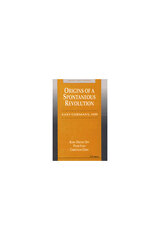
Origins of a Spontaneous Revolution: East Germany, 1989
University of Michigan Press, 1995
Cloth: 978-0-472-10575-5 | eISBN: 978-0-472-22453-1 (standard)
Library of Congress Classification DD289.O65 1995
Dewey Decimal Classification 943.10878
Cloth: 978-0-472-10575-5 | eISBN: 978-0-472-22453-1 (standard)
Library of Congress Classification DD289.O65 1995
Dewey Decimal Classification 943.10878
ABOUT THIS BOOK | AUTHOR BIOGRAPHY | REVIEWS | REQUEST ACCESSIBLE FILE
ABOUT THIS BOOK
November 1989: East Germans danced on the Berlin Wall, and the communist regime began to collapse. A unique revolution has occurred: changes were brought about by peaceful, spontaneous demonstrations. No group organized the famous gatherings of thousands of people at the Karl Marx Square in Leipzig on October 9, 1989, and no government or military attempt was made to crack down on the demonstrations.The events of the GDR revolution have been well documented, but until now there has been no comprehensive attempt to explain the revolution. The authors contend that any explanation must focus on the individual GDR citizen; while situating the individual at the focal point of their analysis, they demonstrate how political events and reforms, in the GDR and neighboring countries, motivated citizens to act despite the risk to their lives. Applying a version of the theory of rational action that uses “soft” incentives and individual perceptions, the authors select the factors that help explain the GDR revolution. New findings include that political discontent — not economic — was a major cause for participation in the demonstrations.Not limiting themselves to theoretical speculations, the authors support their arguments with original documents, jokes, slogans, and a unique data set drawn from a representative survey of 1,300 Leipzig residents in 1990 focusing exclusively on the revolutionary period. Written in a clear and accessible style, this book will be of interest to general readers as well as sociologists, historians, and political scientists.
See other books on: East Germany | Germany (East) | Opposition (Political science) | Origins | Protest movements
See other titles from University of Michigan Press